
Quietest HVAC Systems Twin Cities: Noise Ratings Explained
Key Takeaways
- Spec sheet noise ratings are only comparable when both products carry AHRI Standard 270 certification. Marketing figures without that certification cannot be reliably compared across brands.
- MPCA Rule 7030 caps outdoor HVAC at 60 dBA daytime and 50 dBA nighttime at the residential property line. Standard single-stage condensers commonly run 60-72 dBA.
- Variable-speed and inverter systems run 8-15 dB quieter than single-stage alternatives at partial load. A 10 dB reduction represents a tenfold drop in acoustic energy.
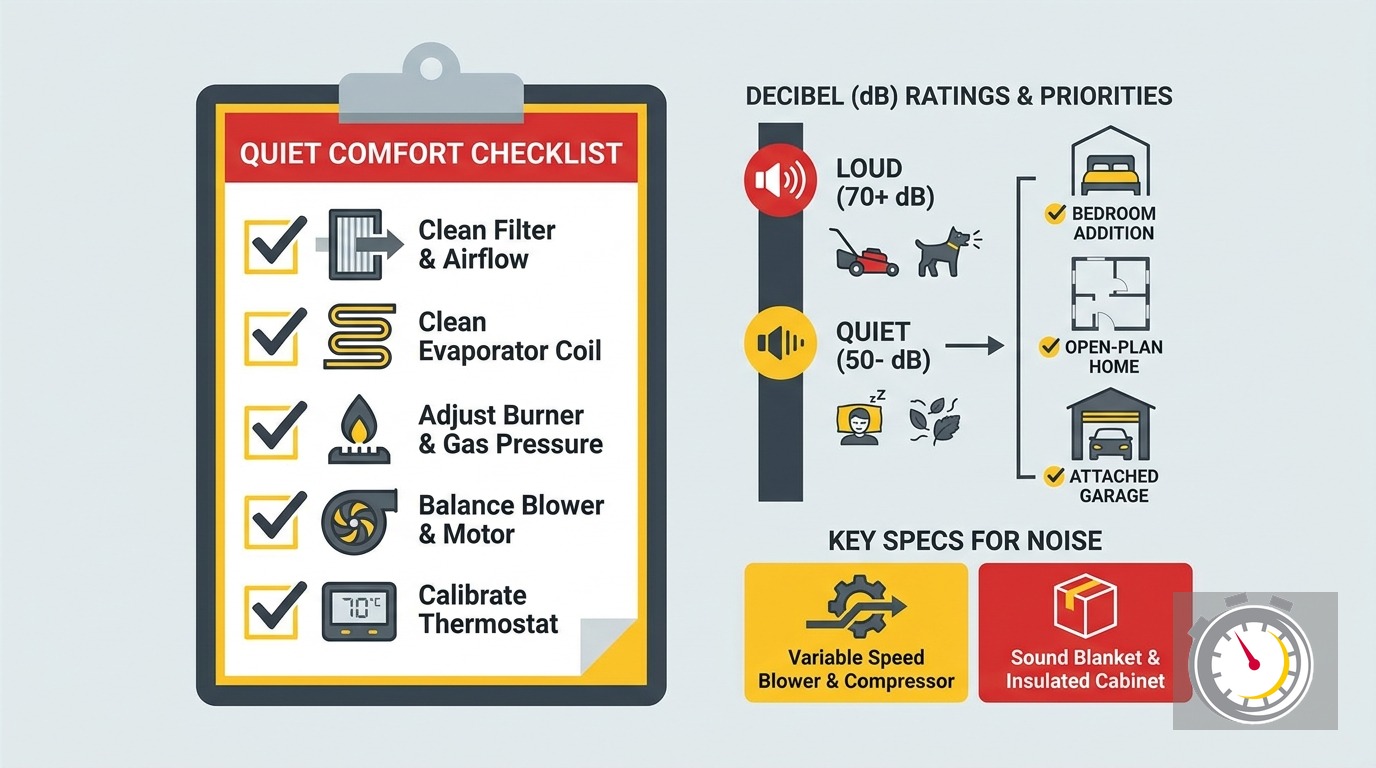
- Bedroom additions need variable-speed equipment and correct Manual J sizing. Open-plan homes need return duct evaluation. Attached garages need vibration isolation, not just a lower dBA rating.
- Minnesota utility rebates and the federal 25C tax credit commonly reduce the cost of qualifying inverter heat pump installs by $3,000-$5,000.
When you shop for the quietest HVAC systems in the Twin Cities, you end up comparing brochure noise figures with no reliable way to read them. Brand A says its condenser runs at 58 dB. Brand B says 60. Neither spec sheet explains whether those numbers come from the same test protocol, what distance was used, or how they translate to sound at your neighbor’s property line. There is also one detail no competing article on this subject mentions: Minnesota law sets a nighttime noise limit at the residential property line. A standard single-stage condenser running in a tight suburban lot may already exceed that limit. This post teaches you how to read the specs, explains the legal context specific to Minnesota, and walks through the right approach for three distinct scenarios: a bedroom addition, an open-plan home, and an attached garage.
Why Brochure Numbers Cannot Be Compared Directly
Before you can find the quietest HVAC systems in the Twin Cities, you need to know what the spec sheet actually measures.
AHRI Standard 270 is the industry’s certified test protocol for outdoor unitary equipment. It measures Sound Power Level at a standardized test setup and distance. AHRI Standard 275 is the companion that estimates what that power level becomes at a real-world distance from the equipment. Only ratings that explicitly state “Rated in accordance with AHRI Standard 270” can be compared across manufacturers. A brochure figure without that statement is a marketing number, not a certified spec.
Indoor air handlers complicate things further. Manufacturers sometimes publish ratings in sones rather than decibels for air handlers and fan coil units. The sone and decibel scales measure different things. One sone is roughly equivalent to a quiet refrigerator, about 28 dBA. Two sones is twice as loud as one sone. The sone scale is linear.
The decibel scale is logarithmic. A 10 dB increase represents a tenfold rise in acoustic energy. A 3 dB difference is roughly the threshold most people can detect. Moving from a 72 dBA single-stage condenser to a 62 dBA variable-speed unit is not a 10-point improvement. It is a tenfold reduction in acoustic energy. That difference is audible on every cycle. The brochure does not explain the math, which is exactly why the numbers mislead.
Does Minnesota Actually Have a Noise Limit for Outdoor HVAC?
Yes. MPCA Rule 7030 sets a 60 dBA daytime limit and a 50 dBA nighttime limit at the property line in residential zones. Standard single-stage condensers run 60-72 dBA. Without adequate setback, they can exceed the nighttime limit from the moment they are installed.
The rule applies to Noise Area Classification 1 zones, also called NAC 1. That covers standard residential neighborhoods across Minneapolis, St. Paul, Ramsey, Maple Grove, Blaine, and most of the Twin Cities suburbs. The 50 dBA limit runs from 10 p.m. to 7 a.m. Both limits are measured at the neighbor’s property line, not at your equipment.
Minneapolis Chapter 389 incorporates MPCA Rule 7030 by reference. It sets the enforcement trigger at 5 dBA or more above ambient. Equipment violations are enforceable by the city. A neighbor complaint to 311 can produce a formal notice of violation and a required correction.
Minneapolis zoning also requires 3-5 feet of clearance between outdoor HVAC and the property line, depending on the zoning district. A unit placed at minimum setback with a 68 dBA rating will not satisfy the 50 dBA nighttime limit. Equipment output and placement distance must be planned together from the start, not treated as separate decisions.
What Does a dBA Rating Feel Like in Practice?
The dBA scale is A-weighted, filtering out frequencies humans deprioritize. A normal conversation is 60-65 dBA. A quiet library is around 40 dBA. ASHRAE sets professional Noise Criteria targets for bedrooms and private offices at NC 20-30, roughly 25-35 dBA of background HVAC sound.
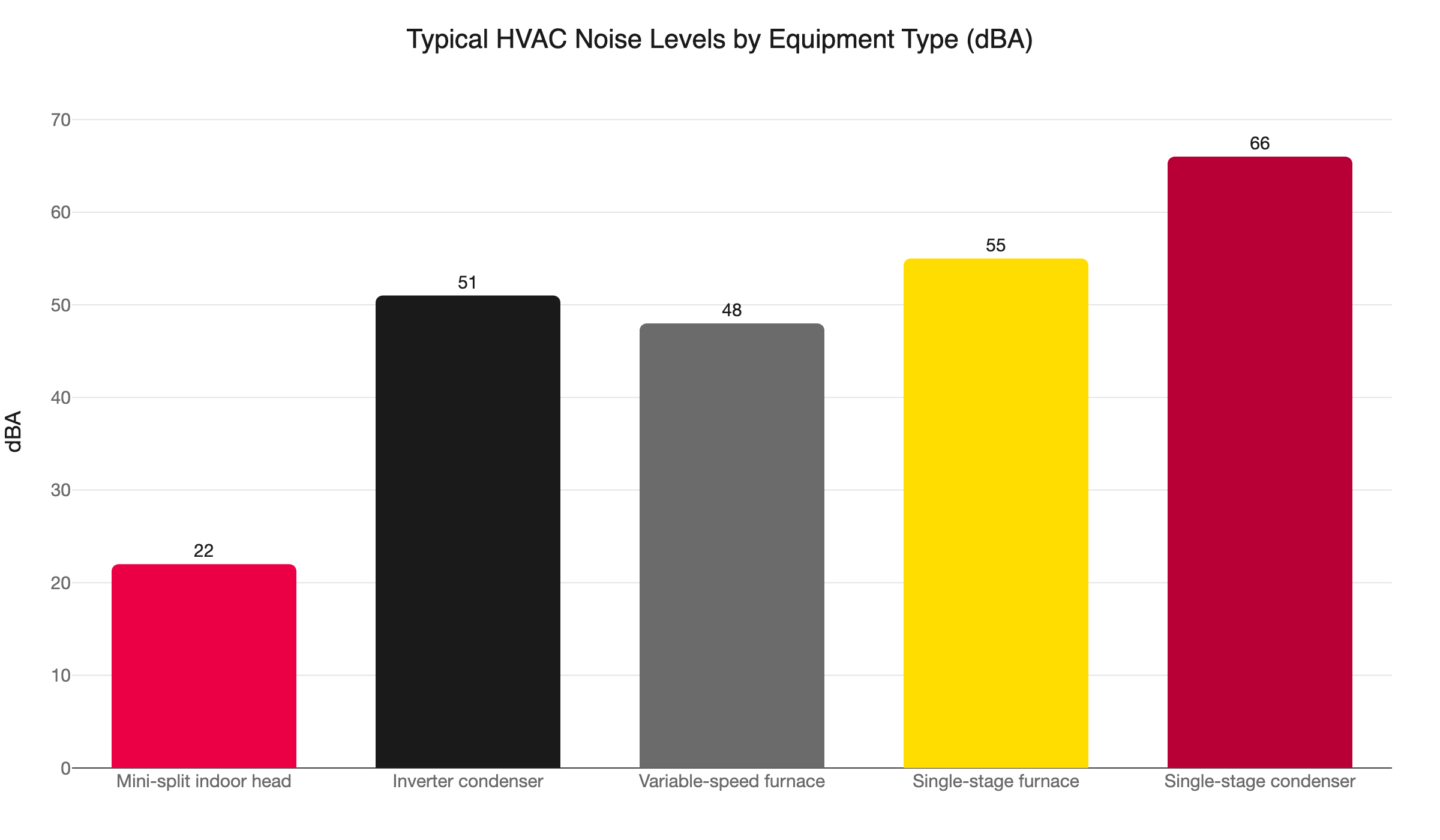
Here is how common equipment types map against those reference points. These are typical operating levels at normal load conditions, not best-case marketing figures:
- Mini-split indoor heads: 19-25 dBA; typical quiet operation around 22 dBA
- Ultra-quiet variable-speed or inverter condenser: as low as 51 dBA
- Variable-speed furnace at moderate load: approximately 48 dBA
- Standard single-stage furnace: 55 dBA typical
- Standard single-stage condenser: 60-72 dBA; midrange around 66 dBA
The gap between a 66 dBA single-stage condenser and a 51 dBA inverter model is not a marginal upgrade. It is the difference between equipment that stays under neighbors’ notice and equipment that eventually produces complaints.
Blower motors matter as much as compressors. An ECM variable-speed blower reduces steady-state duct noise by 5-15 dB compared to a standard PSC motor. That improvement is felt in every room on every cycle. It is not captured in the outdoor condenser rating, which is why the condenser spec sheet alone does not tell the full story.
Which Are the Quietest HVAC Systems for a Bedroom Addition?
Variable-speed equipment with an ECM blower is the right specification. Correct sizing is equally important. An oversized system short-cycles, producing noise spikes at every start and stop. That pattern is more disruptive at night than the steady low hum of a correctly sized variable-speed unit.
Variable-speed compressors and ECM blowers at partial load produce 8-12 dB less noise than single-stage equivalents. That perceptible difference becomes significant in a bedroom where ambient noise drops low. At 60% load, a variable-speed system runs continuously at a quiet hum. A single-stage system hammers on at full capacity and cuts off completely, repeatedly, through the night.
Correct sizing requires a Manual J load calculation. That is not a rule-of-thumb adjustment. It accounts for the room’s insulation values, window area, orientation, and Minnesota climate data specific to your part of the metro. Our team performs Manual J calculations on every new install.
If the bedroom addition is a ductless zone, a mini-split is the quietest available option. Indoor heads operate as low as 19 dBA at the lowest fan setting. That is quieter than most people can consciously perceive in a still room. The outdoor unit for a mini-split typically runs 56-60 dBA, quieter than most single-stage condensers and within the MPCA nighttime limit at standard setbacks. Our guide on ductless mini-splits for older Twin Cities homes covers how these systems serve additions and spaces that ducted systems cannot reach efficiently.
Open-Plan Homes: The Return Duct Problem
Open-plan layouts have a noise problem that equipment ratings do not address. Return ductwork is the hidden variable.
Return air moves faster than supply air. An undersized return creates turbulence and duct roar: a rushing sound that comes from the grilles, not the equipment. More return duct area means lower air velocity. Lower velocity means a quieter system, regardless of what the furnace rating says. A variable-speed furnace installed into undersized returns will still be noisy. These are separate problems that need separate fixes.
When we assess a system for an open-plan home, we evaluate the duct system alongside the equipment. Return sizing is part of that evaluation. Static pressure analysis identifies where return capacity is insufficient. Adding return area or enlarging existing paths is usually straightforward during a system replacement.
Open plans also carry sound farther than compartmentalized floor plans. A mechanical room sharing a wall with a great room becomes a direct noise path. Supply registers positioned near seating areas produce audible turbulence at higher static pressures. These are installation design factors, not equipment-rating factors. Addressing them requires evaluating the system as a whole, not just swapping a furnace.
Attached Garages: Vibration Is the Overlooked Issue
A condenser mounted directly against the garage wall transmits vibration into the building structure. The dBA spec sheet does not measure structure-borne transmission. A unit rated at 51 dBA that is bolted to a concrete wall can still cause a low-frequency hum that resonates through the floor of the room above.
Standard practice for garage-adjacent installations includes rubber isolation mounts between the concrete pad and the unit base. Six or more inches of clearance between the unit and any wall surface is also standard. That gap prevents direct-contact vibration and keeps the airflow path open around the equipment. Refrigerant line sets need isolation at the building penetration. A braided flex connector at the wall entry point stops line-transmitted hum from reaching the structure.
For bedrooms directly above or beside an attached garage, structure-borne vibration is typically more intrusive than airborne sound. You feel it in the floor or wall before you consciously register it as noise. If an existing installation lacks isolation mounts, adding them is usually a straightforward service call, not a full replacement.
Placement also determines how far sound travels to the property line. A condenser on the garage side of the house may sit closer to the neighbor’s window than one on the back of the lot. Rule 7030 applies regardless of which wall the unit is on.
What Are the Quietest HVAC Systems for Minnesota Winters?
Minnesota winters require equipment rated for reliable heating capacity at -13°F or colder. Cold-climate inverter compressors that meet this threshold also modulate speed continuously, making them inherently quieter than single-stage systems. The coldest-capable and the quietest equipment converge on the same product class.
Inverter compressors run continuously at partial load rather than cycling on and off at full power. Every startup on a single-stage system is a noise event. In a Minnesota winter, with the system running most of the night, that means repeated noise spikes across hours of operation. An inverter running at 40% capacity produces a steady, low hum throughout. The difference is noticeable in any room adjacent to the outdoor unit or the mechanical area.
Variable-speed AC systems deliver the same benefit in cooling season. The compressor matches load rather than cycling repeatedly at full capacity. The result is quieter, and the reduced cycling also extends equipment life.
For homeowners who want cold-climate performance and lower noise without full electrification, dual-fuel heat pump systems pair an inverter heat pump with a gas furnace for deep-cold backup. These systems run in heat pump mode for the majority of the Minnesota heating season. That mode is quiet. The gas furnace only kicks in when temperatures drop below the balance point, typically around 0 to -5°F depending on the model and home.
Do Minnesota Rebates Apply to the Quietest Equipment?
Yes. The equipment class with the lowest noise output also carries the largest available rebates. The economics of variable-speed and cold-climate inverter systems have shifted meaningfully toward affordability in the past two years.
Current incentives available to Twin Cities homeowners include:
- Xcel Energy: Up to $2,000 for qualifying cold-climate heat pumps. $400 for central AC rated SEER2 16 or higher. $50 for an ENERGY STAR smart thermostat. Gas furnace rebates ended January 1, 2026.
- CenterPoint Energy: $1,100 for a ducted heat pump in dual-fuel configuration. $150-$500 for furnaces rated 96% AFUE or higher. Up to $1,200 for income-qualified customers on qualifying high-efficiency furnaces.
- Federal 25C tax credit: 30% of project cost, capped at $2,000 for heat pumps. Stacks with utility rebates.
- HEAR program: Point-of-sale rebates for income-qualified Minnesota households on heat pump installs, launched in 2026.
Combined Xcel, CenterPoint, and federal incentives commonly reach $3,000-$5,000 on a qualifying inverter heat pump install. Our Minnesota heat pump rebates guide has current amounts and the specific equipment thresholds that trigger each rebate. We confirm current figures before every estimate. Rebate programs change, and a number published online may already be out of date.
What Should You Ask Before Hiring an HVAC Contractor?
Three questions separate contractors who can deliver a real quiet result from those selling spec sheet promises. Ask before signing. The answers tell you more about the actual outcome than any brochure number will.
First: is the equipment rated under AHRI Standard 270? Ask for the AHRI certification number. That number is searchable in the AHRI product directory. If the contractor cannot provide it, or if the noise rating is listed as an unadjusted manufacturer figure, the spec is not verified.
Second: what is your return duct evaluation approach? Duct roar is one of the most common HVAC noise sources in the Twin Cities, and it has nothing to do with the equipment rating. A contractor who cannot explain how they assess return sizing will likely install a quiet unit into a system that still generates noise at the grilles.
Third: how will you handle vibration isolation for the outdoor unit? This question applies to any installation near a property line, a garage wall, or a structure adjacent to a sleeping area. The answer should cover the pad type and the clearance from walls and fences. It should also address how the refrigerant line set is isolated at the building penetration.
At Northern One Hour, we are locally owned and operated in Ramsey, Minnesota. Our technicians work in Twin Cities neighborhoods every day. MPCA Rule 7030 and Minneapolis setback requirements are the rules that apply to our own community. That local accountability shapes how we plan every install.
We back every job with a 100% satisfaction guarantee. “Always On Time… Or You Don’t Pay a Dime!(R)” is the promise behind every appointment we book. Call (763) 260-6662 or book online to schedule a consultation on quiet HVAC options for your home.
Frequently Asked Questions
What is the quietest HVAC system for a Twin Cities home? +
Does Minnesota have a noise ordinance for outdoor AC units? +
What rebates are available for quiet HVAC systems in Minnesota? +
How do I compare HVAC noise ratings across brands? +
Need a technician now?