
Variable Speed AC vs Single Stage: The MN Humidity Case
Key Takeaways
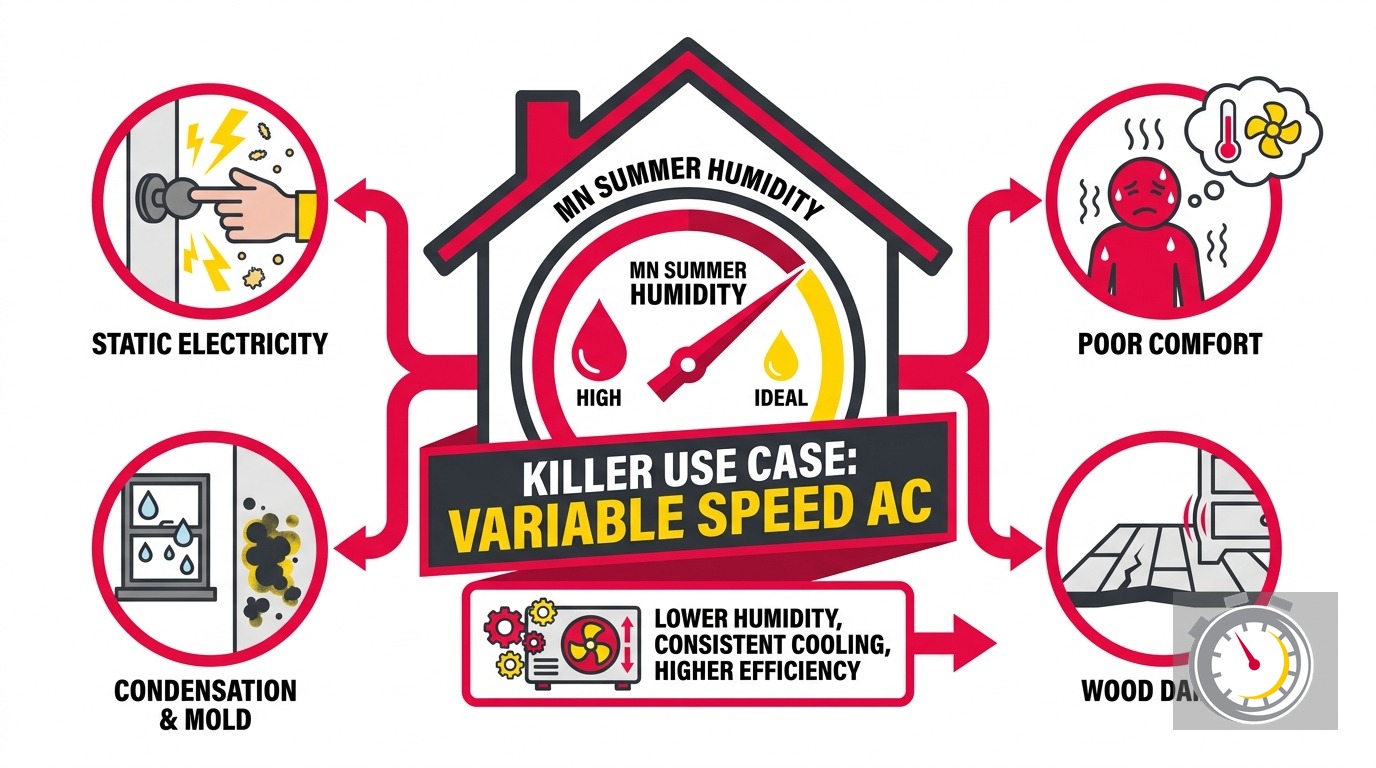
- A single-stage AC short-cycles: it cools quickly at full blast, then shuts off before removing enough moisture from your air.
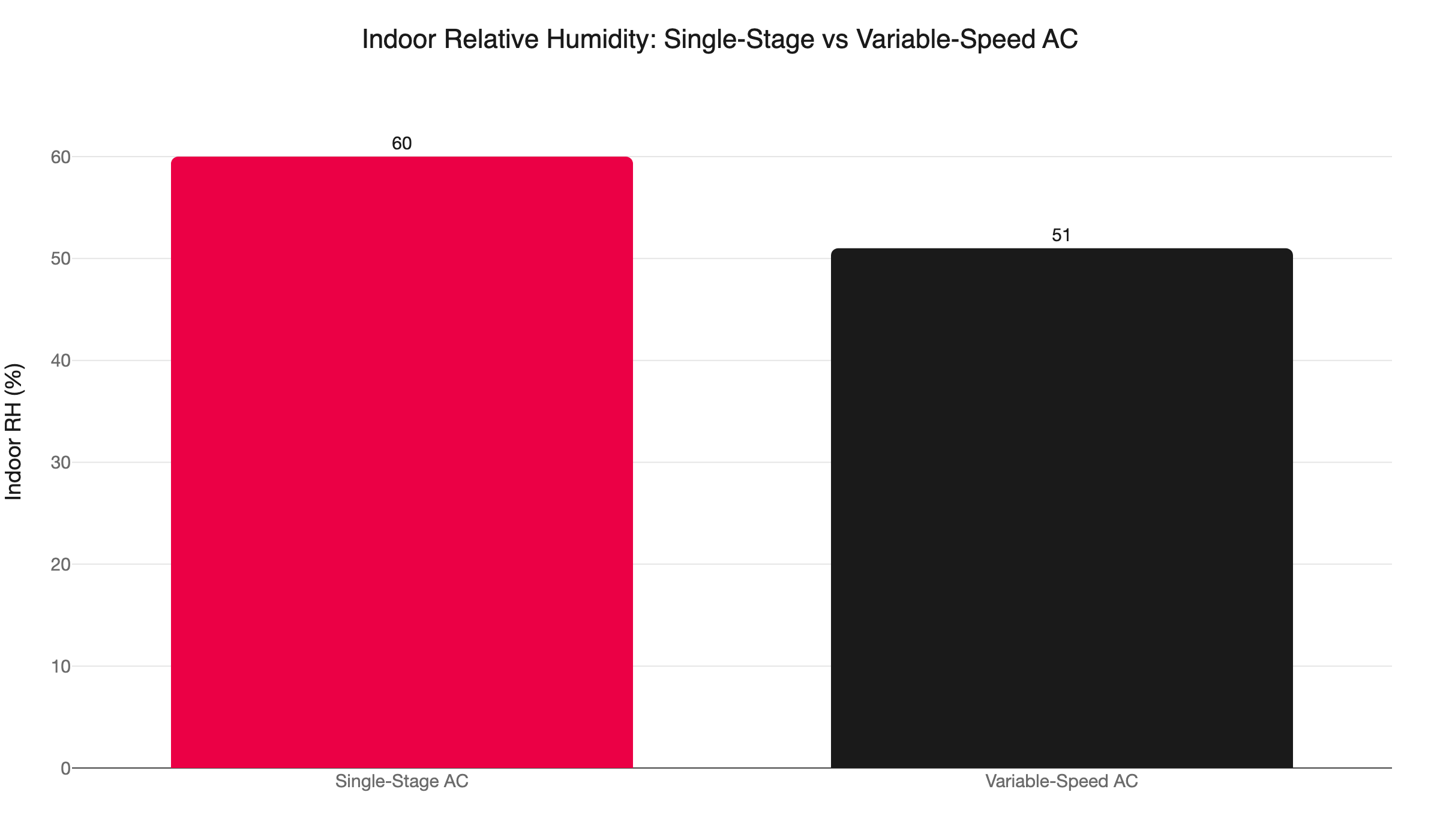
- Peer-reviewed research measured indoor relative humidity at 55-60% with single-speed cooling and 50-52% with variable-speed cooling. That 5-to-8-point gap is the difference between clammy and comfortable.
- Mold and dust mites can establish above 60% indoor RH. Single-stage systems in humid Minnesota summers regularly push homes to or above that threshold between cycles.
- Both the condenser and air handler must be variable-speed and communicating (digitally coordinated) for the humidity benefit to show up. A variable-speed condenser paired with a legacy air handler does not deliver it.
- Rebates stack for qualifying variable-speed installs: Xcel Energy (up to $400 for central AC), City of Minneapolis (up to $1,000), and IRS Section 25C (up to $600 for qualifying AC). Verify current terms before purchasing.
- Northern One Hour is locally owned and operated in Ramsey, MN, serving the greater Twin Cities area.
What Is a Variable Speed Air Conditioner vs Single Stage?
A single-stage AC runs at one speed: full capacity. It fires up, hits the set temperature, and shuts off. A variable-speed system modulates its compressor from roughly 30 to 100 percent of total output, running longer at lower capacity. That difference in run behavior is what determines whether your home feels dry and comfortable or clammy and sticky during a Minnesota summer.
A single-stage system’s approach is blunt. When the thermostat calls for cooling, the compressor fires at 100 percent. It cools the air fast. Once the set temperature is reached, it stops completely. The cycle repeats every time the temperature climbs back up.
A variable-speed compressor modulates continuously. On a 75-degree day with moderate humidity, it might run at 40 percent capacity for two or three hours. On a 95-degree day with a dew point in the high 60s, it ramps toward full output. The system uses the minimum capacity needed to maintain conditions, running longer and slower rather than hard and fast.
The result is more consistent temperatures, less cycling noise, and, most importantly for Twin Cities homeowners, far better moisture removal from indoor air.
Minnesota homeowners often ask whether the extra upfront cost of variable speed is justified given our shorter cooling season. The energy-savings payback is real but compressed here. The more immediate return is comfort: specifically, whether your home stays below the mold threshold on humid July afternoons.
Why Minnesota Summers Are the Real Test
Energy savings are the standard pitch for variable-speed equipment. Fewer short cycles, more consistent operation, and lower electricity draw during long partial-load runs. That argument holds up.
But it is not the most compelling reason for a Twin Cities homeowner.
Our cooling season runs 10 to 14 weeks. Phoenix homeowners run air conditioning for seven or eight months. A shorter season compresses the energy-savings payback timeline. What does not compress is the nature of our summer humidity.
NWS Twin Cities climate records show dew points regularly reaching 65 to 70 degrees during peak summer weeks. That is tropical moisture loading. During those periods, your AC is not just removing heat. It is dehumidifying every breath of air cycling through your home, managing moisture from cooking, showers, open doors, and everyone living there.
The peak weeks in a typical Twin Cities summer run from late June through mid-August. During afternoon dew-point events, outdoor air at 85 degrees can feel suffocating. Your AC runs in that air all day. A single-stage system cycling hard in those conditions builds a dehumidification deficit it never fully closes.
Minnesota homes also work against you here. We build for winter. Well-insulated walls, tight vapor barriers, sealed windows: those features keep January heating bills manageable. They also trap summer moisture once it gets in. A system that cannot continuously pull humidity out of the air lets indoor relative humidity climb for hours between cycles, even when the temperature reads a comfortable 72 degrees.
This is the context that makes the variable speed air conditioner vs single stage comparison particularly worth understanding in our climate. In the Sun Belt, the case is primarily about electricity costs. In the Twin Cities, the case is primarily about whether your home stays below the mold threshold on humid summer afternoons.
How Does Short-Cycling Destroy Humidity Control?
An AC evaporator coil removes moisture the same way a cold glass sweats on a hot day: warm, humid air passes over a cold surface and water condenses out. The coil has to be cold, and air has to stay in contact with it long enough, for that to happen at scale. A single-stage system that cycles on and off every 10 to 15 minutes never gives the coil that sustained run time. Moisture passes through largely uncondensed, and your home stays clammy even after the temperature drops to the set point.
Here is the sequence with a single-stage unit. The thermostat calls for cooling. The compressor fires at 100 percent. Cold air floods the house quickly. The set temperature is reached, sometimes in under 10 minutes during a mild call. The system shuts off. The coil begins to warm. The temperature climbs again. The cycle repeats.
During that short run, the coil does some dehumidification. But it does not do as much as it would during a 40-minute variable-speed run at lower output. High-speed airflow reduces the time each parcel of moist air spends in contact with the cold coil surface. Less contact time means less condensation.
Research on single-stage AC performance during Minnesota high-humidity events documents this directly: oversized or single-stage systems cool air quickly but shut off before adequately removing moisture. The problem compounds in well-insulated Minnesota homes, where the temperature drops faster than indoor humidity can follow.
The physics favors variable speed. A system running at 55 percent capacity for 45 minutes moves more total air across the coil at sustained cold temperatures than a system cycling hard and fast over the same period. More contact time equals more condensation. More condensation equals lower indoor relative humidity.
Common signs that your single-stage system is losing the humidity battle include condensation on interior windows during summer, a persistent sticky feeling indoors even at a comfortable temperature setting, and musty odors in finished basements or carpeted rooms. That last one is particularly telling. It often means your home is sitting at or above the mold threshold for extended periods each day.
Variable Speed Air Conditioner vs Single Stage: The Indoor RH Data
The humidity argument is not theoretical. Measured data from real installations and peer-reviewed research both show a consistent gap between the two system types.
A real-world case study replacing a single-stage system with a fully communicating variable-speed setup recorded indoor relative humidity of 58-62% with the single-stage system in place. After the full variable-speed replacement, measured RH dropped into a noticeably more comfortable range. The case study also confirmed the mismatched-upgrade problem: swapping only the condenser to variable speed while keeping the old air handler produced results much closer to the all-single-stage baseline.
Peer-reviewed research confirms the scale of that gap. A ScienceDirect study comparing variable-speed and single-speed cooling measured indoor RH of 50-52% in variable-speed mode and 55-60% with standard single-speed operation. That is a 5-to-8 percentage-point difference.
Those numbers look modest until you consider where the mold threshold sits. At 60% indoor RH, mold spores can establish and dust mite populations thrive. A single-stage system in a humid Minnesota July routinely pushes homes into that zone between cooling cycles. A variable-speed system running the same thermal load keeps the house at 50-53%, which is the ASHRAE target for indoor comfort.
The temperature on your thermostat looks identical in both scenarios. The air feels completely different.
For homeowners already dealing with summer clamminess and weighing whether an equipment upgrade or a dedicated appliance makes more sense, our guide to whole-home dehumidifiers for the Twin Cities covers the complementary approach of standalone dehumidification.
Does the Whole System Need to Be Variable Speed?
Yes. Replacing only the outdoor condenser with a variable-speed unit and keeping the existing air handler will not deliver the humidity benefit. Both components must be variable-speed and communicating, meaning they exchange real-time data and coordinate their output together. A mismatched system runs the air handler at a fixed blower speed regardless of what the compressor is doing, and that eliminates the dehumidification advantage entirely.
This is the most common misunderstanding our team encounters when homeowners research the variable speed air conditioner vs single stage decision.
The reason both components matter comes down to airflow coordination. A fully communicating variable-speed system matches blower speed to compressor output. When the compressor runs at 50 percent, the blower slows proportionally. Slower airflow across the evaporator coil means each parcel of air spends more time in contact with the cold surface. More contact time means more water condensed out. That is the humidity mechanism.
When you pair a variable-speed condenser with a legacy air handler, the air handler does not receive the coordination signal. It runs at its preset fixed speed. The compressor may be modulating, but the blower is still moving air at the same rate it always has. Contact time stays short. The dehumidification advantage largely disappears.
Installation data from the same variable-speed case study confirms this: the variable-speed condenser paired with a single-stage air handler produced humidity results much closer to an all-single-stage system than to a true fully communicating variable-speed setup. The meaningful RH improvement came only with full equipment replacement.
If you have an older air handler and are considering upgrading just the outdoor condenser, bring that question to the consultation before you invest. We will give you a straight answer on whether a partial upgrade makes economic sense for your specific equipment age and condition.
What Minnesota Rebates Are Available for Variable-Speed AC?
Xcel Energy offers up to $400 for qualifying central air conditioners (minimum 13.4 SEER2 in the northern climate zone). Minneapolis homeowners can stack a city bonus of up to $1,000. The IRS Section 25C credit covers up to $600 (30% of installed cost, $600 cap) for central AC meeting the CEE highest efficiency tier. These stack, and together they meaningfully close the cost gap between single-stage and variable-speed equipment.
Here is each incentive in detail:
Xcel Energy rebate: Up to $400 for qualifying central air conditioners at minimum 13.4 SEER2 in the northern climate zone. Xcel customers should verify current tier amounts and equipment qualification before purchasing, as program terms update periodically. Heat pump rebates run up to $2,000 for qualifying cold-climate ASHPs, which makes a heat pump comparison worth running at the same time.
City of Minneapolis bonus: Up to $1,000 for qualifying equipment for all Minneapolis residents, with up to $5,000 available in designated Green Zones. Equipment must meet Xcel Energy’s efficiency specification tiers to qualify.
IRS Section 25C credit: Up to $600 (30% of installed cost, $600 cap) for central air conditioners meeting the CEE highest efficiency tier. The credit appears active for qualifying installs as of the most recent IRS update. Consult a tax professional to confirm 2026 eligibility and equipment qualification before purchasing. Note: the heat pump tier of this credit ended December 31, 2025.
For a full breakdown of how these incentives work together across equipment types, see our guide to Xcel and CenterPoint HVAC rebates in Minnesota.
The stacking math is specific to your address and equipment selection. A $1,950-to-$2,000 upfront cost difference between single-stage and variable-speed equipment looks considerably different after $1,000 to $2,000 in combined rebates and credits. We walk through the numbers with you before any installation.
Is Variable Speed Worth the Extra Cost in Minnesota?
For most Twin Cities homeowners who experience summer humidity problems, yes. The return in Minnesota is primarily comfort, not just the monthly electric bill. A shorter cooling season limits electricity-savings payback compared to warmer climates, but 10 to 14 weeks of noticeably drier, more breathable indoor air is a real and immediate benefit.
Variable-speed equipment costs more upfront. The gap depends on brand, efficiency tier, and installation specifics. A realistic range is $1,000 to $3,000 more than comparable single-stage equipment before rebates. After available incentives, that gap narrows, sometimes significantly.
Energy savings are real even in our shorter season. A variable-speed system running at partial capacity draws meaningfully less electricity per hour than a single-stage unit cycling hard. Whether the bill savings alone close the upfront gap depends on your home’s size, usage patterns, and current electricity rates. For many households, they do not cover it fully in the first two or three years.
The more consistent value driver is what you stop spending because the system does the full job. If you run a portable dehumidifier from June through August to compensate for what your AC is not handling, variable speed addresses the root cause directly. A portable unit costs $300 to $600 to buy and adds to your electric bill every month it runs. That cost disappears when your AC controls humidity the way it should.
Variable speed also runs quieter. Less on-off cycling means fewer compressor startups, which are the loudest moments in any AC’s operation. The blower running at reduced speeds is quieter too. If your current system is audible from the living room every time it kicks on, you will notice the difference immediately.
Air quality improves as a secondary benefit as well. A system running longer at lower speeds pushes more air through your filter over the course of a day, capturing more dust, pollen, and pet dander per cooling cycle.
For context on what a full AC replacement costs in this market, see our AC replacement cost guide for Minnesota.
Sizing is also part of this conversation. An oversized single-stage system short-cycles more aggressively than a properly sized one, compounding every humidity problem described above. If your current system was not sized using a Manual J load calculation, there is a reasonable chance it is already too large for your home. Ask us about that in your consultation.
Ready to Schedule a Variable-Speed AC Consultation?
Northern One Hour Heating and Air Conditioning is locally owned and operated in Ramsey, MN. We serve Minneapolis, St. Paul, Maple Grove, Blaine, Plymouth, Brooklyn Park, Woodbury, Bloomington, and the surrounding Twin Cities area.
Our team sizes every system using a Manual J load calculation. We walk you through equipment options, rebate availability specific to your address, and what a full communicating variable-speed replacement would look like for your home. We do not recommend an upgrade without putting the numbers in front of you first.
We back every installation with a 100% satisfaction guarantee. And we show up when we say we will: “Always On Time… Or You Don’t Pay a Dime!(R)”
Call (763) 260-6662 or schedule your consultation online to get started. If you are also weighing a cold-climate heat pump against a variable-speed AC, we can run through that comparison in the same visit.
Frequently Asked Questions
What is the difference between a variable speed and a single-stage air conditioner? +
Why does a variable speed air conditioner control humidity better than a single-stage unit? +
What rebates are available for a variable-speed AC in Minnesota? +
Do I need to replace both the condenser and air handler to get the humidity benefit of variable speed? +
Need a technician now?