
Oversized Air Conditioner Problems: Why Bigger Isn't Better
Key Takeaways
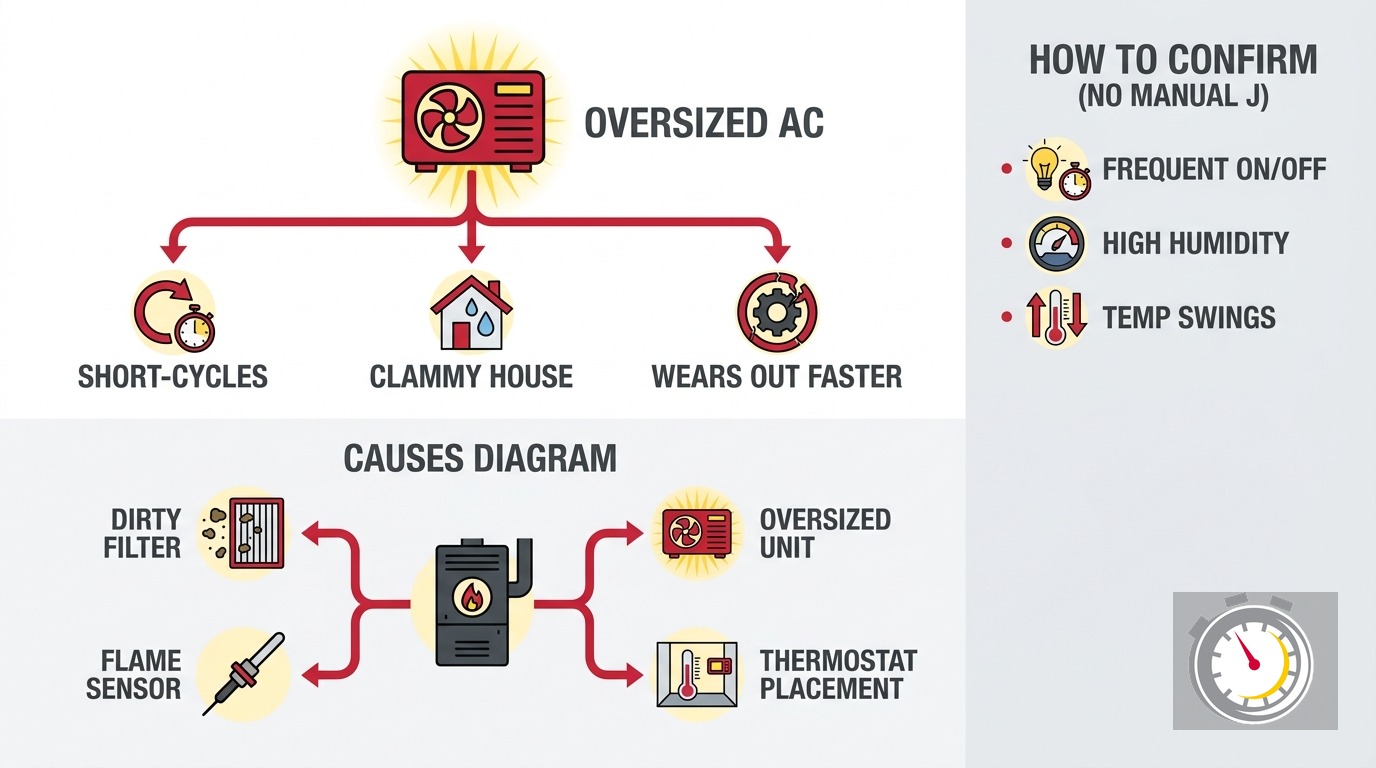
- A healthy AC runs 10-20 minutes per cycle on a hot day. Under 10 minutes is short cycling.
- An oversized unit hits the temperature target fast, shuts off early, and never finishes removing humidity from the air.
- Condensate that forms on the evaporator coil re-evaporates back into the room when cycles end too soon. That is why the house feels clammy even while the system runs.
- You can check for oversized air conditioner problems yourself with a stopwatch, the nameplate on your outdoor unit, and a $15-20 hygrometer.
- Frequent hard starts from short cycling accelerate wear on the compressor, capacitor, and contactor, cutting system life short.
- Minnesota’s lakes and rivers add significant atmospheric moisture in summer, making dehumidification more important here than in drier climates.
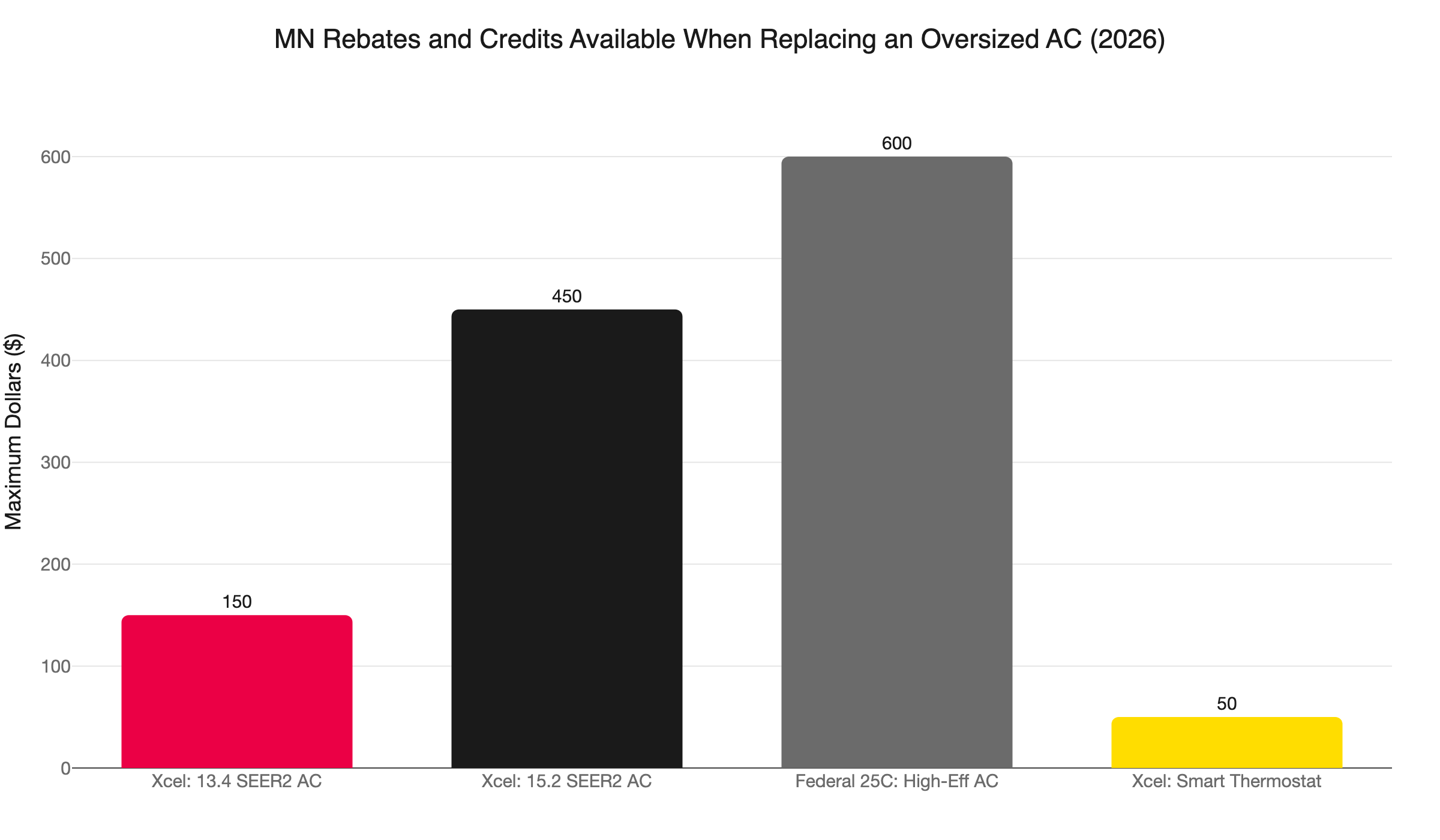
- Xcel Energy rebates ($150-$450) and the federal 25C tax credit (up to $600) can stack when you replace an oversized unit with a qualifying high-efficiency system.
The Problem With “Bigger Is Better” in AC Sizing
Your air conditioner kicks on. Two minutes later, it shuts off. The thermostat reads 72°F. Your house feels cold, but also somehow sticky. The air is heavy.
This is one of the most common oversized air conditioner problems, and it gets misdiagnosed constantly. Homeowners assume the system is working because the temperature number looks right. Temperature is only half of indoor comfort. The other half is humidity.
A too-big AC cools the air fast. It hits its thermostat target and shuts down before doing the other half of its job. The result is a house that is cold and clammy at the same time, a system that wears out faster than it should, and utility bills that do not reflect the power you paid for.
Here is how to confirm you have this problem today, without calling anyone. And if you do need to replace the unit, there are rebates available in Minnesota that make the fix less expensive than most homeowners expect.
What Are the Signs of Oversized Air Conditioner Problems?
The short answer: An oversized AC runs very short cycles, often under 5 minutes, cools the air quickly, shuts off before removing humidity, and cycles back on frequently. High indoor relative humidity while the AC is running is the clearest indicator something is wrong with how the system is sized.
The experience is distinctive. The air temperature drops quickly. The thermostat number looks right. But something feels off. The air is heavy and thick. Surfaces feel slightly damp. You might notice a musty smell from the vents, or condensation on windows that should not be there.
None of that happens with a properly sized system. A right-sized AC runs longer, maintains a steadier temperature, and takes down humidity alongside the air temperature. If your house cools fast but never feels truly comfortable on a humid July day, that pattern is worth looking into.
Why Does an Oversized AC Short-Cycle?
The short answer: A larger unit cools the air to the set point faster than a right-sized unit would. It hits its target, shuts off, the house warms back up, and it fires again. That pattern repeats all day: many short cycles instead of fewer long, complete ones.
According to HVAC performance data, a properly sized AC runs 10-20 minutes per cycle on a hot day. A short-cycling system may run only 2-3 minutes before shutting off. On a 90°F day in the Twin Cities, that means the system fires and stops dozens of times rather than running in steady, sustained cycles.
This is not a thermostat problem or a refrigerant problem. It is a sizing problem. The unit was installed with more cooling capacity than the house needs, so it always reaches the target too fast.
Why Does Your House Feel Clammy Even When the AC Is Running?
The short answer: Dehumidification takes time. When cycles end too quickly, moisture that condensed on the evaporator coil re-evaporates back into the room rather than draining away. The system ran, used electricity, and cooled the temperature. But the humidity it temporarily captured went right back in.
Here is the mechanic. When warm, moist air passes over the evaporator coil (the cold coil inside your air handler), moisture from the air condenses on the coil surface. Think of a cold glass of water on a humid afternoon. That condensate drips down into a drain pan and exits through the condensate drain line.
The catch is that condensate needs time to actually drain. If the cycle ends before the condensate leaves the pan, it sits on the coil when the system shuts off. The coil warms up. The condensate re-evaporates, right back into the air in your home.
You end up with the worst of both situations. The system ran. It used power. It cooled the air temperature down. But the humidity it temporarily pulled out went right back in. Your home reads 74°F and 62% relative humidity. You are cold and sweaty at the same time.
This re-evaporation cycle repeats every time the system short-cycles. On a humid Minnesota summer day, an oversized AC is not just failing to dehumidify. It may be making the humidity problem incrementally worse on each cycle.
For more on what keeps indoor moisture elevated even when your system is running, see our post on why your home feels humid in spring and how AC systems help control it.
How Can You Tell If Your AC Is Oversized?
The short answer: Three checks, none of which require calling anyone: time a cycle with a stopwatch on a hot day, find the tonnage on your outdoor unit’s nameplate and compare it to your square footage, and read indoor relative humidity with a $15-20 hygrometer while the system runs.
Here is how to run each one.
The stopwatch test
On a day above 80°F, go outside when your outdoor unit kicks on and start timing. When the compressor shuts off, stop the clock. Under 10 minutes is a short cycle. Consistently 2-3 minutes is significant short cycling.
Run this test a few times throughout the day. One short cycle can be a warm startup anomaly. A pattern across multiple cycles is a sizing signal.
The nameplate check
The outdoor condenser unit has a model number plate, usually on the side panel. Look for a BTU or tonnage label. Tonnage is sometimes embedded in the model number: a model ending in 036 typically indicates 36,000 BTU (3 tons); 042 = 3.5 tons; 048 = 4 tons; 060 = 5 tons.
A rough sizing guideline is 400-600 square feet per ton of cooling capacity. A 3-ton unit in a 1,200-1,800 square foot home is often reasonable. A 5-ton unit in a 1,500 square foot home is a significant red flag.
That said, square footage alone is not the right sizing tool. The DOE recommends a Manual J load calculation for every HVAC installation. It accounts for ceiling height, insulation levels, window area and orientation, occupant count, local climate zone, and appliances. The nameplate comparison tells you whether you’re in the ballpark. A Manual J gives you the right number.
The hygrometer check
A hygrometer reads relative humidity. You can find one for $15-20 at most hardware stores. Set it in your main living area while the AC is running on a warm day.
The ASHRAE comfort range for indoor relative humidity is 30-50% RH. If you are reading 55%, 60%, or higher while the system is actively running, dehumidification is failing. That is not a normal operating result, and oversizing is one of the most common causes.
What Does Short Cycling Do to Your AC Over Time?
The short answer: Every startup puts maximum electrical load on the compressor, contactor, and capacitor. A right-sized system cycles through this startup load fewer times per day. An oversized system does it many more times, accelerating wear on the most expensive components faster than normal.
The compressor is the most expensive component in your AC system. It is also what makes cooling physically possible. Compressors are engineered for a certain number of start events over their service life. Short cycling multiplies that number dramatically.
Frequent hard starts accelerate wear on the compressor, contactor, and capacitors faster than a properly matched system would generate. Technicians often find evidence of repeated hard-start stress when they open up units that failed well ahead of their expected lifespan.
The practical outcome: a system that should run 15-20 years may develop compressor problems in 8-10 years. The extra money spent on more tonnage comes back out of your equipment’s service life instead of staying in your pocket.
For what early compressor wear looks like from the outside, see our post on signs your AC compressor is failing and what repair costs in the Twin Cities.
Why Are Oversized Air Conditioner Problems Worse in Minnesota?
The short answer: Minnesota’s lakes, rivers, and summer weather patterns load significantly more atmospheric moisture into the air than drier climates do. Dehumidification is not optional here. It is the primary comfort variable on humid days, and short cycling fails at exactly that job.
Minnesota is not a dry-heat state. Our 10,000 lakes and major river systems add significant atmospheric moisture during summer months. The latent cooling load, which is the energy required to remove moisture from the air as distinct from lowering temperature, is unusually high in our region compared to drier parts of the country.
On a typical humid July day, dew points in the Twin Cities can reach the mid-60s or higher. At 74°F with a dew point above 65°F, the air feels muggy and uncomfortable regardless of what your thermostat reads. Your system can hold 74°F perfectly, and you will still reach for a fan. That is the humidity side of the equation failing.
When an oversized AC short-cycles here, the problem goes beyond comfort. High indoor humidity supports mold growth in ductwork and on surfaces. It makes allergens more active. It makes the air feel warmer than it is, so people lower the thermostat to compensate. Lowering the thermostat makes short cycling more aggressive, not less.
Variable-speed (inverter-driven) AC systems are particularly effective for Minnesota’s humid summers. They run longer at lower capacity rather than blasting cold air and shutting off. The evaporator coil has more contact time with the moist air, which means far better moisture removal on each cycle. That is worth understanding when evaluating a replacement in the Twin Cities.
What Rebates Are Available When Replacing an Oversized AC in Minnesota?
The short answer: Xcel Energy offers $150-$450 for qualifying high-efficiency central AC systems in 2026, and the federal 25C tax credit adds up to $600 for high-efficiency AC or up to $2,000 for a qualifying cold-climate heat pump. Both incentives can be stacked on the same install.
If your checks confirm oversizing and the system is already showing wear, replacement is a practical question, not just a comfort one. Here is where the picture often shifts for Twin Cities homeowners.
Xcel Energy central AC rebates (2026):
- $150 for systems rated at the 13.4 SEER2 threshold
- Up to $450 for higher-efficiency 15.2 SEER2 systems
- $50 for an ENERGY STAR-certified smart thermostat
These rebates require a participating Trade Ally contractor and Quality Install documentation. The install must also be permitted with your city. Skip the permit and the rebate does not get issued.
Federal 25C tax credit:
The Inflation Reduction Act created a federal tax credit for qualifying high-efficiency HVAC equipment. A high-efficiency central AC qualifies for up to $600. A cold-climate heat pump, which handles both heating and cooling in one system, qualifies for up to $2,000. These credits stack with Xcel utility rebates. You do not have to choose one or the other.
The credit is claimed on IRS Form 5695 when you file your federal taxes. It reduces your tax owed dollar-for-dollar, not just your taxable income.
The regional minimum standard:
All new central AC installations in the northern climate zone must meet at least 14 SEER2 efficiency. If your existing oversized system is an older, lower-efficiency unit, a replacement meets the current standard by default. The question becomes which efficiency tier makes sense given your budget and rebate picture.
For a full breakdown of rebate options available to Twin Cities homeowners, see our post on Xcel and CenterPoint HVAC rebates in Minnesota.
What Does Proper AC Sizing Actually Look Like?
A correctly sized AC for your home does not come from picking the highest-tonnage unit available. It comes from a Manual J load calculation.
Manual J factors in square footage, ceiling height, insulation levels, window area and orientation, occupant count, local climate zone, and appliances, not square footage alone. The DOE and ACCA require it on every HVAC installation. If a contractor quotes you a replacement based only on the tonnage of your existing system, that is a problem. The existing system might be the problem.
Manual J produces the load number. Manual S, the equipment selection process, narrows that number to the right unit. A proper installation uses both.
In Minnesota, this matters specifically because our climate zone and humidity load can produce different results than a square-footage rule of thumb implies. Modern, well-sealed Twin Cities homes often need less cooling capacity than older sizing methods suggest. The industry shorthand of “one ton per 500 square feet” overestimates cooling needs in well-insulated newer builds more often than homeowners realize.
Is an Oversized AC Always the Installer’s Fault?
The short answer: Not always. A system sized correctly at installation can effectively become oversized over time if the home has been significantly improved. Better insulation, new windows, and reduced air leakage all reduce the cooling load, so the unit that was right for the house in 2005 may be oversized for the same house in 2025.
This happens more often than people expect. Energy efficiency upgrades, new triple-pane windows, and added attic insulation all reduce heat gain into the house. The unit that matched at installation can be oversized years later after substantial home improvements.
It also happens when contractors default to square-footage estimates rather than Manual J calculations. Both situations lead to the same result: a system that short-cycles, misses humidity, and wears out early.
Neither case means an immediate replacement is the only path. But the next system needs a fresh load calculation, not a copy of the old tonnage.
Our Team Does Manual J on Every Install
Northern One Hour Heating & Air Conditioning is locally owned and operated in Ramsey, Minnesota. We serve the Twin Cities metro, including Minneapolis, St. Paul, Blaine, Maple Grove, Plymouth, Brooklyn Park, Woodbury, and Bloomington.
We run Manual J load calculations on every new installation. Not because it is required, but because installing the wrong size defeats the whole point of replacing a system. You should not spend money on a new unit only to have the same short-cycling, clammy-house problem a week later.
If your AC short-cycles, your house feels sticky at 74°F, or your outdoor unit runs 2-3 minutes at a time on a hot day, we can take a look. We will check the cycles, verify the sizing, and give you an honest read on what is going on.
We back every visit with our on-time promise: “Always On Time… Or You Don’t Pay a Dime!(R).” If we say we are coming, we show up.
Call us at (763) 260-6662 or schedule online to set up a sizing consultation. If a replacement makes sense, we will walk you through the rebate options before you commit to anything.
Frequently Asked Questions
What is short cycling in an air conditioner? +
Can an oversized AC damage my home? +
What rebates are available when replacing an oversized AC in Minnesota? +
Need a technician now?