
New Construction HVAC Problems First Year Minnesota
Key Takeaways
- Minnesota Statute 327A.02 gives you a 2-year statutory warranty on all mechanical systems in a new home, including heating, cooling, and ventilation. It is automatic and cannot be waived in the purchase contract.
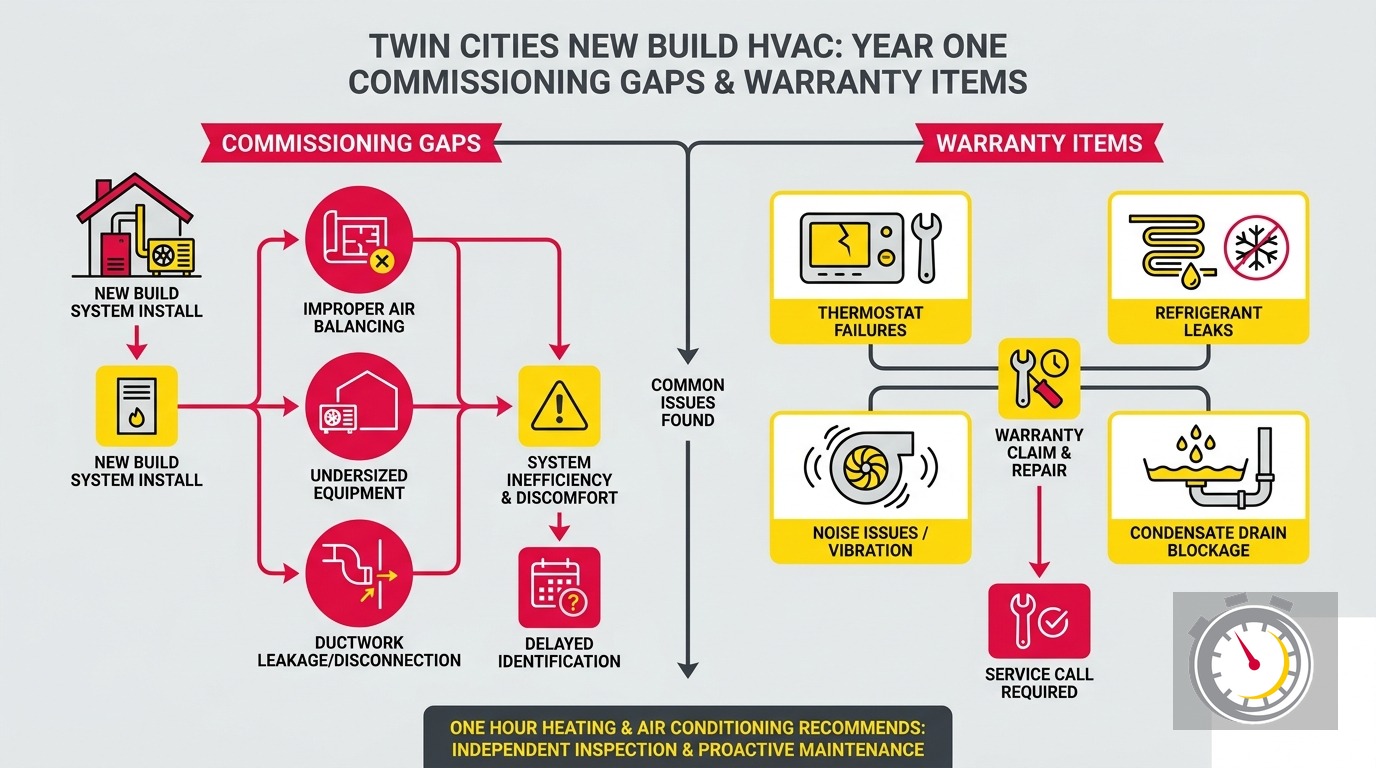
- Seven commissioning gaps drive most year-one HVAC calls on new Twin Cities construction: unbalanced HRV, missing duct leakage test certificate, no Manual J on file, unregistered equipment, unclaimed utility rebates, unclean ductwork, and no documentation provided at closing.
- Equipment registration closes in 60-90 days from the installation date. Miss it and you lose extended warranty coverage.
- CenterPoint and Xcel both offer new-construction furnace rebates the builder may have already claimed. Ask about it before you close, or contact your utility immediately after.
- A written notice to your builder triggers a 30-day inspection obligation under MN 327A.02. You do not need an attorney to start that clock.
Most new Twin Cities homes have at least one HVAC commissioning gap waiting to be found. New construction HVAC problems in the first year in Minnesota rarely announce themselves as a fully broken system. They show up as a basement that runs 10 degrees colder than upstairs, a house that feels stale and stuffy by January, or a gas bill that does not match what the builder’s spec sheet promised.
The reason is simple: permit approval and commissioning are not the same thing. A system can pass inspection without being balanced, tested, or registered. Minnesota averages roughly 8,000 heating degree days a year, and the new homes built here are among the tightest in the country. Those two facts make commissioning gaps expensive fast. The good news: Minnesota law gives you a defined window to make your builder fix them.
Here are seven gaps worth checking in your first 90 days.
What Are the Most Common New Construction HVAC Problems in Year One in Minnesota?
In short: The system runs - it just runs wrong. Uneven temperatures, stale air mid-winter, and utility bills that outpace the builder’s estimates are the top complaints. All of them trace back to commissioning steps the HVAC contractor skipped before handing over the keys.
MN Rules Chapter 1322 sets a maximum blower-door result of 3 ACH50 for new construction. That means natural air infiltration is too low to supply adequate fresh air, combustion makeup air, or humidity relief. The equipment installed to compensate - the HRV, the sealed ductwork, the sized furnace - has to be measured, tested, and balanced precisely. When any of those steps are skipped, the first Minnesota winter finds the problem.
The seven gaps below appear on nearly every year-one new-construction service call we run. Each one is checkable in 90 days or less.
Gap 1: The HRV Was Installed but Never Balanced
A heat recovery ventilator is not optional in modern Minnesota new construction. With a maximum envelope infiltration rate of 3 ACH50, the house cannot breathe on its own. The HRV is the code path to meeting ASHRAE 62.2-2022 ventilation minimums. It is on the permit, and it passed inspection.
Here is what inspection does not verify: balance. A balanced HRV matches supply and exhaust airflows within the manufacturer’s specified tolerance. When those flows are unequal, the home develops a persistent pressure differential. Pull more air out than you bring in and combustion appliances - your furnace, your water heater - can backdraft. Push more in than you exhaust and you pressurize the envelope, driving moisture into wall cavities and rim joists. An HRV that is off by 20 percent in either direction can quietly cause moisture damage before the first heating season ends.
The air quality problems surface first. By February, a home with an unbalanced HRV feels stuffy despite the ventilation system running. CO2 builds in bedrooms overnight. Condensation appears on north-facing windows. None of these are defects in the equipment itself. They are defects in the commissioning.
Ask your builder for the HRV balancing report: a document showing the measured airflow at each supply and exhaust port, the date of the measurement, and the technician’s name and license number. If no such document exists, the HRV was installed but not commissioned. Our guide to whole-home HRV ventilation in Minnesota explains what a properly commissioned system delivers and what a balancing report should include.
Did Your Builder Pull a Duct Leakage Test Certificate?
In short: Probably not, and that is a code gap. Minnesota adopted the 2012 IECC effective February 14, 2015. That code requires a physical duct leakage test with a hard numeric limit: total leakage cannot exceed 4.0 CFM25 per 100 square feet of conditioned floor area. Visual inspection is not an acceptable substitute; a pressurized test is mandatory.
For a 2,000 square foot home, the maximum is 80 CFM25. A system above that threshold pumps conditioned air into unconditioned space on every cycle: your attic, your wall cavities, your attached garage. You pay to heat or cool that air. It never reaches you. The energy loss is ongoing and compounds over the life of the system.
The test produces a certificate: the blower door pressure setting (25 Pascals), the measured CFM25 result, and a pass or fail against the code limit. That certificate should be in your permit file. Ask your builder for it by name. If they cannot produce it, the ductwork was not tested and you have a documented defect for your MN 327A.02 written notice.
Leaky ductwork is fixable. Aeroseal and manual mastic sealing are both common solutions in the Twin Cities and can bring a system into compliance in a single visit. But you need to know you have the problem before you can fix it. Our post on leaky ductwork and energy loss covers what both sealing methods cost and how much energy you recover.
Was Your New Minnesota Home’s HVAC Sized to a Manual J?
In short: Minnesota code requires a Manual J load calculation (ACCA 8th edition) before a mechanical permit is issued. The document is in your permit file. If the installed equipment is substantially larger than the Manual J called for, you have an oversizing defect worth raising with your builder in writing.
A Manual J sizes the heating and cooling equipment to the specific heat loss and heat gain of your home: its square footage, insulation values, window area, ceiling height, and compass orientation. It is a calculation, not a rule of thumb. “1 ton per 500 square feet” is a rule of thumb. Manual J is a code-required document.
The defect it prevents is oversizing. An oversized furnace in a tight new-construction home hits setpoint in minutes, shuts off, and repeats the short cycle. Short cycling means the heat exchanger never reaches stable operating temperature, which accelerates thermal fatigue. It also means latent heat removal is inadequate - the system shuts down before it has run long enough to pull humidity out of the air. You get cold floors, fluctuating temperatures, and equipment that wears faster than its efficiency ratings imply.
Call the city or county building department that issued the mechanical permit and ask for the permit file. The Manual J should be in it. If the installed equipment nameplate tonnage is significantly higher than the Manual J load, document that gap and include it in any defect notice to your builder.
How Long Do You Have to Register New HVAC Equipment?
In short: Most major manufacturers give you 60 to 90 days from the installation date. Miss that window and the warranty defaults to 5-year parts-only coverage with no labor coverage after year one. Extended heat exchanger lifetime warranties require registration within that same window.
New construction makes this gap easy to miss. The HVAC contractor installs the equipment weeks or months before your closing date. The installation date - which starts the registration clock - is not your move-in date. If no one mentions registration at closing, the window closes before you know it started.
Major manufacturers default to 5-year parts-only coverage when equipment is not registered within 60-90 days of installation. Labor is excluded after year one regardless of registration status. A compressor that fails in year two may be covered for the part, but the labor cost to swap it still falls to you. That can reach several hundred dollars for a straightforward replacement and more for anything involving refrigerant recovery.
Find the model and serial number on each piece of equipment: the furnace label is usually inside the blower compartment door; the outdoor AC or heat pump unit has a label on the back panel; the HRV label is typically on the front cover. Log in to each manufacturer’s portal and check registration status. If anything is not registered, do it now. Our guide to HVAC warranty registration for Minnesota homeowners covers the registration process for every major brand and what documentation you will need.
What Utility Rebates Are Available for New Construction HVAC in Minnesota?
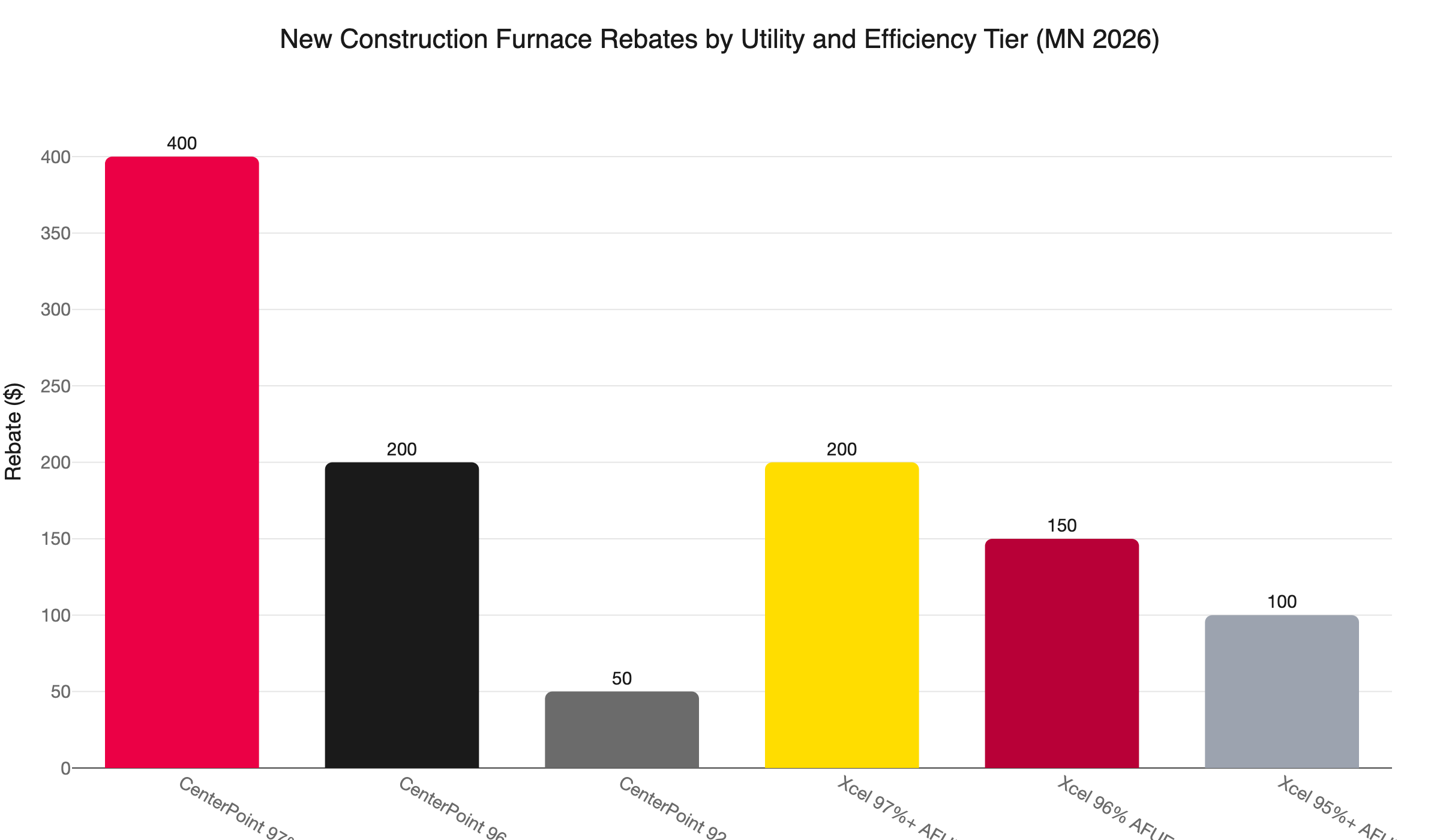
In short: CenterPoint Energy offers up to $400 for a 97%+ AFUE furnace in new construction. Xcel Energy offers up to $200. Both utilities state explicitly that new-construction rebates should be negotiated between the builder and the buyer. Most buyers never hear about them.
This is the commissioning gap that generates the most frustration after the fact. The builder’s HVAC sub installed a high-efficiency furnace during rough framing. They submitted the rebate application during the permit process. The check arrived at the builder’s office weeks before your closing date. You signed the purchase agreement, moved in, and nobody mentioned the rebate.
Here is what the 2026 programs actually pay:
CenterPoint’s new-construction furnace schedule: 97%+ AFUE earns $400, 96-96.9% AFUE earns $200, 92-95.9% AFUE earns $50. Xcel’s new-construction furnace schedule: 97%+ AFUE earns $200, 96%+ earns $150, 95%+ earns $100. Xcel’s program rules include this note verbatim: “rebates for new home construction should be negotiated between the builder and resident.”
To check your situation: find the yellow EnergyGuide sticker on your furnace, which shows the AFUE rating. Then ask your builder directly which rebate tier was applied for and who received the check. If you have not closed yet, request a rebate credit at closing. If you have already closed, call your utility with your address and ask whether a rebate was submitted. Some utilities will allow you to claim an unclaimed rebate directly if the 12-month submission window is still open.
Our post on Xcel and CenterPoint HVAC rebates in Minnesota covers the current full schedules and the application process for both utilities.
Gap 6: The Ductwork Was Never Cleaned Before First Use
New construction produces debris. Drywall dust, insulation fragments, wood scraps, and fasteners collect in open ductwork during framing, drywall, and finish work - weeks before the furnace ever fires. Most builders do not include a post-construction duct cleaning in the standard contract. The system runs at final inspection and circulates that debris into the home from day one.
One documented thread of homeowner accounts of new construction HVAC problems includes a homeowner who reported eye injury from “shrapnel” when lifting a floor register - drywall dust, screws, and wood scraps. That material passes through the air handler filter, loads the furnace filter faster than normal, and circulates particulates through every room until someone physically removes it.
Ask your builder whether a post-construction duct cleaning was performed and request the service receipt. Post-construction cleaning is different from standard HVAC maintenance cleaning. It uses a higher-capacity vacuum collection method and targets construction debris specifically. If it was not done, schedule it before the first heating season, and replace the furnace filter immediately afterward.
What Commissioning Documents Should You Have Received at Closing?
In short: Six documents, minimum: HRV balancing report, duct leakage test certificate, Manual J load calculation, equipment registration confirmation for every HVAC unit, model and serial numbers for every component, and filter sizes for the furnace and HRV. If any of these are missing, request them in writing before you need them for a warranty claim.
The ENERGY STAR National HVAC Commissioning Checklist (Rev. 14, January 2025) requires a credentialed contractor to verify refrigerant charge, fan airflow, and room-by-room balance before certification. That is the standard for an ENERGY STAR-rated home. Homes not seeking that certification have no equivalent mandatory third-party verification step, which is exactly why buyers need to request the documentation themselves.
Build a simple document file at closing:
- HRV balancing report with measured supply and exhaust airflows and technician signature
- Duct leakage test certificate with date, CFM25 result, and pass/fail notation
- Manual J load calculation matching the installed equipment
- Equipment registration confirmation numbers for furnace, AC or heat pump, and HRV
- Model and serial numbers for every HVAC component in the home
- Filter size and location for the furnace and HRV (write it on a sticky note in the utility room if nothing else)
If your builder cannot produce these documents, request them in writing via email. That timestamp matters. The paper trail you build in the first 30 days is the same paper trail you will hand to an attorney if the problems turn out to be consequential.
What Does Minnesota Law Give You If Your Builder Won’t Fix It?
In short: Minnesota Statute 327A.02 mandates a 2-year warranty on all mechanical systems in every new dwelling, including heating, cooling, and ventilation. Written notice to your builder triggers a 30-day inspection obligation. The warranty is automatic, non-waivable, and covers defects the builder’s HVAC sub caused, not just the builder directly.
Here is how to use it. When you identify a defect - short-cycling furnace, unbalanced HRV, ductwork that was never tested to code - write a notice to your builder. List each defect specifically, with dates and symptoms. Send it via certified mail or email with read receipt. The 30-day inspection obligation begins on delivery of that notice, and the builder must respond. You do not need an attorney to send the letter.
The 2-year clock runs from the date of the warranty deed or the date you took possession, whichever came first. Do not wait until year two to document problems. The best time to build your defect record is during the first heating season, while symptoms are fresh and the statutory window is fully intact.
Practical steps for documenting your case:
- Keep a dated log of every HVAC symptom, including the outdoor temperature at the time.
- Photograph anything visible: frost on the HRV core, debris in floor registers, error codes on the thermostat display.
- Note room-to-room temperature differentials during heating and cooling. Five degrees is normal; ten or more in a new build is a commissioning defect.
- All HVAC work on Minnesota new construction must be performed by a contractor licensed under MN Stat. Chapter 326B. Unpermitted work voids manufacturer warranties immediately. Confirm the permit file is complete before the contractor signs off.
- A defect that causes consequential damage, such as moisture infiltration from an unbalanced HRV, may involve additional claims under separate statutes. Consult a construction attorney if the dollar amount is significant.
A 90-Day Action Plan for New Construction HVAC Problems in Minnesota
Work through this checklist before the first heating season. Most steps take under an hour total, and they are much easier to complete before a problem becomes urgent.
Closing week:
- Pull the model and serial number for every HVAC component in the home: furnace, outdoor AC or heat pump unit, HRV, and any supplemental equipment.
- Log in to the manufacturer portal for each unit and check registration status. Register anything that is not yet registered, and save the confirmation numbers.
- Ask your builder in writing which utility’s new-construction rebate was submitted, the efficiency tier, and who received the check.
Within 30 days:
- Request the duct leakage test certificate and HRV balancing report in writing. Email is sufficient; you want a timestamp on the request.
- Call the city or county building department and ask for the mechanical permit file. Confirm the Manual J is included.
- Locate every filter in the home - furnace and HRV - write down the sizes, and set a calendar reminder at 6 months for the HRV filter. Furnace filters in new construction often load fast in the first 60 days due to construction dust.
Within 90 days:
- Schedule a third-party commissioning inspection with a licensed HVAC contractor. This is separate from the home inspection you had before closing. Have the technician verify refrigerant charge, fan airflow, HRV balance, and room-to-room temperature distribution against the Manual J design.
- Note temperature differentials room-to-room during a heating cycle. Under five degrees is normal for a Minnesota cold snap. Ten degrees or more in a new build is a commissioning problem, not a weather problem.
- If you find defects, send written notice to your builder before the 90-day mark. Starting your paper trail early gives you maximum leverage under MN 327A.02 while the statutory window is fully intact.
Our team at Northern One Hour is locally owned and operated in the Twin Cities. We run commissioning inspections on new construction and know the specific gaps that surface in Minnesota-built homes. If your year-one system is not performing the way it should - uneven temperatures, unexplained utility bills, air that feels stale in February - call us at (763) 260-6662 or book online. We show up when we say we will. “Always On Time… Or You Don’t Pay a Dime!(R)”
Frequently Asked Questions
Does Minnesota law require a warranty on new construction HVAC? +
What is the duct leakage limit for new homes in Minnesota? +
How long do I have to register new HVAC equipment for full warranty coverage? +
Can I still claim new construction utility rebates after closing? +
Need a technician now?