
Basement Humidity in Minnesota Summers: Why AC Isn't Enough
Key Takeaways
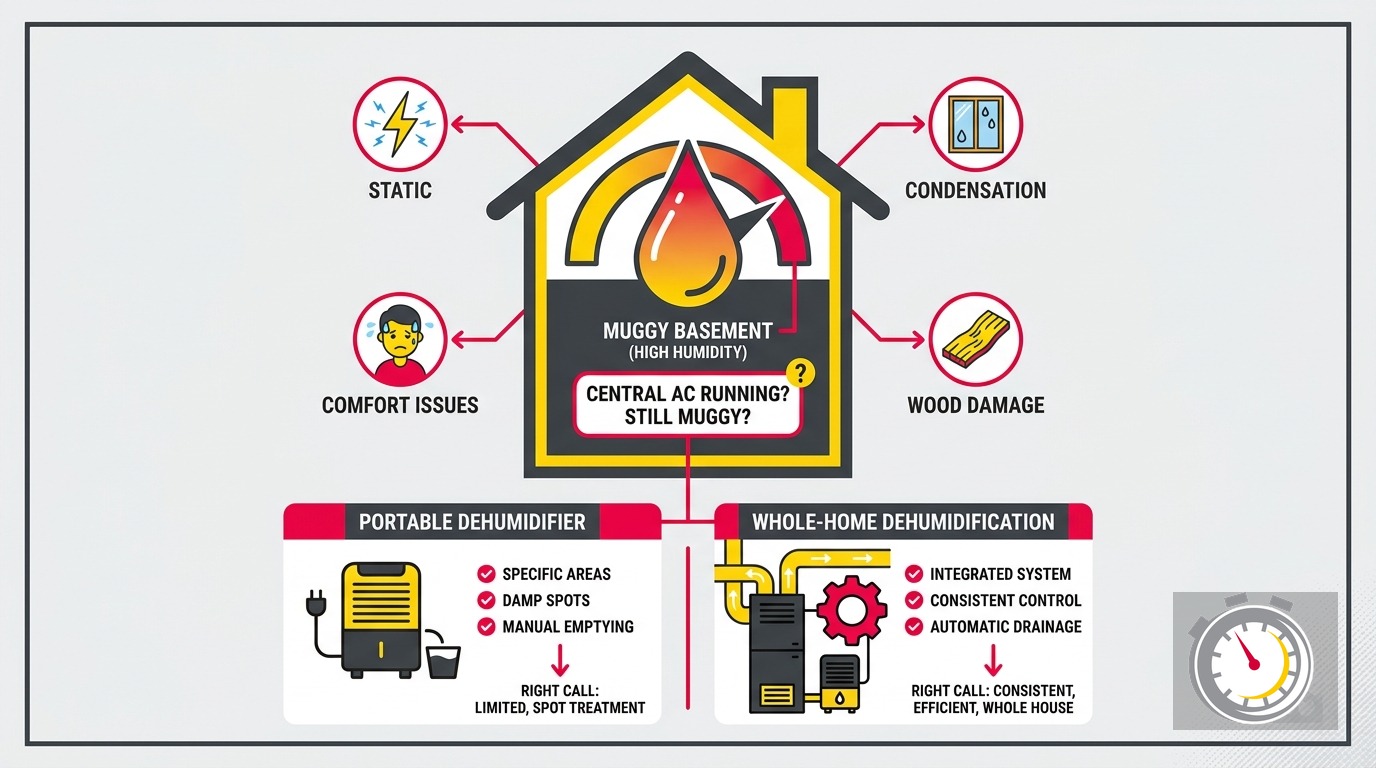
- Basements are natural humidity sinks. Cooler below-grade surfaces, porous concrete, and summer air infiltration all feed the problem, separate from your AC.
- Central AC removes moisture as a side effect of cooling. It was not designed to keep a basement dry on its own.
- The EPA recommends keeping indoor humidity below 60%. The ideal range is 30% to 50%. Mold begins growing on wet surfaces within 24 to 48 hours of a moisture event.
- A $15 to $20 hygrometer is the correct first step, not a dehumidifier purchase.
- A 50-pint portable dehumidifier handles most basements under 1,500 square feet. Larger or persistently wet spaces need more capacity or a whole-home unit.
- Whole-home dehumidifier installation requires a mechanical permit in Minnesota. Use a licensed HVAC contractor.
- ENERGY STAR certified dehumidifiers use about 20% less energy than non-certified models.
Why Is My Basement So Humid in Summer, Even With AC Running?
Short answer: Your central AC cools the whole house but was not designed for the moisture sources specific to below-grade spaces. At least three separate mechanisms push humidity into your basement every summer. AC partially addresses only one of them.
Most homeowners assume a working AC means a dry home. That holds true for upper floors and main levels, where ductwork delivers conditioned air consistently. The basement is a different environment. Limited airflow, colder surfaces, and direct contact with the ground create conditions your central system was not built to fix.
The good news: once you understand the three sources, the solution is usually straightforward.
Three Reasons Basement Humidity Builds in Minnesota Summers
These three mechanisms work at the same time. Understanding all three tells you what kind of fix will actually hold.
Surface condensation
Your basement walls, floor, and cold-water pipes stay cool year-round. In summer, warm outdoor air enters and contacts those cooler surfaces. Air cannot hold as much moisture at lower temperatures. The excess drops out as condensation.
Picture a cold glass of water on a humid July afternoon. Now imagine that effect playing out continuously across 900 square feet of concrete floor. That moisture soaks into the slab, runs down the walls, or re-evaporates back into the basement air.
Minnesota intensifies this problem. Twin Cities dew points during humid events in July and August routinely reach 65 to 70 degrees Fahrenheit. That air is near saturation before it enters your home. When it contacts a basement slab sitting at 55 to 60 degrees, condensation is nearly guaranteed.
Ground moisture migration
Concrete is porous. It wicks moisture from the soil beneath and around your foundation walls continuously. Rain, snowmelt, and groundwater all contribute. Summer accelerates the process because the ground surface holds more moisture after recent rain and sustained humidity.
No amount of air conditioning fixes this. The moisture enters from below. It never passes through your duct system.
Summer air infiltration
In summer, a phenomenon called the reverse stack effect pulls warm outdoor air into your home at its lowest points. Foundation cracks, sump pit openings, utility penetrations, basement windows, and crawl space vents all become entry points. By the time that humid outdoor air reaches your basement, it may already be at or near its dew point.
Your AC handles what flows through upper-level supply ducts. It does not reach humid air seeping in at the foundation line.
How the three sources compound
These forces do not take turns. They act simultaneously. On a humid July day in the Twin Cities, warm outside air infiltrates through the sump pit. Ground moisture wicks through the slab. Condensation forms on the cold floor drain. Your AC upstairs keeps the main floor comfortable. It has no way to reach what is happening eight feet below grade.
Is Your AC Short-Cycling? That Could Be Part of the Problem
Short answer: If your AC runs in short 8- to 10-minute bursts, it is removing almost no moisture from your air. Short-cycling is common in Twin Cities homes built with oversized equipment in the 1980s and 1990s.
Moisture removal during an AC cycle happens late, not early. The evaporator coil needs time to chill down enough for water vapor to condense on its surface. That typically takes 10 to 15 minutes of continuous runtime. A system that shuts off at 8 to 10 minutes skips most of that work.
Signs your system might be short-cycling:
- The house cools quickly but still feels sticky and humid
- The AC turns on and off frequently, even on moderate days
- You can hear it cycle more than four or five times per hour
Many Twin Cities homes built between 1980 and 2000 have oversized equipment. Manual J load calculations determine the correct equipment size for a home’s actual heat gain. They were not always applied consistently during that era. An oversized system satisfies the thermostat quickly, then shuts off before completing a full dehumidification cycle.
If you suspect this is happening in your home, a proper load calculation is the right next move. For more on why sizing affects comfort and efficiency, see our post on HVAC sizing and Manual J load calculations.
That said, even a correctly sized AC will not keep a Minnesota basement dry during a humid stretch. The basement moisture sources don’t stop when your equipment is right-sized.
What Should You Do Before Buying Anything?
Short answer: Spend $15 to $20 on a hygrometer and check it around 2 pm on a warm, humid day. One reading tells you whether you have a minor problem, a significant one, or nothing that needs attention right now.
A hygrometer measures relative humidity. Small digital models are available at hardware stores and online for $15 to $20. Place it in the center of your basement, away from walls and the floor drain, and leave it for an hour. Check the reading in the early-to-mid afternoon, when outdoor humidity peaks.
How to interpret the reading:
- Below 50%: Healthy range. No action required now, but monitor it through the summer.
- 50% to 59%: Elevated risk. A portable dehumidifier is a reasonable precaution.
- 60% or above: Action needed. Mold risk is active.
- 70% or above: Significant moisture problem. A professional assessment makes sense before any equipment purchase.
This $15 to $20 investment tells you whether you need a $200 portable unit, a $1,950 installed system, or nothing at all. Do not skip it.
How Do You Know If Your Basement Humidity Is a Health Risk?
Short answer: Humidity above 60% is an active health risk. Mold grows on wet surfaces within 24 to 48 hours. You do not need to see mold before you act.
Watch for these early warning signs, all of which appear before visible mold:
- Condensation on basement windows, cold-water pipes, or the base of your water heater
- A musty or earthy smell that intensifies in summer
- Efflorescence: white chalky mineral deposits on concrete walls or the floor
- Wood framing or subfloor that feels slightly soft or spongy when pressed
- Allergy or asthma symptoms in household members that worsen in summer
The EPA is direct on this: keep indoor humidity between 30% and 50%, and always below 60%. Mold produces allergens and irritants that can trigger asthma attacks and allergic reactions, even in people without prior sensitivities.
Inadequate ventilation is one of the primary causes of indoor air quality problems. It allows pollutants, including mold spores, to accumulate. Basements are typically the least ventilated space in any home.
Portable vs. Whole-Home Dehumidifier: Which One Do You Actually Need?
Short answer: A portable unit is the right starting point for most basements under 1,500 square feet with moderate, seasonal dampness. A whole-home system makes sense for larger spaces, persistent moisture, or homes where humidity is migrating into living areas above.
When a portable dehumidifier is the right call
- Your basement is under 1,500 square feet
- The dampness is seasonal, not year-round
- You have not seen mold, standing water, or water intrusion
- You want to verify the scope of the problem before a larger investment
- You can run a drain hose to a floor drain, or do not mind emptying a tank
Portable units cost $120 to $500 for the unit, with no installation required. A 50-pint model handles the typical smaller basement. Look for the ENERGY STAR label and a built-in humidistat.
When a whole-home system makes more sense
- Your basement is over 1,500 to 2,000 square feet
- Humidity problems extend to the main floor or upper levels
- You have a history of water intrusion, flooding, or visible mold
- You want automated, set-and-forget operation without managing a tank
- You are already replacing or upgrading your HVAC system
Whole-home units tie into your existing ductwork and run automatically based on a humidistat. Total installed cost typically runs $1,100 to $1,900: $800 to $1,200 for the unit and $300 to $700 for installation.
For a deeper look at whole-home options for Twin Cities homeowners, read our post on whole-home dehumidifiers in the Twin Cities.
Sizing a Dehumidifier for Your Minnesota Basement
Getting capacity right matters. An undersized unit runs constantly and still falls behind. An oversized one short-cycles, wearing out faster and removing less moisture per dollar spent.
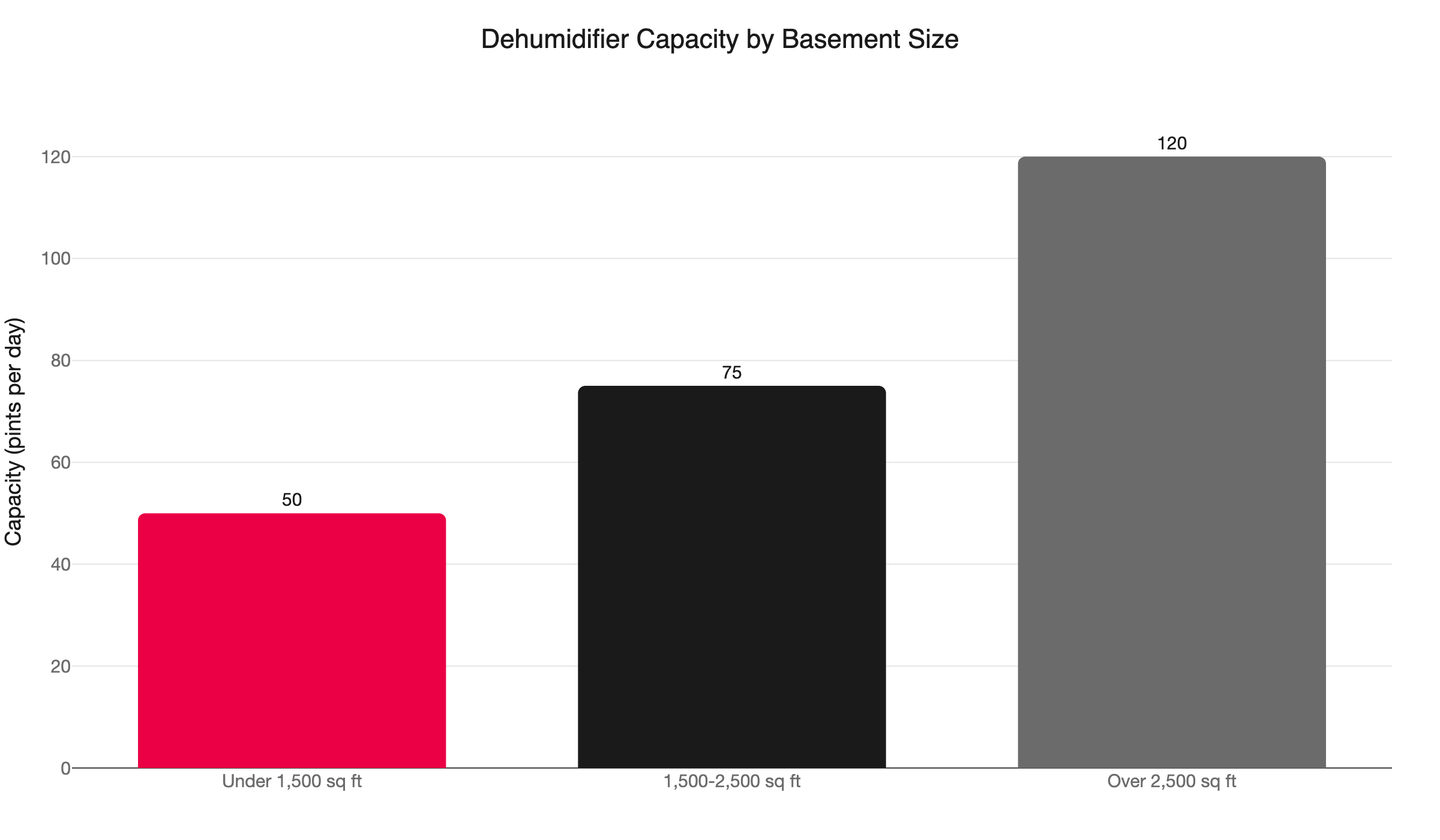
HVAC industry sizing benchmarks map basement area to daily removal capacity:
- Under 1,500 sq ft, moderate dampness: 50 pints per day. A standard portable unit covers this.
- 1,500 to 2,500 sq ft, or persistently wet: 70 to 80 pints per day. Step up to a larger portable or a smaller whole-home unit.
- Over 2,500 sq ft, or whole-house humidity migration: 90 to 150 pints per day, or a ducted whole-home system.
“Pints per day” is the volume of water the unit pulls from the air in 24 hours. During a humid July event in Minnesota, a 50-pint unit fills its 1.5-gallon tank in 12 to 24 hours. Without a continuous drain line, plan to empty it daily.
One Minnesota-specific factor: our state sits on more than 10,000 lakes and rivers. Ambient outdoor moisture here runs consistently higher than the national average. During humid stretches, outdoor air entering your basement is close to saturation. If you are on the fence between two size categories, size up.
Placement matters too. Set the unit in the center of the basement, not against a wall. Keep interior doors open to allow air circulation. Keep basement windows closed on humid days. Opening them to “air things out” imports moisture rather than removing it.
What Does Basement Humidity Control Cost in Minnesota?
Short answer: Portable dehumidifiers run $120 to $500 with no installation cost. A whole-home ducted system costs $1,100 to $1,900 installed. The whole-home option requires a mechanical permit pulled by a licensed HVAC contractor.
Portable dehumidifier: $120 to $500 for the unit. No installation cost. Most homeowners start here.
Whole-home ducted dehumidifier: $800 to $1,200 for the unit, plus $300 to $700 for installation. Total installed: $1,100 to $1,900.
Whole-home installation in Minnesota requires a mechanical permit. Your licensed HVAC contractor pulls it. Do not skip the permit. It protects you at resale and in any future warranty or insurance claim.
At both price points, look for the ENERGY STAR label. The efficiency difference adds up on a unit running through a full Minnesota summer.
Are There Rebates for Dehumidifiers in Minnesota?
Short answer: Limited for standalone units. Xcel Energy and CenterPoint have no current major dehumidifier rebate. Minneapolis homeowners pairing dehumidification with a qualifying HVAC upgrade may access the Minneapolis Bonus Rebate Program.
Xcel Energy and CenterPoint Energy serve most of the Twin Cities metro. Both focus their main residential rebates on heat pumps, insulation, and smart thermostats. There is no significant standalone dehumidifier rebate in either program currently. Some municipal utilities offer about $10 for ENERGY STAR certified models, but availability varies by city.
Verify the current Xcel program here: Xcel Energy MN Residential Rebate Summary.
If you are combining a whole-home dehumidifier with a larger HVAC upgrade, the picture changes. Minneapolis homeowners may qualify for the Minneapolis Bonus Rebate Program through MNCEE. Non-Green Zone residents can qualify for up to $6,000 in bonus rebates stacked on top of qualifying utility rebates. Green Zone residents can qualify for up to $20,000. Work must be completed before you apply. Funding is first-come, first-served.
Whether your project qualifies depends on scope and how it connects to other HVAC work. Our team can help you sort through what applies to your situation.
What to Look for in an Efficient Dehumidifier
If you are buying a portable unit, start with the ENERGY STAR label.
ENERGY STAR certified dehumidifiers use about 20% less energy than non-certified models. The efficiency metric is called Integrated Energy Factor, or IEF: liters of water removed per kilowatt-hour consumed. Higher is better. The ENERGY STAR efficiency criteria page lists certified models and current minimum thresholds.
For a unit running through a Minnesota summer, that 20% efficiency advantage adds up across months. Both portable and whole-home models can earn the ENERGY STAR certification.
Beyond the label, look for:
- A continuous drain connection so you do not empty a tank every day
- A built-in humidistat with auto-shutoff at your target humidity level
- A washable or replaceable filter
- Auto-restart after a power outage, which matters during summer storm season in Minnesota
When to Call Northern One Hour
A hygrometer and a 50-pint portable unit solve most Twin Cities basement humidity situations. There are times, though, when a professional assessment is the smarter first step:
- You see visible mold or have had recurring water intrusion
- Your AC cools the house quickly but it still feels sticky throughout
- Your basement is over 1,500 square feet and a portable is not keeping up
- You want a whole-home dehumidifier installed, permitted, and connected to your ductwork correctly
- You want someone to assess whether the issue is the equipment, the building envelope, or both
We are Northern One Hour Heating & Air Conditioning, locally owned and operated in Ramsey, MN. We serve homeowners across Minneapolis, St. Paul, Blaine, Maple Grove, Plymouth, Brooklyn Park, Woodbury, Bloomington, and the surrounding Twin Cities metro. We offer a full range of indoor air quality services, including dehumidification, air filtration, and whole-home ventilation.
Our on-time promise is real: “Always On Time… Or You Don’t Pay a Dime!(R).” That applies to every appointment, including IAQ consultations. We back every job with a 100% satisfaction guarantee.
Call us at (763) 260-6662 or schedule a dehumidifier consultation online. We will assess your basement, check your current system, and give you a straight answer on what the fix is and what it costs.
Frequently Asked Questions
How do I know if my basement humidity is too high? +
Can I fix a humid basement just by running my AC more? +
Do I need a permit to install a whole-home dehumidifier in Minnesota? +
What size dehumidifier do I need for my Minnesota basement? +
Need a technician now?