
How to Heat and Cool a Finished Basement in Minnesota
Key Takeaways
- Minnesota furnaces are sized to handle -12°F. On the coldest design days, there is no spare capacity for a finished basement load.
- Extending supply ductwork without a matched return creates negative basement pressure. That pulls cold outside air through rim joists and foundation cracks all winter long.
- A Manual J recalculation - not a verbal estimate - is the only defensible way to know whether your system can carry the added square footage.
- Cold-climate ductless mini-splits are engineered for ASHRAE Climate Zone 6A. They heat and cool with one system and qualify for up to $2,600 in Xcel Energy rebates.
- In 2026, the federal 25C tax credit has expired. Xcel and CenterPoint utility rebates are the primary financial tools now - up to $3,100 combined on eligible projects.
- Any mechanical work in Minnesota requires a permit and a passed inspection. An inspector will flag a missing return-air duct.
- Call (763) 260-6662 or book online to have our team assess your basement and give you a clear, honest recommendation.
Why Does Extending Existing Ductwork Fail in Most Minnesota Basements?
Short answer: Minnesota furnaces are already running at or near maximum output on the coldest design days. Adding supply registers without a matched return creates a pressure imbalance that starves upstairs rooms and draws cold infiltration air into the basement through rim joists and foundation gaps.
The longer explanation is three interconnected problems. Most online guides treat them separately - or skip them entirely. Understanding all three is what separates a good basement HVAC decision from an expensive mistake.
The Static Pressure Problem
Every residential duct system operates within a designed static pressure range. The air handler’s fan, the duct diameter and layout, and the number and size of supply and return openings all set that range. When you add basement branch runs to an existing plenum, static pressure across the entire system shifts.
The result: upstairs rooms lose supply volume during peak demand. On the coldest January night, when the furnace is running almost continuously, the branches with the least resistance get the most air. Basement runs, added last and often at the far end of a trunk line, compete poorly. Industry measurements show typical residential duct systems already lose 20-30% of airflow through leaks and poor connections before any extension is added. A system delivering 75-80% of designed airflow before a basement project may not heat two floors adequately after it.
The fix is not simply adding larger basement registers. ACCA Manual D methodology governs duct system design, and recalculating it for a new load requires engineering, not a site visit estimate.
The Return-Air Gap Almost Nobody Mentions
Supply registers deliver conditioned air into a room. Return grilles carry it back to the air handler. Every cubic foot of air pushed into a space must have a path to return. Without one, the basement runs at negative pressure relative to the rest of the house.
IRC Section M1501.1 requires balanced supply and return in habitable spaces. Basement ductwork extensions almost universally install supply registers and skip the matched return. In a Minnesota winter, that negative pressure forces the basement to draw air from wherever it can find it: rim joists, foundation penetrations, and the cracks that frost-heave cycles open and widen over six months each year.
The rim joist - where wood framing meets the concrete foundation wall - is already one of the highest heat-loss locations in a Minnesota home. Running the basement at negative pressure during January makes that worse. The furnace runs longer trying to compensate. The basement stays cold. The infiltration carries moisture that causes mold and framing problems over time.
Your Furnace Has No Spare Capacity
The 99% design temperature for Minneapolis-St. Paul is -12°F under ASHRAE Climate Zone 6A. Duluth is -21°F. When a contractor sizes a furnace using Manual J - the only defensible sizing method - that temperature is the target condition. A properly sized furnace runs at or near 100% output when the outdoor temperature hits -12°F.
Adding 800-1,200 square feet of finished basement load without upsizing equipment means the system is now undersized for its new total square footage. The basement will not reach setpoint on the coldest nights. The upper floors will compete with it for output.
Any contractor who says “your existing furnace can probably handle it” without running a new Manual J calculation is guessing. That is not a professional assessment. It is a verbal estimate that costs you money when it is wrong.
What Are Your Real Options for Heating and Cooling a Finished Basement in Minnesota?
Short answer: Four paths are worth evaluating: extending existing ductwork under specific conditions, installing a cold-climate ductless mini-split, adding in-floor electric radiant heat, or adding a dedicated zone-control system. Each has a distinct cost range, comfort profile, and set of conditions where it works.
The right choice depends on your basement’s size and layout, your current equipment’s age and remaining capacity, your utility provider, and whether you are in the rough-in stage or working with a floor that is already finished.
When Does Extending Existing Ductwork Actually Make Sense?
Short answer: Ductwork extension makes sense when a new Manual J calculation confirms the existing equipment has genuine remaining capacity, a matched return-air path is included, and the system is balanced after installation. Without that calculation, you are guessing.
Ductwork extension is not automatically wrong. It can work in larger homes where equipment was sized conservatively at installation, or when the basement footprint is modest relative to the existing system’s output. The conditions that must be met:
- A new Manual J load calculation covering the full finished basement square footage
- A return-air path with properly sized return grille locations - not an afterthought
- Balancing of all existing supply registers after the extension is complete
- A mechanical permit and passed inspection (required for all mechanical work in Minnesota)
Installed cost for a simple extension on a system with confirmed capacity runs $3,800-$7,600. Complex or larger basements run $8,500-$16,000. If a zone-control system is added to give the basement its own thermostat, budget an additional $1,500-$3,000 for motorized dampers and a second control point.
Zone control eliminates the “one thermostat for the whole house” problem. It does not increase your furnace’s output. If the equipment is already running near capacity, zone control redistributes the available BTUs. It does not create new ones.
One advantage of ductwork extension: it includes central air conditioning for the basement as part of the same system. That matters in a humid Minnesota summer, provided the air handler and coil have the capacity.
Is a Ductless Mini-Split Right for a Minnesota Basement?
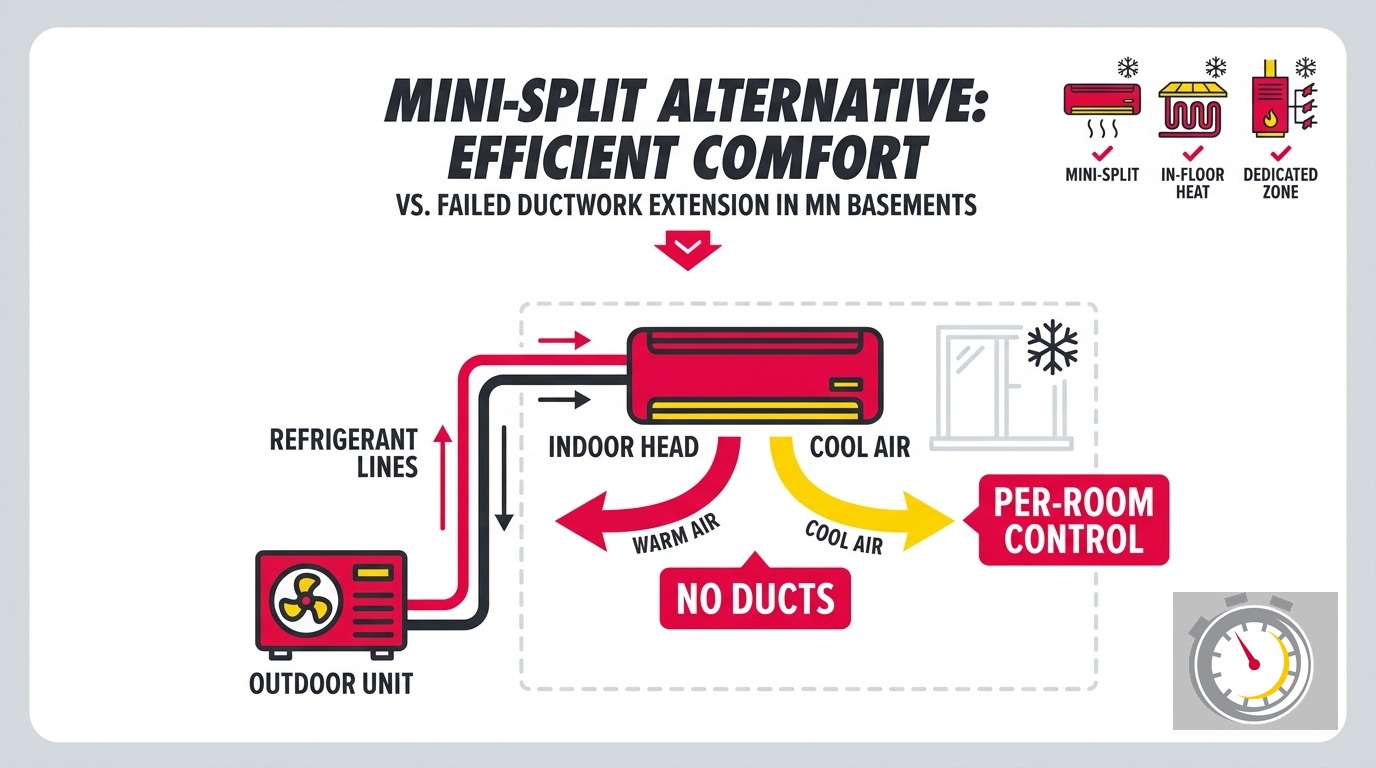
Short answer: For most finished Twin Cities basements, yes. A cold-climate mini-split handles heating and cooling with one system, requires no modification to your existing ductwork, gives the basement independent thermostat control, and qualifies for meaningful utility rebates in 2026.
Cold-climate mini-splits are engineered specifically for ASHRAE Climate Zone 6A. ENERGY STAR’s Cold Climate certification requires a coefficient of performance of at least 1.75 at 5°F and at least 70% of heating capacity retained at 5°F compared to 47°F. Units continue operating below 5°F, but at Minneapolis-St. Paul’s -12°F design temperature, your existing gas furnace still provides useful backup during the most extreme cold. The mini-split handles the basement load efficiently across the bulk of the heating season. The furnace covers the deep-cold days.
Look for units that appear on the NEEP Cold Climate Air-Source Heat Pump product list. The ENERGY STAR Cold Climate label and the NEEP listing together confirm the unit will perform at rated capacity in real Minnesota conditions - not just under laboratory testing at milder temperatures.
Key advantages for a basement application:
- No penetrations into the existing duct system
- Independent thermostat for the basement zone
- Provides cooling in summer without a window unit
- Handles dehumidification more precisely than extended ductwork during humid months
- Quieter than forced-air at the room level
- Eligible for Xcel Energy utility rebates
For a multi-room basement - a bedroom, a rec area, and a home office - a multi-zone mini-split with a head unit in each space gives you independent comfort control room by room.
Installed costs run $3,500-$6,000 for a single-zone system. Multi-zone systems with two or three indoor heads run $6,000-$10,000. High-efficiency cold-climate models run $7,000-$12,000 before utility rebates. After Xcel’s rebates, out-of-pocket cost on a qualifying system drops meaningfully. See the rebates section below for the full breakdown.
For more on how ductless systems solve space-conditioning challenges in Twin Cities homes, see our post on ductless mini-splits in older Twin Cities homes.
In-Floor Electric Radiant Heat for a Basement
In-floor electric radiant is the most comfortable heat delivery method available for a below-grade space. Heat radiates upward from the floor surface, which eliminates the cold-floor feeling that basements often have even when air temperature is at setpoint. There are no visible registers, no fan noise, and no maintenance on the heat delivery side of the system.
Three trade-offs matter for Minnesota homeowners.
Timing is fixed before flooring. Electric in-floor heating costs $8-$15 per square foot installed. It must be planned and installed before the finished floor goes in. Retrofit after the fact means removing the floor. If you are in the framing or rough-in stage, this is a real option. If the floor is already down, it is not.
Operating costs are high. Electric resistance heating has a coefficient of performance of 1.0: one unit of electricity produces one unit of heat. A cold-climate mini-split operates at 1.75 to 3.0 COP in the same conditions - delivering two to three times the heat output per dollar of electricity. In Minnesota, with a heating season that runs six months or more, that efficiency gap adds up on every utility bill.
Radiant provides no cooling. A finished Minnesota basement in July and August can be comfortable on its own, but summer humidity is a separate problem. Without cooling or dehumidification, a finished basement becomes sticky and uncomfortable during peak summer. A separate solution - a mini-split, a window unit, or a whole-home dehumidifier - would be needed for the humid season. Our post on basement humidity control in summer covers those options.
Radiant floor heat makes the most sense when comfort and aesthetics are the top priorities, timing allows for pre-floor installation, and a separate summer cooling solution is acceptable.
Dedicated Zone Control
A dedicated zone-control system uses motorized dampers in the existing ductwork to divide your forced-air system into independently controlled zones. The basement gets its own thermostat. The main living area keeps its own.
Zone control addresses a real comfort problem: below-grade spaces gain and lose heat differently than the floors above them. When the upstairs thermostat satisfies on a cold evening, the basement may still be several degrees below target. A zoned system lets the basement call for heat independently without cycling the entire house.
The key limitation is the same as any ductwork extension: zone control does not change how much heat your furnace produces. It manages distribution. If the equipment is already undersized for the combined load, zone control spreads the discomfort more evenly. It does not solve the capacity shortfall.
Installed cost for a two-zone electronic system with motorized dampers and a separate basement thermostat runs $1,500-$3,000 on top of ductwork costs. It is appropriate when a load calculation confirms the equipment can handle both zones simultaneously at peak demand. For more on how zoning works across multiple levels, see our post on HVAC zoning systems for two-story homes.
What Rebates and Incentives Are Available in 2026?
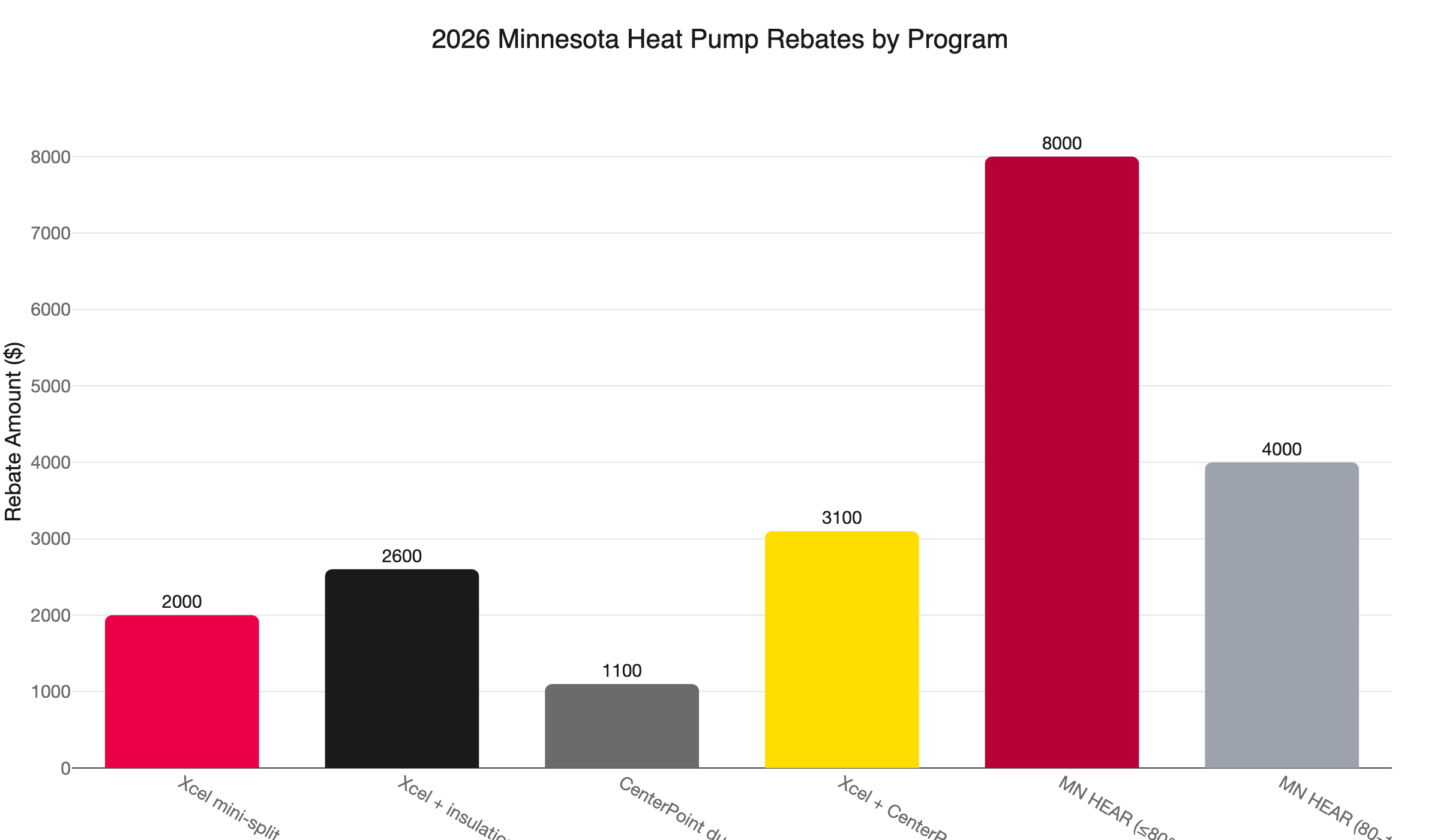
Short answer: The federal 25C tax credit expired at the end of 2025. Xcel and CenterPoint utility rebates are the primary tools now. Combined, eligible projects can reach $3,100. The state HEAR program is not yet launched and should not be counted on for 2026 projects.
Here is the full breakdown.
Federal 25C tax credit: expired. The Section 25C energy-efficient home improvement credit - 30%, up to $2,000 for qualifying heat pumps - expired December 31, 2025. It is not available for 2026 installations.
Xcel Energy ductless mini-split: $2,000. Xcel offers a $2,000 rebate for a cold-climate ductless mini-split for gas or combo customers. The system must appear on NEEP’s product list with a COP of 1.7 or higher. Add a $600 insulation bonus if qualifying insulation is installed within two years of the heat pump. Total Xcel potential: $2,600.
CenterPoint Energy ducted heat pump: $1,100. CenterPoint offers $1,100 for a ducted air-source heat pump installed in an existing home, paired with a gas furnace rated at 92% AFUE or higher, with the switchover point programmed at 40°F or lower. Ductless mini-splits and full-electric replacements do not qualify for this rebate.
Stacking both utilities: up to $3,100. A dual-fuel ducted heat pump installation can combine both utility rebates, reaching $3,100 combined plus the $600 Xcel insulation bonus on eligible projects.
Minnesota HEAR Program: not yet launched. The state HEAR program offers up to $8,000 for households at or below 80% of area median income and up to $4,000 for households between 80-150% AMI. The program requires a BPI-certified energy audit and completed insulation and air-sealing improvements per that audit. As of 2026, the program has not launched. Do not plan a 2026 project around this rebate - it is not available yet.
For a full breakdown of how to stack Minnesota heat pump rebates, see our post on Minnesota heat pump rebates and tax credits.
Choosing the Right Solution for Your Basement
The right answer depends on your basement’s size and layout, your current equipment’s age and remaining capacity, your utility provider, and whether you are in the rough-in stage or have a finished floor.
A practical decision framework:
- Furnace has confirmed spare capacity (Manual J verified), basement is one open zone: Ductwork extension with a matched return and proper balancing is worth evaluating. Get the load calculation first.
- Basement is large, has multiple rooms, or the furnace is more than 10-15 years old: Cold-climate mini-split. It avoids taxing aging equipment, gives the basement full independent control, and handles both heating and cooling.
- In the framing stage, radiant comfort is the top priority, separate cooling is acceptable: In-floor electric radiant paired with a mini-split or dehumidifier for summer.
- Want basement thermostat control without a mini-split project, and a load calculation confirms the equipment can handle both zones: Dedicated zone control added to a properly designed duct extension.
Before any work begins, a licensed HVAC technician should assess your existing system, verify its actual remaining capacity, and run a Manual J calculation that includes the finished basement load. Skipping that step is how homeowners end up with a cold basement, high energy bills, and a contractor returning to fix work that should have been done correctly the first time.
Northern One Hour is locally owned and operated in Ramsey, MN, serving Minneapolis, St. Paul, Blaine, Maple Grove, Plymouth, Brooklyn Park, Woodbury, Bloomington, and the surrounding Twin Cities communities. We show up when we say we will - “Always On Time… Or You Don’t Pay a Dime!(R)” - and we give you honest options without pressure. If your basement project involves heating or cooling, start with a site visit and a real capacity assessment from our team. Call (763) 260-6662 or book online to get a clear recommendation that fits your home.
Frequently Asked Questions
Can I extend my existing ductwork to heat a finished basement in Minnesota? +
What rebates are available for a basement mini-split in Minnesota in 2026? +
Do I need a permit to add heat to a finished basement in Minnesota? +
How much does it cost to heat and cool a finished basement in Minnesota? +
Need a technician now?