
Mini Split vs Window AC Minnesota: Which Fits Your Home?
Key Takeaways
- Window ACs are cheaper upfront ($200-$700 per unit) but cool only, and they last 8-12 years.
- Mini-splits cost more installed ($2,000-$10,000 per zone) but provide heating and cooling and last 15-20 years.
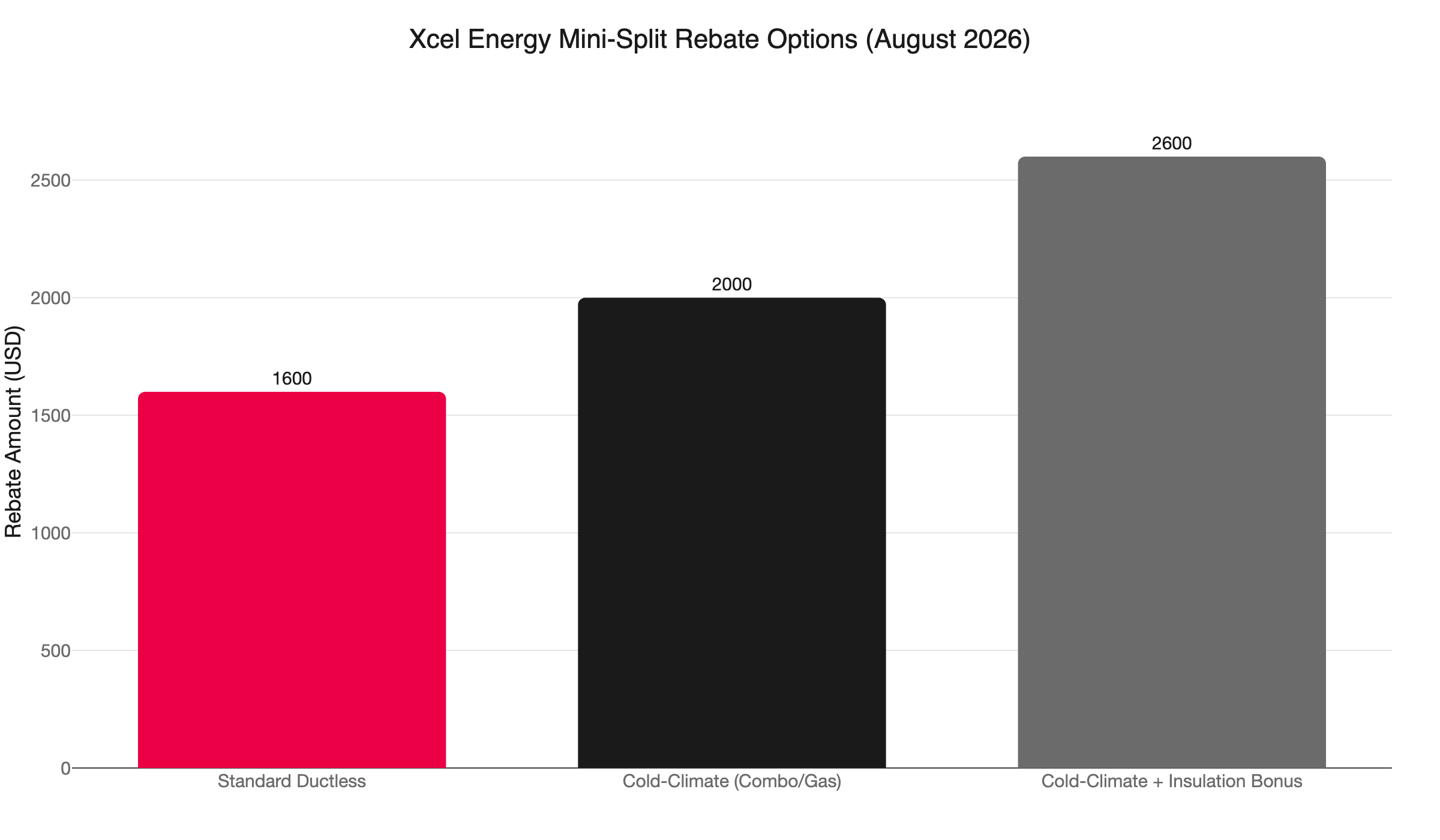
- Xcel Energy rebates can offset up to $2,600 of a cold-climate mini-split installation for Combo/Gas customers with qualifying insulation. Window ACs do not qualify for rebates.
- The federal 25C tax credit expired December 31, 2025. Installations in 2026 get no federal credit.
- Casement and crank windows common in older Twin Cities bungalows cannot accept a standard window unit without modification.
- Mini-splits require two permits in Minnesota: a mechanical permit and a separate electrical permit. Window ACs require none.
- HOA rules may restrict or ban both options. Get written approval before purchasing anything.
Cooling Without Ductwork in the Twin Cities
If your Minneapolis or St. Paul bungalow was built before World War II, it probably came without central air. The mini split vs window AC Minnesota debate is more complicated here than anywhere else in the country, and the national comparison articles won’t tell you that.
Both options work. But the choice depends on details that are specific to your home: what kind of windows you have, what shape your electrical panel is in, whether your HOA has anything to say about exterior equipment, and what Xcel Energy will pay you back.
This guide is for Twin Cities homeowners, not a hypothetical homeowner somewhere in America. We’ll cover cost, efficiency, noise, permits, HOA rules, and the rebate stack available right now.
What Makes the Mini Split vs Window AC Minnesota Question Different?
Twin Cities bungalows face three specific wrinkles: casement windows that don’t fit standard window units, pre-1960 electrical panels that may need an upgrade, and a $2,600 Xcel rebate stack that doesn’t exist for window ACs. None of the national comparison articles address any of these.
Most people comparing these two products look at purchase price and efficiency ratings. Those things matter. But if you own a 1924 stucco bungalow in Linden Hills or a 1940 Cape Cod in Highland Park, the variables are more specific than any generic listicle covers.
Many Minneapolis and St. Paul bungalows were built about 100 years ago - pre-AC, no ductwork, designed for whatever ventilation came through open windows. Now those same windows may be casement-style, and that creates a hard physical problem for window AC units. Add a 100-amp electrical panel, an HOA with architectural review requirements, and a rebate program that changed significantly in 2025, and the decision becomes very specific to your house.
Minnesota winters also shift the math. Window ACs sit in a box in the garage from October through May. A cold-climate mini-split runs the heat all winter. That changes the cost-per-year comparison substantially.
How Efficient Is Each System?
Mini-splits and modern window ACs are surprisingly close on cooling efficiency alone, but mini-splits pull ahead because they also heat - and they bypass the duct losses that drain central systems.
EnergySage data puts a basic window AC at roughly 11.4 EER, a modern high-efficiency window AC at about 15 EER, and a ductless mini-split at around 13.8 EER on a cooling-only basis. Those numbers are in the same ballpark.
But there are two factors that tilt real-world efficiency toward mini-splits in most older homes.
First: duct losses. If your home has a central forced-air system with ductwork in the attic, you’re already losing efficiency there whether you run the AC or not. The Department of Energy estimates that duct losses account for more than 30% of energy consumption for space air conditioning in homes where ducts run through unconditioned spaces. A ductless system doesn’t have that problem. The refrigerant line runs directly from the indoor head to the outdoor condenser - no air moving through leaky ducts in a 130-degree attic.
Second: heating. A cold-climate mini-split is a heat pump. It heats your home in January. A window AC does not. If you’re trying to make a room addition or a finished attic comfortable year-round, a window AC gives you half the solution. That changes the per-year cost comparison significantly when you factor in what you’re actually buying.
What Does Installation Actually Cost?
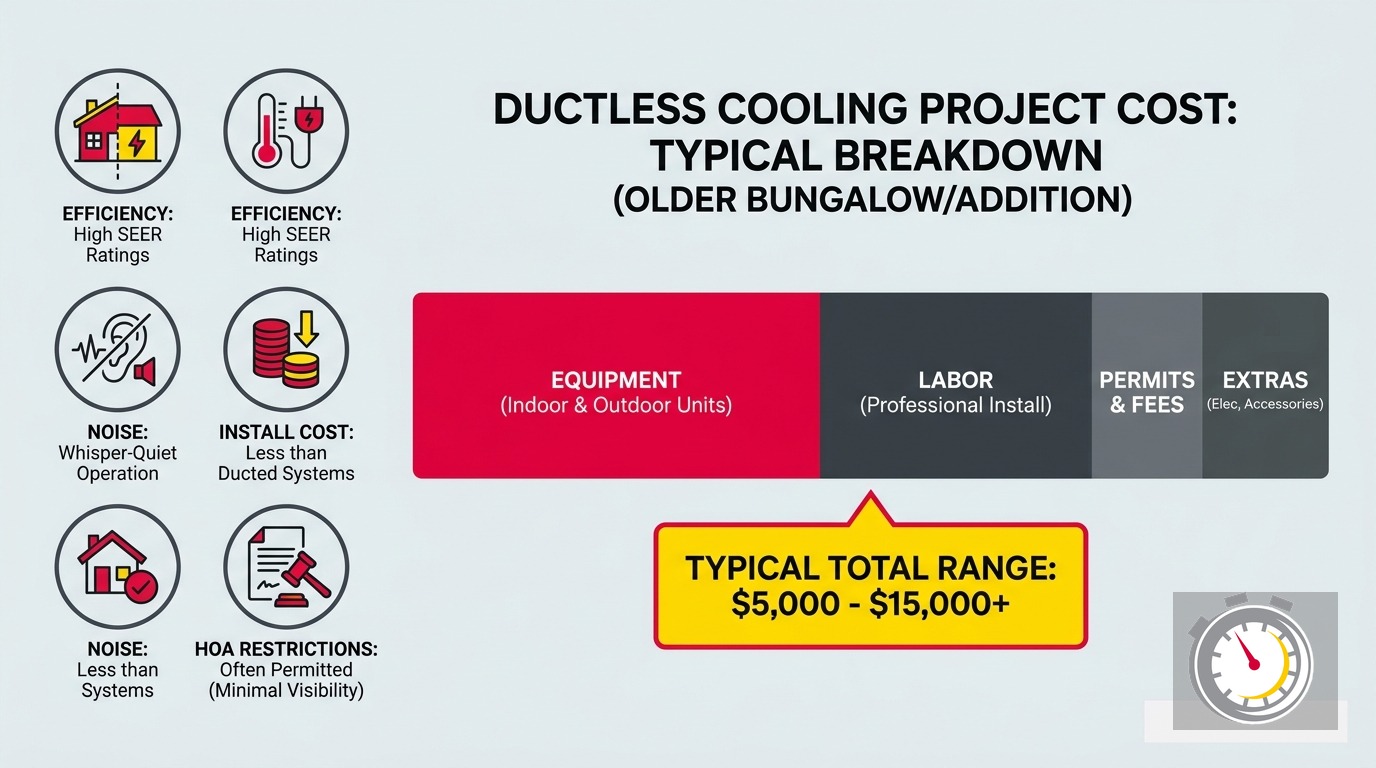
Window ACs run $200-$700 per unit with no professional install required. Mini-splits cost $2,000-$10,000 per zone installed, but they last 15-20 years versus 8-12 for a window unit. Xcel rebates change the net cost significantly for qualifying installs.
EnergySage puts window AC cost at $200-$700 for basic units and $350-$700 for modern, higher-efficiency models. You buy them at a big-box store and install them yourself. No contractor, no permit, no coordination.
Mini-split installation is a different category. Installed cost per zone runs $2,000-$10,000 depending on brand, BTU capacity, whether you need a multi-zone setup, and what condition your electrical panel is in. That range is wide. A single-zone system in a room with straightforward panel access sits toward the lower end. A multi-zone system with a significant electrical upgrade sits higher.
HVAC.com data puts mini-split lifespan at 15-20 years versus 8-12 years for window units. Over two window-AC replacement cycles, the gap between a $500 window unit (purchased twice) and a $4,000 mini-split narrows. And the mini-split is also your heating solution in winter, which the window unit never was.
The Xcel rebate stack is the variable that moves the needle most. That’s covered in detail below. For a general look at replacement and installation costs, our post on AC replacement cost in Minnesota covers the broader pricing landscape.
The Casement Window Problem in Twin Cities Bungalows
Standard window air conditioners require a double-hung window - the kind that slides up and down. You raise the lower sash, set the unit in the opening, and seal the gaps around it.
Older Minneapolis and St. Paul bungalows frequently have casement windows (hinged on the side and cranked open horizontally) or awning windows (hinged at the top). You cannot fit a standard window AC in these openings without modifying the window frame. That modification can mean cutting trim, altering rough openings, and potentially compromising the original window - a significant carpentry project that changes the calculation entirely.
This isn’t a minor inconvenience. It’s a hard stop for a meaningful share of the homes most likely to lack ductwork in the first place.
A ductless mini-split has no such requirement. The indoor air handler mounts on the wall. A refrigerant line set runs through a three-inch hole to the outdoor condenser. Your existing windows are irrelevant to the installation.
Before you buy a window AC, identify your window type. If they’re double-hung with a large enough opening, a window unit may work fine. If they’re casement or crank-style, a mini-split is likely the practical choice regardless of the cost or efficiency comparison.
Multi-zone mini-splits can serve up to four indoor air-handling units from one outdoor condenser. That means a single installation can cover a whole-house addition, a finished attic, or multiple rooms without ductwork - all with one permit application and one Xcel rebate submission.
Does a Mini Split Heat as Well as It Cools?
Yes. Cold-climate mini-split models operate effectively well below 0°F, making them a genuine year-round solution in Minnesota. Window ACs do not heat.
This is where the comparison shifts most dramatically for Minnesota homeowners.
EnergySage confirms that cold-climate mini-split models are rated to operate well below 0°F. These systems are purpose-built for northern climates. If you’re heating a sunroom, a finished basement, a room addition, or a bonus room above the garage in January, a cold-climate mini-split handles it. A window AC is in storage.
For homeowners solving a zone-specific comfort problem - a room that’s always too hot in summer and too cold in winter because it doesn’t connect well to the main HVAC system - the heating capability often makes the decision. You’re not buying a cooling appliance. You’re buying a year-round comfort solution that replaces both a window unit and whatever electric space heater currently sits in the corner.
Our post on ductless mini-split systems for older Twin Cities homes covers the heating side in more detail, including which room types benefit most from this setup. If you’re thinking about a full ductless installation, the ductless mini-split installation page walks through what to expect from the process.
How Loud Are These Systems?
Window ACs clunk on startup and hum constantly. Mini-splits are nearly silent indoors because the compressor - the noisy component - sits outside. For bedrooms and home offices, the difference is significant.
EnergySage is direct on this: window units are loud on startup and maintain a persistent operational hum while running. Mini-splits are almost always very quiet at the indoor head unit. The compressor - the component that makes most of the noise - sits outside in the condenser.
For a bedroom or a home office, this matters. A window unit running overnight is background noise you eventually stop noticing. Until you remove it, and the room is suddenly quiet. A mini-split indoor head running at low speed is close to inaudible.
The outdoor condenser is a different story. It does make noise. On a dense city lot where your neighbor’s bedroom window is 15 feet from your side yard, condenser placement matters. A good installer will walk the exterior with you before siting the unit. A condenser tucked behind a fence on the back of the house is a very different experience than one placed directly under a window.
Ask about noise ratings (measured in decibels) when comparing equipment. Most modern cold-climate models are reasonably quiet, but there’s variance between brands and configurations.
Permits, Panels, and Electrical Work
Window ACs do not require a permit in Minnesota. Plug a 115-volt unit into a standard outlet, or have an electrician run a dedicated 20-amp circuit for a 230-volt unit. The permitting process ends there.
Mini-splits require two permits: a mechanical permit for the HVAC equipment and a separate electrical permit for the new circuit. Under MN Stat. 326B.33, homeowners cannot pull their own electrical permit. A licensed electrician must do that work. Minnesota also requires a weatherproof disconnect within sight of the outdoor unit, per NEC 440.14, applicable to all MN permits filed after July 1, 2023.
Older homes create one more variable. Pre-1960 houses commonly have 100-amp electrical service panels. Adding a 240V mini-split circuit requires a load calculation first. Depending on what’s already running on the panel, you may need a panel upgrade before the mini-split circuit can be permitted. That is an additional cost - and it needs to be part of your upfront budgeting, not a surprise after the equipment arrives.
For a more complete picture of what triggers an HVAC permit in Minnesota and what the inspection process involves, our post on HVAC permit requirements in Minnesota covers the full list.
We’re a locally owned HVAC company. The electrical side of a mini-split install requires a licensed electrician - our sister brand Northern Mr. Sparky handles that work, and we coordinate regularly on joint installs.
Will Your HOA Allow It?
HOAs are the most overlooked variable in the mini split vs window AC Minnesota comparison, and no national competitor article develops this angle for Twin Cities homeowners.
The core issue: mini-split outdoor condensers are visible exterior equipment. Most HOA covenants, conditions, and restrictions (CC&Rs) classify them as architectural modifications subject to written approval before installation. If you install first and ask for forgiveness after the fact, the HOA may require you to remove the equipment at your expense.
Window ACs in street-facing windows are also commonly restricted or banned by HOA rules. Many HOAs prohibit window protrusions visible from the street, regardless of equipment type. This is a point that no competing article makes: a homeowner banned from a mini-split condenser by their HOA may also be banned from a window unit in the same window.
Before purchasing either system, pull your HOA CC&Rs and search for language on exterior modifications, window alterations, mechanical equipment, and architectural review. Then submit a written request for approval with a drawing showing placement before you schedule any work. Your installer should be prepared to provide documentation on unit dimensions and any screening options. Some HOAs will approve a condenser that is screened with approved fencing or plantings. Others have blanket restrictions that require a variance process.
One distinction worth raising with your HOA: a mini-split outdoor condenser sits on a pad outside the building and does not penetrate the structure the same way a window unit does. Some CC&Rs distinguish between equipment that penetrates the building envelope and equipment placed on the exterior. Whether that distinction matters to your HOA’s architectural committee is something to verify in writing before you spend money.
What Rebates Are Available for Minnesota Homeowners?
Xcel Energy offers up to $2,600 for a qualifying cold-climate mini-split installation. The federal 25C tax credit expired December 31, 2025. Installations in 2026 receive no federal credit.
This section requires care because the numbers have shifted substantially.
Xcel Energy rebates (current as of August 2026):
Xcel offers $1,600 for a standard ductless mini-split, or $2,000 for a cold-climate model for Combo/Gas customers. Cold-climate equipment must appear on the NEEP list with a COP of 1.7 or higher. You do not need to use an Xcel participating contractor to qualify - any licensed contractor installation can meet the criteria.
If you completed qualifying insulation or air sealing within two years of the mini-split installation, Xcel adds a $600 insulation bonus, applied automatically when you submit the rebate. The maximum stacked total for a Combo/Gas customer with qualifying insulation: $2,600.
CenterPoint Energy customers should ask about the Home Service Plus program, which performs a computerized heat-loss/heat-gain sizing assessment and alerts customers to applicable rebates at the consultation.
Federal 25C tax credit:
The Section 25C Energy Efficient Home Improvement Credit expired December 31, 2025. The One Big Beautiful Bill Act, signed July 4, 2025, accelerated its expiration by nine years. Installations completed in 2026 or later receive zero federal credit. Note: the EnergyStar.gov 25C page had not been updated to reflect this expiration as of this writing. Verify current status directly at IRS.gov before making decisions based on federal credit eligibility.
Save Energy Minnesota:
A state rebate of up to $4,000 for cold-climate air-source heat pumps (income-qualified) is not yet launched as of 2026. Equipment must be installed after the program officially opens to qualify. There is no retroactive eligibility for earlier installs.
Window ACs do not qualify for any of these programs.
For a current breakdown of all available rebates and credit programs, our post on Minnesota heat pump rebates and tax credits is updated as programs change.
Mini Split vs Window AC Minnesota: Which Option Is Right for You?
Window ACs work best for quick, low-cost cooling in one or two rooms with standard double-hung windows and no HOA complications. Mini-splits are the stronger long-term choice for homes with casement windows, year-round heating needs, Xcel rebate eligibility, or aging electrical panels already due for an upgrade.
Use this quick decision list:
Choose a window AC if:
- Your windows are double-hung with a large enough opening for the unit
- You need to cool one or two rooms on a tight near-term budget
- You’re renting or the home will sell within a few years
- Your HOA explicitly allows window units
- The space is cooling-only and has no winter heating need
Choose a mini-split if:
- Your windows are casement, awning, or crank-style
- You need year-round heating and cooling in a zone without ductwork
- You plan to stay long enough to recoup the higher upfront cost
- You qualify for the Xcel rebate (especially the $2,600 stack)
- Your HOA will approve a condenser with proper documentation
- Your electrical panel is already being upgraded or replaced
For multi-room situations, a multi-zone mini-split with one outdoor condenser and up to four indoor heads is often more cost-effective per room than separate window units across multiple rooms - particularly when you factor in a single permit, a single installation mobilization, and a single rebate submission.
Ready to Talk Through Your Options?
We’re a locally owned HVAC company serving the Twin Cities from Ramsey, Minnesota. We size and install ductless mini-splits for homes exactly like the ones in this article: bungalows without ductwork, room additions, finished attics, and garages. We do the HVAC work and coordinate directly with a licensed electrician on the circuit.
When you call us, we show up when we say we will. That is our promise: “Always On Time… Or You Don’t Pay a Dime!(R)”.
Call (763) 260-6662 or book online to schedule a sizing assessment. We’ll walk your home, look at your panel, flag any permit or HOA considerations upfront, and give you a clear number before any work starts.
Frequently Asked Questions
Do mini splits work in Minnesota winters? +
How much is the Xcel Energy mini-split rebate in Minnesota? +
Do window ACs require a permit in Minnesota? +
Can a standard window AC fit in a casement window? +
Need a technician now?