
SEER2 Rating Explained: The Minnesota Homeowner's Guide
Key Takeaways
- SEER2 replaced the old SEER standard for all new central AC and heat pump equipment sold in the US starting January 1, 2023.
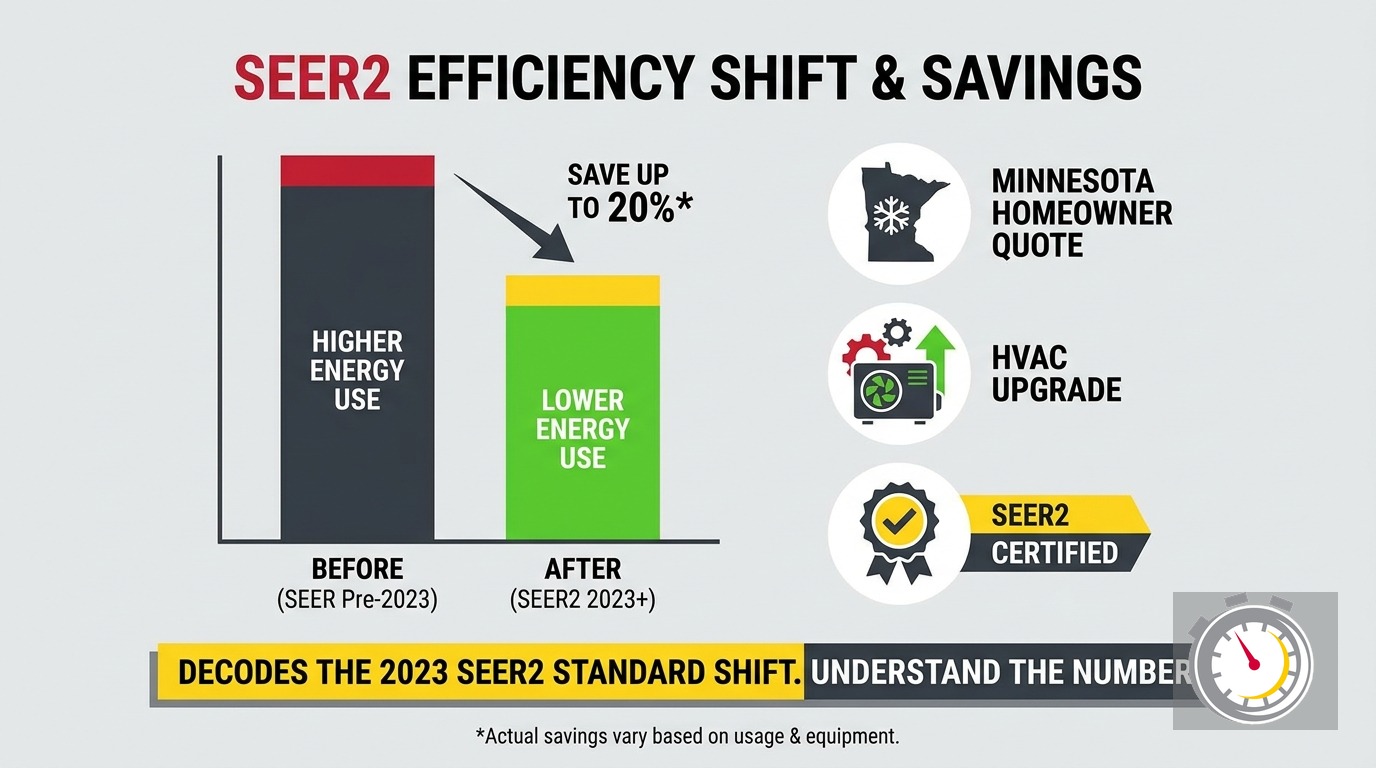
- SEER2 numbers run 4-7% lower than the old SEER for identical equipment. The test got harder, not the equipment worse.
- Minnesota’s legal minimum is 14.3 SEER2 for split-system central AC (North region, Climate Zone 6A).
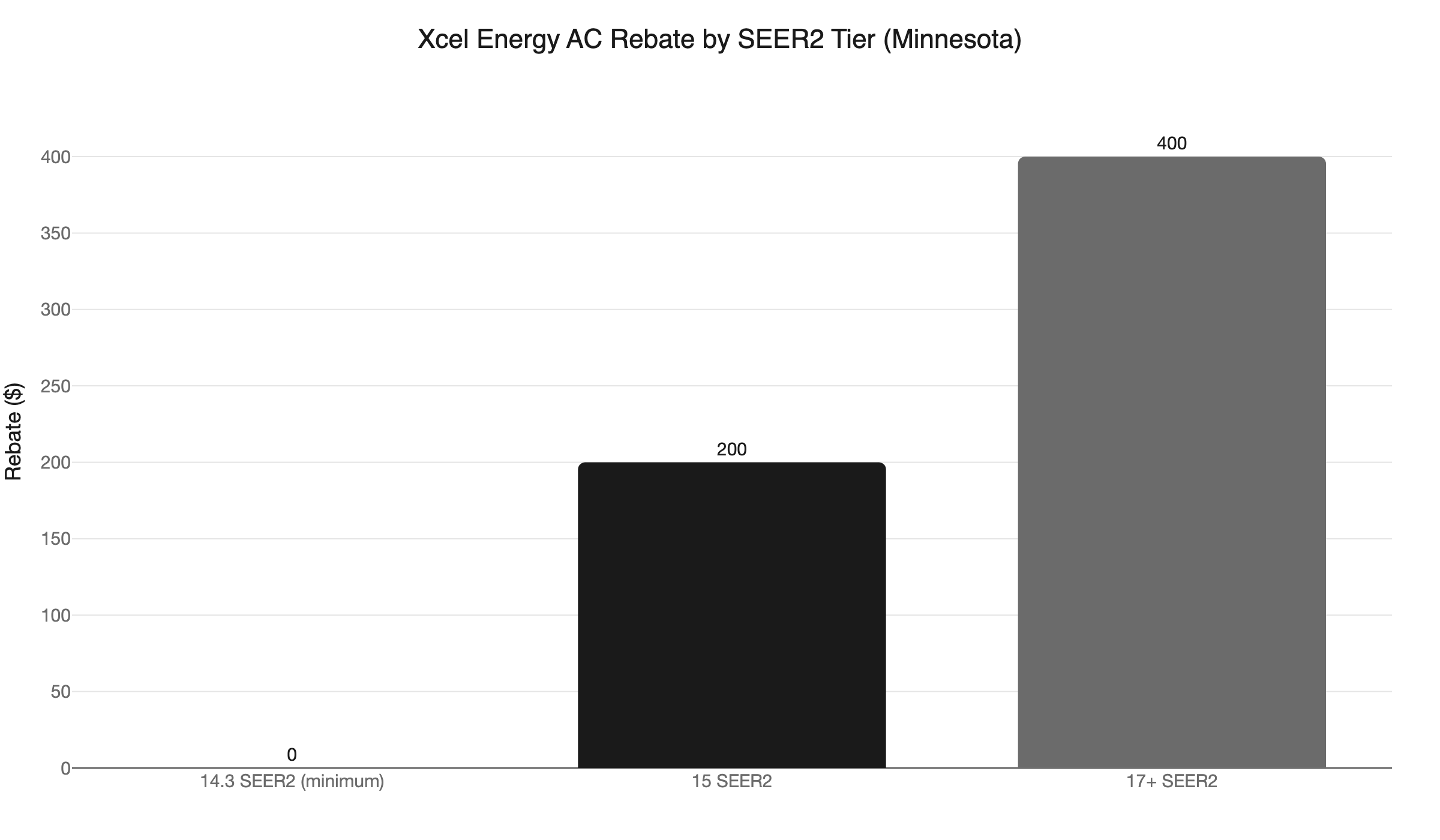
- You need at least 15 SEER2 to qualify for the Xcel Energy $200 rebate and the IRS 25C tax credit (up to $600 for central AC). At 17 SEER2, the Xcel rebate jumps to $400.
- Minnesota’s short cooling season makes the payback on premium efficiency thinner than national averages suggest. Rebates and credits close that gap.
- Ductwork condition shapes real-world efficiency as much as the SEER2 number on the spec sheet.
- Call (763) 260-6662 or book a consultation to get a straight answer on what SEER2 rating makes sense for your home.
Getting a quote for a new central air conditioner can feel like reading a foreign language. The technician hands you a spec sheet with a rating like “14.3 SEER2” or “17 SEER2,” and you have no easy way to know whether that is the legal bare minimum or a meaningful upgrade worth paying for. You may also notice that the number looks lower than an old quote you found in a file from five years ago - same brand, roughly the same price, but the rating is smaller.
That is not a mistake. The efficiency standard changed in 2023, and most contractors do not take time to explain what that actually means for a Minnesota homeowner.
What Is SEER2?
SEER2 stands for Seasonal Energy Efficiency Ratio, version 2. It is the current federal standard for measuring how efficiently a central air conditioner or heat pump converts electricity into cooling over a full season. A higher number means more cooling output per dollar of electricity. As Carrier describes it: “The SEER2 rating of an air conditioner is much like miles per gallon (MPG) for a car.”
The calculation works the same way the old SEER did: total BTUs of cooling delivered divided by watt-hours of electricity consumed, measured across a representative cooling season. What changed is how the test is conducted, not the underlying math.
The DOE updated the standard under AHRI Standard 210/240-2023, with a compliance date of January 1, 2023. Any new central AC or heat pump manufactured or sold in the US after that date carries a SEER2 rating. Older equipment that was already rated under the original SEER standard stays labeled as-is. Only new sales and installations are subject to the updated rule.
Why Does My New Quote Show a Lower Number Than My Old One?
The test got harder, not the equipment less efficient. That is the entire story, but the details matter for comparing quotes across years.
The original SEER test used an external static pressure of 0.1 inches of water column. That is essentially an ideal lab condition with almost no duct resistance. The SEER2 test runs at 0.5 inches of water column - five times higher - which much more closely simulates the resistance a real duct system puts on the equipment. Because the test is harder, SEER2 ratings run approximately 4-7% lower for identical equipment. A unit that would have scored SEER 15 under the old test earns roughly SEER2 14.3 under the new one.
This is particularly relevant for Twin Cities homeowners. Pre-1980 ramblers, 1960s split-levels, and 1970s two-stories throughout the metro often have flex duct runs that are undersized or have degraded over decades. The 0.5 iwc test condition is a much closer proxy to what those duct systems actually impose on an AC unit running on a humid July afternoon. The old 0.1 iwc test produced ratings that were sometimes difficult to achieve outside a controlled lab. SEER2 is simply more honest.
If you see a SEER2 14.3 quote today and remember a SEER 15 quote from five years ago for similar equipment at a similar price, those units perform at essentially the same real-world level. The 2023 unit is not inferior. The ruler changed.
What Is the Minimum SEER2 in Minnesota?
14.3 SEER2 for split-system central AC. That is the legal floor as of January 1, 2023. No contractor can install new or replacement central AC below this threshold in Minnesota.
The DOE divided the country into two efficiency regions. Minnesota falls in the North region, classified as Climate Zone 6A - moist, heating-dominant, with cold winters and a cooling season that runs roughly June through August. The North minimum is 14.3 SEER2. The South and Southeast minimum is a higher 15 SEER2, because those regions run their AC many more hours per year and the payback on higher efficiency comes faster.
When a contractor quotes you 14.3 SEER2 for a Minnesota home, they are quoting the legal entry point - not a substandard or cut-rate product. It is fully capable equipment. The question is whether stepping up to 15, 17, or higher justifies the premium cost, given what those thresholds unlock in rebates and credits.
It also helps to know that the 14.3 SEER2 North minimum is effectively equivalent in real-world cooling performance to the old SEER 15 minimum. The standard actually rose when you account for the stricter test. A homeowner who bought a “SEER 13” unit fifteen years ago and is now getting a “14.3 SEER2” replacement is moving to meaningfully better efficiency - the label just does not make that obvious at first glance.
What Does a Higher SEER2 Unlock for Minnesota Homeowners?
Going above the 14.3 SEER2 floor opens two significant financial incentives: a utility rebate from Xcel Energy and a federal tax credit. Both have specific SEER2 thresholds. Both stack with each other.
Xcel Energy rebates
Xcel Energy serves most Twin Cities metro customers for electricity. Their residential central AC rebate program currently offers $200 for units rated at 15 SEER2 or higher, and $400 for units rated at 17 SEER2 or higher. Verify the current amounts directly at Xcel’s rebate page before signing a contract - program amounts change between annual cycles, and the dollar figures above should not be treated as guaranteed until confirmed against the current program year.
One useful note for homeowners replacing both a furnace and an AC at the same time: Xcel rebates cover the AC side (which runs on electricity). CenterPoint Energy or Minnesota Energy Resources rebates may apply to the furnace side (which runs on natural gas) through separate programs. They do not compete with each other; you may be able to capture both. Our guide to stacking HVAC rebates and tax credits in Minnesota walks through how to combine them effectively.
IRS 25C tax credit
The Energy Efficient Home Improvement Credit under Section 25C equals 30% of the installed cost of qualifying central AC, capped at $600 per year. For qualifying heat pumps, the cap is a higher $2,000. The credit applies to installations through December 31, 2025 under current law.
To qualify, equipment must meet the CEE (Consortium for Energy Efficiency) Tier 1 thresholds for the North region: 15 SEER2 and 12.5 EER2. CEE Tier 2, which some utility programs treat as a separate qualifying level, requires 17 SEER2 and 12.5 EER2.
The minimum 14.3 SEER2 unit does not qualify for 25C. You need to reach at least 15 SEER2 to unlock it. Since 15 SEER2 is also the bottom of the Xcel $200 rebate tier, clearing 15 SEER2 activates two incentives at once. That makes 15 SEER2 the first meaningful threshold above the legal floor for most Minnesota homeowners.
ENERGY STAR certification
ENERGY STAR Version 5.0 for central AC in the North region requires 15.2 SEER2 and 12.5 EER2. Some utility programs use ENERGY STAR certification as the qualifying threshold rather than raw SEER2 numbers. Confirm which standard your utility program references when you apply for a rebate.
Why Doesn’t a Higher SEER2 Always Pay Off Faster in Minnesota?
Minnesota’s cooling season is short - and that changes the math in a way most manufacturer literature ignores.
Minneapolis averages roughly 700-800 cooling degree days per year. Houston is around 2,800. Phoenix is near 4,000. The fewer hours your AC runs each year, the smaller the annual energy savings from a higher SEER2 rating. A 20 SEER2 unit might pay for its premium over a 16 SEER2 unit in 3-4 years in Phoenix. In Minneapolis, the same comparison might take 8-12 years before the energy savings recover the cost difference.
This does not mean high-efficiency equipment is a bad investment in Minnesota. It means the financial case rests more heavily on rebates and credits than on raw energy savings. A $1,000 combined stack of a $400 Xcel rebate and a $600 25C credit against a mid-tier AC installation - which runs $7,500-$10,400 installed in the Twin Cities - meaningfully shortens the payback window.
Going from 15 to 17 SEER2 to capture the $400 Xcel tier (up from $200) typically costs a few hundred dollars more in equipment. If that same step also satisfies CEE Tier 2, the incentive math often supports the upgrade.
Going from 17 to 20 SEER2 is harder to justify purely on numbers here. High-efficiency central AC in the Twin Cities starts around $11,000 and can reach $15,600 installed for top-tier units. There is no additional Xcel rebate tier above 17 SEER2, and the 25C credit caps at $600 regardless of how far above 15 SEER2 you go. Our guide on AC replacement costs in Minnesota covers what the installed price ranges look like across efficiency tiers.
For a detailed look at how the short cooling season shapes the payback math on different efficiency tiers, see our post on AC replacement payback in a short Minnesota cooling season.
What About Heat Pumps and SEER2?
Heat pumps carry a SEER2 rating for cooling and an HSPF2 rating for heating. For Minnesota homeowners considering a heat pump, the SEER2 number alone does not tell the full story.
Minneapolis has a design temperature around -13 degrees F. A heat pump that performs well at moderate temperatures but loses significant heating capacity below 20 degrees F is not a reliable primary heat source in Zone 6A. Cold-climate heat pumps rated to -13 degrees F or colder are the only models worth quoting in the Twin Cities. Evaluate SEER2 alongside low-temperature heating capacity - do not let a high SEER2 number distract from whether the unit can actually heat your home in February.
The 25C credit is more generous for heat pumps: 30% of installed cost with a $2,000 cap, compared to $600 for central AC. That higher cap reflects the larger installed cost and the fact that a heat pump replaces both your AC and your primary heating source. If you are exploring a heat pump, ask specifically about cold-climate models and make sure the SEER2 conversation includes an HSPF2 discussion.
The Ductwork Caveat Most Contractors Skip
The SEER2 number on your quote is only as good as the duct system delivering the air to your rooms.
SEER2 is tested at 0.5 inches of water column. That is more realistic than the old test, but it is still a controlled condition. In an older Twin Cities home with undersized or deteriorated duct runs, actual resistance often exceeds the test condition. A leaky duct system can erase 20-30% of any efficiency gain regardless of what the SEER2 label says.
In practical terms: a 14.3 SEER2 unit installed into a well-sealed, correctly sized duct system can outperform a 20 SEER2 unit installed into a leaky one. Before you spend significantly more for higher-efficiency equipment, it is worth asking your contractor to assess the duct system. Addressing major leaks or undersized runs often delivers more real-world comfort and efficiency improvement than stepping up two or three SEER2 tiers.
Proper equipment sizing matters for the same reason. We size systems using Manual J load calculations - the method that accounts for your home’s actual square footage, insulation levels, window area, orientation, and air leakage. An oversized AC short-cycles regardless of its SEER2 rating. It removes less humidity, leaves rooms feeling clammy, and wears out faster. Getting the size right is foundational to any efficiency investment paying off.
How to Read the SEER2 Number on Your Quote
When a technician hands you a proposal, here is a straightforward framework:
- 14.3 SEER2: Legal minimum for Minnesota. Fully capable equipment. Does not qualify for Xcel rebates or the 25C credit. A reasonable choice for homeowners focused on keeping installed cost down, or for a home they do not plan to own long-term.
- 15-15.2 SEER2: Qualifies for the $200 Xcel rebate. Meets ENERGY STAR Version 5.0 at 15.2. Meets CEE Tier 1 for the 25C credit at 15 SEER2 / 12.5 EER2. This tier is often the best balance of upfront cost and incentive capture in Minnesota.
- 17 SEER2: Qualifies for the $400 Xcel rebate. Meets CEE Tier 2. The combined rebate and credit stack makes this tier financially defensible even at a higher equipment price for homeowners staying in the home 10 or more years.
- 18-21 SEER2: Premium efficiency. Worth considering for homes with strong summer cooling loads, good ductwork, and long-term ownership plans. Run the numbers on payback before committing at these price points.
What Northern One Hour Will Tell You Straight
We are locally owned and operated in Ramsey, MN - not a national call center routing you to whoever is closest. Our technicians work across the Twin Cities every day: Ramsey, Blaine, Maple Grove, Plymouth, Brooklyn Park, Minneapolis, Woodbury, Bloomington, and throughout the metro. We understand how Minnesota cooling seasons actually work, which is nothing like the markets that most national efficiency calculators were built around.
When we quote you a SEER2 number, we tell you exactly which rebate and credit tiers it hits, what the installed cost looks like across efficiency levels, and whether your duct system warrants attention before you invest in higher-efficiency equipment. We do not push the most expensive unit on the spec sheet. We explain the payback math honestly and size systems correctly using Manual J.
Every installation is backed by our 100% satisfaction guarantee. And we show up when we say we will - that is not a slogan. It is covered by our commitment to every customer: “Always On Time… Or You Don’t Pay a Dime!(R).”
Call (763) 260-6662 or schedule your consultation online. If you have a quote in hand and want to understand what the SEER2 number on it actually means for your home and your budget, that is exactly the conversation we are here for.
Frequently Asked Questions
What is SEER2 and how is it different from SEER? +
What is the minimum SEER2 in Minnesota? +
Does a higher SEER2 always pay off faster in Minnesota? +
What SEER2 do I need to qualify for the Xcel Energy rebate? +
Need a technician now?