
Heat Pump HSPF2 Rating Minnesota: Why It Matters Most
Key Takeaways
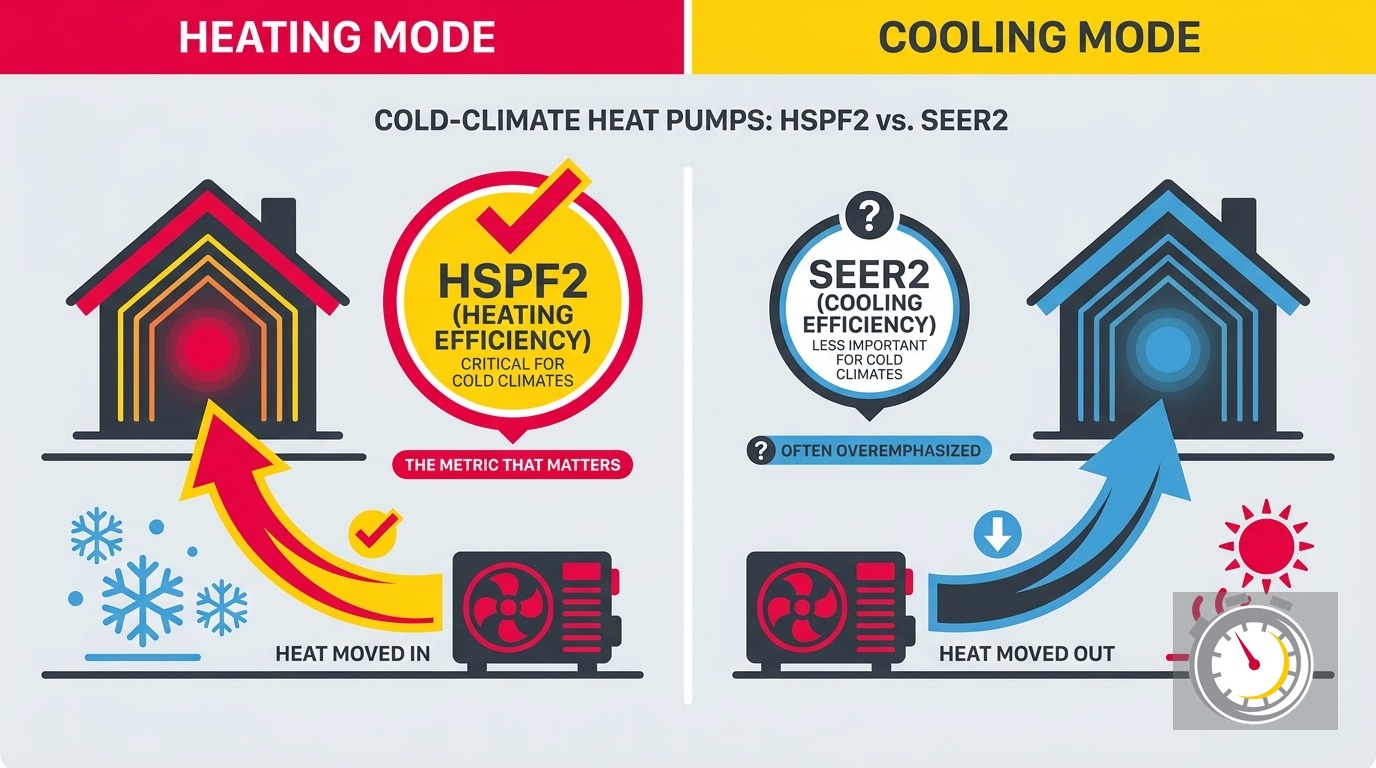
- HSPF2 measures heating efficiency. SEER2 measures cooling efficiency. Minneapolis averages roughly 8,300 heating degree days per year versus fewer than 1,000 cooling degree days. That 8-to-1 ratio makes HSPF2 the number that dominates your annual energy bill.
- The federal minimum for a new split-system heat pump is HSPF2 7.5. Xcel Energy’s cold-climate rebate tier starts at HSPF2 8.1 plus a NEEP listing.
- A 10 HSPF quote from 2022 converts to roughly 8.5 HSPF2 today. The test method changed, not the equipment.
- The Section 25C federal tax credit expired December 31, 2025. Xcel Energy and CenterPoint utility rebates are active in 2026.
- Twin Cities homeowners with both Xcel electric and CenterPoint gas service can stack both utility rebates, bringing the total on a qualifying dual-fuel cold-climate system to $3,100 or more.
What Is a Heat Pump HSPF2 Rating?
HSPF2 stands for Heating Seasonal Performance Factor, Second Edition. It measures how efficiently a heat pump heats your home over an entire season. Specifically, it tells you how many BTUs of heat the system delivers for every watt-hour of electricity consumed. A system with HSPF2 8.5 delivers 8.5 BTUs per watt-hour of input. A higher number means lower operating costs in heating mode.
The “2” tells you which test method applies. The DOE updated its test procedure under Appendix M1, effective January 1, 2023. The old method tested ductwork at 0.1 inches water column of static pressure. The new method tests at 0.5 inches water column - five times higher, and much closer to the resistance a heat pump actually encounters inside a real home’s duct system. That change made the measurement more honest. It also caused HSPF2 numbers to land roughly 15% lower than the equivalent HSPF for the same equipment.
The practical conversion: multiply the old HSPF by 0.85 to estimate the HSPF2 equivalent. A unit that rated 10 HSPF under the old test would score roughly 8.5 HSPF2 today. Nothing about the unit changed. The ruler got more accurate.
Starting January 1, 2023, all new heat pump equipment must be rated and sold using HSPF2. Any spec sheet that still shows only an HSPF number is at least two years out of date. Before comparing systems, confirm that every quote uses HSPF2.
Why the Heat Pump HSPF2 Rating in Minnesota Matters More Than SEER2
Here is the math that most national comparison sites skip entirely.
Minneapolis-St. Paul sits in IECC Climate Zone 6A, with substantially more annual heating demand than cooling demand. The national average heating degree day count is roughly 4,500. Minneapolis runs nearly double that. The cooling side runs well below the national average.
The 8-to-1 ratio changes the calculation for every efficiency comparison you make. For every $100 you spend running the system in cooling mode over a summer, you will spend roughly $800 running it in heating mode over a winter. A 10% improvement in heating efficiency saves you about eight times as much annually as a 10% improvement in cooling efficiency. A system with strong SEER2 and weak HSPF2 will cost more to operate here than a system with modest SEER2 and strong HSPF2. The cooling season does not have enough hours to close that gap.
The ASHRAE 99% heating design temperature for Minneapolis reaches -9°F. That is the outdoor temperature the heating system must handle on the coldest 1% of hours in a year. Polar vortex events push below -20°F. This is not a mild climate where a standard heat pump runs unassisted all winter. Backup heat is a design requirement, not an optional add-on.
If two contractors hand you competing quotes and one leads with SEER2 while the other leads with HSPF2, the second contractor is thinking about your energy bill the right way.
I Have a Quote from 2022 That Shows HSPF. Does It Compare to a New HSPF2 Quote?
Quick answer: It compares, but the numbers are not on the same scale. Multiply the old HSPF by 0.85 to estimate the HSPF2 equivalent. A 2022 quote showing 10 HSPF translates to roughly 8.5 HSPF2. A newer quote at 8.5 HSPF2 may be describing equipment at the same efficiency level.
This conversion trips up a lot of buyers. Seeing 8.5 HSPF2 next to a 2022 quote showing 10 HSPF looks like a step down in efficiency. It is not necessarily that. The DOE’s Appendix M1 test update changed how the measurement is taken, not how the equipment performs in your home.
There is a second layer: equipment technology has continued to advance since 2022. Many 2026 units that rate 8.5 HSPF2 outperform 2022 units that rated 10 HSPF in real cold-weather conditions, because compressor and refrigerant technology has improved. The conversion gives you a rough baseline. A contractor who can walk you through a system’s performance curve at -10°F is giving you more useful information than a single seasonal average.
When comparing quotes, ask each contractor to confirm whether their efficiency number is HSPF or HSPF2. Any contractor active in the market since 2023 should be quoting HSPF2. If they present a number without identifying the standard, ask before you proceed.
What HSPF2 Rating Do You Need to Qualify for Minnesota Utility Rebates?
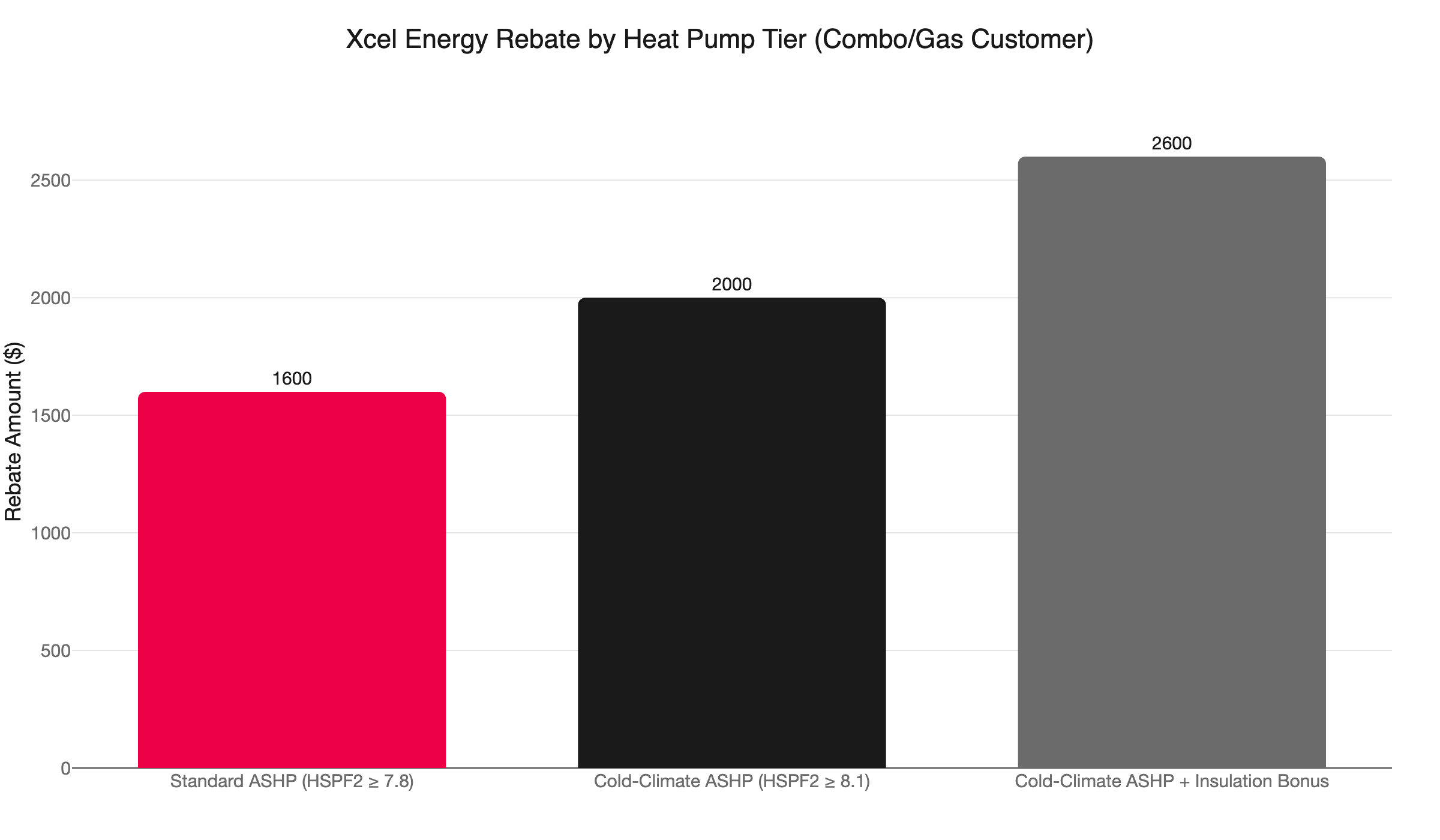
Quick answer: Xcel Energy’s standard-tier rebate starts at HSPF2 7.8. The cold-climate tier, which pays $400 more, requires HSPF2 8.1 plus a NEEP listing and a COP of at least 1.75 at 5°F. CenterPoint Energy requires HSPF2 7.8 on a qualifying dual-fuel system paired with a high-efficiency gas furnace.
Here are Xcel Energy’s current thresholds for ducted heat pumps, from the 2024-2026 Minnesota Rebate Summary:
Standard ducted ASHP (HSPF2 at or above 7.8):
- Combo/gas customer: $1,600
- Electric-only customer: $1,100
Cold-climate ducted ASHP (HSPF2 at or above 8.1, NEEP-listed, COP at or above 1.75 at 5°F):
- Combo/gas customer: $2,000
- Electric-only customer: $1,500
Standard mini-split (HSPF2 at or above 8.5):
- All customers: $1,600
Cold-climate mini-split (HSPF2 at or above 9.5, NEEP-listed, COP at or above 1.75 at 5°F):
- All customers: $2,000
A $600 bonus is available when qualifying insulation and air sealing is completed within two years of a qualifying heat pump install. That brings the Xcel cold-climate ducted ASHP rebate to $2,600 for combo/gas customers.
CenterPoint Energy’s 2026 rebate covers ducted ASHP only, and only in a dual-fuel hybrid setup paired with a 92%+ AFUE gas furnace. Mini-splits do not qualify. The rebate is $1,100 for existing homes. The switchover temperature must be programmed at 40°F or lower.
If your home has both Xcel electric service and CenterPoint gas service, which describes most of the Twin Cities metro, you can combine both rebates on a qualifying dual-fuel system. A cold-climate ducted ASHP with Xcel’s insulation bonus at $2,600 plus CenterPoint’s $1,100 totals $3,700 in utility rebates for a qualifying installation.
Why NEEP Is the Gatekeeper for Cold-Climate Rebates
A brand’s “cold climate” marketing label does not automatically qualify a unit for Xcel’s higher rebate tier. The equipment must appear on the NEEP Cold Climate ASHP Product List at ashp.neep.org. That registry is what Xcel uses to determine cold-climate eligibility.
NEEP’s minimum thresholds for ducted systems: HSPF2 at or above 7.7, SEER2 at or above 14.3, and a COP greater than 1.75 at 5°F. That COP-at-5°F requirement is the cold-climate spec that matters most for Minnesota. It confirms the unit can move meaningful heat when outdoor temperatures fall to single digits, not just at mild test conditions.
One practical note: In April 2026, NEEP transitioned its list to pull directly from AHRI data. Some eligible products temporarily dropped off during that transition. Before your contractor submits a rebate application, verify the unit appears on the NEEP list yourself at ashp.neep.org. A unit missing from the registry will not qualify for the cold-climate tier, regardless of what the spec sheet says.
Energy Star’s cold-climate certification is a separate designation with slightly different thresholds: HSPF2 8.1 or higher for ducted cold-climate systems. A unit can carry the Energy Star label without appearing on the NEEP list, and vice versa. For Xcel’s cold-climate rebate application, the NEEP listing is the requirement, not Energy Star certification.
What Happened to the Section 25C Federal Tax Credit?
Quick answer: It is gone for new installations in 2026. Public Law 119-21, signed July 4, 2025, terminated the Section 25C credit for systems placed in service after December 31, 2025. If you installed a qualifying heat pump before January 1, 2026, you can still claim it on your 2025 return using IRS Form 5695.
Most HVAC content online still references 25C as active. It is not. The credit had offered 30% of installed cost up to $2,000 for heat pumps meeting HSPF2 9.0 or higher. That option is no longer on the table for 2026 installations.
What is still available:
- Xcel Energy and CenterPoint rebates: Active and described above. These are the primary incentives available to most Twin Cities homeowners in 2026.
- Section 25D: The geothermal heat pump credit remains at 30% with no cap through December 31, 2032. A ground-source heat pump installation still qualifies.
- HEAR rebates: The Home Efficiency and Electrification Rebates program can provide up to $8,000 for heat pump installation for income-qualifying Minnesota households. HEAR was not affected by the 25C expiration.
The loss of 25C shifts the incentive math. A household that would have combined a $2,000 federal credit with $2,000 from Xcel now works from utility rebates alone. That still leaves meaningful money on the table. Ask our team about current financing options for the remainder when you call.
For the full current rebate picture, see /blog/minnesota-heat-pump-rebates-tax-credits/.
What HSPF2 Rating Should You Look for When Shopping in Minnesota?
Quick answer: For most Twin Cities homes, target HSPF2 8.1 or higher on a NEEP-listed unit. That clears Xcel’s cold-climate rebate threshold, meets Energy Star cold-climate requirements, and reflects tested cold-weather performance. If you are replacing your gas furnace entirely and going all-electric, look at units with HSPF2 10 or higher.
The tiers in practice:
HSPF2 7.5 to 7.7 - Federal minimum. Meets the DOE floor. Qualifies for no Xcel rebate. Acceptable in a mild-climate region. Not a recommendation for Minneapolis winters.
HSPF2 7.8 - Energy Star standard. Qualifies for Xcel’s standard-tier rebate ($1,600 for combo/gas customers). A reasonable baseline if upfront cost is the primary constraint.
HSPF2 8.1 or higher, NEEP-listed - Cold-climate tier. Qualifies for Xcel’s $2,000 rebate, or $2,600 with the insulation bonus. This is the target for most Twin Cities homeowners. The NEEP listing confirms the unit was tested for cold-weather COP, not just rated at a mild outdoor temperature.
HSPF2 10 or higher - Premium cold-climate. Higher upfront cost, meaningfully lower operating cost over a Minnesota heating season. Worth the conversation when you are also upgrading ductwork or eliminating gas service entirely.
One important calibration: HSPF2 is a seasonal average across a range of outdoor temperatures. The unit’s efficiency will drop as outdoor temperature falls toward -10°F and below. That is expected and normal. The correct Minnesota setup pairs a cold-climate heat pump with a gas furnace or electric backup that carries the load when temperatures drop below the heat pump’s balance point. Read more on how heat pump balance points work in Minnesota.
How the Dual-Fuel Setup Fits Into This
The dual-fuel approach pairs a heat pump with a gas furnace. The heat pump handles the bulk of the heating season, and the gas furnace takes over when outdoor temperatures fall below the programmed switchover point. It is the most common heat pump path for existing Twin Cities homes with gas service, and it is the setup CenterPoint rebates.
In a dual-fuel system, the heat pump’s HSPF2 rating describes efficiency during the hours it runs. The gas furnace covers the coldest hours, which means the heat pump is not sized to handle every possible Minnesota extreme. That expands your equipment options and keeps system cost more manageable than a single cold-climate unit spec’d for -20°F operation.
The switchover temperature matters for CenterPoint’s rebate. Their application requires the thermostat set to switch to gas at 40°F or lower. A good contractor will run a Manual J load calculation, size the heat pump for your home, and set the balance point based on local fuel costs and the equipment’s performance curve at different outdoor temperatures. A bid that skips the load calculation is not a complete bid.
What Does a Cold-Climate Heat Pump Cost to Install in Minnesota?
In the Twin Cities market today, a mid-tier cold-climate ducted heat pump system - parts and labor installed - runs $7,500 to $10,400. High-efficiency cold-climate units at 18 SEER2 and above land between $11,000 and $15,600 installed.
A dual-fuel setup adds furnace cost if the existing unit is also being replaced. A 95-96% AFUE gas furnace starts at $6,500 installed. After a qualifying Xcel cold-climate rebate of $2,000 to $2,600 and a CenterPoint dual-fuel rebate of $1,100, the net out-of-pocket on a qualifying combined system drops significantly. We offer financing for the balance. Ask our team about current terms when you call.
For a full breakdown of heat pump installation pricing in the Twin Cities, see /blog/heat-pump-installation-cost-minnesota/.
Ready to Compare Heat Pump Options?
Shopping heat pumps in Minnesota without understanding HSPF2 is like evaluating a furnace without knowing its AFUE rating. The number tells you what the system will cost to run over a full heating season. In a climate where heating degree days outnumber cooling degree days eight to one, that is the most important number on any spec sheet.
Northern One Hour Heating & Air Conditioning is locally owned and operated out of Ramsey, serving Minneapolis, St. Paul, Blaine, Maple Grove, Plymouth, Brooklyn Park, Woodbury, Bloomington, and the surrounding metro. We know what equipment performs here. We know the Xcel and CenterPoint rebate thresholds. And we back every appointment with our on-time promise: “Always On Time… Or You Don’t Pay a Dime!(R)”
Call us at (763) 260-6662 or book online to schedule a heat pump assessment. We will run the numbers on your home, identify the HSPF2 tier that fits your goals and budget, and handle the rebate paperwork on your behalf.
Frequently Asked Questions
What is a good HSPF2 rating for a heat pump in Minnesota? +
How do I convert HSPF to HSPF2? +
Is the federal heat pump tax credit still available in 2026? +
What is the NEEP list and why does it matter for Minnesota heat pump rebates? +
Need a technician now?