
Heat Pump Installation Cost in Minnesota: 2026 Real Ranges
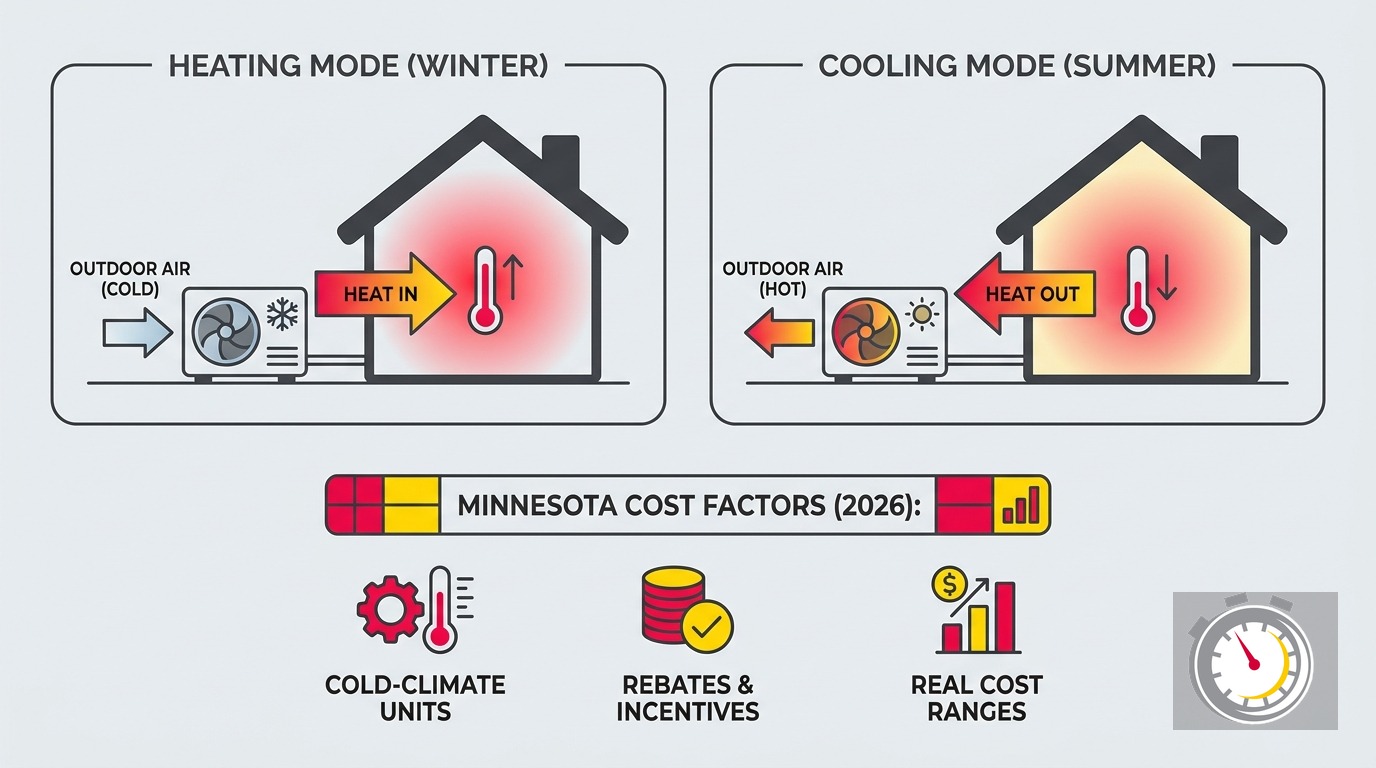
Key Takeaways
- Heat pump installation cost in Minnesota runs $10,200 to $21,000 installed for most ducted systems in 2026, depending on home size and system tier.
- A cold-climate-rated system (NEEP ccASHP list, COP at least 1.75 at 5°F) is required to heat reliably past the single digits and to qualify for Xcel’s top $2,000 rebate.
- Federal Section 25C tax credits expired December 31, 2025. There is no federal credit for heat pumps installed in 2026.
- Xcel Energy offers up to $2,000 for a qualifying cold-climate ducted system through December 2026. Applications are accepted through September 30, 2027.
- CenterPoint’s $1,100 rebate applies only to dual-fuel setups (heat pump paired with a gas furnace at 92% AFUE or higher). Mini-splits and full-electric conversions do not qualify.
- Minneapolis homeowners can layer in the Green Cost Share on top: up to $5,000 in non-Green Zones, up to $14,000 to $20,000 in Green Zones.
- Save Energy Minnesota, the IRA-funded state rebate program, has not launched. The Minnesota Department of Commerce has not announced a launch date as of October 2026.
- Contractor quotes vary 20-30% in the Twin Cities for the same job. Get at least two bids.
What Does Heat Pump Installation Cost in Minnesota in 2026?
The short answer: A ducted cold-climate system for a typical Twin Cities home costs $10,200 to $19,500 installed, with the midpoint around $14,500 before any rebates. Premium 3.5-ton systems in larger homes run $18,000 to $21,000.
According to heatpumppricing.com’s Minneapolis cost guide, a 3-ton ducted install in Minneapolis averages around $14,500 before incentives. That covers most single-family homes in Ramsey, Blaine, Maple Grove, Plymouth, Brooklyn Park, and the surrounding suburbs. Quotes for the same job vary 20-30% between contractors, which makes getting multiple estimates worth the time.
Premium sizing pushes costs higher. homeenergybasics.com’s Minnesota guide puts a 3.5-ton Mitsubishi Hyper-Heat replacement in a 2,400-square-foot home at $18,000 to $21,000 installed. Expect the upper end of any range if your home is larger, has complex ductwork, or requires an electrical panel upgrade alongside the heat pump.
Two Configurations, Two Cost Ranges
There are two main ways to set up a ducted heat pump for a Twin Cities home:
Full replacement: The heat pump replaces both the furnace and the central AC. This requires a cold-climate-rated unit capable of operating below 0°F. Higher upfront cost, but you are buying one system instead of two.
Dual-fuel (hybrid): The heat pump handles most of your heating and all of your cooling. A gas furnace takes over below a set balance point. Installed cost typically runs $6,500 to $16,000 in Minnesota, lower because you keep the existing furnace.
For homes without existing ductwork, ductless mini-split systems are a different conversation with a different cost structure. Our ductless vs. ducted heat pump guide covers how those options compare for a Minnesota home.
What Goes Into That Installed Price?
The short answer: Equipment, labor, ductwork modifications, electrical work, and permits are all separate line items. Labor and electrical are the ones most likely to vary between quotes and surprise homeowners comparing bids.
heatpumppricing.com breaks down a typical Minneapolis install into these categories:
- Equipment: $4,590 to $8,190
- Labor: approximately $98/hour over 16 to 28 hours, depending on complexity
- Ductwork modifications: $800 to $2,400 if your existing system needs changes
- Electrical work: $400 to $1,800 for a new circuit or panel upgrade
- Mechanical permit: $295 to $375
That permit is not optional. Minnesota requires a mechanical permit for every heat pump installation. The contractor must be licensed and bonded at $25,000 or more under Minnesota DLI rules. If a contractor suggests skipping the permit to save money, that is a serious red flag.
Proper equipment sizing matters too. A legitimate installer will run a Manual J load calculation before selecting a unit. Oversizing wastes money upfront and causes short cycling that reduces comfort and shortens equipment life. Undersizing means you will be cold on the days that matter most.
What Makes a Heat Pump “Cold-Climate Rated”?
The short answer: A cold-climate air-source heat pump (ccASHP) must appear on the NEEP list at ashp.neep.org, deliver a COP of at least 1.75 at 5°F, and maintain at least 70% of its rated heating capacity at 5°F compared to its 47°F output. Standard heat pumps do not meet those specs.
This is not a marketing category. It is a specific performance threshold that matters because of Minnesota’s climate. The bulk of your heating load arrives when temperatures are below 20°F outside. A standard heat pump loses capacity quickly below that point and may stop working entirely near 0°F. A cold-climate unit is rated to operate down to -13°F without supplemental electric resistance heat, according to the DOE Cold Climate Heat Pump Challenge. Advanced cold-climate models can deliver up to 70% energy savings compared to electric resistance heating.
To qualify for Xcel’s top $2,000 rebate, the unit must meet all four specs: SEER2 at least 15.2, EER2 at least 10.0, HSPF2 at least 8.1, and COP at least 1.75 at 5°F. Ask for the AHRI certificate number before you accept any quote. The rebate application requires that documentation, and a contractor who cannot produce it before installation may cost you the rebate afterward.
One practical note: NEEP transitioned its product database to pull directly from AHRI data starting April 1, 2026. Some eligible units temporarily dropped from the list during that transition. If a unit you are considering does not appear on ashp.neep.org today, ask your contractor to confirm AHRI certification directly rather than assuming the unit is disqualified.
For brand-specific performance data in Minnesota winters, see our cold-climate heat pump brand performance guide.
Will Your Existing Ductwork Work with a Heat Pump?
The short answer: In many cases, yes. Heat pumps move a higher volume of air at a lower temperature than a furnace, so undersized or leaky ductwork becomes a bigger problem. An honest contractor will assess your duct system before quoting and include any needed modifications in the price.
Older homes in the Twin Cities often have ductwork designed around a high-temperature furnace and sized decades ago when insulation standards were lower. A heat pump can expose static pressure problems, leaks, and undersized runs that the old system papered over with brute heat output. If your ductwork needs work, expect $800 to $2,400 in modifications as part of the installed price.
This is one reason the cost range for heat pump installation is wide. Two homes on the same block can be quoted very differently if one has newer ductwork and the other needs significant modification. Ask any contractor to include ductwork assessment in their site visit, not a phone estimate.
Are Federal Tax Credits Still Available in 2026?
The short answer: No. Section 25C (heat pumps) and Section 25D (geothermal) both expired December 31, 2025. Installs completed in 2026 receive no federal credit.
This is the most consequential piece of outdated information still circulating. Many articles currently ranking on this topic were written when the credits were active and have not been updated. homeenergybasics.com’s Minnesota heat pump guide confirms both credits expired at year-end 2025.
If a contractor or website is still advertising a 30% federal credit for your 2026 install, ask them to show you current IRS guidance. State and utility rebates are now the only incentive stack available, which makes understanding exactly what those programs cover more important than ever.
What Rebates Can I Stack on a Minnesota Heat Pump in 2026?
The short answer: Xcel Energy offers $1,500 to $2,000 for qualifying systems installed by December 2026. Minneapolis homeowners can add the Green Cost Share for up to $14,000 to $20,000 more. CenterPoint’s $1,100 applies to dual-fuel setups only.
Xcel Energy
Xcel’s rebate program runs through December 31, 2026, with applications accepted through September 30, 2027. Amounts depend on system type and whether your home uses gas for heating:
| System Type | Combo/Gas Customer | Electric-Only Customer |
|---|---|---|
| Cold-climate ducted ASHP | $2,000 | $1,500 |
| Standard ducted ASHP | $1,600 | $1,100 |
| Cold-climate mini-split | $2,000 | - |
| Standard mini-split | $1,600 | - |
Xcel also offers a +$600 bonus when insulation and air-sealing work is completed at the same time as the heat pump install. If your home is older and poorly sealed, that bonus is worth pursuing alongside the HVAC upgrade.
CenterPoint Energy
CenterPoint’s $1,100 rebate has one hard constraint: the system must be a dual-fuel configuration with a gas furnace rated at 92% AFUE or higher. CenterPoint does not rebate mini-splits, ground-source systems, or full-electric conversions that remove the gas furnace.
If you are keeping your gas furnace as backup heat, a dual-fuel setup lets you stack Xcel and CenterPoint rebates together. Our dual-fuel heat pump guide covers how the balance point is set for Minnesota winters and when the gas furnace takes over the heating load.
Minneapolis Green Cost Share
For Minneapolis homeowners, this program represents the largest potential incentive in the stack. Administered by the Center for Energy and Environment (CEE), it applies on top of utility rebates:
- Non-Green Zone residential: up to $5,000
- Green Zone residential: up to $14,000 to $20,000
Source: mncee.org/MPLS-GCS
The program is first-come, first-served until funds are depleted. The 2026 application rounds listed deadlines in February and April. Check the City of Minneapolis program page for current availability before building this into your budget.
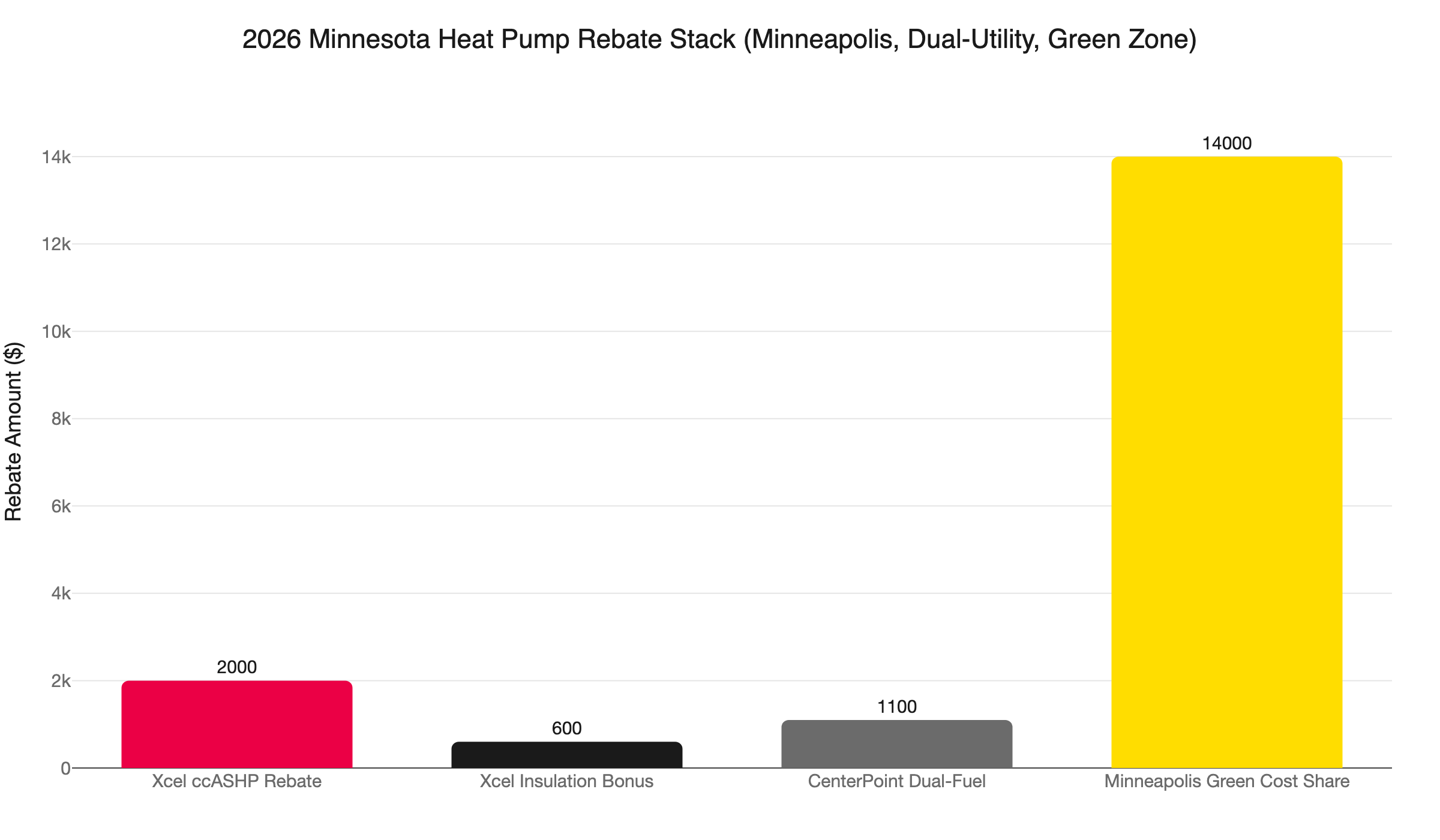
For a Green Zone homeowner doing a dual-fuel system, the maximum stack in 2026 looks like this:
- Xcel ccASHP rebate: $2,000
- Xcel insulation bonus: $600
- CenterPoint dual-fuel rebate: $1,100
- Minneapolis Green Cost Share (Green Zone): up to $14,000
- Total: up to $17,700
On a typical $14,500 install, that scenario can bring net cost close to zero. Not every homeowner qualifies for every tier, and funding availability is not guaranteed. But mapping the full stack before you choose a system type can change your decision.
Save Energy Minnesota: Not Yet Open
Save Energy Minnesota is the IRA-funded state program designed to provide up to $8,000 for households below 80% of area median income. As of October 2026, the program has not launched, and the Minnesota Department of Commerce has not announced a launch date. Do not count on it for your 2026 project.
For step-by-step guidance on applying for each program, see our Minnesota heat pump rebates guide.
Does a Heat Pump Make Financial Sense for a Twin Cities Home?
The short answer: The operating-cost case is tighter in Minnesota than in warmer states. The strongest argument is when you are replacing both a furnace and aging AC, when your current equipment is low-efficiency, or when the rebate stack meaningfully reduces your first-year cost.
A few factors that shape the math:
You may be replacing two systems, not one. If your furnace and central AC are both near end of life, a heat pump replaces both. Compare the total cost of two separate replacements against the heat pump. The gap narrows.
Your current efficiency baseline matters. A heat pump replacing an 80% AFUE furnace has more room to improve on heating costs than one replacing a 96% AFUE unit. At current Minnesota gas and electricity rates, a high-efficiency gas furnace is typically cheaper to operate for heating alone, but the heat pump covers cooling too.
Rebates shift the payback calculation in year one. A $2,600 utility rebate stack on a $14,500 install is an 18% reduction before you consider operating costs at all.
Dual-fuel setups reduce the risk in extreme cold. Setting the balance point so the gas furnace handles the coldest days means the heat pump operates in its most efficient range for most of the heating season. You get heat pump efficiency during the moderate weeks and reliable gas heat when it drops below zero.
What to Ask Before You Sign a Heat Pump Quote
These questions matter before you commit:
- Is this unit on the NEEP ccASHP list? Ask for the AHRI certificate number. If they cannot provide it, the Xcel $2,000 rebate is at risk.
- Will you run a Manual J load calculation? Proper sizing prevents short cycling and comfort problems.
- Who pulls the permit? The contractor pulls the mechanical permit under their license. You should never be told to pull it yourself.
- Are you licensed and bonded at $25,000 or more in Minnesota? This is a state requirement for HVAC work.
- What electrical work is included? Heat pumps often need a dedicated 240V circuit. If your panel needs upgrading, that cost belongs in the quote before you compare bids.
Getting two estimates for the same job typically takes a few days and can save $1,500 to $3,000 on a project of this size.
Ready to Get an Estimate?
Northern One Hour Heating & Air Conditioning is locally owned and operated in Ramsey, MN. Our team serves Minneapolis, St. Paul, Blaine, Maple Grove, Plymouth, Brooklyn Park, Woodbury, Bloomington, and the surrounding Twin Cities area. We install heat pumps including cold-climate-rated systems and dual-fuel setups configured for Minnesota winters, and we handle the rebate documentation for Xcel and CenterPoint as part of the process.
We show up when we say we will. That is the promise behind “Always On Time… Or You Don’t Pay a Dime!(R)” - backed by a 100% satisfaction guarantee and upfront pricing before any work starts. Financing is available for qualifying heat pump installations.
Call (763) 260-6662 or book your heat pump estimate online.
Frequently Asked Questions
What does heat pump installation cost in Minnesota in 2026? +
Are federal tax credits still available for heat pumps in 2026? +
What rebates can I stack on a Minnesota heat pump install in 2026? +
Does a heat pump work reliably in Minnesota winters? +
Need a technician now?