
When to Replace AC: Cost Savings Math for Minnesota
Key Takeaways
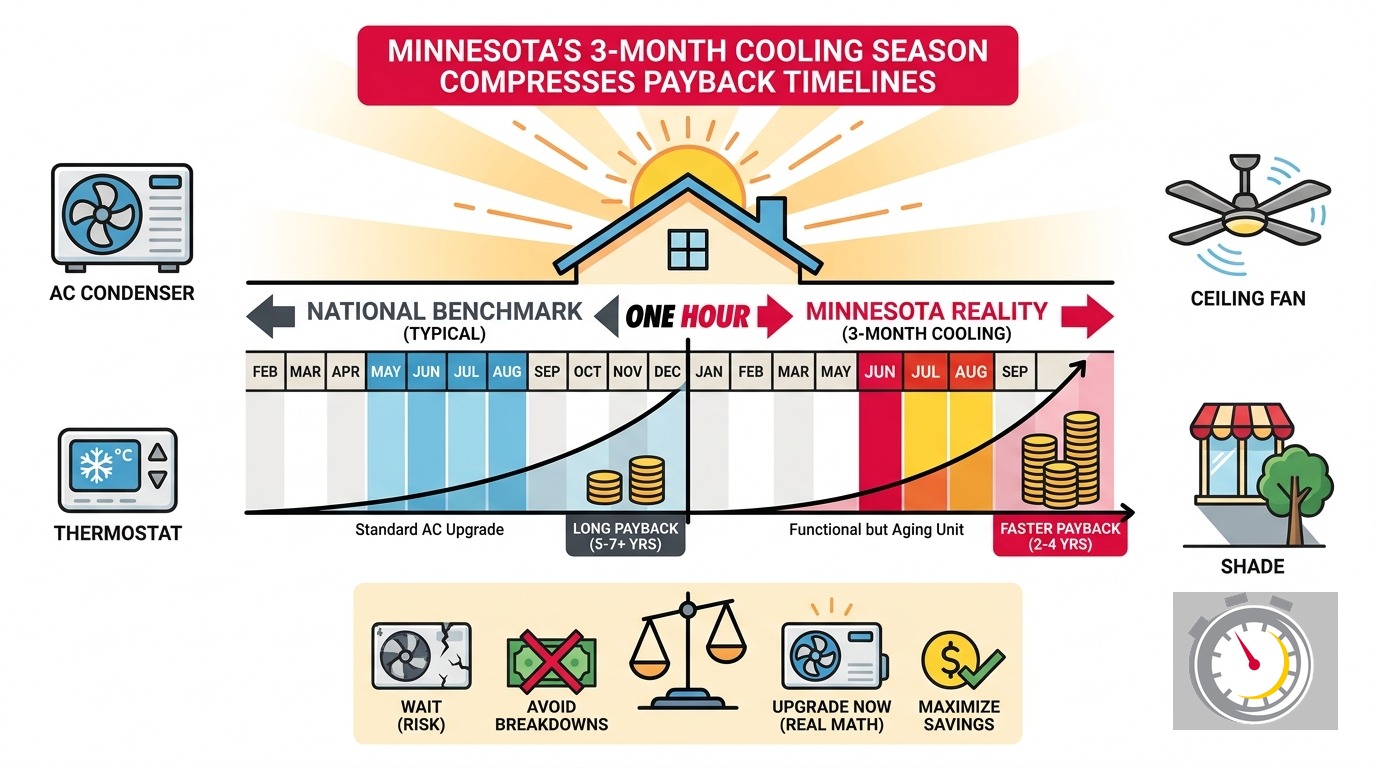
- Minnesota AC units run roughly 1,000 hours per cooling season, about one-third the runtime of a unit in Arizona or Texas.
- National payback calculators assume your aging unit still operates at its original nameplate SEER. Most units older than 10 years do not.
- A unit degraded to 8-10 effective SEER makes a new 16 SEER2 system 40-50% more efficient, not 20%. That gap matters more than the season length.
- Annual repair costs on aging systems accelerate. At $600-$800 per year in repair spend, the real payback window on replacement drops to 7-10 years, even in Minnesota’s short cooling season.
- R-22 refrigerant on pre-2010 units changes the repair economics entirely. That refrigerant is no longer produced.
- Xcel Energy offers $150-$300 for qualifying high-efficiency central AC in 2026. The federal 25C tax credit expired December 31, 2025.
- Installed replacement cost in Minnesota: $7,500-$10,400 for a standard 16 SEER2 system.
Why National Payback Math Misleads Minnesota Homeowners
Minneapolis averages approximately 700-800 cooling degree days per year, compared to roughly 2,700 in Houston and 4,000-plus in Phoenix. A Twin Cities central AC runs approximately 1,000 hours per cooling season versus 3,000 hours per year in Arizona. That runtime difference is real, and it does compress raw efficiency savings.
The problem with national payback calculators: they apply full-year efficiency numbers to Minnesota’s shorter season, and they assume the aging unit still runs at nameplate efficiency. Upgrade from a 10 SEER unit to a 16 SEER2 unit, run it 1,000 hours at Minnesota’s residential electricity rate of roughly $0.15/kWh, and you save about $150-$200 per summer. At $7,500-$8,500 installed, payback from efficiency alone stretches to 37-57 years. That number discourages a lot of homeowners from a replacement that actually makes sense.
But there is a buried assumption in that calculation. It assumes your old unit is still performing at its original nameplate SEER rating. In most cases, after 10 or more years, it is not.
That single assumption is where national guidance falls apart. It is also where Minnesota homeowners end up keeping aging systems years longer than the math actually supports.
What Is Your Old Unit Actually Running At?
A unit rated 13 SEER when new is likely running at 10-11 effective SEER today, after more than a decade of Minnesota winters. Coil pitting, motor wear, and refrigerant micro-leaks degrade real operating efficiency over time. A 13 SEER unit installed in 2010 is not still running at 13 SEER. In practice, it is closer to 10-11 effective SEER. A unit rated 10 SEER from the mid-2000s may be running at 8-9 effective SEER.
That gap reshapes the payback calculation completely.
Compare a new 16 SEER2 unit to a system running at 8-9 effective SEER. The efficiency difference is 40-50%, not 20%. On a 3-ton unit running 1,000 hours at $0.15/kWh, annual energy savings from replacing a degraded unit jump to $280-$330 per summer, not $150-$200.
One more point of context: the 2023 federal minimum for new central AC in the North Central region is 13.4 SEER2, equivalent to roughly 14.5 old-SEER. A unit installed at 10 SEER in 2005 that is now running at 8-9 effective SEER is operating 30-40% below today’s code minimum. That is not “a little less efficient.” That is a meaningful performance deficit, and it changes the payback math accordingly.
The Payback Calculation No One Is Publishing
This is the breakdown that does not appear in the top search results for “when to replace AC cost savings Minnesota.”
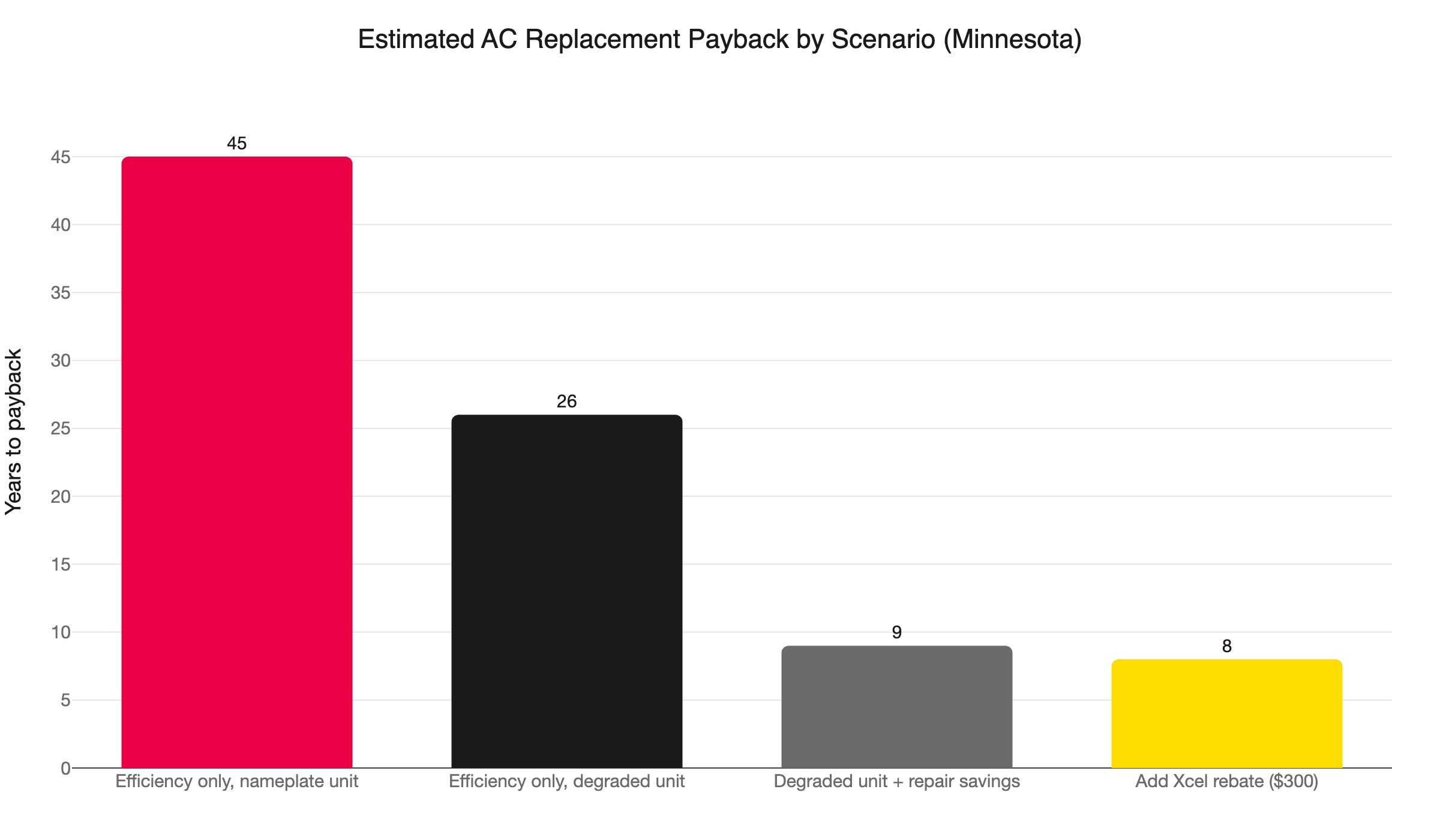
Scenario 1: New unit versus a nameplate-perfect aging unit. Annual energy savings: $150-$200 per summer. On an $8,000 installed system, payback from efficiency alone: roughly 45 years. This is the number that convinces homeowners that Minnesota’s short season makes replacement economically pointless. It only applies to a unit still performing at its original nameplate efficiency, which is unlikely after 12-plus years.
Scenario 2: New unit versus a degraded aging unit at 8-10 effective SEER. Annual energy savings: $280-$330 per summer. Payback narrows to roughly 26 years. The direction has changed significantly.
Scenario 3: Add accelerating repair costs. A 12-15 year old system does not have flat annual repair costs. It has accelerating ones. A capacitor this year ($195-$500). A condenser fan motor next summer ($375-$900). A compressor in the next few years ($1,950-$4,500 for the compressor alone, often a replacement-trigger event on its own). Average those at $600-$800 per year conservatively, which is not aggressive for a system in the second half of its service life. The annual benefit of replacing the system becomes energy savings plus repair avoidance: $880-$1,130 per year combined. On an $8,000 installed system, payback drops to 7-9 years.
Scenario 4: Add the Xcel rebate. Xcel Energy’s $300 rebate on an 18+ SEER2 system comes off year-one cost. With energy savings, repair avoidance, and the rebate applied, the realistic payback window for replacing a functional but aging Minnesota AC lands at 7-9 years.
That is the number the short-season framing has been obscuring. The payback on AC replacement in Minnesota is not 30 years. It is 7-10 years when you account for the full picture.
Does the $5,000 Rule Apply to Minnesota?
Yes. It is the fastest filter to run before you approve any repair quote.
Multiply your unit’s age in years by the repair estimate in dollars. If the result exceeds $5,000, replacement is the financially sound choice. A 15-year-old unit with a $400 repair quote: 15 times 400 equals $6,000. Replace. A 10-year-old unit with a $300 repair quote: 10 times 300 equals $3,000. Repair for now.
Use the 50% Rule as a second filter: if a single repair costs more than half the price of a full replacement, stop repairing. On a $7,500 installed system, that threshold is $3,750. A compressor replacement at $1,950-$4,500 sits right at that line. And a compressor failing on a 12-year-old system is rarely an isolated event. It typically signals a unit entering its failure phase, not a one-time fix.
Both rules are quick filters. If a repair quote passes both, it is usually worth proceeding. If either one fires, call us before you approve the repair. Our team will give you a straight read on whether the economics point toward repair or replacement.
What About R-22 Refrigerant?
If your unit was manufactured before 2010, the repair economics may already be settled.
Pre-2010 units almost certainly use R-22 refrigerant. R-22 is no longer manufactured under EPA phaseout rules. R-22 recharge costs have risen sharply due to limited supply from reclaimed and recycled sources. A refrigerant leak on a pre-2010 system is not a repair. It is a delay. Without fixing the underlying leak, the refrigerant exits again at the same rate. And fixing the underlying leak on an aging system can cost nearly as much as the recharge.
R-22 exposure changes the economics of keeping a system entirely. Even a successful repair leaves you on a refrigerant that is increasingly scarce and expensive every season. If our technicians find a refrigerant leak on a pre-2010 system, replacement is almost always the correct answer, independent of the $5,000 Rule or any other calculation. The math on patching an R-22 system rarely adds up.
Is Short Cycling Always a Replacement Signal?
On units older than 12 years, it is almost always a replacement signal.
Normal AC cycles run 12-20 minutes. Short cycling under 7 minutes burns compressor life faster than normal operation, regardless of season length. Each startup draws a large current surge. A compressor that is starting every four or five minutes degrades faster than one running long, efficient cycles.
Short cycling on a unit under five years old usually points to a sizing problem or a refrigerant issue. Both are worth diagnosing and repairing. Short cycling on a unit 12 years or older is a different story. By the time it is chronic and obvious to the homeowner, the compressor is typically already stressed.
Our guide to AC short cycling causes and fixes in the Twin Cities walks through the diagnostic steps. When our team identifies compressor-related short cycling on an older system, replacement is usually the more economical path — and the more reliable one for getting through a Minnesota summer without an emergency call.
Minnesota’s Unique Wear Pattern
Twin Cities AC units do not just run less than units in warmer climates. They age differently.
Minnesota AC systems sit dormant approximately 8 months per year. That dormancy is not neutral. Rubber seals dry and crack over long Minnesota winters. Rodents nest in outdoor cabinets during the off-season. Refrigerant lines cycle from -20 degrees Fahrenheit in January to 95 degrees in July — a 115-degree thermal range that fatigues materials in ways that steady Southern heat does not. That stress pattern is different from year-round use, not simply less of it.
The practical result: a 15-year-old Minnesota AC has often experienced as much material stress as a 10-year-old unit in a warm climate. National age-based guidelines and payback benchmarks understate this pattern. When a Southern HVAC resource says “a well-maintained AC should last 15-20 years,” that guidance often does not fully account for what Minnesota winters do to components sitting idle for eight months at a time.
There is also a cost that payback calculators never capture: the reliability premium. One emergency service call in July costs $400-$900 in parts and labor. An after-hours or weekend call adds $180-$270 per hour on top of standard rates. Miss one week of functional cooling during the six weeks per year you rely on your AC, and you have erased two to three years of marginal efficiency savings. An aging unit that holds on through May can still strand you in August, and that failure always arrives on the worst possible day.
What Does AC Replacement Cost in Minnesota in 2026?
Installed replacement costs in the Twin Cities for 2026:
- Standard central AC (14-16 SEER2): $7,500-$10,400 installed
- High-efficiency central AC (18+ SEER2): $11,000-$15,600 installed
- Heat pump system: $12,000-$19,000 installed
The range within each tier depends on home size, duct condition, the refrigerant type in the existing system, and equipment brand. Our full guide to AC replacement costs in Minnesota covers what drives those variables and what to expect on installation day.
Financing is available for larger jobs. Ask our team when you call and we will walk you through current options. For homeowners also considering a furnace replacement in the same season, bundling both units in one installation often reduces total labor cost.
What Rebates Are Available for AC Replacement in 2026?
Xcel Energy offers $150-$300 for qualifying central AC. The federal 25C tax credit expired December 31, 2025 and is not available for 2026 installations.
Xcel Energy’s 2026 rebate program covers the following for cooling equipment:
- Central AC, 16+ SEER2: $150 rebate
- Central AC, 18+ SEER2: $300 rebate
- Cold-climate heat pump: $400-$800, based on capacity and HSPF2 rating
- ENERGY STAR smart thermostat: $50
Rebates require a participating contractor and an AHRI certificate. Submit within 60 days of installation. These are funded through Minnesota’s Conservation Improvement Program, which is state-mandated and does not depend on federal budget cycles. That makes the Xcel rebate a reliable, bankable year-one savings, not a politically contingent one.
On the federal side: the Section 25C Energy Efficient Home Improvement Credit (30% of cost, up to $600 for central AC) was terminated by the One Big Beautiful Bill Act, signed July 4, 2025. No federal credit is available for AC equipment placed in service in 2026. If a contractor mentions a federal tax credit for a 2026 installation, ask them to show you the current IRS guidance.
Our Minnesota HVAC rebate guide keeps the current figures up to date as program rules change between seasons.
When Does Replacing Your AC Actually Make Financial Sense?
Here is a practical framework that pulls together everything above.
Replace now if any of these are true:
- Your unit uses R-22 refrigerant (manufactured before 2010)
- Your unit is over 15 years old and facing any repair over $500
- The $5,000 Rule fires: age in years times the repair estimate exceeds $5,000
- A single repair quote exceeds 50% of installed replacement cost
- You are seeing chronic short cycling on a unit older than 12 years
- You have had two or more repair calls in the past 18 months
Consider replacement if:
- Your unit is 10-14 years old and repairs are becoming annual events
- You are on R-410A but seeing longer run times, higher cooling bills, or reduced comfort, all signs of efficiency degradation
- You want to replace before the next cooling season; spring installs avoid the peak July scheduling pressure
Hold and maintain if:
- Your unit is under 10 years old, passing annual tune-ups without repairs
- A repair quote passes both the $5,000 Rule and the 50% Rule
- The system is cooling reliably and running full cycles without short cycling
The short cooling season is real. But it does not change the math the way most homeowners expect. When you account for how much an aging Minnesota unit has actually degraded, how repair costs accelerate in the second half of a system’s life, and how the Xcel rebate front-loads the payback curve, replacing a functional but aging AC often pays off in 7-10 years. Not 30.
We are locally owned and operated in Ramsey, serving Minneapolis, St. Paul, and the Twin Cities metro. Our team gives you an honest read on your system, not a sales pitch. We back every visit with our promise: “Always On Time… Or You Don’t Pay a Dime!(R)”
Ready to know where your system stands? Call us at (763) 260-6662 or schedule a visit online. We will tell you straight whether your system is worth repairing, worth replacing now, or worth watching for another season.
Frequently Asked Questions
How long does AC replacement take to pay off in Minnesota? +
What is the $5,000 Rule for deciding to replace an AC? +
Are there rebates for new AC in Minnesota in 2026? +
What does a new central AC cost installed in Minnesota in 2026? +
Need a technician now?