
AC Short Cycling Twin Cities: Causes, Diagnosis, and Fixes
Key Takeaways
- AC short cycling means run cycles of 2-5 minutes or less. Normal is 15-20 minutes during typical summer weather.
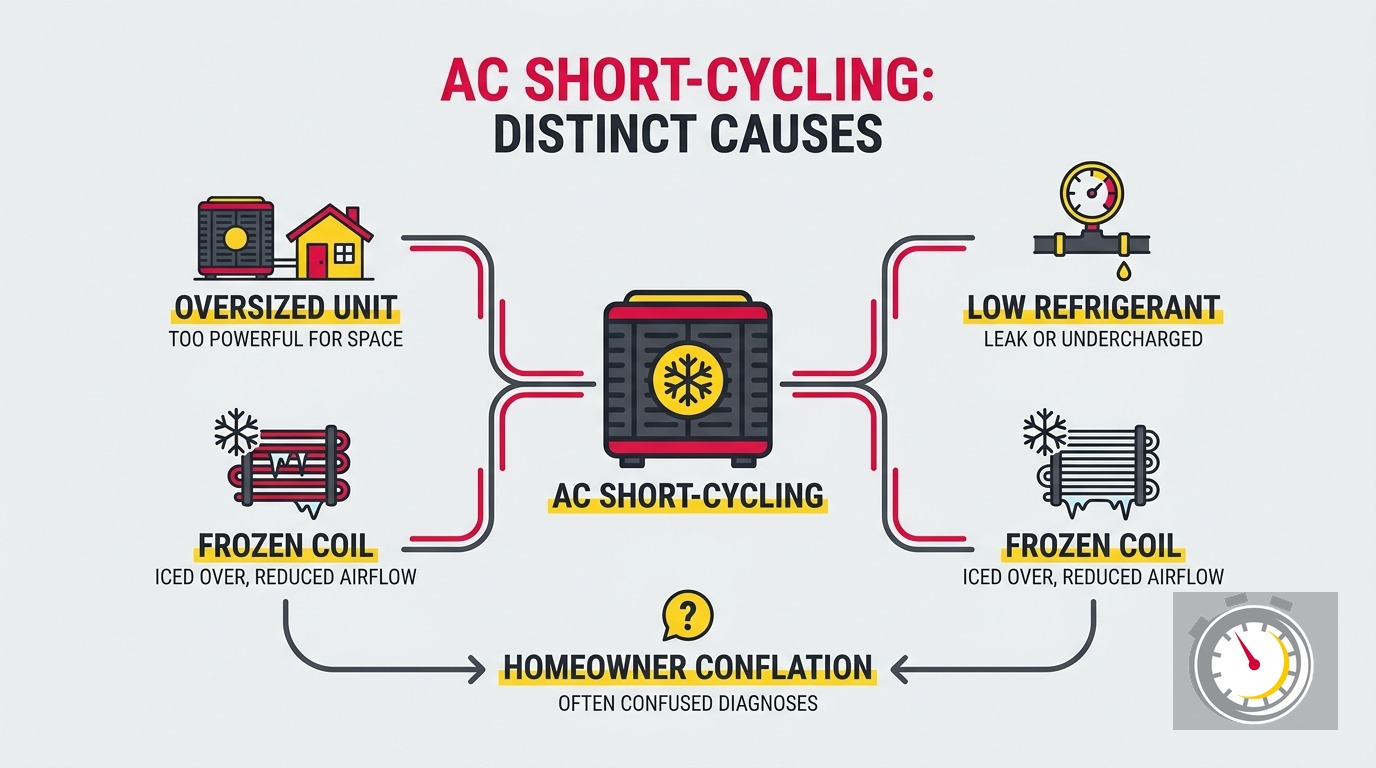
- Three root causes exist: an oversized unit, a frozen evaporator coil, or a refrigerant leak. Each has distinct symptoms and a different fix.
- When the short cycling started tells you a lot: day-one cycling points to oversizing; gradual onset with ice on the lines points to a frozen coil; sudden onset with warm air points to a refrigerant leak.
- In Minnesota, short cycling also means your home cannot dehumidify. July dew points of 65-70°F make that a mold risk, not just a comfort problem.
- Start with your air filter. A clogged filter is free to address and rules out the most common cause of frozen-coil short cycling.
- An older R-410A system with a confirmed refrigerant leak in 2026 is a repair-or-replace decision, not just a recharge.
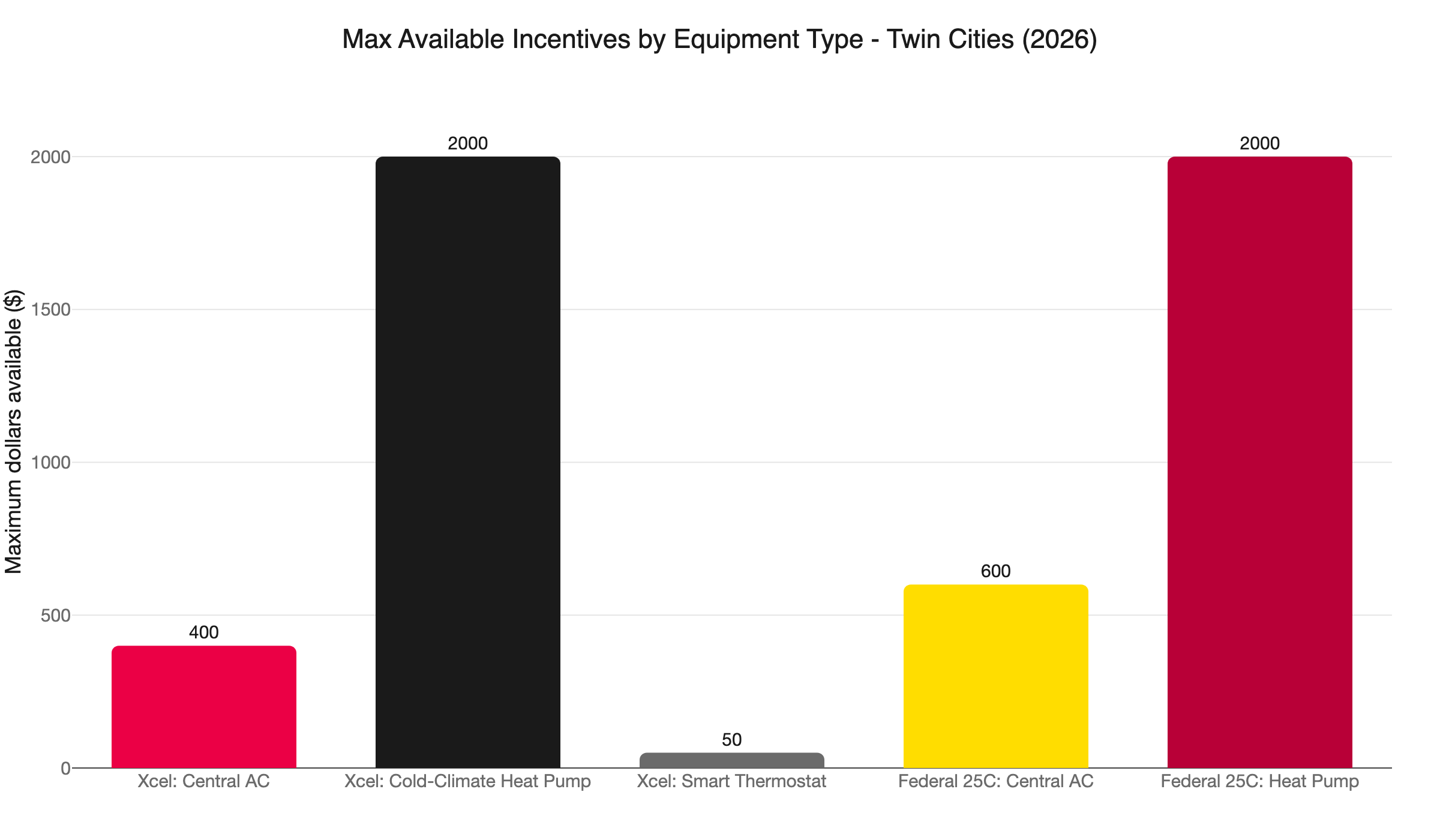
- Xcel Energy offers up to $400 for qualifying central AC and up to $2,000 for a cold-climate heat pump. Federal tax credits stack on top.
What Is AC Short Cycling?
Your air conditioner is designed to run in cycles of roughly 15-20 minutes. Short cycling means those cycles shrink to 2-5 minutes - or less. The compressor starts, briefly cools the air near the thermostat, satisfies the setpoint, and shuts off. Then it restarts a few minutes later. Repeat, all day.
That constant restart sequence is hard on equipment. Every cold start draws a surge of electrical current and mechanical stress on the compressor. Do it dozens of times a day and you compress years of normal wear into months.
This post covers the cooling-season version of the problem. It shares a name with the heating-season issue, but the causes are entirely different and so are the fixes.
Why Does AC Short Cycling Hit Harder in Minnesota?
Because in dry climates, short cycling mainly means uneven temperatures. In Minnesota, it also means your home fills with humid air that your AC cannot remove - and at summer dew points, that creates real mold conditions.
Minneapolis dew points regularly reach 65-70°F during July and August. Your AC controls humidity by passing warm, moist air over a cold evaporator coil. Moisture condenses on the coil and drains away. That process takes time - more time than a 3-minute cycle allows.
ENERGY STAR research puts it plainly: an oversized system “will cool the air before it has a chance to remove the humidity, making the room feel damp and clammy.” A short-cycling system - whatever the cause - produces the same result. Your home reads 72°F and still feels sticky because the latent heat was never removed.
Sustained indoor humidity above 60% is a mold-risk condition. In a tight, well-insulated Minnesota home, that risk compounds quickly. Short cycling is not a minor efficiency complaint. In our climate, it is a home health issue.
How Do You Tell the Three Causes Apart?
Three questions narrow down the likely cause before you call anyone. They do not replace a technician’s instruments, but they help you describe the problem accurately and point the diagnosis in the right direction.
Bring your answers when you schedule service. They make the call faster and more focused.
Question 1: Did your AC short-cycle on the very first day it was installed - and every day since?
If yes, an oversized unit is the most likely culprit. A system sized too large for the home’s actual heat load satisfies the thermostat sensor in 2-3 minutes and shuts off. The rest of the home stays warm and humid. This is a design error, not a mechanical failure.
Question 2: Did the short cycling develop gradually over weeks or months? Do you see frost or ice on the refrigerant lines or the indoor air handler?
If yes, look at a frozen evaporator coil. Ice builds up on the coil, blocks airflow, trips a safety switch, and forces a shutdown. The coil freezes because of restricted airflow - usually a clogged filter or blocked return - or low refrigerant charge. Two different root causes. One common result.
Question 3: Did the short cycling start suddenly this season? Is the air blowing warm? Do you hear a faint hissing sound near the indoor or outdoor unit?
If yes, a refrigerant leak is the most likely cause. Dropping refrigerant charge reduces low-side pressure. The safety controls read that as a fault and shut the compressor down to prevent damage.
Write down which question best fits your situation. It will make the service call shorter and more useful.
What If Your AC Short-Cycled from Day One?
If the problem existed from installation, you likely have an oversized unit. An oversized AC satisfies the thermostat before it can dehumidify the home. The only real fix is a correctly sized replacement.
An oversized AC cools the air near the thermostat quickly and shuts off. It never runs long enough to remove humidity from the full volume of conditioned air in the home. ENERGY STAR’s right-sizing research documents the efficiency cost directly: “when operating time increases from just 5 to 9 minutes, efficiency improves by 17 percent.” An oversized system leaves that efficiency on the table every single cycle - and the homeowner pays for it in both utility bills and shortened equipment life.
Minnesota mechanical code requires a Manual J load calculation before sizing new heating and cooling equipment. That calculation accounts for your home’s insulation values, window area, infiltration rate, orientation, and local climate data. It is not a rule of thumb. If you cannot find a Manual J report in your original installation paperwork, ask your contractor whether one was ever performed. Understanding why proper HVAC sizing matters gives you the background to have that conversation confidently.
A compressor cannot be downsized after the fact. If oversizing is confirmed, replacement is the solution. That is unwelcome news, but it opens the door to current rebates and tax credits - which are meaningful right now. See the rebates section below.
What Causes a Frozen Coil - and Why Does Ice Shut Your AC Down?
A frozen evaporator coil is the shutdown mechanism, not the root cause. Ice on the coil is caused by restricted airflow or low refrigerant - two distinct problems that produce one common failure mode.
When airflow across the evaporator coil drops below its design threshold, the coil cannot absorb enough heat from the passing air. Its surface temperature falls below 32°F. Moisture in the air freezes onto the coil. As ice builds up, airflow drops further - the ice itself becomes the restriction. The safety switch detects the condition and shuts the compressor off to prevent damage.
Two things cause airflow to drop that far:
Restricted airflow. A clogged air filter is the most common culprit. The filter blocks return air, starving the coil of warm air. The fix is simple: replace the filter and run the system on fan-only mode for 30-60 minutes to let the coil thaw. Then switch back to cooling and watch. If the short cycling stops, a filter was the entire problem. If it returns, something else is driving the freeze.
Low refrigerant charge. Low refrigerant reduces pressure on the low side of the refrigerant circuit. Lower pressure means a lower evaporator temperature. Even with adequate airflow, the coil gets cold enough to freeze moisture from the air. This is not something a homeowner can measure or address. It requires a technician with a set of manifold gauges.
Our detailed post on the frozen evaporator coil covers what a technician checks during a service call and what repair typically involves. One important note: do not keep running a system you suspect has a refrigerant problem. A compressor running without adequate refrigerant can fail permanently - and a failed compressor often costs more to replace than the full system.
Is Low Refrigerant the Cause? The 2026 Repair-or-Replace Factor
A refrigerant leak on an R-410A system in 2026 is not a simple recharge call. It is a repair-or-replace decision. R-410A manufacturing is banned for new equipment, and aging systems face rising repair costs as the refrigerant supply tightens.
Signs that point to a refrigerant leak include warm air from the supply vents, frost or ice on the copper refrigerant lines outside, a hissing or gurgling sound near the indoor or outdoor unit, and a system that ran fine last summer but has degraded noticeably this season. Our full guide to AC refrigerant leak signs in Minnesota gives you a checklist to work through before the service call.
A technician must locate and repair the leak before recharging the system. Otherwise the refrigerant bleeds out again and you pay for the same service twice.
Now for the 2026-specific context. Most central AC systems installed before 2025 use R-410A refrigerant. Under the EPA’s AIM Act Technology Transitions Rule, manufacturing of R-410A for new residential equipment was banned as of January 1, 2025. Existing R-410A can still be used to service older systems. A technician can still recharge your unit. But the supply is finite, prices are rising, and new systems use R-454B (Puron Advance) or R-32. You cannot mix refrigerant types between systems.
The practical question is this: if your R-410A system is 10-12 years old and has a significant leak, how many more cooling seasons are you buying with a repair? The repair extends a system approaching end of life, at increasing cost for a refrigerant that will only become harder to source. A new system uses current-standard refrigerant that will be serviceable for decades.
Ask your technician three things: the leak repair cost, the recharge cost, and an honest estimate on remaining system life. Then weigh those numbers against a replacement quote plus the incentives currently available.
Can You Diagnose AC Short Cycling Yourself?
You can rule out the most common fixable cause - a clogged air filter - before calling a technician. Beyond that, refrigerant pressure, airflow measurements, and coil condition require instruments your technician brings to the call.
Here is what you can do without tools or training:
- Replace the air filter. If it is gray and packed with debris, swap it for a clean one. Run the system on fan-only mode for 30-60 minutes to let any ice on the coil thaw. Then switch back to cooling and watch. A clogged filter is free to fix and rules out the most common cause.
- Check all supply and return vents. Make sure none are fully closed, blocked by furniture, or covered by rugs. Every closed vent reduces system airflow and can push the coil toward freezing.
- Clear the outdoor unit. Remove leaves, grass clippings, and debris from around the condenser coil. The unit needs at least 12-18 inches of clearance on all sides to reject heat properly. Blocked condenser fins force the compressor to work harder in high humidity.
- Look at the outdoor refrigerant lines. The copper lines running from the house to the outdoor unit should be dry. Frost or ice on them is a clear sign of low refrigerant. If you see it, turn the system off and call for service. Do not keep cycling a low-refrigerant system.
- Check your thermostat placement. A thermostat in direct sunlight or near a lamp or TV reads a falsely high temperature and calls for cooling more frequently than needed. Moving the thermostat or adding a remote sensor can stabilize the call pattern.
If short cycling continues after all those checks, stop running the system. The problem is internal. Continuing to cycle a low-refrigerant or frozen-coil system risks compressor damage that turns a manageable repair into a replacement decision.
When Does Short Cycling Mean You Need a New System?
Three conditions tip the decision toward replacement: a confirmed oversized unit, a refrigerant leak on an older R-410A system, or a repair estimate that exceeds 50% of the cost of a new system.
An oversized unit cannot be fixed without replacement. There is no compressor downsizing option. If that is the diagnosis, the only path to a system that actually performs is a new one sized correctly through a Manual J calculation.
An older R-410A system with a significant refrigerant leak faces two headwinds at once: the cost of the repair itself, and the tightening supply and rising price of R-410A refrigerant for future service needs. For many homeowners with a 12-plus-year-old system, the math favors replacement.
The 50% rule is a widely used contractor guideline: if a single repair costs more than half the price of a new system, the investment rarely makes financial sense. You put money into equipment that is still aging and will need the next repair sooner than a new system would.
The right sequence is to get both numbers - a repair estimate and a replacement quote - before deciding. Then factor in the rebates and credits available right now.
What Rebates and Credits Are Available?
Short-cycle-driven replacement opens the door to meaningful incentives from Xcel Energy and the federal government. Both programs are active in 2026, and they can be stacked to reduce your net cost by $1,000-$4,000 depending on equipment choice.
The Xcel Energy rebate program currently offers:
- Up to $400 for a qualifying central AC replacement (SEER2-rated equipment)
- Up to $2,000 for a qualifying cold-climate heat pump (ducted)
- $50 for a qualifying smart thermostat
Rebates must be submitted within 60 days of installation. Your contractor must be an Xcel Trade Ally for the rebate to qualify. Ask before you book service if this matters to you.
The federal Section 25C Energy Efficient Home Improvement Credit stacks on top:
- 30% of cost, up to $600/year for qualifying central AC
- 30% of cost, up to $2,000/year for a qualifying heat pump
You claim the credit on IRS Form 5695 with your 2026 return. A central AC replacement could net you $400 from Xcel plus $600 from the federal credit. A cold-climate heat pump could reach $2,000 from Xcel plus $2,000 federally. These are the incentive ceiling figures - your actual amount depends on installed cost and equipment qualification. The chart in this post shows the maximum amounts by equipment type and source.
CenterPoint Energy’s rebate program is oriented toward gas heating equipment. If your cooling system is electric - as most central AC systems are - the rebates above run through Xcel. If you are also replacing a gas furnace in the same project, ask about stacking CenterPoint heating rebates on the heating side.
How Northern One Hour Handles Short-Cycling Calls
We are locally owned and operated in Ramsey, Minnesota. We serve the full Twin Cities metro. When our technicians arrive for a short-cycling call, they run a full system diagnosis: airflow measurements, refrigerant pressure readings, thermostat calibration check, and a visual inspection of the coil and filter housing. They explain what they find before quoting anything. You know the diagnosis and the price before any work begins.
No surprises. No pressure. That is how we operate.
We back every appointment with the guarantee we stand behind every day: “Always On Time… Or You Don’t Pay a Dime!(R)” If we schedule a window and miss it, the call is on us. That is not a marketing line - it is a standard we hold ourselves to because your time matters.
If the diagnosis points toward replacement, we will walk you through Xcel rebate eligibility and federal credit documentation with your estimate. We also offer financing options for replacement projects - so the upfront cost does not have to be the deciding factor.
Call our team at (763) 260-6662 or book your AC service appointment online. Tell us when the short cycling started and what you have already checked. We will take it from there.
Key Takeaways
- AC short cycling means run cycles of 2-5 minutes. Normal is 15-20 minutes during typical summer weather.
- Three root causes exist: oversized unit, frozen evaporator coil, or refrigerant leak. Each has distinct symptoms and a different fix. They are not interchangeable.
- The timing of onset is your first diagnostic clue: day-one cycling points to oversizing; gradual onset with ice on the lines points to a frozen coil; sudden onset with warm air points to a refrigerant leak.
- Start with the air filter. A clogged filter is free to address and rules out the most common cause of frozen-coil short cycling.
- Minnesota’s humidity makes short cycling worse than in dry climates. A short-cycling system cannot dehumidify, and 65-70°F summer dew points create genuine mold risk in tight homes.
- An older R-410A system with a confirmed refrigerant leak in 2026 is a repair-or-replace decision. R-410A supplies are finite and prices are rising.
- If replacement is the answer, up to $400 in Xcel rebates and up to $600 in federal tax credits are available for central AC. A cold-climate heat pump opens up to $2,000 from Xcel and up to $2,000 federally - and both can be stacked.
Frequently Asked Questions
How long should an AC run per cycle? +
Does short cycling damage my AC? +
Can I still recharge my R-410A system if it has a refrigerant leak? +
What are the signs that my AC is short cycling? +
How do I know if my AC is oversized? +
Need a technician now?