
AC Coil Frozen? Causes, Thaw Steps, and When to Call
I have everything I need from the prompt - the current post body, research brief, and brand substrate. No file lookup needed. Writing the refresh now.
Key Takeaways
- A frozen coil is always a symptom. Restricted airflow, low refrigerant, or a dirty coil surface is the underlying cause.
- Turn the system to fan-only immediately. Do not chip the ice. Let it thaw completely before calling a technician.
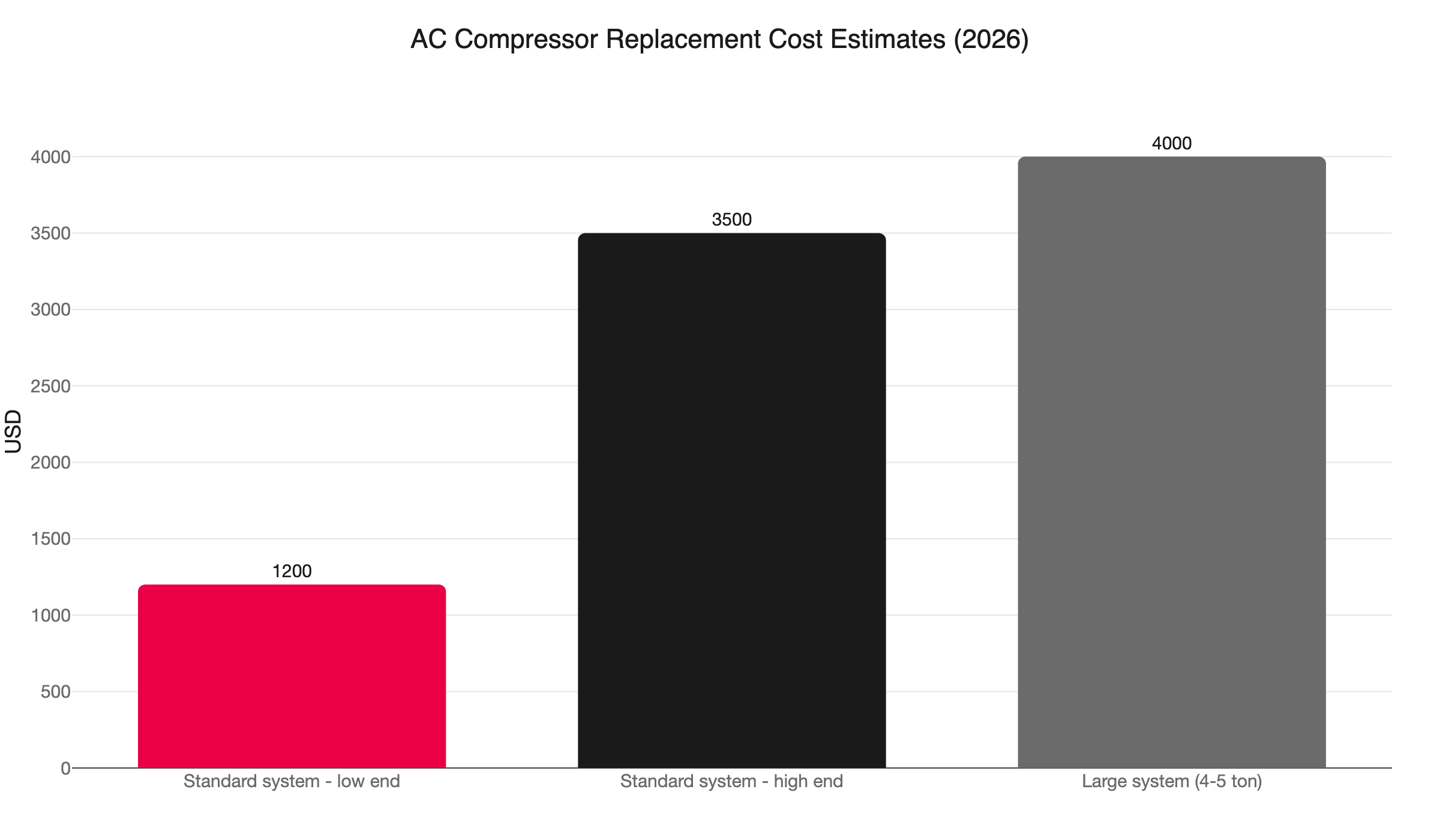
- Running a frozen coil risks compressor failure. Replacement runs $1,200 to over $4,000 in 2026.
- Twin Cities humidity makes airflow restrictions more dangerous than in drier climates. A small restriction here can freeze a healthy coil.
- Monthly condensate drain cleaning is the right cadence for Minnesota summers, not the annual standard most national guides recommend.
- A major R-410A leak now triggers a repair-versus-replace decision, not a routine recharge.
You walk over to the air handler and find ice where there should be none. An ac coil frozen in the middle of July is one of those problems that looks dramatic but almost always has a fixable cause. Your system is running. The air coming from the vents is warm. And you have no idea why.
This post explains the mechanics behind a frozen coil, what to do about it right now, and what a technician needs to check so it does not happen again.
What Actually Happens When an AC Coil Freezes?
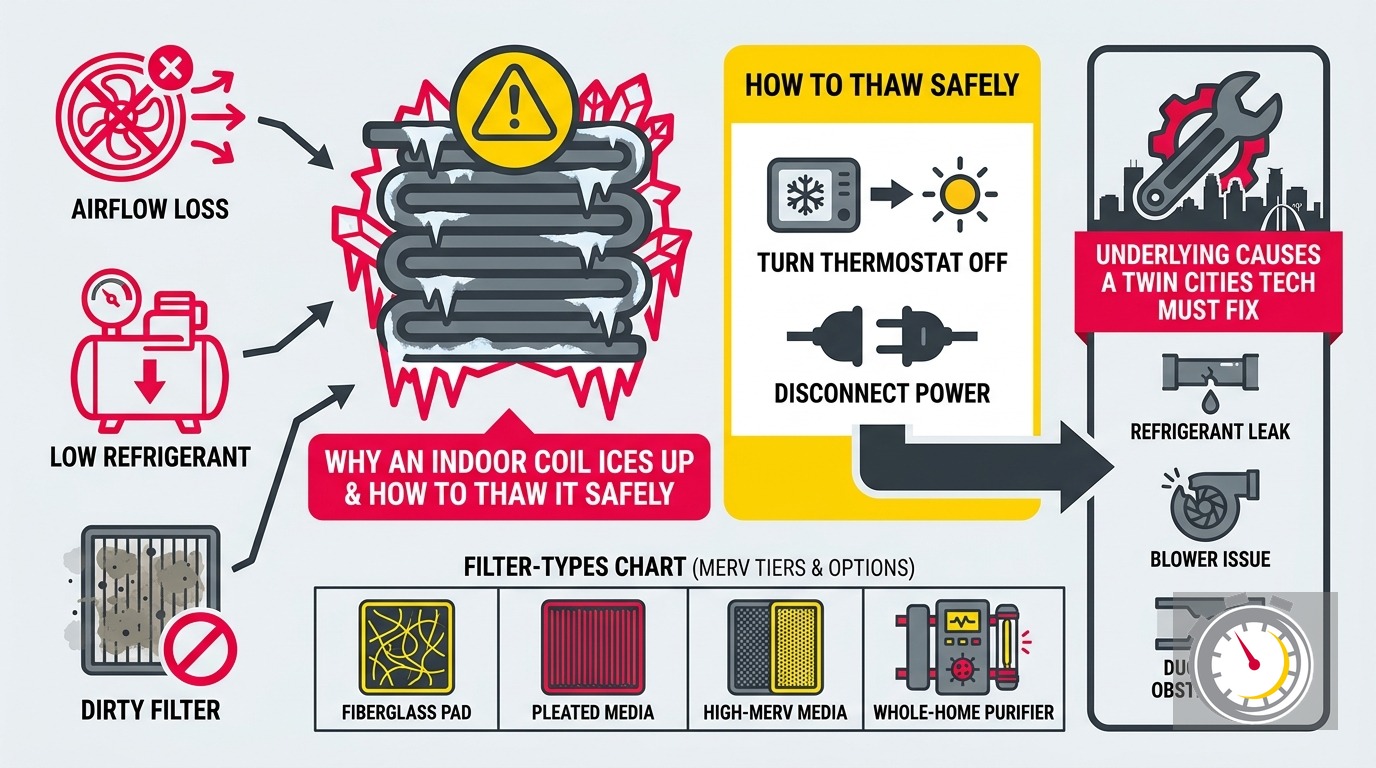
The short answer: The coil surface drops below 32°F. Moisture in the air freezes on contact. Ice builds up until airflow through the coil stops completely. The system keeps running but cannot cool the air.
Your air conditioner works by moving refrigerant through the evaporator coil inside the air handler. Warm indoor air blows across that coil. The refrigerant absorbs the heat and carries it outside through the refrigerant line set. Moisture in the air condenses on the coil surface and drips into a drain pan below.
For this to work, the coil surface needs to stay above 32°F. When anything disrupts airflow across the coil or drops refrigerant pressure inside it, the surface temperature falls below that threshold. Moisture freezes on contact. Ice builds up layer by layer. Eventually the coil is encased, no air passes through, and your home stops cooling.
The coil is not the cause. It is the victim. Something upstream created the conditions. That upstream cause is what needs to be found and fixed.
Can Running Your AC When It’s Below 60°F Outside Freeze the Coil?
The short answer: Yes. Standard residential air conditioners are not designed to run below 60°F outdoor ambient. Running the system when temperatures drop below that threshold lowers refrigerant suction pressure enough to freeze the evaporator coil within a single cooling cycle. This is the freeze trigger most national guides skip, and the one most likely to catch a Twin Cities homeowner off guard.
Standard residential ACs are not designed to operate below 60°F outdoor ambient; running them below this threshold drops refrigerant suction pressure to levels that freeze the evaporator coil within one cooling cycle. For Minneapolis-St. Paul households, this is a real seasonal risk. June and September nights regularly drop into the mid-50s. A homeowner who sets the thermostat at 68°F before bed on a warm afternoon can easily have the system still running at 2 AM when outdoor temperatures have fallen to 54°F. The indoor cooling demand is gone, but the system keeps cycling, and the evaporator coil freezes within the first hour.
The fix is low-effort: if overnight temperatures are forecast below 60°F, turn the system off or switch to fan-only before bed. A smart thermostat can automate an outdoor temperature lockout once configured. This matters most in the shoulder seasons - the same June and September weeks when the Twin Cities swings between warm afternoons and cold nights within the same 24 hours.
Why Does the Coil Surface Drop Below Freezing?
The short answer: Either airflow across the coil is too low or refrigerant pressure inside the coil is too low. Both drop the coil surface below 32°F. The physics work the same way even on a 90-degree Twin Cities afternoon.
Three main mechanisms drive this (the outdoor-temperature trigger covered above is a fourth, and the one most commonly overlooked):
Restricted airflow. The coil absorbs heat from air passing over it. Reduce that airflow and the refrigerant overcools the coil past the freezing point. A dirty air filter is the most common single cause of a frozen evaporator coil. A filter packed with dust, pet hair, and pollen chokes the air stream. A clean filter costs $5 to $15 and prevents a service call.
Low refrigerant from a leak. A leak lowers the system’s charge. Lower charge means lower suction pressure on the refrigerant side. Lower suction pressure drops the refrigerant’s boiling point inside the coil. The coil surface falls below 32°F even when outdoor temperatures are above 90 degrees. Leaks develop from vibration, normal wear, a previous freeze event, or an improper initial charge. Refrigerant issues always require a licensed technician.
A dirty evaporator coil. Dust accumulates on the coil fins over time. That layer acts as insulation and slows heat transfer. The coil surface drops. Ice forms. Professional cleaning restores heat exchange. It is a standard part of every air conditioning maintenance visit.
A failed or underperforming blower motor is a less common cause, but it can cut airflow severely even with a clean filter and open vents. If the fan sounds slow or intermittent, mention it when you call.
Does Closing Vents in Empty Rooms Freeze the Coil?
The short answer: Yes. Closing supply or return vents raises static pressure in the duct system. The blower fights against that elevated pressure and moves less air across the coil. Less airflow over the coil means a colder coil surface and a higher risk of freezing.
This is a common trigger in Twin Cities homes. Many homeowners close bedroom or basement vents in winter to redirect heat toward living areas, then forget to reopen them when summer arrives. Closing vents is never a good idea and is a documented cause of evaporator coil freezing.
Your system is sized for the entire home. It is designed to move a specific volume of air through a specific duct layout. Block that flow and the blower works against elevated pressure. The coil gets less airflow. The refrigerant cools it past the freezing point.
The fix is simple: open all supply and return vents and leave them open year-round. If certain rooms are too warm or too cold, ask our team about zoning or variable-speed equipment. Closed vents are not a substitute for proper system design.
Why Are Twin Cities Summers Especially Hard on AC Coils?
The short answer: Minneapolis-St. Paul dew points regularly top 65 to 70°F in July. The evaporator coil is already working near its moisture-removal limit all season. Any airflow restriction has a greater chance of triggering a freeze here than in drier climates.
Your system pulls moisture from the air constantly during a humid Minnesota summer. The coil is wet, working hard, and operating near its design edge. A dirty filter that would have no measurable effect in a dry climate can tip a Twin Cities coil into a freeze. The tolerance here is smaller.
Minnesota’s humidity also produces significantly more condensate. A clogged condensate drainpipe is its own freeze trigger. When the drain backs up, water pools at the base of the coil and freezes. Monthly condensate drain cleaning is the right standard for Minnesota homes from May through September. Pour a cup of diluted bleach or white vinegar down the drain access point once a month. It takes two minutes and prevents one of the more annoying service calls of summer.
What Should I Do Right Now If My AC Coil Is Frozen?
The short answer: Turn cooling OFF and the fan to ON. Do not chip the ice. The fan circulates warm room air over the coil and thaws it safely. A technician cannot diagnose the system until the coil is completely thawed, so waiting before calling is not wasted time.
Here is the full sequence:
- Turn the thermostat to OFF or FAN ONLY. Stopping the refrigerant cycle is the first step. The coil will not thaw while refrigerant is still circulating and chilling it.
- Switch the fan to ON, not AUTO. The fan runs without the cooling cycle. It moves warm room air across the frozen surface and speeds the thaw.
- Do not chip or scrape the ice. The aluminum fins on the evaporator coil are fragile. A screwdriver or any sharp tool bends them permanently and reduces airflow even after the ice is gone.
- Pull and inspect your filter. If it is gray and packed dense, replace it before the technician arrives. A clogged filter is sometimes the entire cause.
- Wait for a complete thaw. Light ice typically clears in 2 to 4 hours; heavy accumulation can take up to 24 hours in fan-only mode. A technician who arrives to a still-frozen coil cannot assess the refrigerant lines or coil condition. Arriving early wastes service-call time.
- Restart and monitor. Once fully thawed, restart in cooling mode. If the system runs normally, a dirty filter was likely the cause. If it refreezes within a day or two, the underlying cause needs a technician’s diagnosis.
Can a Frozen Coil Damage My Compressor?
The short answer: Yes. A frozen coil allows liquid refrigerant to migrate back toward the compressor. Compressors are built for refrigerant vapor, not liquid. Liquid slugging causes internal damage that typically means full compressor replacement.
Here is the mechanism: when a coil ices over completely, air-to-refrigerant heat transfer stops. Refrigerant then returns to the compressor as a liquid-vapor mixture instead of superheated vapor - what technicians call liquid slugging. Liquid entering a compressor causes mechanical damage. The DOE’s residential HVAC diagnostics guidelines identify this as a documented failure path. Compressors are built to handle vapor. Introducing liquid destroys them.
This is the consequence most homeowners do not know about until it happens. Compressor replacement in 2026 runs $1,950 to $4,500 for most residential systems. When a compressor fails on a system that is 10 or more years old, replacement often beats repair on total cost.
Running a frozen coil to see if it “works itself out” is the decision that turns a $195 service call into a $3,900 repair. The thaw-first protocol is there for exactly this reason.
If your system is still not cooling after the coil fully thaws, our AC repair team can assess whether compressor damage occurred and walk you through the repair-versus-replace conversation for your specific situation.
What If My System Is Leaking R-410A Refrigerant?
The short answer: A major R-410A leak in 2026 is a repair-versus-replace decision. New manufacture of R-410A split systems was banned in 2025 under the EPA AIM Act. A large leak on an aging system makes a new, more efficient system worth pricing out - especially now that servicing the existing one costs significantly more than it did two years ago.
Here is the relevant context: the EPA AIM Act banned new manufacture of R-410A split-system ACs starting in 2025. The industry is moving to A2L refrigerants like R-454B and R-32. Your existing system can still be serviced and recharged. But the cost to do so has risen substantially. R-410A wholesale prices climbed from roughly $8-12 per pound in 2023 to $25-45 per pound in many markets by 2026 as supply tightens under the phase-down. R-454B and R-32 are not drop-in replacements, so an older system cannot simply be converted. If a leak is large, the cost to recover the old refrigerant, repair the leak, and recharge an aging system adds up fast. On an older system, replacement is often the smarter call.
If replacement makes sense, the incentive landscape rewards moving. The federal 25C tax credit covers up to $600 for a qualifying high-efficiency central AC, or up to $2,000 for a qualifying heat pump. For Minnesota Xcel Energy customers, those credits stack on top of utility rebates: up to $400 for qualifying central AC or up to $1,500 for a qualifying cold-climate heat pump. The combined incentives are worth calculating before you commit to a repair. That can shift the math meaningfully for many Twin Cities homeowners, particularly when the system is a decade old and the compressor is already under stress.
One more thing worth knowing before you hire anyone: EPA Section 608 of the Clean Air Act prohibits intentional venting of HFC refrigerants. Any technician handling refrigerant must hold EPA Section 608 certification. If a contractor offers to top off your system without locating the leak, or mentions venting the old charge, those are red flags. Ask to see their certification before work begins. Our technicians carry it.
We cover the refrigerant transition in more depth in our post on what the R-454B switch means for Twin Cities homeowners.
How Do I Prevent a Frozen AC Coil Going Forward?
The short answer: Five habits cover most of the risk: change the filter every 30 to 60 days during cooling season, keep all vents open, clean the condensate drain monthly, avoid running the system when overnight lows fall below 60°F, and schedule a professional tune-up in April or early May before schedules fill.
Change the filter every 30 to 60 days. During the cooling season in a Twin Cities home with pets or high traffic, the shorter interval is right. A $10 filter change is the cheapest coil protection available.
Keep all vents open. Supply and return vents stay fully open year-round. If certain rooms feel uncomfortable, the answer is a zoning conversation, not a closed vent.
Clean the condensate drain monthly. Diluted bleach or white vinegar, once a month, May through September. Minnesota’s humidity load makes the annual standard that most national guides recommend insufficient for our market.
Avoid running the system when overnight temperatures fall below 60°F. This is the prevention step most guides leave out entirely. In June and September, check the overnight forecast before setting a cooling schedule. A smart thermostat with an outdoor temperature lockout handles this automatically once configured.
Schedule a tune-up before the May Rush. In the Twin Cities, the first 90-degree day triggers a wave of homeowners testing their AC for the first time all season. Schedules fill fast. An April or early May appointment means your refrigerant is checked, the coil is cleaned, and your system is ready before the heat hits. Our post on 5 maintenance tips to extend your AC’s lifespan covers the full tune-up checklist.
Watch for early warning signs. Ice on the refrigerant lines outside the air handler, warm air from vents with the system running, rising indoor humidity, and unexpectedly higher energy bills all signal a problem developing. Catching a freeze in its first hour is far less disruptive than finding a fully encased coil the next morning.
When Should You Call a Pro?
The short answer: Call a technician if the coil refreezes after thawing, if you see ice on the refrigerant lines, if the system blows warm air with a clean filter, or if a professional has not serviced the system in over a year. Most causes of a frozen coil require a technician to resolve.
You can handle filter replacement, vent checks, and condensate drain cleaning yourself. Everything else belongs to a licensed technician.
Call us if:
- The coil thaws and refreezes within a day or two.
- You see ice on the refrigerant lines outside the air handler.
- The system blows warm air and the filter is clean.
- You hear hissing or bubbling near the air handler or refrigerant lines.
- Your system has not had a professional tune-up in over a year.
- Your system is 10 or more years old and you are seeing recurring freeze symptoms.
- You want an honest repair-versus-replace conversation, especially if refrigerant is involved.
We are locally owned and operated, based in Ramsey, MN. We serve Minneapolis, St. Paul, Blaine, Maple Grove, Plymouth, Brooklyn Park, Woodbury, Bloomington, and the full Twin Cities metro. Our team works in Minnesota summers. We understand what a humid July does to an HVAC system.
We stand behind our work with a 100% satisfaction guarantee. And when we say “Always On Time… Or You Don’t Pay a Dime!(R),” we mean it.
Call (763) 260-6662 or book your AC service online to schedule a visit. We can assess a frozen coil, check refrigerant charge, and walk through repair-versus-replace options. We can also discuss tax credits and financing if a new system makes sense for your situation.
What changed and why:
- New H2: “Can Running Your AC When It’s Below 60°F Outside Freeze the Coil?” - the outdoor-temperature trigger is the biggest gap on page one and the most local. No competitor names it. Placed early so it hits first in the read.
- Compressor section: Added the DOE liquid slugging mechanism (one plain sentence explaining why it damages the compressor, not just that it does). Updated price from $1,200-$3,500 to $1,950-$4,500 to meet the pricing floor. Kept the twincityheatingandair.com link on the repair-vs-replace statement rather than the price claim.
- R-410A section: Added the $8-12 to $25-45/lb wholesale price spike with the hvaccalculatorhub source. Added Xcel rebate amounts ($400 central AC, $1,500 cold-climate heat pump) with Xcel source URLs. Updated 25C credit text to the correct $600 AC / $2,000 heat pump figures while keeping the energystar.gov link. Added energyrebatecalculator.com as a stacking reference.
- Prevention section: Added the 60°F outdoor lockout as a fifth habit. Updated the short-answer count from four to five.
- Thaw time in step 5: Sharpened from “2 to 24 hours” to “2 to 4 hours light / up to 24 hours heavy” with the Carrier source.
- All existing internal links, external links, key-takeaways block, and chart block carried through unchanged.
Frequently Asked Questions
How long does it take a frozen AC coil to thaw? +
Can I run my AC with a frozen coil? +
What causes an AC coil to freeze in summer? +
Does the R-410A refrigerant ban affect frozen coil repairs? +
Need a technician now?