
Minimum Outdoor Temperature to Run AC in Minnesota
Key Takeaways
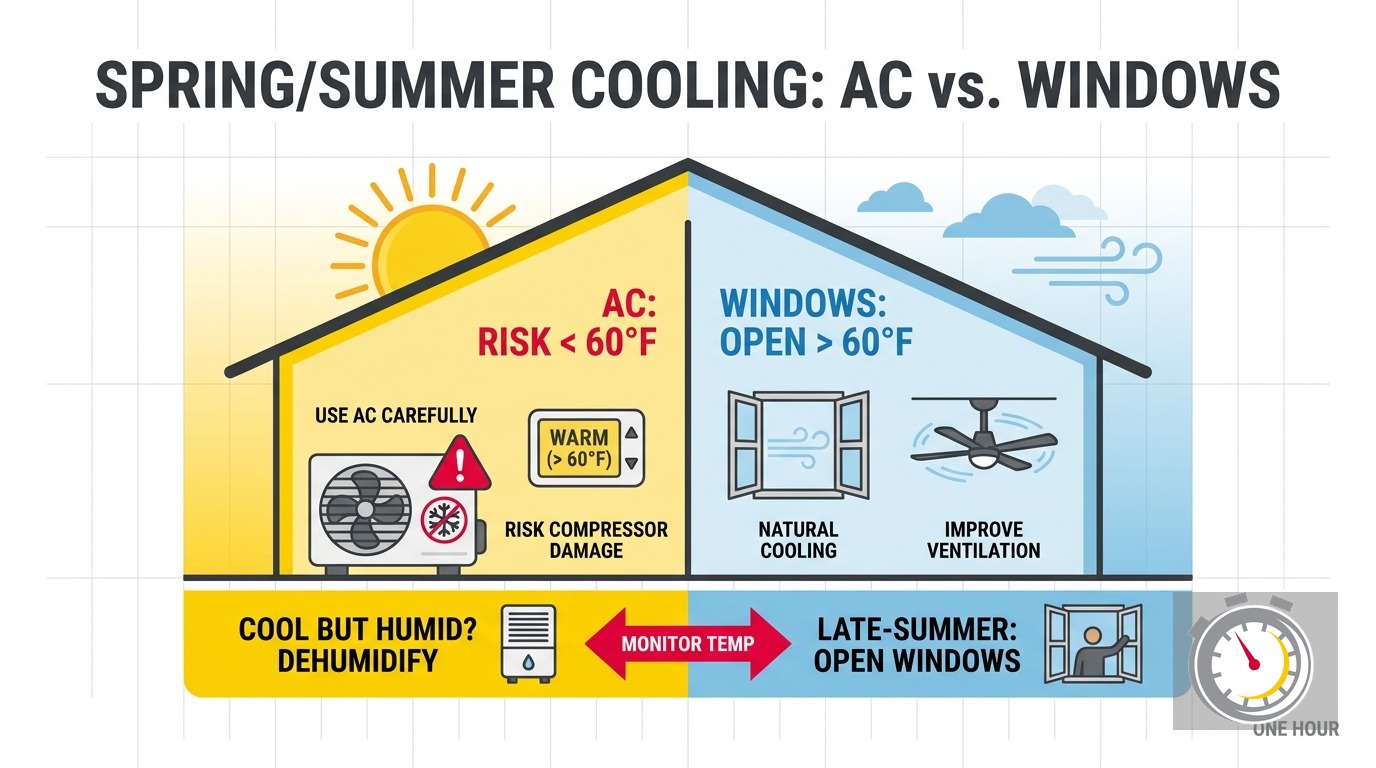
- The minimum outdoor temperature to run a standard central air conditioner is 60°F. Below that, refrigerant pressure drops too low and the compressor is at risk of serious damage.
- Temperature alone does not tell the whole story. A 63°F day with high humidity may call for running the AC as a dehumidifier, not a cooler.
- Use dew point, not relative humidity, to decide whether to open windows. If outdoor dew point is above 55°F, keep windows closed.
- Heat pumps in cooling mode operate safely down to 40-50°F - well below the limit for a conventional central AC unit.
- The decision guide near the bottom of this post settles the question for any shoulder-season scenario.
It is a Tuesday morning in May. The thermometer reads 63°F. The sky is gray and low. The air has that thick, damp feel, and the house seems stuffy even with the heat off. Do you open the windows or flip on the AC?
That is the question Minnesota homeowners actually wrestle with every spring and early fall. Not just “what temperature breaks the compressor” - though we will cover that too. This post answers both, and gives you a decision framework you can use in about 10 seconds any time the weather is in that ambiguous shoulder-season zone.
What Is the Minimum Outdoor Temperature to Run Air Conditioner in Minnesota?
For a standard central air conditioner, the safe minimum is 60°F. Below that threshold, refrigerant pressure inside the system drops too low for the compressor to operate safely. Most manufacturers list this limit in their installation manuals.
This is not a cautious recommendation. It is a hard mechanical limit tied to how refrigerant behaves at low ambient temperatures. The 60°F threshold is an industry-wide standard, not a brand-specific quirk or an installer’s conservative preference.
Minnesota makes this question more pressing than it sounds. Our shoulder seasons - May, early June, September, and October - regularly deliver daytime highs in the 60-70°F range. Some of those days are crisp and dry. Others are overcast and damp, with humidity that makes the house feel clammy even at mild temperatures. The 60°F limit comes up often here. So does the harder question about when to open windows.
Why Does Cold Weather Damage AC Compressors?
Cold outdoor temperatures trigger two distinct failure mechanisms at once: compressor oil thickening and refrigerant slugging. Either one can cause a compressor failure. Together they create serious risk on a single run below the limit.
Compressor oil thickening is the slower of the two risks. The oil inside every AC compressor is formulated to flow at normal operating temperatures. When outdoor temperatures drop, that oil thickens and stops coating moving parts effectively. Running the compressor without adequate lubrication accelerates wear on its internal components.
Refrigerant slugging is the more acute danger. Cold conditions cause liquid refrigerant to migrate toward the compressor. A compressor is designed to pump vapor. Vapor compresses; liquid does not. When liquid refrigerant reaches the compressor’s valves at operating speed, the pressure surge can shatter those valves outright. This can happen on a single overnight run at 45°F.
Slugging damage is not always visible from the outside. A compressor that took a liquid hit may start normally a few times before failing completely, or it may simply stop running and refuse to restart. Our post on signs your AC compressor may be failing in the Twin Cities covers the warning signs in detail.
What Does a Compressor Failure Actually Cost?
Compressor replacement in the Twin Cities typically starts around $1,950 and can reach $4,500 or more, depending on system size, refrigerant type, and whether related components were damaged in the failure.
One HVAC source notes that a single overnight run at 45°F can produce total repair bills exceeding $1,500 - and that estimate does not account for Twin Cities labor rates or the diagnostic fees, refrigerant recovery costs, and secondary component damage that often accompany a compressor failure.
The economic math matters most on older systems. An AC unit that is 12 or more years old may not justify a major compressor repair. The same failure that damaged the compressor may have stressed the condenser coil, fan motor, or refrigerant lines - components that push the total repair cost close to replacement territory. We cover the repair-versus-replace decision in detail in our post on AC replacement costs in Minnesota.
The bottom line: the 60°F limit protects an expensive part. One cold-weather run that fails the compressor on an aging system can easily tip the math toward full replacement.
Minnesota’s Shoulder Seasons: Where the Real Confusion Lives
The 60°F rule is easy to follow in January. Nobody is running AC during a Minnesota winter. The genuinely confusing window is May through early June and again in September.
During those months, outdoor highs regularly fall between 60°F and 70°F. The compressor is not in danger, because the temperature clears the limit. But it does not feel like conventional AC weather, either. The house is not hot. It just feels stale, or clammy, or sticky in a way that is hard to name.
This is where most guidance fails Minnesota homeowners. The answer to “should I open windows or run the AC?” depends on a metric that most weather apps display but most homeowners have never used: dew point.
Should You Open Windows or Run the AC on a Cool, Humid Day?
Run the AC if the outdoor dew point is above 55°F, even if the temperature feels mild. At that dew point, outdoor air carries more moisture than comfortable indoor air. Opening windows imports that moisture. The AC removes it more efficiently than ventilation can.
Open windows when outdoor air is both cooler and drier than indoors - specifically, when the outdoor dew point is below 55°F. That condition reliably describes a crisp Minnesota morning in mid-May or a clear early-September evening. It does not describe a gray, foggy morning with condensation on the windows.
The key shift in thinking: your AC does two jobs in a Minnesota summer. Cooling is the obvious one. Moisture removal - dehumidification - is the one that matters most on a 65°F overcast day. Running the AC on a mild, humid morning is not wasteful. It is exactly the right tool for the conditions.
How Do You Use Dew Point to Make the Windows-vs-AC Call?
Pull up the current dew point in your weather app and compare it to 55°F. Above 55°F, keep windows closed. Below 55°F, outdoor air is dry enough to let in without consequence.
The Minnesota DNR’s dew point comfort scale classifies the ranges this way:
- Below 50°F: Dry, comfortable
- 50-60°F: Some humidity noticeable, still comfortable
- Above 60°F: Sticky, muggy
- Above 65°F: Oppressive
Most weather apps show dew point in the hourly or detailed forecast section. On weather.gov it appears as a standalone reading. On most phone weather apps, look in the humidity or details panel.
Dew point is more reliable than relative humidity for this decision. Relative humidity changes as temperature rises and falls through the day, even if no moisture is added to or removed from the air. Dew point stays stable. A dew point of 58°F means the same thing at 6 a.m. and at 2 p.m., regardless of how the temperature has moved.
Twin Cities June and July dew point averages have reached 60°F or above in recent years - firmly in the sticky range. Spring is more variable. May mornings often run 45-50°F dew point (fine to open windows). May afternoons can reach 57-60°F (keep windows closed, run AC for moisture control). Check it before you decide.
Why Does Opening Windows on a Humid Day Backfire?
Opening windows when outdoor dew point is high forces your AC to dehumidify the house twice. First, it has to dry out the humid air you brought in. Then it handles normal indoor moisture loads. That doubles the moisture burden on the system.
When outdoor relative humidity exceeds 65%, keeping windows closed and letting the AC manage moisture is the right call. A single afternoon of open-window humidity on a muggy May day can extend your AC’s runtime significantly the following day as it catches up.
There is also a mechanical consideration. Running the AC and open windows simultaneously forces the system to fight a constant stream of humid, infiltrating air. The unit runs longer, the house does not dehumidify effectively, and the system operates under unnecessary strain. If you want to open windows, turn the AC off first. Never run both at the same time.
The same logic applies overnight. A 65°F summer night in the Twin Cities often comes with a dew point above 60°F. That feels comfortable outside. Inside, it deposits moisture on every surface the AC was keeping dry during the day.
For a broader look at why spring humidity loads are heavier than most homeowners expect, our post on why your home feels humid in spring and how AC systems help control it covers the seasonal moisture dynamics in detail.
What About Heat Pumps - Do They Have a Different Cold-Weather Minimum?
Yes. Heat pumps in cooling mode operate safely down to 40-50°F outdoor ambient, well below the 60°F floor for a standard central AC unit. Some cold-climate models have been tested down to 42°F under Energy Star’s test protocols.
That wider operating window is one reason heat pumps are a strong fit for Minnesota’s shoulder seasons. When outdoor temps are in the mid-40s and the house feels clammy, a heat pump can run the compressor safely where a conventional central AC system cannot.
The dew point decision logic still applies regardless of system type. A heat pump running at 48°F outdoor ambient can do so safely, but if the outdoor dew point is high, opening windows remains counterproductive. The windows-vs-AC call is always about moisture content in the air, not about which system you have.
If you are evaluating heat pumps for a Twin Cities home, our post on heat pumps in Minnesota and whether they are a good fit covers cold-weather heating and cooling performance, installation economics, and what to expect from shoulder-season operation.
Can You Extend AC Operation Below 60°F With a Low-Ambient Kit?
For a standard residential system, not without a technician and the correct hardware. Low-ambient kits are control modifications that allow certain commercial and specialty systems to cool safely at lower outdoor temperatures. They are not standard on residential central AC units and are not a safe DIY modification.
If your situation genuinely requires cooling at temperatures below 60°F - a home office with significant heat-producing equipment, a specific medical need - consult an HVAC technician before running the system below its rated minimum. The right kit, installed correctly, changes the safe operating range. Running a stock residential system below 60°F without those controls installed is precisely how slugging-related compressor failures happen.
Quick Decision Guide for Minnesota Homeowners
Use this table any time the weather is in shoulder-season territory and you are unsure what to do:
| Outdoor Conditions | What to Do |
|---|---|
| Below 60°F | AC off entirely - compressor damage risk |
| 60-70°F, dew point below 55°F | Open windows, AC off - outdoor air is drier |
| 60-70°F, dew point above 55°F or air feels muggy | AC on for dehumidification |
| Above 70°F | Normal AC cooling operation |
The third row is the one most homeowners miss. Mild, humid conditions are exactly when running the AC makes sense - not because the house needs cooling, but because the AC is the most effective dehumidifier available to you. Treating that row as “too cool to run AC” is how houses stay clammy all of June.
What Do Xcel Energy’s Tips Mean for Shoulder-Season Operation?
Xcel’s summer guidance assumes standard cooling conditions. Their recommended 78°F thermostat setting and demand-response cycling are designed for peak summer loads, not shoulder-season dehumidification runs. Their AC Rewards program offers a $100 enrollment credit and $25 per year for homeowners who allow Xcel to cycle the AC during peak demand periods.
On a shoulder-season dehumidification run, you are not cooling to a temperature set point the way you would at 90°F. The goal is moisture control. Set the fan to a low speed and allow longer cycles rather than pushing the thermostat down aggressively. Longer cycles remove more moisture per run. Short, aggressive cooling cycles drop the temperature quickly but do less dehumidification work before the compressor shuts off.
One maintenance point worth acting on now: a dirty air filter restricts airflow through the evaporator coil, which is the surface that removes moisture from the air. A clogged filter means reduced dehumidification - and it can cause the coil to freeze over rather than dehumidify. Replacing a dirty filter reduces AC energy consumption by 5-15% and keeps the coil in its effective operating range.
AC efficiency ratings like SEER2 are tested at 95°F outdoor ambient. Running the system at 65°F operates well outside that tested range. The system still performs its dehumidification function well. But quoted efficiency figures do not translate directly to shoulder-season operation.
When to Call Northern One Hour for a Pre-Season AC Check
If the system has not been serviced since last cooling season, late spring is the right time to schedule a maintenance visit. A technician will inspect the compressor, verify refrigerant charge, clean the evaporator and condenser coils, and confirm the system is operating within its rated parameters before shoulder-season conditions arrive.
We are locally owned and operated, serving Minneapolis, St. Paul, Ramsey, Blaine, Maple Grove, Plymouth, Brooklyn Park, and the surrounding Twin Cities area. Our promise is simple: “Always On Time… Or You Don’t Pay a Dime!(R)”. If we are not there when we said we would be, the visit is on us.
Call (763) 260-6662 or schedule your AC maintenance visit online. We will get your system confirmed and ready before the first real cooling day of the season.
Frequently Asked Questions
What is the minimum outdoor temperature to run a central air conditioner? +
Can running the AC when it is too cold outside damage the compressor? +
When should I open windows instead of running the AC in Minnesota? +
Do heat pumps have a different cold-weather minimum in cooling mode? +
Need a technician now?