
Loud AC Noises Meaning: What Each Sound Is Telling You
Key Takeaways
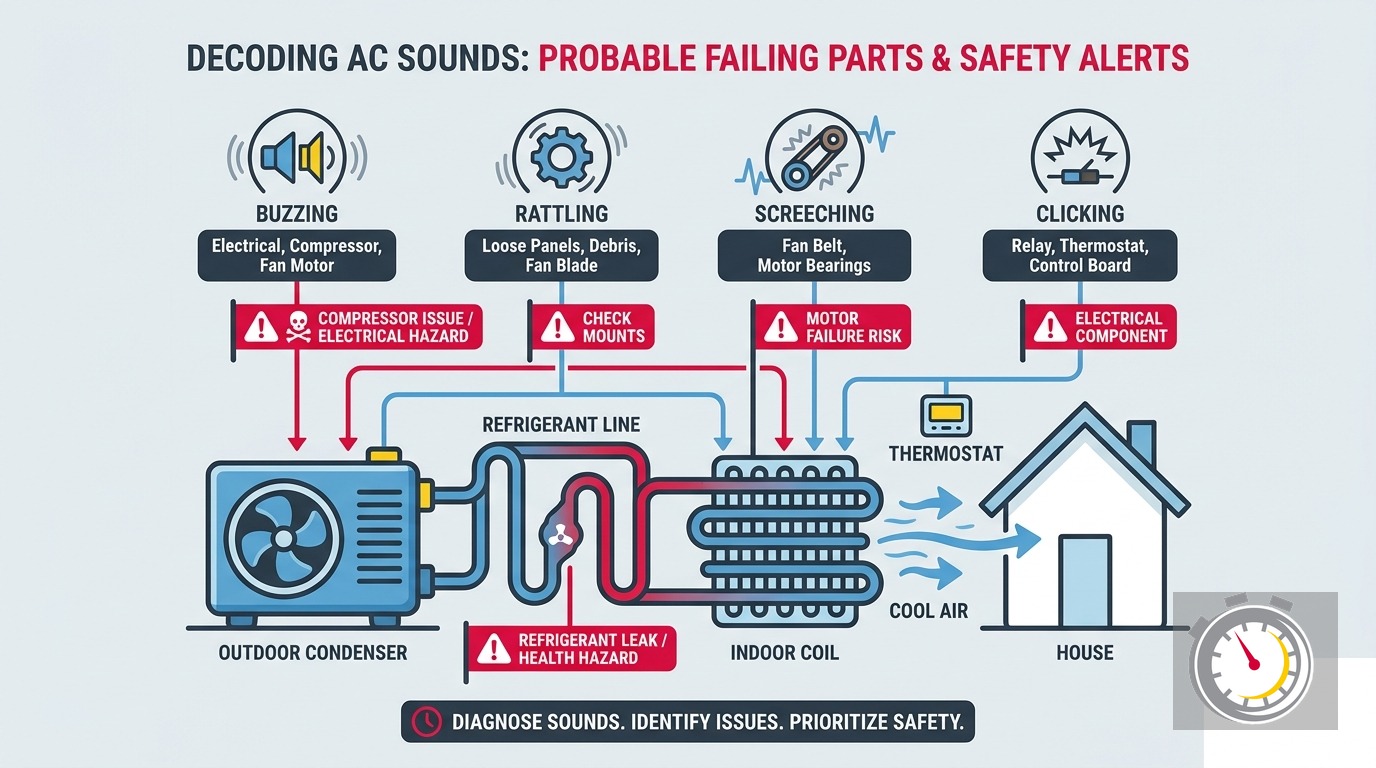
- Different sounds point to different failing parts. Matching the noise to the component tells you how fast to act.
- Screeching with warm air from the vents: turn the system off now and call for service. This can signal dangerously high compressor pressure.
- Hissing with any chemical or oily smell: power it down, ventilate the space, and call. Refrigerant leaks are a safety issue, not just a repair.
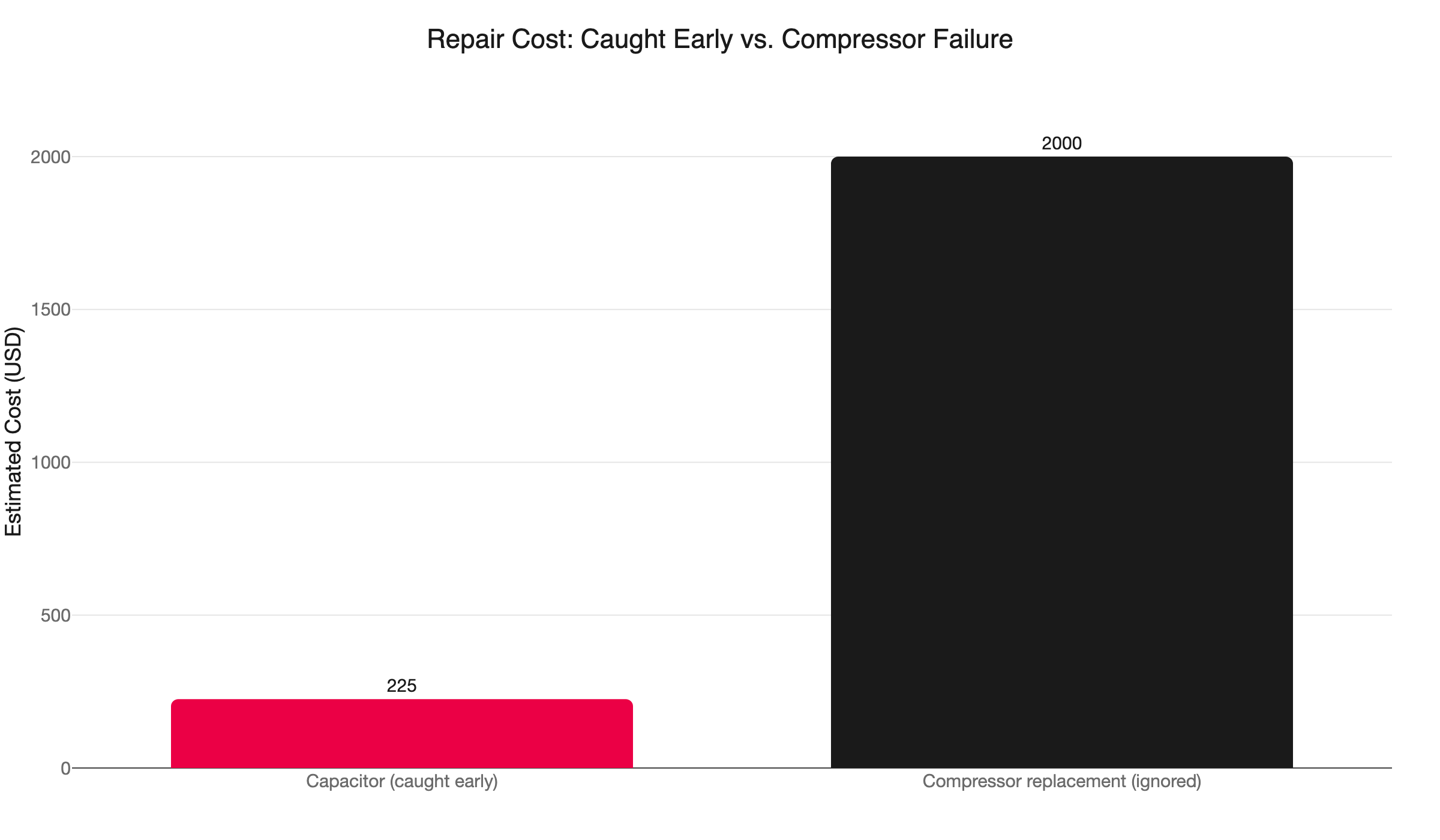
- Buzzing or repeated clicking that starts this summer often means a failing capacitor. Caught early, a capacitor runs $195-375 to replace. Ignored, it can destroy the compressor: a $1,950-3,200 job.
- EPA Section 608 makes it a federal violation to handle refrigerant without certification. DIY recharge products can catch fire in systems not designed for them.
- Xcel Energy customers who replace a failing central AC with a qualifying 16 SEER2 unit can claim up to $400 in rebates.
- Call us at (763) 260-6662 or book online.
Which AC Noises Mean Turn It Off Right Now?
Two situations call for powering the system off immediately. Screeching combined with warm air from the vents can indicate the compressor is running under dangerously high head pressure. Hissing with any chemical or oily odor signals a possible refrigerant leak. Both are shut-it-off-now situations, not schedule-it-soon ones.
For every other noise in this guide, “call soon” means within 24-48 hours. Not “watch it through another week of 95-degree afternoons.”
What Does Banging or Clanging from Your AC Mean?
Banging or clanging usually means a loose or broken part is striking something it should not be touching inside the blower assembly or the compressor. The louder and more rhythmic the bang, the more urgent the call. This is not a monitor-and-wait situation.
Inside the blower assembly: The indoor air handler has a blower wheel that spins to push conditioned air through your ducts. If a blade breaks or the wheel loosens on its shaft, it bangs against the housing on every rotation. This is repairable without replacing the whole unit, but it will not improve on its own. Running a damaged blower accelerates wear on the motor shaft and housing.
Inside the compressor: Your compressor has internal pistons, valves, and connecting rods. When a piston pin breaks or an internal component loosens, it produces a deep metal-on-metal bang from the outdoor unit. This is a serious failure. Compressor replacements run $1,950-3,200. On a system over 10 years old, a full unit replacement often makes more financial sense than a compressor swap. Our post on when to repair versus replace your HVAC system walks through that decision in detail.
What to do: Turn the system off or drop the thermostat setting and call for service the same day. Running a blower with a broken wheel or a compressor with a loose internal part compounds the damage with every cycle.
What Does Screeching or Squealing Mean?
Screeching almost always points to fan motor bearings or, on older systems, a belt-driven blower. Both are repairable. The exception: screeching combined with no cooling. That combination can signal dangerous compressor pressure, and the system should be turned off immediately.
Fan motor bearings: Both the outdoor condenser fan motor and the indoor blower motor ride on bearings. When those bearings wear out, they produce a high-pitched squeal that often intensifies as the motor heats up. Early-stage bearing wear can sometimes be extended with lubrication, but worn-out bearings need replacement before they seize and take the motor with them.
Blower belt: Most systems built in the last 10-15 years use direct-drive motors with no belt. If your system is older, a belt-driven blower may still be in place. A worn, glazed, or misaligned belt squeals much like a worn car accessory belt. It is an inexpensive fix, but a snapped belt stops your cooling entirely.
The Minnesota startup factor: Twin Cities AC units sit completely dormant from roughly October through April or May. After five to six months idle, bearings can develop flat spots and belt material can stiffen from cold. A screeching noise in the first week of cooling season sometimes works itself out as the system warms up - but it can also be a bearing that has degraded too far to recover. Worth having a tech evaluate rather than hoping it resolves on its own.
The safety exception: Screeching combined with the system blowing warm air or no air is a different situation entirely. That combination can point to a compressor running under abnormally high head pressure - a condition that stresses the entire refrigerant circuit. Turn the system off and call immediately.
What Does Buzzing or Humming Mean?
A new or worsening buzz is almost always electrical - a failing capacitor, a worn contactor, or loose wiring. These faults do not resolve on their own. Buzzing is a 24-48 hour call, not an emergency shutoff, but it should not run unattended through a heat wave.
Capacitor: The capacitor stores and delivers the extra voltage boost that compressor and fan motors need to start under load. When a capacitor begins to fail, it produces a noticeable buzz and the motor may struggle to come on. You might hear a hum followed by a click as the system tries and fails to start, then shuts back down. Capacitor replacement is one of the more affordable AC repairs at roughly $195-375. Left unaddressed, a weak capacitor subjects the compressor to hard-start stress on every cycle. Compressors are not designed for sustained hard starts, and this shortens their life significantly.
Contactor: The contactor is a relay that closes to deliver high-voltage power to the compressor when your thermostat calls for cooling. Worn contactor points arc and buzz audibly. A visibly pitted or burned contactor needs replacement before it fails mid-cycle or causes a short.
Loose wiring or terminals: Vibration over years of operation can loosen electrical terminal connections inside the disconnect box or air handler. Loose connections arc, create resistance heat, and buzz. They are also a fire risk inside an enclosure that contains refrigerant oil.
Refrigerant flooding: A lower-pitched gurgling buzz can sometimes indicate liquid refrigerant flooding back to the compressor suction line. This is less common but can cause compressor damage when sustained over time.
Electrical faults do not self-correct. Schedule service within 24-48 hours.
What Does Hissing Mean?
Hissing most often signals a refrigerant leak. Turn the system off and ventilate the space if you notice any odor. Refrigerant exposure carries risks including toxicity and, with certain refrigerant types, flammability. This is a call-now situation, not a schedule-this-week one.
Why a refrigerant hiss is serious: Refrigerant circulates under pressure. A leak at a fitting, evaporator coil, or refrigerant line produces a hiss as pressurized gas escapes. According to the EPA, refrigerant exposure risks include toxicity, potential flammability, and asphyxiation in enclosed or poorly ventilated spaces. The risk is highest when working on pressurized components, but an active outdoor coil leak is not something to leave running.
The A2L refrigerant transition: R-410A, found in most residential systems installed before 2025, is in a federally mandated phaseout. New systems use refrigerants classified as A2L - mildly flammable. The safety profile of a refrigerant hiss depends on which refrigerant your system uses. The EPA has documented cases where propane-based DIY recharge products “can catch fire or explode” in systems not designed for flammable refrigerants. One marketer faced a $300,000 civil penalty. The refrigerant circuit is not the place to improvise.
EPA Section 608 - no DIY option: Federal law requires EPA Section 608 certification to purchase or handle regulated refrigerants. There is no Minnesota exemption. A can of refrigerant from an auto parts store is not a legal or safe fix for a leaking line set or evaporator coil.
What a certified technician does: A licensed tech locates the leak, repairs or replaces the affected component, and recharges the system with the correct refrigerant using proper recovery and recharge equipment. For context on what the refrigerant transition means for your system, see our post on R-454B and what the changeover means for homeowners.
What Does Clicking Mean?
A single click when your AC starts or stops is normal relay operation. Repeated clicking while the system is trying to start, or clicking that continues after startup, points to a problem. Acting on repeated clicking promptly is the difference between a $195-375 repair and a $1,950-3,200 compressor replacement.
Rapid clicking at startup with no compressor start: If your thermostat calls for cooling and you hear repeated clicking from the outdoor unit without the compressor coming on, the capacitor is almost certainly the cause. The contactor is closing properly, but the motor cannot start because the capacitor cannot deliver enough starting voltage. This is the most cost-sensitive scenario in this guide. Schedule service the same day.
Foreign object in the fan: A twig, cottonwood debris mass, or any object that made it through the condenser grille will produce a rhythmic click as the fan blade strikes it on each rotation. Turn the unit off at the disconnect before inspecting or clearing anything from the cabinet.
Fan blade damage: On older units, a fan blade can develop a hairline crack and flex enough at speed to clip the wire cage or housing. This starts as a light tick and worsens with each run cycle. Worth addressing before a blade fragment causes more damage inside the unit.
Control board relay: Rapid clicking from inside the air handler near the control board can indicate a faulty relay. Less common, but worth a tech visit if the outdoor unit is not the source.
What Does Rattling Mean?
Rattling has a wide range: it can be a loose panel screw or a compressor approaching failure. Location matters. A rattle from the outdoor unit that persists after you rule out debris and loose panels is worth a service call. A rattle from walls or ceilings is often ductwork vibration.
Loose panels or fasteners: Vibration gradually works sheet-metal screws and panel fasteners loose. A rattling access panel is one of the easiest fixes you can handle yourself. Power the system down, tighten any loose screws on the unit panels, and restart. If the rattle stops, you are done.
Debris in the outdoor unit: Cottonwood seeds, leaves, twigs, and small branches fall into the condenser through the top grille. A piece of debris strikes the fan blade on each rotation. Power off the unit at the disconnect, remove the top grille if you can do so safely, and clear the debris. Make this part of your annual spring startup routine.
Ductwork vibration: If the rattle seems to come from walls, ceilings, or floor registers, the ducts are likely vibrating in their supports. Loose duct joints are a common cause - and those same loose joints mean conditioned air leaking into wall cavities instead of reaching your rooms. A tech can evaluate duct integrity during a service visit.
A failing compressor: A compressor near the end of its service life sometimes develops a rattling or clattering quality underneath its normal operating sound. On a system that is already 12-15 years old, this rattle is a signal that internal components are wearing beyond serviceable tolerances. A technician can test compressor efficiency and give you an honest repair-versus-replace read.
The Cost-Consequence Ladder
Most AC failures do not arrive without warning. They announce themselves through sound, weeks or months before they become complete failures. The financial difference between acting on the signal and ignoring it is significant.
A failing capacitor costs roughly $195-375 to replace. The repair takes under an hour. Left in service, it forces the compressor to hard-start on every call for cooling. Compressors are not built for sustained hard starts. Compressor replacement runs $1,950-3,200. On an aging system, you are often looking at full unit replacement rather than a compressor swap.
A refrigerant leak found early means sealing the leak and recharging the system. Found after the compressor has been running low on refrigerant for weeks - overheating and cycling on thermal protection - the repair bill is substantially higher.
The pattern holds across components. The noise is cheap information. Acting on it is affordable. Replacing what the noise pointed to is expensive.
Why Twin Cities Summers Are Especially Hard on AC Components
This is not a generic nationwide problem. Minnesota’s cooling season runs three to four months, short and intense. Minneapolis hit an official high of 99°F in July 2026, with dew points reaching 81°F and heat index values above 100°F. AC units that were borderline in May become failing units in July.
Two Minnesota-specific factors accelerate this. First, AC systems here sit completely dormant from roughly October through April. Six months of cold followed by a hard restart every spring stresses fan bearings, capacitors, and contactors in ways that systems in warmer climates never experience. Second, the urban heat island effect raises ambient temperatures in denser parts of the metro, meaning compressors in some Minneapolis and St. Paul neighborhoods work harder than the official temperature suggests.
If your system ran nearly continuously during this summer’s heat waves, that sustained operation has accumulated wear. The noises showing up now are often components that were marginal at the start of cooling season and have finally crossed the line.
Annual maintenance catches these trends before they become emergency calls. Our guide on 5 maintenance tips to extend your AC’s lifespan covers what a tune-up inspection checks and why it matters specifically in a Minnesota climate.
When Should You Call an HVAC Technician?
Any time a noise is new, getting worse, or paired with reduced cooling or higher energy bills, call a technician. Some noises mean call today. Others mean schedule within 48 hours. Waiting through a heat wave is how a $250 repair becomes a $2,600 one.
Sounds that mean call today:
- Screeching or squealing combined with warm air from the vents
- Hissing with any unusual chemical or oily smell
- Loud banging or clanging from the outdoor unit
- Repeated clicking at startup without the compressor coming on
Sounds that mean schedule within 48 hours:
- Buzzing or humming that is new or progressively louder
- Clicking at startup that is becoming more frequent
- Rattling from the outdoor unit after you have ruled out debris and loose panels
When you call Northern One Hour, you are calling a locally owned and operated Twin Cities HVAC company. Our technicians are licensed and bonded under Minnesota’s mechanical contractor requirements. Every visit is backed by a 100% satisfaction guarantee.
If the diagnostic visit points toward a new system, ask about rebates. Xcel Energy customers replacing a central AC with a qualifying unit rated at 16 SEER2 or higher can claim up to $400 back. Catching a failing system early enough to make a planned replacement - rather than an emergency one - is the path to capturing that rebate on your own schedule.
Ready to Stop Guessing?
A loud AC noise is your system communicating. The translation is usually clear. The urgency varies. But running any of these sounds through another week without a diagnosis is how a $250 repair becomes a $2,600 one.
Call us at (763) 260-6662 or schedule a repair visit online. A licensed technician will diagnose the problem, give you honest pricing upfront, and get your system back to quiet. We are locally owned and operated, and we stand behind every visit: “Always On Time… Or You Don’t Pay a Dime!(R)”
Frequently Asked Questions
Is a loud buzzing noise from my AC dangerous? +
What does loud screeching from an AC unit mean? +
Can I recharge my AC refrigerant myself? +
Need a technician now?