
AC Condenser Fan Motor Failing: Signs and What to Do
Key Takeaways
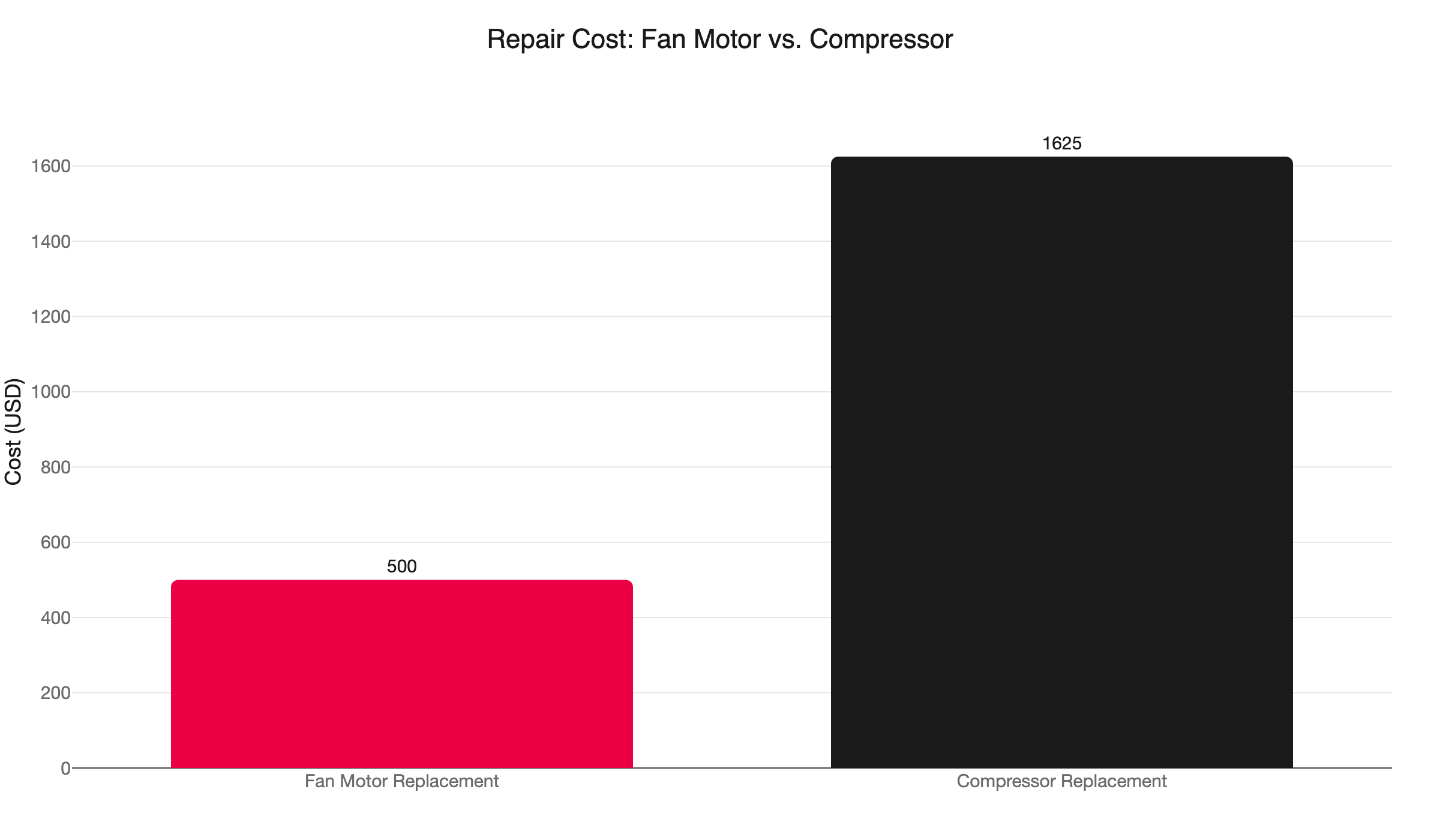
- An AC condenser fan motor failing is more than a minor inconvenience. When the fan stops, the compressor can overheat within hours, turning a $300-$700 repair into a $950-$3,200 replacement.
- A fan blade that isn’t spinning does not always mean a dead motor. About half the time, a failed run capacitor is the real problem, and the part costs $15-$40.
- You can safely check three things yourself: look at the blade, listen for grinding or humming, and nudge the blade with a long non-conductive stick. Stop before you touch anything electrical.
- Running the AC with a failed fan motor is one of the fastest ways to destroy a compressor. Turn the system off and call.
- Fan motor replacement in the Twin Cities typically runs $300-$700 all-in for parts and labor.
- If your unit is over 15 years old and has had multiple recent repairs, replacement may be the smarter financial call.
What Does the Condenser Fan Motor Do?
The condenser fan motor pulls air through the outdoor unit so the refrigerant can release heat outside your home. Without that airflow, heat builds up, refrigerant pressure climbs, and the compressor overheats and shuts down or fails.
Think of the outdoor unit as a radiator. The refrigerant arriving from inside your home carries the heat it absorbed from your air. The fan motor pulls outside air across the condenser coil so that heat bleeds off into the yard. Once the refrigerant cools and releases that heat, it cycles back inside to pick up more. The motor is what keeps that exchange moving.
According to Inspectapedia, when the condenser fan motor fails, head pressure climbs and the compressor overheats. That is the risk in a sentence. Everything else in this post is about catching it before that happens.
Signs of an AC Condenser Fan Motor Failing
Some of these you can spot or hear yourself. Others only show up as a symptom inside your home.
At the outdoor unit:
- The fan blade is not spinning, but you can hear the unit humming and running
- The blade spins slowly or struggles to get started
- A grinding, squealing, or rattling sound comes from the top of the unit
- A burning smell near the outdoor unit
- The unit shuts itself off after a few minutes on a hot day, then tries to restart
Inside the home:
- The air coming from your vents is less cold than usual
- The system runs much longer than normal without cooling the house down
- The AC repeatedly trips the breaker
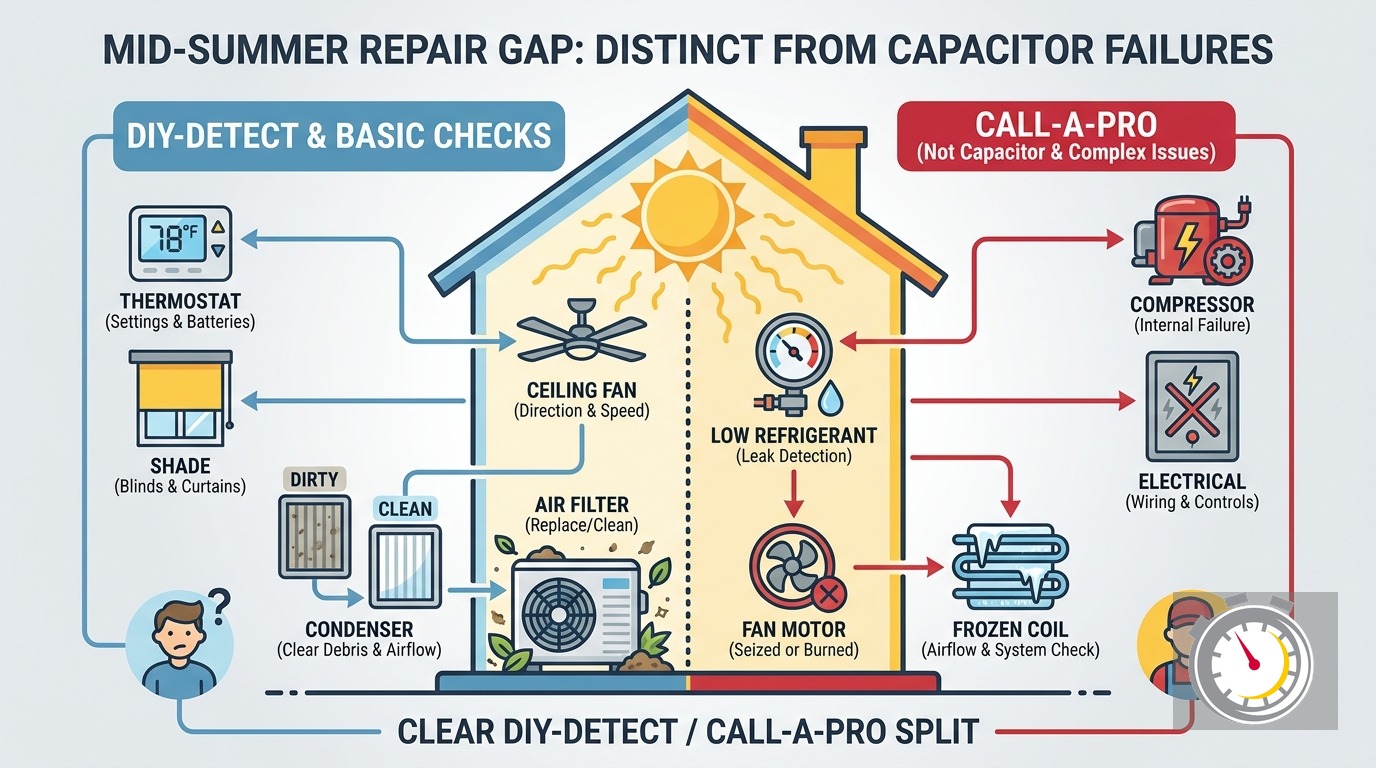
The last two inside symptoms can have several causes beyond the fan motor. A refrigerant leak, a dirty coil, or a frozen evaporator coil can produce similar results. But if the fan blade is not turning at all, work through the next section before calling anything else.
What Can You Check Before Calling a Tech?
Three safe checks take about five minutes and give you useful diagnostic information before you call. Look at the fan blade through the top grille, listen for abnormal sounds, and do the blade nudge test. Stop before you touch anything electrical inside the unit.
Here is the full sequence:
Step 1: Look. Stand near the outdoor unit and look through the top grille. Is the fan blade turning? Is it spinning slowly, or completely still? A blade that is not moving while the compressor hums is the clearest visual sign of a motor or capacitor problem.
Step 2: Listen. Before you get close, listen from a few feet away. A running motor is relatively quiet. A humming sound with no rotation often means the motor is receiving power but cannot turn. Grinding or squealing points to failing bearings inside the motor itself.
Step 3: The blade nudge test. This single check gives you the most useful diagnostic signal before a tech arrives. With the unit powered on and running, use a long non-conductive stick (a wooden dowel or the handle of a plastic rake works well) to gently push the fan blade through the top grille. If the blade spins up on its own after a nudge and keeps running, the capacitor has likely failed, not the motor. If the blade still refuses to turn, the motor itself has probably failed.
Agway Energy documents this test as the standard field method for separating a capacitor failure from a motor failure. It works because the capacitor supplies the starting torque the motor needs to get moving. Without that initial kick, a healthy motor will not start on its own.
Stop here. Do not open the electrical panel on the side of the unit. Do not touch the capacitor. Jackson Systems is explicit on this point: the capacitor holds a lethal charge even after the power is off. Testing motor windings or touching internal components is a licensed technician’s job, not a homeowner’s job.
Is the Problem the Motor or the Capacitor?
About half of all fan-not-spinning calls trace back to a failed run capacitor, not a dead motor. The capacitor part costs $15-$40. A motor replacement runs $300-$700. A professional diagnosis tells you which before any work is authorized.
The run capacitor is a small cylindrical component inside the electrical panel of the outdoor unit. Its job is to give the motor the burst of energy it needs to start and to keep it running efficiently through each cycle. National HVAC Parts explains that a capacitor reading more than 6% below its nameplate MFD rating is a confirmed failure. The part itself costs $15-$40. The labor to replace it is a fraction of what a motor swap costs.
The blade nudge test from the previous section is the clearest homeowner-accessible signal. If the fan spins up after a nudge and keeps going, you have almost certainly found a capacitor problem. If the fan still won’t move, the motor has failed.
One important note: when a tech replaces the motor, the capacitor should be replaced at the same time. Lone Star HVAC identifies this as the most common callback in summer HVAC service: replacing a motor without also swapping the run capacitor. A weak capacitor burns out a new motor faster than most homeowners expect.
For a deeper look at capacitor symptoms and costs specific to the Twin Cities, this post on bad AC capacitor symptoms and what they cost covers that diagnosis in detail.
Why Does AC Condenser Fan Motor Failing Spike in Late Summer?
Motors that survive June and early July accumulate heat damage with every long run cycle. By late July and August, those marginal motors hit their limit during the year’s hottest, most demanding stretch. The timing is not random.
Early in the cooling season, a worn motor can still keep up. Run cycles are shorter. Overnight temperatures drop enough to give the system a recovery window. As summer deepens, overnight lows stay higher. The system runs longer each cycle. The motor never fully cools between runs.
Heat is the primary enemy of electric motors. Prolonged exposure degrades insulation, wears bearings, and shortens winding life. A motor that is 12 years into a 10-15 year expected lifespan is already past its window. Summer heat accelerates the damage. Late summer heat finishes the job.
The Twin Cities make this worse than average. Our summers pair high temperatures with dew points that regularly push into the 60s and 70s. That forces the AC to run double-duty as a dehumidifier, extending run cycles well beyond what the same system would face in a drier climate. Minnesota’s temperature range is among the largest of any non-mountainous U.S. state. HVAC systems here face season-to-season swings that wear equipment faster than in more moderate climates.
If your system struggled through the first heat wave and is now showing signs of an AC condenser fan motor failing, mid-summer timing is not a coincidence. It is the accumulated damage bill coming due.
What Happens If You Keep Running the AC?
Running the system with a failed condenser fan motor can destroy the compressor within hours. A compressor failure turns a $300-$700 repair into a $950-$3,200 replacement and can push an older system into full replacement territory.
This is the urgency point, and it is worth being direct about.
When the fan motor stops, airflow across the condenser coil stops. The refrigerant has no way to shed the heat it is carrying. Pressure inside the system climbs rapidly. According to Hyde’s AC, without adequate airflow the compressor overheats fast and internal components break down.
If the outdoor unit is cycling off every few minutes on a hot day, that is not the thermostat doing its job. That is the compressor’s thermal overload tripping to protect itself from the heat buildup. 911 HVAC is direct on this: if the unit is repeatedly shutting itself off on a hot day, turn the system off and call a technician.
Turn it off. Open windows if the heat is tolerable. Use fans. Call.
The compressor is the most expensive single component in your AC system. Losing it to a preventable fan motor failure is a painful outcome. For more on what compressor failure looks and feels like in a Twin Cities home, this post on AC compressor failing: signs and repair costs covers the full picture.
How Much Does Condenser Fan Motor Replacement Cost in Minnesota?
Expect $300-$700 all-in for parts and labor in the Twin Cities. The range depends on the motor spec, your unit’s brand, and the timing of your service call.
HomeGuide puts Midwest condenser fan motor replacement at $300-$700, which tracks with what we see in the Twin Cities market. The motor itself is the majority of the cost. Labor on a straightforward swap typically runs one to two hours.
A few factors push toward the higher end of that range:
- Older or less common unit brands with harder-to-source motor specs
- Emergency or after-hours service calls
- Variable-speed or multi-speed motor specs, which cost more than standard single-speed replacements
A few factors keep the cost toward the lower end:
- A common motor size and spec that is already in stock on the truck
- Scheduling during normal service hours
The run capacitor is almost always replaced alongside the motor during a properly done repair. Budget for that as part of the job, not an added cost on top. A tech who replaces only the motor and leaves the original capacitor in place is setting you up for a callback.
When Is It Time to Replace the Whole System?
If the unit is over 15 years old, has had multiple repairs in recent seasons, or the repair cost exceeds half the price of a comparable new system, replacement deserves a serious look.
A fan motor replacement on a 5-year-old system is almost always the right call. On a 16-year-old system that has already needed a capacitor, a refrigerant charge, and now a motor, the math changes. You may be spending repair dollars on a system that will need another major fix within a season or two.
A practical rule: if the repair cost exceeds 50% of a new system’s price, and the unit is more than 10-12 years old, the money usually works harder toward replacement. Our post on AC replacement cost in Minnesota covers the full numbers if you want to run that comparison yourself.
One more factor worth knowing: Xcel Energy currently offers up to $400 toward a new central AC that qualifies at SEER2 16 or higher. That rebate reduces your net cost and is worth factoring into the repair-versus-replace math before you commit.
Keeping It From Happening Again
Fan motors rarely fail without warning signs. Most fail because of sustained heat accumulation, dirty coils that force the motor to work harder than it should, or a run capacitor that was already weak and eventually took the motor with it.
Annual AC maintenance addresses all three root causes. The Department of Energy notes that keeping outdoor components clean improves AC efficiency by up to 15%, and adequate clearance around the condenser unit is required for the fan to do its job properly. A clean condenser coil means the motor moves less heat per cycle. That directly extends motor life.
During a professional tune-up, a technician checks motor amperage, tests capacitor readings, and inspects coil condition. A capacitor reading low gets caught and replaced before it damages the motor. A motor pulling higher amps than its spec gets flagged before it fails on the hottest day of July.
Catching a weak capacitor during a spring tune-up is a small repair. Catching it only after it destroys a motor is a $900 repair. That difference is the value of annual maintenance in plain terms.
Get Fast Help From a Locally Owned Twin Cities Team
If your outdoor unit is humming but the fan isn’t spinning, or the system is cycling off repeatedly on a hot day, turn the system off and call.
Northern One Hour Heating & Air Conditioning is locally owned and operated in Ramsey, MN. We serve Minneapolis, St. Paul, Blaine, Maple Grove, Plymouth, Brooklyn Park, Woodbury, Bloomington, and the surrounding Twin Cities metro. Our technicians carry common fan motors and capacitors on the truck, so many repairs happen the same day you call.
Every job is backed by a 100% satisfaction guarantee and our on-time promise: “Always On Time… Or You Don’t Pay a Dime!(R)” When your AC goes down in the middle of a Minnesota summer, a vague arrival window and a no-show is not acceptable. We show up when we say we will.
Call us at (763) 260-6662 or schedule your AC repair online. If the motor is still worth replacing, we will fix it fast and do the job right. If the numbers point toward a new system, we will give you a straight answer and real options, not pressure.
Frequently Asked Questions
How do I know if my AC condenser fan motor is failing? +
Can I fix a condenser fan motor myself? +
How long does a condenser fan motor last in Minnesota? +
What does condenser fan motor replacement cost in the Twin Cities? +
Need a technician now?