
Bad AC Capacitor Symptoms: A Twin Cities Homeowner's Guide
Key Takeaways
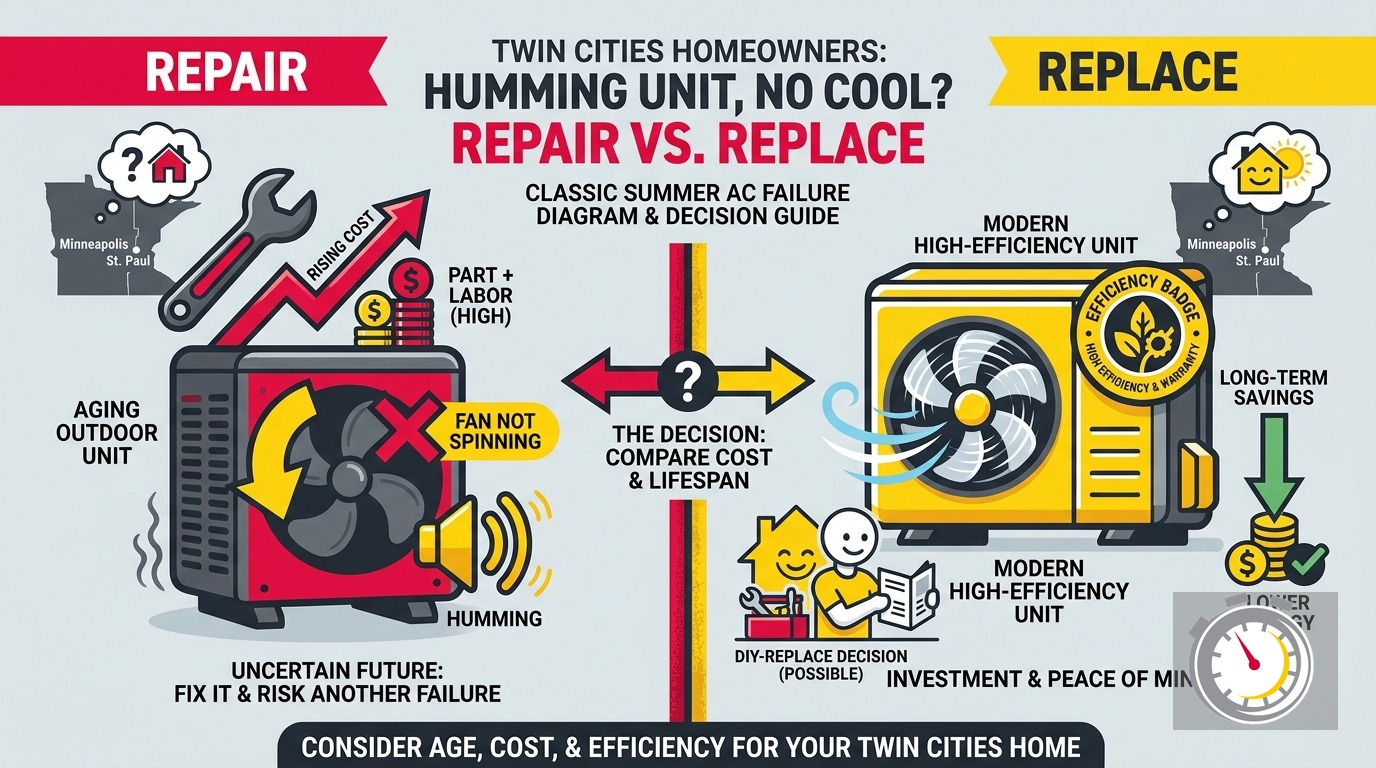
- A humming outdoor unit with a fan blade that is not moving is an emergency. Turn the system off immediately.
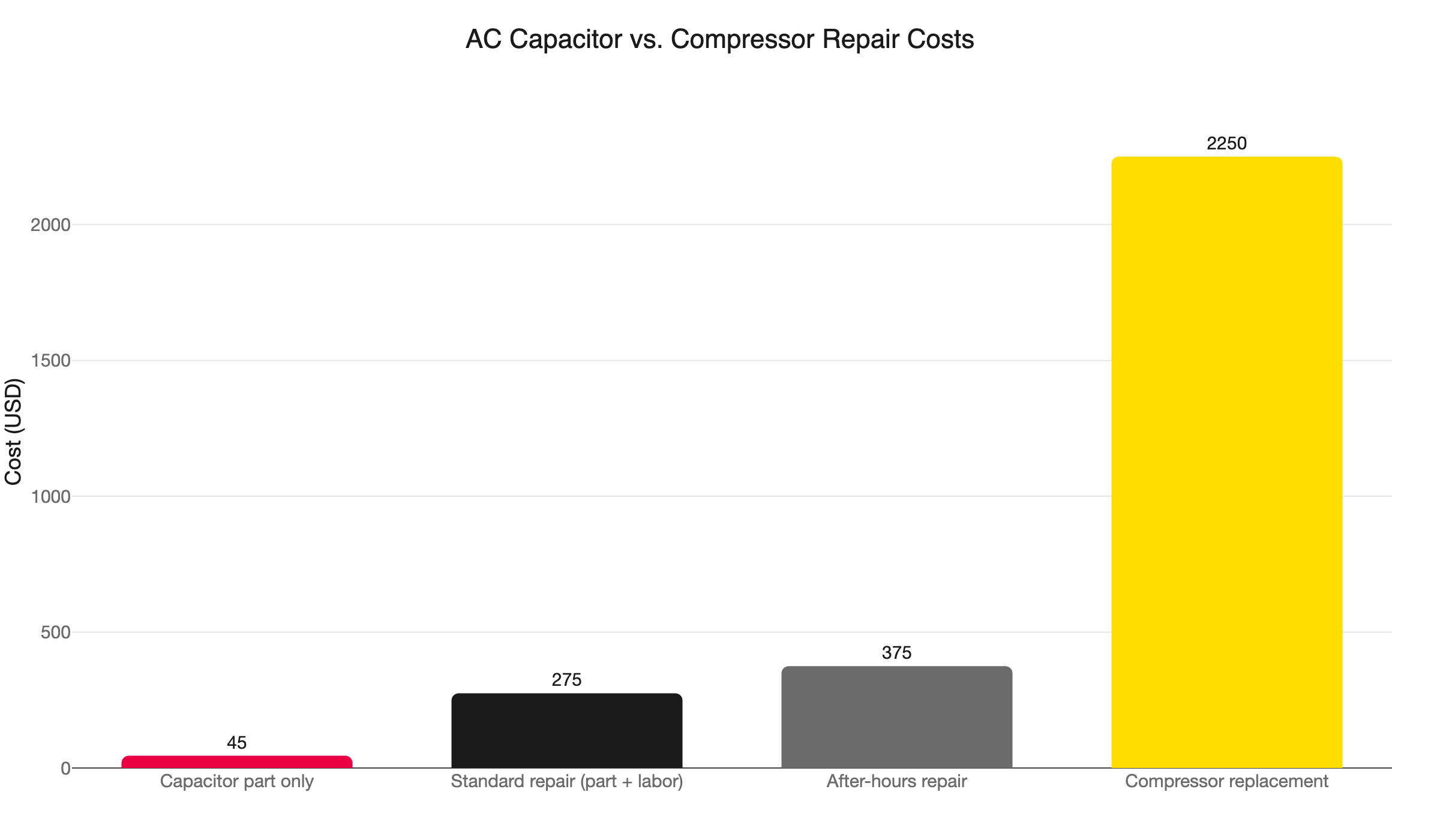
- Running the system in that state overheats your compressor within minutes. Compressor replacement costs $1,950 to $3,900 - far more than a capacitor repair.
- Twin Cities capacitors typically last 8 to 15 years. Our shorter cooling season puts far less cumulative thermal stress on the part than Sun Belt climates do.
- Capacitor replacement runs $195 to $500 for a standard service call. The part is $10 to $80. You are paying for a tech who stocks it on the truck, discharges it safely, and matches the exact microfarad spec.
- Do not manually spin the stopped fan blade with a stick or pencil to test the capacitor. That popular YouTube technique puts you near live electrical terminals that hold a lethal charge even after the power is cut.
- A weak capacitor caught during a tune-up can be replaced at a standard rate, before a July heat wave forces an emergency call.
Bad AC capacitor symptoms often show up fast. What you do in the next few minutes can determine whether you pay $350 or $3,200. This post covers what to look for, what is at risk, and what repair costs in the Twin Cities.
What Does a Capacitor Actually Do?
The quick answer: A capacitor supplies the burst of electrical energy that starts your AC’s compressor motor and condenser fan motor. It also keeps a steadying charge flowing while the motors run. Most homes have one dual-run capacitor that serves both motors at once. When it fails, both motors are affected.
Your outdoor AC unit has two electric motors. One runs the compressor, which moves refrigerant through the cooling cycle. The other spins the condenser fan on top of the unit, pulling air across the coils so heat can escape outside. Neither motor generates enough starting torque on its own. The capacitor bridges that gap.
Think of it like a starter motor on a car engine. Without it, nothing turns over.
Most residential systems use a single three-terminal unit called a dual-run capacitor. It handles both motors at the same time from one component. When that part weakens or fails, both motors are affected simultaneously. That is why a bad capacitor often looks, from the outside, like the entire outdoor unit stopped working at once.
What Are the Bad AC Capacitor Symptoms to Watch For?
The quick answer: A humming outdoor unit with a fan that is not spinning is the most urgent sign. Other symptoms include warm air from your vents, a slow or hesitant startup, short cycling, rising energy bills, and a visibly bulged or oil-stained capacitor. Any one of these warrants a service call.
Here is what to look and listen for, ordered from most urgent to least:
Fan not spinning, unit humming
This is the failure that demands immediate action. If you can hear the outdoor unit running but the fan blade on top is completely still, turn the system off at the thermostat right now. Do not let it keep running. The next section explains exactly what is happening inside when that fan stops.
Warm air from the vents
The system is running and air is moving, but it does not feel cold. A failing capacitor that still allows the compressor to limp along will reduce cooling output noticeably. This symptom usually builds over a few days before the unit quits altogether.
Slow, hesitant startup
The outdoor unit stumbles when it starts, nearly stalls, and then eventually gets going. Sometimes it takes two or three tries before it holds. That hesitation is the compressor motor straining to start without adequate capacitor support.
The system turns on, runs for a few minutes, and shuts off before reaching the set temperature. Then it starts again. This repeating pattern can mean the capacitor is failing intermittently and the compressor is tripping on thermal protection as it overheats on each start attempt.
Unusually high energy bills
A motor that is not getting proper starting assistance draws more current than normal. An unexplained midsummer electricity spike is a signal worth chasing down.
Visible damage on the capacitor
Open the service panel on the outdoor unit. If the cylindrical component inside is bulging on top, has an oil stain at its base, or smells burned near it, the capacitor has failed. Do not touch it. It likely still holds a charge.
Why Is My Outdoor Unit Humming but the Fan Isn’t Spinning?
The quick answer: The capacitor has failed and cannot start the condenser fan motor. The compressor is still trying to run, which explains the hum. Without the fan moving air across the condenser coils, heat cannot leave the cabinet. The compressor overheats, shuts down on thermal protection, and risks permanent internal damage with each restart attempt.
This is the failure pattern that turns a $350 repair into a $2,600 one.
Here is the sequence. The capacitor fails. The fan motor cannot start. Heat builds inside the condenser cabinet because nothing is moving air across the coils. The compressor runs hot and trips its thermal protection switch within minutes. The system cools slightly, tries again, and trips again. You may hear it cycling on and off every few minutes while this plays out.
Each failed hard-start attempt drives high current through the compressor’s motor windings. That current builds heat that degrades the winding insulation with each cycle. Enough of these cycles short the windings internally. At that point, the compressor cannot be repaired in the field. Replacement costs $1,950 to $3,900 depending on unit size.
Turn it off. Call a technician. That is the right move.
A warning about a popular YouTube test
Many videos tell homeowners to spin the stopped fan blade manually with a stick or pencil while the unit is running, to see if the motor kicks on by itself. Skip this. The control compartment near the fan is adjacent to live electrical terminals. Capacitors retain a lethal electrical charge even after the disconnect switch is pulled. A blade that kicks unexpectedly when the motor starts adds a second hazard. We have not seen this specific warning on any how-to site or tutorial that recommends the test. We are telling you plainly: it is not worth the risk.
How Long Do AC Capacitors Last in the Twin Cities?
The quick answer: Plan on 8 to 15 years for a Twin Cities home. Minnesota’s shorter cooling season, about 4 to 6 months, and moderate summer temperatures mean your capacitor faces far less cumulative heat stress than a unit running in Phoenix or Houston.
Research from HVAC Pricing Guide shows that in moderate climates where outdoor units run 4 to 6 months per year and ambient temperatures rarely exceed 95 degrees, capacitors typically last 8 to 15 years. In Sun Belt markets where units run nearly year-round in extreme heat, the same part lasts only 3 to 7 years.
This is meaningful for Twin Cities homeowners. An 8-year-old capacitor in Maple Grove is not in the same condition as an 8-year-old unit in Dallas. Moderate your urgency accordingly - but do not ignore symptoms once they appear. The window from first sign to full failure can be short.
When failures cluster in Minnesota
Most Twin Cities capacitor failures happen during the first sustained heat wave of summer, usually in July and sometimes in late June. The pattern is consistent. The system runs intermittently through a mild spring. Then three to five straight days of 90-plus-degree heat arrive. The unit runs nearly continuously for the first time all year. That jump in thermal load is what tips a weakening capacitor over.
If your system is 8 years or older, scheduling a pre-season AC maintenance visit gives a technician the chance to read the capacitor’s microfarad output with a meter. A capacitor reading 10 to 20% below its rated value is considered weak and should be replaced. Doing it then, at a standard rate, costs far less than an emergency call at 9 PM on a 95-degree Tuesday.
What Happens When You Ignore Bad AC Capacitor Symptoms?
The quick answer: Ignoring the symptoms puts your compressor directly at risk. Each restart attempt on a failed capacitor drives heat through the compressor’s motor windings. Enough cycles short the windings internally. Compressor replacement costs $1,950 to $3,900 - versus $195 to $500 for a capacitor repair caught early.
The compressor is the most expensive component in your outdoor unit. A bad capacitor that keeps running the system damages it in a very specific way.
Each hard-start attempt on a weakened or failed capacitor pushes excessive current through the compressor’s motor windings. Heat accumulates in the winding insulation with each cycle. Repeated stress breaks it down. Once it fails internally, the compressor is shorted and must be replaced.
Compressor replacement costs $1,950 to $3,900 depending on unit size. At that price point, you are often comparing repair against a full outdoor unit replacement. For more detail on what compressor failure looks and sounds like before you reach that stage, see our post on AC compressor failing signs, repair costs, and options for Twin Cities homeowners.
The math is plain. A capacitor repair at $195 to $500 now, versus a compressor replacement at $1,950 to $3,900 later. The window between those two outcomes can be as short as a few hours of running the system after the hum-and-no-fan symptom first appears.
Should You Replace the Capacitor Yourself?
The quick answer: We recommend against it for most homeowners. The part costs $10 to $80. But capacitors hold a lethal electrical charge even after you cut power, and the wrong microfarad rating can destroy the motor it serves, turning a $50 experiment into a much larger repair.
Here is the full picture.
The part costs $10 to $80 on Amazon or at an electrical supply house. A standard service call with labor runs $195 to $500. On the surface, DIY looks like a reasonable save.
But capacitors retain lethal electrical charge after the disconnect is pulled. A trained tech uses an insulated discharge tool before touching the terminals. Without that step, contact with the terminals is potentially fatal. That is not a hedge. It is the specific reason this repair carries real risk for an untrained homeowner.
The second issue is the specification. A wrong microfarad rating, even a nearby value such as 40/5 µF instead of 45/5 µF, can damage the fan motor or compressor the capacitor serves. The correct rating is printed on the old capacitor, but reading it accurately, sourcing an exact match, and verifying it against the unit’s data plate takes experience. A wrong part that runs for a few weeks before burning out the motor turns a $50 DIY save into a $650 motor replacement or worse.
No permit is required in Minnesota for a like-for-like capacitor swap. That is not a regulatory barrier. It is purely a safety and warranty question. If you are experienced with electrical work and understand capacitor discharge procedures, the technical steps are not complex. For most homeowners, the risk-to-savings ratio does not favor DIY here.
How Much Does AC Capacitor Replacement Cost?
The quick answer: Budget $195 to $500 for a standard daytime call. After-hours and weekends run $325 to $650. The part is $10 to $80. That range reflects the service call fee, diagnostic time, and labor for a 20-to-45-minute repair.
Here is how the costs typically break down:
- The part: $10 to $80 for a dual-run capacitor. Most common residential sizes fall in the $20 to $50 range.
- Service call and diagnostic fee: $95 to $195.
- Labor: 20 to 45 minutes if the tech carries the right size on the truck. A company that stocks common capacitor sizes completes most repairs on the first visit.
- After-hours premium: Adds $95 to $195 on top of the standard rate.
One question worth asking when you call: does the tech stock common capacitor sizes on the truck? If the exact size must be ordered, that means a return trip and a second service call fee.
Two add-ons worth considering
The contactor and the capacitor share the same electrical path and wear at similar rates. If your system is more than 8 years old and the capacitor just failed, ask the tech to check the contactor at the same time. Replacing both in one visit costs $325 to $700. Two separate visits run $375 to $950. Bundling saves one service call fee and one trip.
For systems 8 years or older that have already had one capacitor failure, a hard-start kit is worth discussing. Hard-start kits run $130 to $250 installed. They reduce the electrical stress on the compressor at startup and extend the life of both the compressor and the next capacitor.
What a Good Technician Checks Beyond the Capacitor
A capacitor swap takes 20 to 45 minutes. A thorough one takes a little longer. The difference matters.
After installing the new capacitor, the tech should measure motor amp draw on both the condenser fan motor and the compressor. If either is drawing above its nameplate rating, that motor is beginning to fail. A motor in decline burns through the new capacitor within months. Knowing this on the same visit lets you plan rather than react to a second breakdown later in the summer.
The tech should also confirm the new capacitor’s microfarad value matches the spec exactly, not approximately. The label on the old capacitor and the unit’s data plate should agree.
If you have not had a maintenance visit in more than a year, this is a reasonable time to ask about a full tune-up rather than a single component swap. You leave with a complete system assessment instead of just one fixed part. For the things you can do yourself between service calls, our post on 5 maintenance tips to extend your AC’s lifespan is a practical starting point.
Call Before the Fan Stops
Northern One Hour is locally owned and operated in Ramsey, MN. We serve Minneapolis, St. Paul, Blaine, Maple Grove, Plymouth, Brooklyn Park, Woodbury, Bloomington, and the surrounding Twin Cities area. Our trucks carry common capacitor sizes, so most repairs are completed on the first visit.
We back every appointment with our on-time guarantee: “Always On Time… Or You Don’t Pay a Dime!(R)”
If your outdoor unit is humming but not cooling, or if the fan has stopped entirely, turn the system off and call us at (763) 260-6662. You can also book your AC repair online. Same-day appointments are available for urgent calls.
If you are not in a breakdown yet but your system is 8 years or older, scheduling a maintenance visit now is the lower-cost path. A weak capacitor caught during a tune-up costs far less to replace than one that fails at 10 PM on a July weekend.
Frequently Asked Questions
What are the most common bad AC capacitor symptoms? +
Can I replace an AC capacitor myself? +
How much does AC capacitor replacement cost in Minnesota? +
How long do AC capacitors last in the Twin Cities? +
Need a technician now?