
AC Contactor Bad Symptoms: Why Your Outdoor Unit Fails
Key Takeaways
- The contactor is the high-voltage relay that delivers power to your outdoor unit’s compressor and fan motor every cooling cycle.
- A stuck-open contactor leaves the outdoor unit completely silent. A stuck-closed contactor makes it run nonstop.
- The nonstop-run failure is unique to the contactor. No other common HVAC failure produces it.
- Chattering or rapid clicking from the outdoor unit points to the contactor, not the capacitor.
- Visual signs include pitting, charring, and green or white residue on the contact surfaces.
- Contactor replacement in the Twin Cities runs approximately $195-$500, parts and labor. It is usually a same-visit fix.
- The stuck-closed failure is the more urgent one. A compressor running nonstop in summer heat can overheat and fail.
What Are AC Contactor Bad Symptoms?
AC contactor bad symptoms fall into four patterns: a completely silent outdoor unit, a humming outdoor unit that won’t start, rapid chattering or clicking from outside, or an outdoor unit that won’t stop running after the thermostat calls for off. That last one - nonstop running - belongs almost exclusively to the contactor.
The contactor is the relay switch inside your outdoor unit. It connects the compressor and condenser fan motor to line voltage every time your thermostat calls for cooling. When demand drops, the contactor opens and power stops. Simple in theory. Under stress, the contacts wear out.
That wear is accelerated in the Twin Cities. Our summers hit the mid-90s. Our winters hit -20. Your outdoor unit lives through more than a hundred degrees of temperature swing between seasons. The contactor opens and closes dozens of times on a hot July day. Over a season, that adds up to thousands of cycles. The contacts pit, they oxidize, and eventually they fail.
When they fail, they go in one of two directions. Either the contacts cannot close - the outdoor unit goes dead - or they cannot open - the outdoor unit won’t stop. Both failures surface most often on the hottest, busiest days of summer, when the system has been running the hardest and the contacts are most stressed.
What Does the AC Contactor Do?
The contactor is a high-voltage relay. Your thermostat sends a low-voltage (24V) signal that energizes the contactor’s coil. The coil pulls a metal plunger down to bridge a set of contacts, which delivers line voltage to your outdoor unit’s compressor and condenser fan motor. When the signal drops, the plunger releases and power stops.
One switch. Two states. Every cooling cycle depends on it.
The part itself costs $20-$100. But it handles every amp of power your compressor and fan motor draw, hundreds of times per season, under conditions that stress it more than a national average suggests.
Minnesota’s climate is hard on contactors. The wide seasonal temperature swing causes metal contact surfaces to expand and contract with every cycle. Summer humidity adds moisture to the equation. A contactor that lasts 10 years in a mild climate may show wear in 7 or 8 years here. Peak failure season is July and August, when systems run the longest hours and local technicians are at their busiest.
The good news: a failing contactor almost always shows warning signs before it fails completely. Catching those signs means a routine repair call instead of an emergency one.
What Are the Two Ways an AC Contactor Fails?
Contactors fail in two opposite directions: stuck open and stuck closed. Stuck open means no power reaches the outdoor unit. Stuck closed means power stays on permanently. Each produces a distinct symptom profile, and knowing the difference helps you decide how quickly to act.
Stuck open: the outdoor unit goes dead
A stuck-open contactor fails to close when the coil energizes. The plunger does not bridge the contacts, so no line voltage reaches the compressor or fan motor.
Symptoms of a stuck-open contactor:
- Complete silence from the outdoor unit while the indoor air handler continues running.
- Air moving through the vents, but the air is warm or barely cooled.
- A faint hum or buzz from the outdoor unit area without the fan or compressor starting - the coil is energized but the contacts are not closing.
- Chattering or rapid clicking, if the contacts are partially degraded and the coil is cycling the plunger repeatedly without latching shut.
A stuck-open contactor is uncomfortable - you lose cooling - but it is not usually an active damage risk. You can wait for a scheduled repair call in most cases.
Stuck closed: the outdoor unit won’t stop
A stuck-closed contactor has contact surfaces that have fused or welded together. The plunger cannot release even when the coil drops power. Line voltage stays connected to the compressor and fan motor permanently.
Symptoms of a stuck-closed contactor:
- The outdoor unit runs nonstop regardless of what the thermostat says.
- The unit continues running after you raise the setpoint, switch to fan-only mode, or turn the thermostat off.
- The unit runs through the night when no cooling is needed.
This failure mode is more urgent. A compressor running without the normal stop-start cycle cannot manage heat dissipation the way it is designed to. Extended nonstop run on a hot day risks overheating and compressor failure. That is a much more expensive outcome than a contactor swap.
If your outdoor unit won’t stop, shut off the outdoor disconnect and call for same-day service.
How Do You Tell a Bad Contactor from a Bad Capacitor?
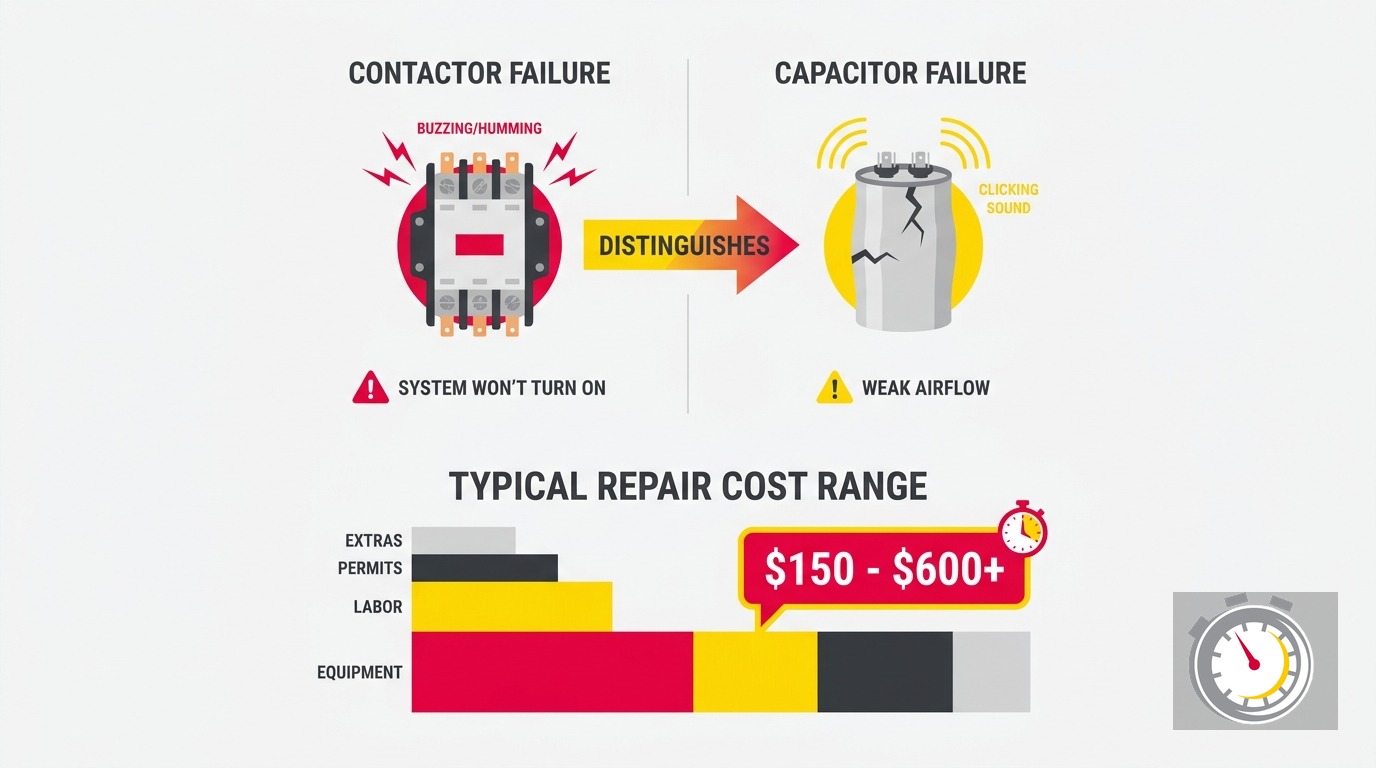
Use the symptom profile. Completely silent outdoor unit with no sound: the contactor is more likely. Fan or compressor hums but won’t spin: the capacitor is more likely. Outdoor unit won’t shut off: the contactor, almost certainly. Both parts can cause a no-start, but only the contactor causes nonstop running.
The two parts affect the same outcome - whether the outdoor unit starts - but they fail at different steps in the power chain.
The contactor delivers power to the outdoor unit. When the contactor fails open, no power reaches the motors at all. When the capacitor fails, power is present but the motors cannot generate the starting torque needed to turn over.
Think of it as a two-step process. Step one: the contactor closes and delivers electricity. Step two: the capacitor gives each motor its starting push. Step-one failure is a contactor problem. Step-two failure is a capacitor problem.
Chattering is the clearest differentiator by sound. Rapid clicking from the outdoor unit points to the contactor’s coil cycling without holding the plunger closed. A bad capacitor does not produce that sound.
For a full look at capacitor failure specifically, see our post on bad AC capacitor symptoms and repair cost in the Twin Cities.
What Sounds Does a Bad AC Contactor Make?
A working contactor makes one solid thunk when it closes at the start of a cooling cycle. A failing contactor either makes no sound at all (stuck open) or chatters rapidly (coil cycling the plunger without holding it shut). A faint buzz from the outdoor unit with nothing running points to partial contact failure.
Breaking it down by sound:
- Silence from the outdoor unit: The stuck-open failure. No power is reaching the compressor or fan motor. The indoor unit runs, air moves through the vents, but the outdoor unit is completely quiet.
- Chattering or rapid clicking: The coil is cycling the plunger rapidly because it cannot hold it closed. Each failed closure attempt produces a click. This creates a machine-gun sound from inside the outdoor unit. It is a contactor-specific failure mode.
- Faint buzzing with nothing running: The coil is partially energized but the contacts are not making solid connection. The outdoor unit receives some signal but not enough to start.
None of these sounds resolve on their own. A chattering contactor is also stressing the coil with each failed attempt. Left alone, a contactor problem can become a wiring or transformer problem.
What Do the Visual Warning Signs Look Like?
Pitting, charring, burn marks, or green and white residue on the contact surfaces are the visible signs of a worn or damaged contactor. A technician identifies these during any routine inspection. Visible damage usually means the contactor has been failing for some time.
The contacts are inside the outdoor unit’s electrical compartment. Opening that compartment safely requires cutting power at the disconnect and waiting for internal capacitors to discharge. A technician also uses test equipment to verify the unit is fully de-energized before touching anything inside. This is not a homeowner visual check.
Here is what a technician looks for:
- Pitting or craters on the contact faces: Minor pitting is expected after several seasons. Deep cratering signals end-of-life for the part.
- Charring or carbon deposits: Burn marks from arcing. The contacts have been running degraded for some time.
- Green or white residue: Green discoloration is oxidation from moisture exposure. White residue is mineral deposit from condensation. Both increase contact resistance and accelerate wear.
- Fused or welded surfaces: Metal visibly melted together at the contact face. This is the stuck-closed failure mode.
Our technicians inspect the contactor during every AC tune-up and maintenance visit. A worn contactor caught during maintenance is a straightforward swap at a scheduled rate. The same problem found on a 95-degree afternoon with the house heating up is a more expensive, more stressful call.
How Much Does Contactor Replacement Cost in the Twin Cities?
Contactor replacement in the Twin Cities runs approximately $195-$500, parts and labor. The contactor itself costs $20-$100. Labor and the service visit make up most of the total. Local technicians stock contactors on their trucks, so this is typically a same-day repair.
National sources put the average range at $150-$450. Twin Cities pricing runs above that. Regional labor rates and the concentrated July-August demand window both push local repair costs higher than a national average built from dozens of markets.
For context, capacitor replacement nationally averages $100-$250. Both are inexpensive repairs relative to what an unaddressed failure can become. A stuck-closed contactor that runs a compressor nonstop in summer heat turns a $200-$400 repair into a compressor replacement conversation.
A few factors that affect your final number:
- After-hours and weekend calls: Emergency calls carry a premium on top of standard rates. If the failure is stuck-open (no cooling but no active damage risk), scheduling during regular hours saves money without meaningful risk.
- System age: If your system is 12 years or older, ask about overall condition while the technician is already on-site. A contactor repair that buys another full season is often worth it. A pattern of multiple repairs in a short window is a signal that a replacement conversation makes sense.
Should You Replace an AC Contactor Yourself?
A contactor costs $20-$100 online. The swap looks simple on YouTube. But the outdoor unit’s electrical compartment carries line-voltage wiring, and capacitors inside the unit hold a charge even after you cut the outdoor disconnect. Working at line voltage without proper training and test equipment is a real shock risk.
There is also a diagnostic argument for professional replacement. A contactor is cheap. A compressor is not. If the real problem is a failing compressor, a low-voltage wiring fault, or a control board issue, replacing the contactor will not fix it. A technician tests coil voltage and contact resistance before condemning the part. That verification is part of what the labor cost covers.
A licensed HVAC technician can complete the swap in under an hour. Labor costs are modest. A missed diagnosis or a wiring error on a unit carrying thousands of dollars in compressor and coil value is not.
When Should You Call a Technician?
Call for same-day service if the outdoor unit won’t shut off, if you hear loud chattering or repeated clicking from outside, or if you see burn marks or smell burning near the outdoor unit. Schedule during regular hours if the outdoor unit is silent and the situation is stable.
Situations that warrant same-day attention:
- The outdoor unit is running nonstop and does not respond to the thermostat.
- Loud chattering or rapid clicking from the outdoor unit.
- A burning smell or visible burn marks near the outdoor disconnect or access panel.
Situations where a regular-hours call is appropriate:
- The outdoor unit is completely silent. No cooling, but no active damage risk while you wait.
- Intermittent failures that resolve on their own but are becoming more frequent.
Our team is locally owned and operated, serving Minneapolis, St. Paul, Ramsey, Blaine, Maple Grove, Plymouth, Brooklyn Park, Woodbury, and Bloomington. We stock contactors on our service trucks and book same-day appointments during the cooling season when slots are available.
Call (763) 260-6662 or book online. We back every visit with our on-time guarantee: “Always On Time… Or You Don’t Pay a Dime!(R).”
If your AC has been showing other warning signs alongside contactor symptoms, our guide to AC compressor failure signs and repair costs in the Twin Cities covers what to watch for next. And if short cycling is part of the pattern, our post on AC short cycling causes and fixes covers the other faults worth ruling out.
Frequently Asked Questions
What are the symptoms of a bad AC contactor? +
How do I tell if it is the contactor or the capacitor? +
How much does AC contactor replacement cost in the Twin Cities? +
Can I replace an AC contactor myself? +
Need a technician now?