
AC Keeps Tripping the Circuit Breaker? Here's Why
Key Takeaways
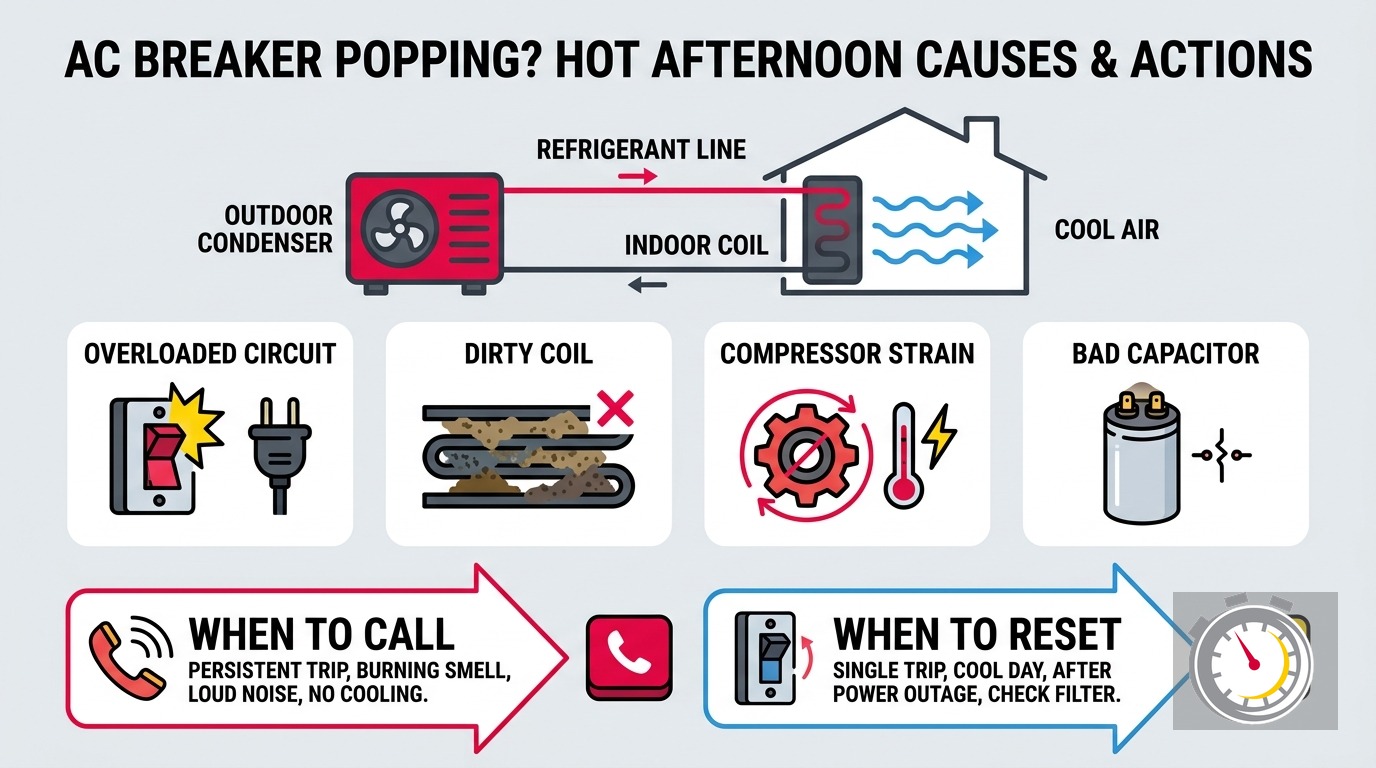
- When your ac keeps tripping the circuit breaker, the system is drawing more current than the breaker can handle. Heat, dirty components, and failing parts all push amp draw higher.
- The timing of the trip tells you what broke. A trip at startup points to a bad capacitor or a hard-starting compressor. A trip after 20-40 minutes of running points to thermal overload: dirty coil, low refrigerant, or aging motor windings.
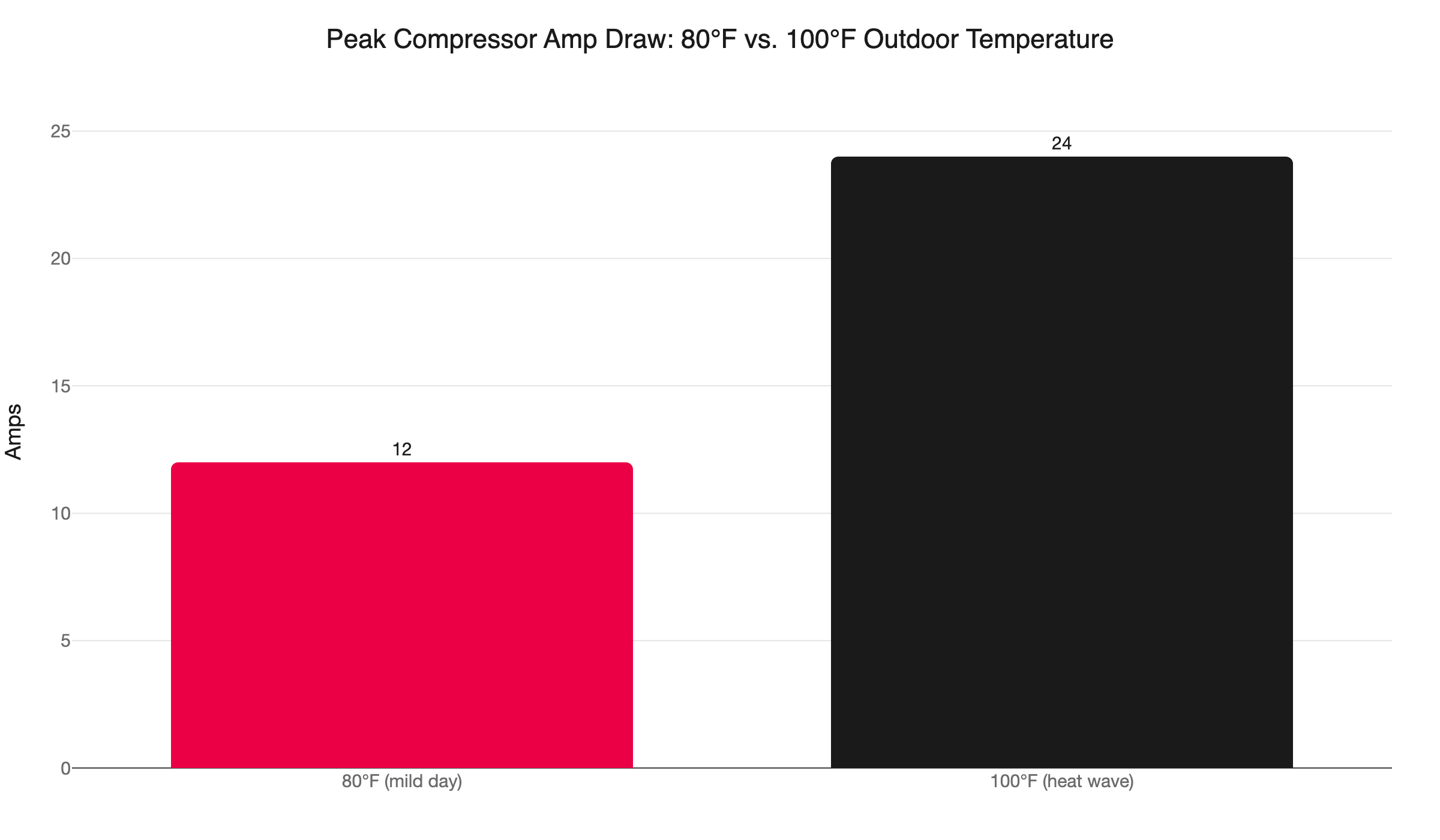
- At 100°F ambient, a typical compressor draws twice the amps it does at 80°F. A system that ran fine all morning can reach its amp limit by early afternoon.
- Reset the breaker once. Wait 30 minutes. Restart. If it trips again within a few hours, stop and call a tech. Never reset more than twice in a single day.
- Xcel Energy offers $150-$450 in rebates on AC replacement. If your system is 12 or more years old, asking for a replacement estimate alongside the repair quote is worth it.
Why Does My AC Keep Tripping the Circuit Breaker?
Your AC trips the circuit breaker when it draws more current than the breaker is rated to handle. The cause can be a failing component inside the AC, a wiring or circuit problem, or an aging breaker that no longer holds its rated trip point. The cause determines whether you need an HVAC tech, an electrician, or both.
Your AC runs on a dedicated 240-volt circuit with a double-pole breaker. NEC Article 440 governs how that circuit must be sized. The maximum overcurrent protection is printed on your outdoor unit’s nameplate. When the compressor draws more amps than that rating allows, the breaker trips to protect the wiring from overheating.
That is not a malfunction. That is the safety system working as designed. The problem is whatever pushed the amp draw over the limit.
The short list of causes: a failing capacitor, dirty condenser coils, low refrigerant charge, an aging compressor motor, or a weakened breaker. We will walk through each one. But the most useful starting point is understanding why the problem almost always peaks on the hottest afternoons in the Twin Cities.
Why It Gets Worse on Hot Afternoons
This is the question most HVAC content skips, and it matters specifically for Minnesota homeowners.
July 2026 ended as the 6th hottest on record at Minneapolis-St. Paul International Airport, averaging 78.9°F for the month. That is 4.6 degrees above the 1991-2020 normal. MSP hit 100°F on July 27, with a dew point of 81°F. Days like that stack three separate problems on your AC unit by mid-afternoon.
Solar gain on the house. The home has been absorbing heat since morning. Attic temperatures, wall surface temperatures, and interior temps are highest between 2 and 4 p.m. The thermostat calls for cooling more aggressively and holds that call longer.
The condenser unit has been baking. Your outdoor unit sits in direct sun. The metal cabinet, the aluminum fins, and the refrigerant lines inside it have absorbed solar radiation for hours. By afternoon, the unit has to shed heat into air that is already very hot and has very little capacity to absorb more.
Ambient temperature drives amp draw up. Compressor amp draw is not a fixed number. It climbs with outdoor temperature. Field measurements from HVAC technicians show a typical unit pulling 10-12 amps on an 80°F day will pull 24 amps or more at 100°F. Same motor, same refrigerant charge, same ductwork. The heat is the multiplier.
A unit that ran without issue all morning is already operating near its amp ceiling by 3 p.m. One dirty coil or one marginal capacitor tips it over.
Startup Trip vs. Running Trip: What the Timing Tells You
Before you call a tech, note exactly when the trip happens. That single piece of information tells you which part likely failed and what parts the technician should bring on the truck.
The breaker trips within 1-2 seconds of startup. This almost always points to a capacitor problem or a hard-starting compressor. Every compressor motor needs a surge of current to go from zero to running speed. That startup surge can reach 6-10 times the rated running current for a half-second to two seconds. A healthy capacitor delivers the energy boost needed and the motor snaps to speed. A failing capacitor cannot deliver it. The motor holds in that high-amp, locked-rotor state, and the breaker trips before the compressor ever reaches operating speed.
The breaker trips after 20-40 minutes of running. This is thermal overload. The system ran, but the heat it was trying to move had nowhere efficient to go. Dirty coils, low refrigerant, or aging motor windings forced the compressor to keep running past the point a healthy system would have finished the cycle. Amp draw climbed over those 20-40 minutes until it crossed the breaker’s rated threshold.
Tell the technician which pattern applies when you call. “It trips the instant it starts” and “it runs for half an hour and then trips” point to different failed parts. Giving the tech that context means a faster diagnosis and the right parts on the first visit.
What Causes a Trip at Startup?
Short answer: A failing start capacitor is the most common cause. Without it, the compressor motor cannot reach running speed quickly enough, and the sustained high amp draw trips the breaker. Heat degrades capacitors faster than anything else, making hot Twin Cities afternoons the worst possible conditions for a marginal cap.
Here is what your technician will check:
Capacitor failure. The capacitor stores and releases a burst of electrical energy to help the compressor and fan motors start. Heat degrades the dielectric material inside the capacitor over time. A cap that was borderline last fall may not survive a July heat wave. A failing capacitor causes what technicians call a hard start: the compressor struggles to reach running speed, holds in the high-amp locked-rotor zone, and trips the breaker. Capacitor replacement is a relatively low-cost repair with a fast turnaround. It is one of the most common fixes on a summer service call.
A hard-starting compressor. If the capacitor tests good but the compressor still struggles at startup, the motor windings may be weakening with age. A hard-start kit can give the compressor the extra boost it needs and extend its useful life by a season or two. At some point, compressor replacement becomes the better option.
A grounded compressor. If the breaker trips at startup and will not reset at all, the compressor may have an internal winding shorted to ground. In that case, the breaker is doing exactly what it should: stopping current flow through a dead short. The fix is compressor replacement or, in most cases with systems over 12 years old, a full system replacement. Installing a new compressor in an aging system often creates a mismatched unit and may not be covered under equipment warranties.
What Causes a Trip After 20-40 Minutes of Running?
Short answer: Something is blocking heat transfer and forcing the compressor to work harder and longer than it was designed to. The three most common culprits are a dirty condenser coil, low refrigerant charge, and aging motor windings. All three get worse on hot days because there is less margin for error when ambient temperatures are already high.
Dirty condenser coils. The outdoor unit’s job is to dump your home’s heat into the outdoor air. Dirty condenser coils cannot shed that heat efficiently. The compressor runs under higher head pressure, draws more current, and eventually trips the breaker after sustained operation. This is one of the most preventable causes on this list. Annual spring maintenance includes coil cleaning. A tune-up in April or May means this problem does not surface on a 100-degree afternoon in July. Our air conditioning maintenance page covers what a full tune-up includes.
Dirty air filter. A clogged filter restricts airflow across the indoor evaporator coil. Less airflow means the evaporator cannot absorb heat from the home’s air efficiently. The system runs longer trying to reach setpoint, and the compressor draws more amps over time. ENERGY STAR identifies a dirty filter as the leading cause of premature AC failure and efficiency loss. During peak cooling season, check your filter at least once a month.
Low refrigerant charge. Low refrigerant means the system has less working fluid to carry heat from the indoor coil to the outdoor unit. The compressor compensates by running harder and longer, drawing more current in the process. Low refrigerant is almost always a sign of a leak somewhere in the system. Adding refrigerant without finding and sealing the leak is a temporary patch that will not hold through the season.
Aging motor windings. Motor windings in the compressor and fan motors degrade with years of heat cycling. Degraded windings have higher electrical resistance, which translates to higher amp draw for the same mechanical output. If your system is 12-15 years old and starts tripping the breaker regularly on hot days, aging windings may be the root cause rather than any single replaceable component.
An oversized system. An AC that is too large for your home short-cycles: it hits the thermostat setpoint quickly, shuts off, then fires back up a few minutes later. Every startup is a high-amp surge. Frequent startups compound wear on the compressor and raise the total number of trips over a season. If your system was installed without a Manual J load calculation, oversizing is worth discussing with your technician.
Can I Reset the Circuit Breaker Myself?
Short answer: Yes, once. Reset the breaker, wait 30 minutes, then restart the AC. If the system holds through the afternoon, watch it. If it trips again within a few hours, stop resetting and call a tech. Never reset the same breaker more than twice in a single day for the same appliance.
The 30-minute wait is not optional. Your compressor builds high-pressure refrigerant on one side of the system and low-pressure on the other while running. When it shuts off mid-cycle, those pressures need time to equalize. Restarting immediately after a trip forces the motor to start against an unequalized system. That compounds stress on a compressor that was already struggling.
Here is the decision rule to follow:
- Reset the breaker once.
- Wait 30 minutes with the AC off.
- Restart the system.
- If it holds for the rest of the afternoon, watch it over the next day or two. A single trip can result from a transient voltage event. One trip is not always a crisis.
- If it trips again within a few hours, stop there and call a tech.
Repeated resets push current through a circuit that is telling you something is wrong. At best, you accelerate wear on the compressor motor. At worst, you damage the wiring inside the panel. The breaker trips to protect you. Resetting it repeatedly overrides that protection.
Is the Circuit Breaker Itself the Problem?
Short answer: Sometimes. Breakers wear out over years of repeated trips. An aging breaker can start tripping at current below its rated value, shutting down a system that is drawing within spec. An electrician can test whether your breaker is still holding its rated trip point.
Older Minneapolis and St. Paul homes often have 60-100 amp panels that were sized before central air conditioning was standard. A modern 3-ton AC system typically needs a dedicated 40-50 amp, 240-volt, double-pole circuit. If the circuit was sized for an older, smaller unit and the panel has not been updated, the breaker may be undersized for the system currently running on it.
This is an electrical issue, not an HVAC issue. If our technician finds the AC unit is drawing within spec but the breaker keeps tripping, the next call is to a licensed electrician to assess the panel and circuit size. We handle the HVAC side of that conversation and can give you the exact running amp measurement so you have the right data for the electrical contractor.
What Does This Mean for Older Twin Cities Homes?
A large share of Minneapolis and St. Paul housing stock is 50-80 years old. Many of these homes have panels sized before central air conditioning was common. Add an aging AC system and a heat wave like July 2026, and the risk of a mid-summer failure increases significantly.
The practical answer is spring maintenance before peak heat arrives. A technician who checks capacitor health, measures running amps, inspects the condenser coil, and verifies refrigerant charge in May can catch a marginal capacitor or a coil that needs cleaning well before either one causes a trip at 3 p.m. in July.
If your system is already showing signs of strain beyond a tripped breaker, our post on AC compressor failing signs and repair cost in the Twin Cities walks through the warning signs that appear before a compressor completely fails, along with what you can expect to pay.
When Should You Replace the AC Instead of Repairing It?
Short answer: If your system is 12 or more years old and the repair involves the compressor or repeated trips pointing to aged motor windings, the math often favors replacement. A new ENERGY STAR unit can cut cooling costs by up to 30% compared to an older system, and Xcel Energy rebates reduce the upfront cost meaningfully.
The formula most HVAC professionals use: multiply the repair cost by the system’s age in years. If that product exceeds the cost of a new system, replacement is the better investment.
A $1,550 compressor repair on a 14-year-old system: 1,200 x 14 = 16,800. A new system at or below that figure is a better call. You also avoid paying for the next component that fails on a 14-year-old unit six months later.
Repeated breaker trips are one of the more reliable signals that a system is approaching end of life. If your AC has tripped the breaker multiple times this summer and is pushing 15 years old, it is worth asking for both a repair quote and a replacement estimate at the same visit. Our AC replacement cost guide for Minnesota homeowners covers what to expect, including which efficiency tier makes sense for our climate and what size system is right for your home.
Xcel Energy Rebates Worth Knowing
If your system is headed toward replacement, timing the purchase while rebates are active lowers the out-of-pocket cost.
Xcel Energy offers $150-$450 in rebates on central AC replacement, depending on the efficiency tier of the new unit. Those rebates stack with the federal tax credit for qualifying high-efficiency systems. If you are weighing a cold-climate heat pump instead of a straight AC replacement, Xcel offers up to $2,000 in rebates on heat pump installs, and the federal credit can add more on top.
Xcel also runs an AC Rewards program: enroll your smart thermostat, and Xcel may cycle your AC for a few hours on peak-demand afternoons during summer. You receive a $25-$40 annual bill credit in return. If you are not home during peak afternoon hours, that is a low-effort way to reduce a bill that has been climbing.
Talk to your technician about which rebates apply to the system they recommend. We factor those numbers into the replacement conversation so you understand the net cost, not just the sticker price.
What to Expect When You Call Us
When you call Northern One Hour, we ask about timing first. Does the breaker trip at startup or after 20-40 minutes of running? That single answer tells us which parts to put on the truck. A startup trip in peak cooling season typically means a capacitor and a hard-start kit. A running trip means refrigerant gauges, a running amp check, and a condenser coil inspection.
We are locally owned and operated in Ramsey, MN, serving the Twin Cities metro: Minneapolis, St. Paul, Blaine, Maple Grove, Plymouth, Brooklyn Park, Woodbury, Bloomington, and surrounding communities. Our technicians know Minnesota summers. They know what a 100-degree afternoon does to a marginal system, and they know that a missed or late service appointment is not acceptable when your home is heating up fast.
Our guarantee is straightforward: “Always On Time… Or You Don’t Pay a Dime!(R)” That promise exists because we understand what a wide service window costs you when your AC is down in July.
If your AC is tripping the breaker today, call us at (763) 260-6662 or schedule a repair online. We will diagnose the cause, give you straight pricing, and tell you honestly whether repair or replacement is the right call for your system.
Key Takeaways
- When an ac keeps tripping the circuit breaker, amp draw has exceeded the breaker’s rated limit. Heat, dirty components, and failing parts all force amp draw higher.
- Timing tells you what broke. A startup trip means a bad capacitor or hard-starting compressor. A running trip means thermal overload from a dirty coil, low refrigerant, or aging motor windings.
- At 100°F, a typical compressor draws twice the amps it does at 80°F. A marginal system that ran cleanly all morning can trip its breaker by early afternoon in a Twin Cities heat wave.
- Reset once. Wait 30 minutes. Restart. If it trips again within a few hours, call a tech. Never reset more than twice in a day.
- Systems 12 or more years old should get a repair vs. replacement estimate. Xcel rebates of $150-$450 are available now.
- Call (763) 260-6662 or book online. We will tell you exactly what is happening and what it costs to fix it.
Frequently Asked Questions
Can I reset the breaker if my AC trips it? +
Why does my AC only trip the breaker in the afternoon? +
How can I tell if it's the capacitor or the compressor causing the trip? +
Need a technician now?