
AC Leaking Water Inside: 3 Causes and How to Fix Them
Key Takeaways
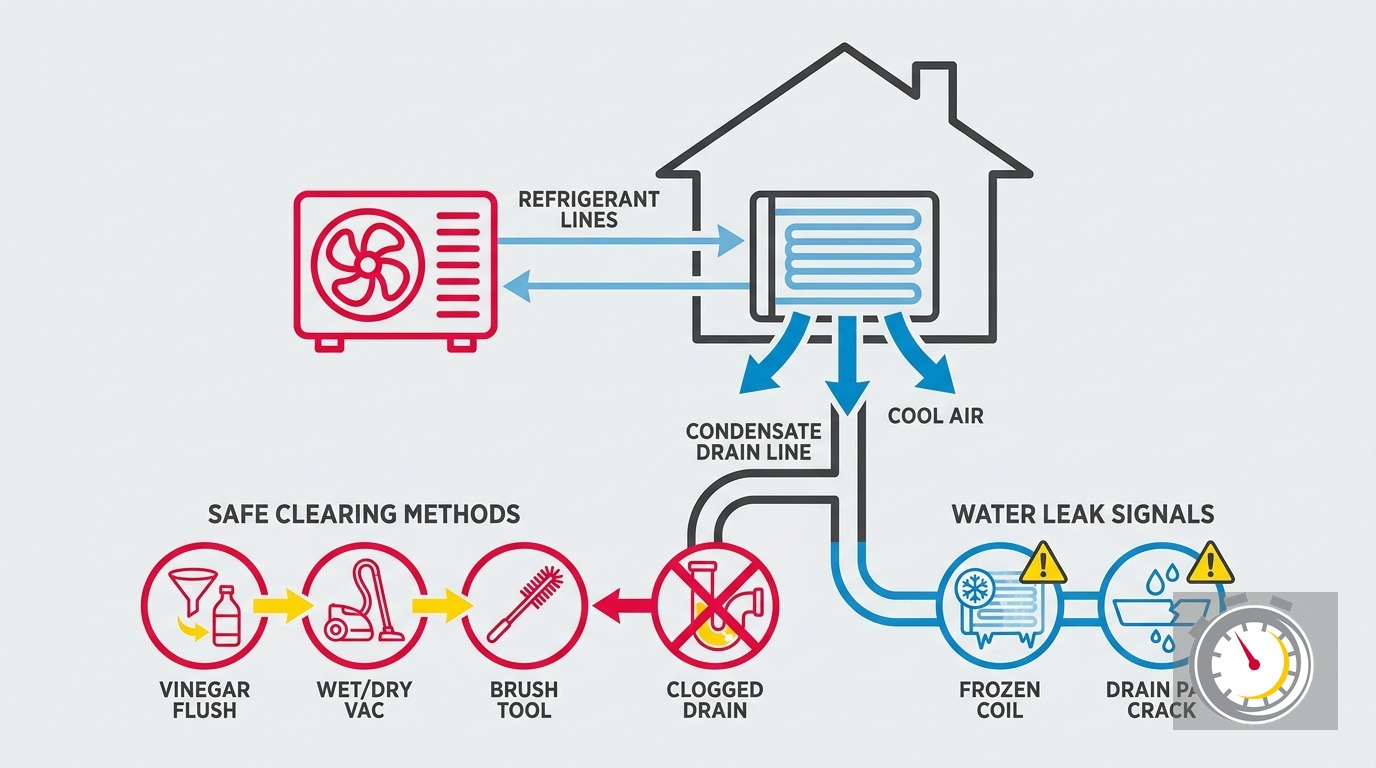
- An AC leaking water inside almost always comes from one of three causes: a clogged condensate drain line, a frozen evaporator coil, or a cracked drain pan.
- Each cause has its own symptom pattern. Knowing which one you have tells you whether to grab a shop vac or call a tech.
- Twin Cities summer dew points regularly hit 65 to 70 degrees Fahrenheit. Your AC can shed 20 to 30 gallons of condensate on peak days - all through one 3/4-inch PVC line.
- If your air handler is in the attic, a condensate clog is a structural emergency. It can rot subfloor within hours.
- You can safely clear a clogged drain with a wet/dry vac and distilled white vinegar. Do not use bleach - it degrades PVC glue joints over time.
- A float switch that cuts power before your pan overflows is code-required for attic installs and a smart upgrade for any unit.
- Call (763) 260-6662 if your coil is frozen, your pan is cracked, or the clog does not clear after two attempts.
Why Does an AC Produce Water in the First Place?
Your AC pulls humidity out of warm indoor air as it cools. That moisture drips into a collection pan, then drains through a 3/4-inch PVC line. When the drain, the pan, or the coil fails, that water ends up somewhere it should not be.
Think of your air conditioner as a dehumidifier that also cools. Warm air passes over a cold evaporator coil. The coil surface is cold enough to pull water vapor out of the air - the same way a cold glass sweats on a humid day. That water drips into the condensate drain pan. From there, a drain line carries it out to a floor drain, a utility sink, or outside your home.
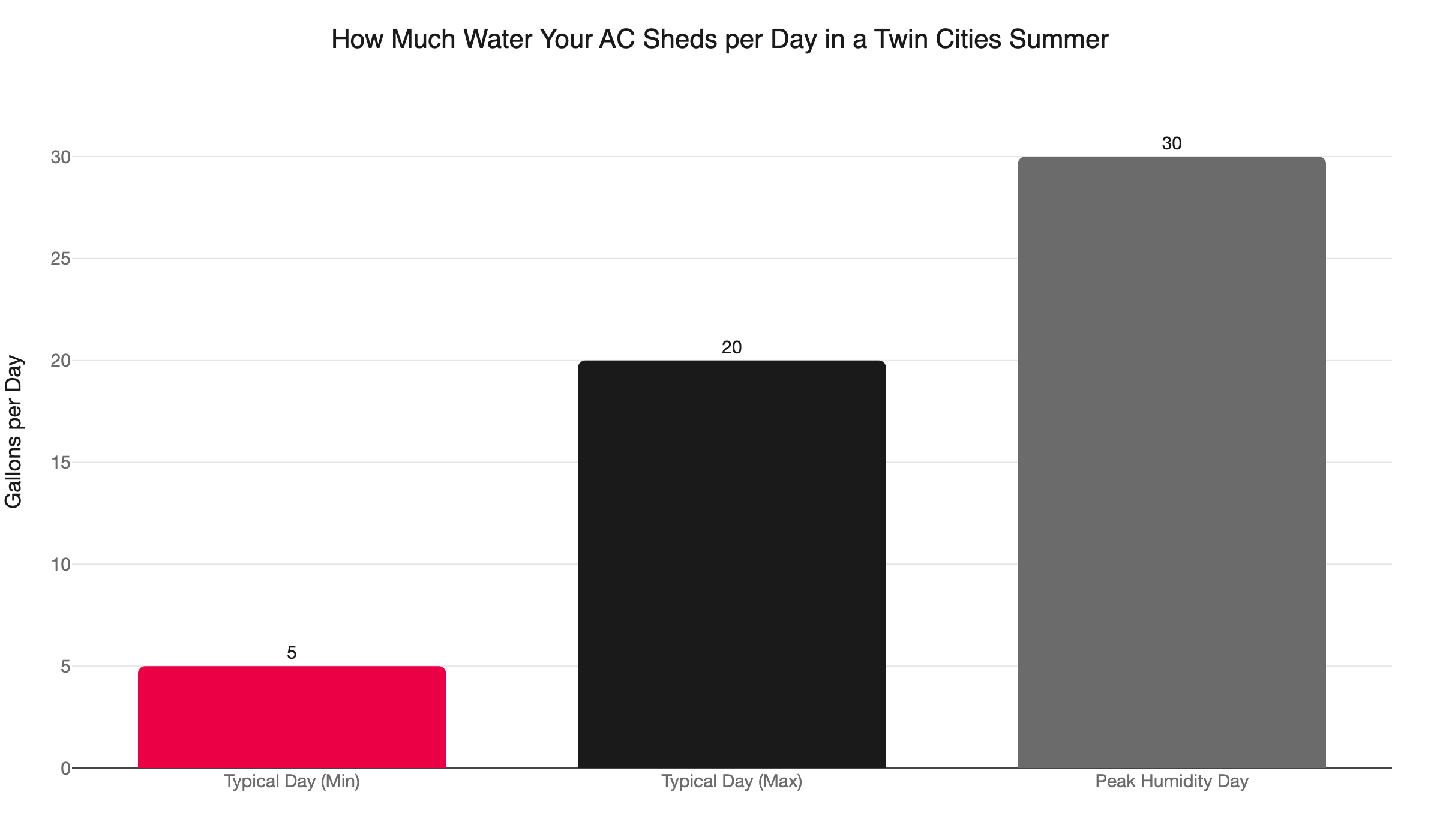
On a typical summer day in the Twin Cities, your AC sheds 5 to 20 gallons of water through that line. On peak-humidity days, larger systems can push toward 30 gallons, according to Midland Heating and Cooling. That is a lot of water moving through one small drain all summer long. When the system works, you never think about it. When it fails, you find out fast.
What Does AC Leaking Water Inside Look Like?
A wet spot on the floor near your air handler, ceiling staining or soft drywall below an attic unit, a musty smell from standing water in the pan, or your AC shutting off without explanation because a float switch tripped.
What you see depends on where your air handler lives:
- Basement unit: Water pools on the floor near the unit, or the drain pan overflows onto concrete.
- Attic unit: You may see a water stain or soft drywall on the ceiling below. By the time staining appears, moisture has already reached the structure.
- Utility closet unit: Water seeps under the door onto adjacent flooring.
If your system has a float switch, it may shut the AC off before any visible overflow occurs. That shutoff is doing its job. Do not override it and restart the system until you have cleared the cause.
Three Causes of an AC Leaking Water Inside
These three causes cover the vast majority of residential water leaks from air conditioning systems.
Clogged Condensate Drain Line
This is the most common cause. Algae, mold, and dust collect inside the drain line over time. The buildup slows flow and eventually stops it. Water backs up into the pan. Once the pan fills and overflows, you get a leak.
The U.S. Department of Energy recommends occasionally running a stiff wire through drain channels to prevent clogs. Most homeowners skip that step. Most service calls for a leaking AC start here.
Key signs: slow drip at the pan edge, a full pan, or the float switch tripping. The AC still blows cold air until the pan overflows. That is the critical difference from a frozen coil.
Frozen Evaporator Coil
A frozen coil behaves differently. The coil ices over because airflow is restricted - usually a dirty air filter - or because refrigerant is low. While the coil is frozen, your AC blows warm air. It is not cooling the house properly. When the ice melts, often when you turn the system off, a large amount of water releases quickly. You can see a sudden flood even if your drain line is completely clear.
Carrier notes that a hissing or bubbling sound from the unit often precedes the leak when refrigerant is low. If you heard that sound before the water appeared, a refrigerant leak is the likely root cause. Low refrigerant is not a DIY repair. It requires a licensed technician.
Our post on frozen evaporator coils covers the full ice cycle in detail.
Cracked or Rusted Drain Pan
Drain pans wear out. Metal pans rust through. Plastic pans crack after years of temperature cycling. Cool Today’s technician documentation places drain pan failure at 12 to 15 years into a system’s life.
A cracked pan leaks even when the drain line is clear and the coil is not frozen. Water appears at the pan itself, not at the drain outlet. If you open the access panel, see a dry drain line, and still find a wet floor, the pan is the likely culprit.
How Do You Tell Which Cause You Have?
Check two things in order: Was your AC blowing warm air before the leak? If yes, you have a frozen coil. Is the pan cracked or rusted through? If yes, the pan needs replacement. If neither, the drain line is clogged.
Follow this sequence before calling a tech:
Step 1 - Was the AC blowing warm air before the leak appeared?
If yes, turn it off immediately. Let the ice melt for two to three hours with the system off. Check the air filter - a clogged filter is the most common cause of a frozen coil. If the filter is clean and the coil froze anyway, you likely have a refrigerant issue. Call a tech.
Step 2 - Is the pan cracked, warped, or rusted through?
Look with a flashlight at the pan’s seams and bottom. If the pan is failing, clearing the drain will not stop the leak. The pan needs replacement.
Step 3 - Is the pan full of standing water with a clear drain line?
Or does water drip slowly over the pan edge? That is a clog. Move to the clearing steps below.
This order matters. Do not spend time clearing a drain when the real cause is a cracked pan or a frozen coil.
Why Minnesota Summers Make This Worse Than You Think
Minnesota is not Florida. But in July, our dew points compete.
Twin Cities summer dew points regularly hit 65 to 70 degrees Fahrenheit. At that level of atmospheric moisture, your AC pulls a large amount of water vapor out of every cubic foot of air it conditions. The result: your system can shed 5 to 20 gallons of condensate on a typical summer day. On peak-humidity days, larger systems push toward 30 gallons, as Midland Heating and Cooling documents for the Twin Cities market.
All of that water moves through one 3/4-inch PVC drain line.
A partial clog that barely registers on a dry spring day can become a flood on a humid July afternoon. The condensate volume spikes, the slow drain backs up quickly, and the pan overflows. The ENERGY STAR Maintenance Checklist lists condensate drain inspection as a required maintenance item for exactly this reason. A plugged drain causes water damage and raises indoor humidity - both are real problems in a Minnesota summer.
The practical takeaway: flush your condensate drain once per cooling season, not once a decade.
Is Your Air Handler in an Attic or Utility Closet?
If your air handler is in the attic, treat any condensate leak as an emergency call, not a weekend project. Attic leaks can rot subfloor and introduce mold before a ceiling stain ever appears. Minnesota code requires specific overflow protection for attic installs.
Most Twin Cities homes built with central AC have the air handler in the basement. A drain clog there means water on concrete. Annoying - not dangerous.
The situation is different for older Minneapolis and St. Paul homes originally heated with boilers. Many of those homes added central AC later using a retrofit air handler in the attic. Structure Tech, a Twin Cities home inspection firm, has documented both outcomes with infrared photography. A basement clog leaves a puddle. An attic clog can rot the subfloor before you see any staining on the ceiling below.
MN Mechanical Code Section 307.2.3, cited by Structure Tech, requires one of four overflow protections for attic air handlers:
- A secondary drain pan that drains to a conspicuous location
- A secondary drain pan with a float switch
- A shutoff device in the primary line or drain pan
- A separate overflow drain that visibly alerts the occupants
If you are not sure which protection your attic unit has, confirm it on the next service call. Adding a float switch costs far less than replacing a rotted subfloor.
For basement units, a float switch is optional under code. It is still a cheap safeguard if you travel during the summer. MN Plumbing Code (MN Rules 4714.0814) also requires condensate drain lines to slope at least 1/8 inch per foot. If you have recurring clogs that return shortly after clearing, inadequate slope may be the root cause rather than the clog itself.
How to Clear a Clogged Condensate Drain Line
DIY clearing makes sense when your diagnosis points to a simple clog - not a frozen coil, not a cracked pan, not a refrigerant issue.
What you need: A wet/dry shop vac, distilled white vinegar, a small cup or funnel, and clean water.
Steps:
- Turn the AC off at the thermostat. Not fan-only mode - power it fully off.
- Find the exterior end of the drain line. This is typically a 3/4-inch PVC pipe that exits through the foundation wall or near the outdoor unit. It may have a small cap.
- Apply the wet/dry vac to the exterior drain line end. Run it for one to two minutes. This pulls debris toward you rather than pushing it deeper into the line.
- Locate the access port on the drain line. Near the air handler, there is usually a T-fitting or clean-out cap. Remove it.
- Pour one cup of distilled white vinegar into the access port. Let it dwell for 30 minutes. Vinegar breaks down algae and mold buildup. Carrier recommends this approach specifically because it is safe for PVC components.
- Do not use bleach. Bleach can degrade the glue joints on PVC fittings over time. It trades one problem for a slower, harder-to-find one.
- Flush with clean water. Pour one cup of water through the access port after the vinegar dwell. Watch the exterior end of the line - you should see water exit. If nothing comes out, the line is still blocked.
- Reinstall the cap and restart the system. Watch the pan for 10 to 15 minutes. If water backs up again, the clog is either fully obstructing the line or there is a slope problem.
If this fails after two attempts, stop. Compressed air and aggressive snaking can crack glue joints without a clear picture of where the line runs. At that point, call a tech.
What Is a Condensate Pump and Do You Need One?
A condensate pump is a small electric device that pushes condensate water uphill when gravity drainage is not possible. Many Twin Cities basement air handlers rely on one. A failed pump floods the space just as fast as a clogged drain line.
Some basement setups have no floor drain at the right height to gravity-drain condensate. These systems use a condensate pump instead: a small reservoir with a float switch and a pump that lifts water up to a utility sink or exterior discharge line.
If your system has a condensate pump, it is a separate failure mode with its own signs:
- The reservoir fills but the pump does not activate
- The pump runs but water still overflows (the discharge line may be blocked)
- The pump runs continuously without the reservoir draining (the float switch is stuck)
Add a once-per-season visual check to your routine. Is the reservoir empty? Does the float move freely? Is the discharge line clear at the outlet? A failed condensate pump can flood a finished basement as quickly as a blocked drain line.
When Should You Call a Pro Instead of DIYing It?
Call immediately if the coil was frozen, the pan is cracked, the clog does not clear after two attempts, you have an attic air handler with any ceiling staining, or you hear a hissing or bubbling sound from the indoor unit.
Specific triggers for a service call:
- AC was blowing warm air before the leak. The coil froze. After the ice melts, a tech needs to check refrigerant levels and find what restricted the airflow.
- The pan is cracked or rusted through. Pan replacement can require draining refrigerant on certain configurations. Not a DIY task.
- Two failed clearing attempts. The clog is deep in the line, the slope is inadequate, or there is a damage point in the line.
- Attic unit with ceiling staining below it. This is a same-day call.
- Hissing or bubbling from the indoor unit. This is a refrigerant leak symptom. A licensed technician is the only fix.
Our AC repair service covers all of these scenarios. If you prefer a proactive approach, our AC maintenance plan includes an annual condensate drain flush and a full system inspection - the simplest way to prevent this problem from showing up mid-July.
Does a Leaking AC Mean Replacement Time?
Usually not. A clog is routine maintenance. A cracked pan is a repair. The exception: if pan failure coincides with a system older than 15 years that is also losing cooling capacity or needing frequent repairs, replacement may be worth pricing.
Most of these situations resolve with a drain clear or a pan swap. You do not need a new system because of a clogged drain line.
The calculus shifts when pan failure or refrigerant issues pile onto an aging system. If your system is older than 15 years with multiple problems at once, replacement may cost less over the next several years than continued repairs.
Current Xcel Energy rebates make replacement more accessible. The Xcel Energy 2026 rebate program offers $400 on new central AC units at SEER2 16 or higher. Minneapolis customers qualify for up to $450. Cold-climate heat pumps qualify for up to $2,000.
Our post on AC replacement costs in Minnesota walks through what a full system swap costs in this market. If you are weighing repair versus replace, that context is worth having before you decide.
Next Steps
A leaking air conditioner is worth addressing today, not next week. Standing water in a drain pan invites mold. A slow attic leak invites rot. And a Twin Cities July is not the time to lose your AC.
Try the DIY clearing steps if your diagnosis points to a simple clog. If the clog does not clear after two attempts, call us. If the coil was frozen or the pan is cracked, call immediately. Reach us at (763) 260-6662 or book online.
We are locally owned and operated in Ramsey, MN. We serve Minneapolis, St. Paul, Blaine, Maple Grove, Plymouth, Brooklyn Park, Woodbury, Bloomington, and the surrounding Twin Cities metro.
“Always On Time… Or You Don’t Pay a Dime!(R)” - that is our promise to every homeowner we serve.
Frequently Asked Questions
Can I clear a clogged condensate drain myself? +
Why is my AC leaking water suddenly after a very humid day? +
Is it safe to run my AC if it's leaking water inside? +
Need a technician now?