
Does a MERV 13 Filter Restrict Furnace Airflow? MN Guide
Key Takeaways
- Filter depth often matters more than the MERV number. A deep pleated filter can run at lower resistance than a thin one.
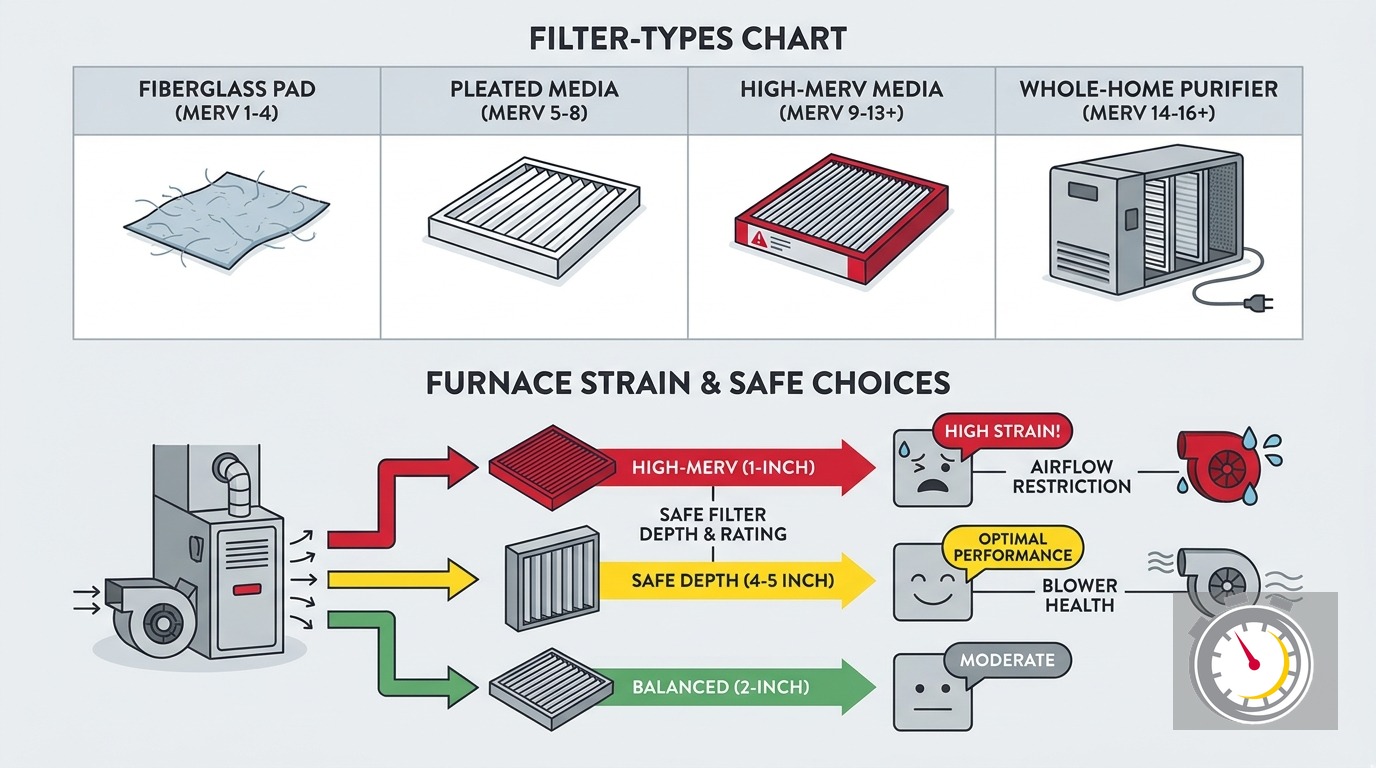
- The safest setup for most homes that want MERV 11 to 13 is a 4-inch filter in a properly sized cabinet.
- For a 1-inch filter, Minnesota’s MnCEE advises a MERV rating of 8 or less.
- PSC blower motors tolerate extra resistance poorly. ECM motors handle more, but they can still strain.
- A loaded filter in January is the real risk. Check high-MERV filters monthly in winter.
- Check your furnace manual, or ask a technician to measure static pressure, before you switch.
Does a MERV 13 filter really cut furnace airflow?
It can, but not always. A MERV 13 filter adds resistance, and your furnace blower must push air through it. In a deep 4-inch filter with a properly sized cabinet, many systems handle it fine. In a thin 1-inch filter, the same rating can strain the blower.
So the honest answer is “it depends.” Three things decide it: the depth of the filter, the type of blower motor in your furnace, and how loaded the filter is with dust.
We are a locally owned and operated Twin Cities heating and cooling company. We see this question every fall, right when furnaces start their long Minnesota run. Homeowners want cleaner air. They also do not want a repair bill.
You can have both. This guide gives you real numbers, a simple decision path, and the warning signs to watch for. It covers the “why” behind each recommendation, so you can make the call with confidence.
What does static pressure have to do with it?
Static pressure is the resistance your blower pushes against. Every part of your system adds some: the filter, the coil, the ducts, and the registers. Too much total resistance means less air moves, and the equipment works harder.
The filter is a big piece of that puzzle. According to the Building America Solution Center, the filter typically accounts for 20%-50% of total system pressure drop. The exact share depends on configuration, efficiency, and loading.
Pressure is measured in inches of water column, written “in. WC.” Most residential systems run efficiently when total static pressure is no higher than 0.4 or 0.5 in. WC, per the same guide.
Here is why that matters. If the filter eats up half of your budget, little is left for the rest of the system. Dirty coils, leaky or undersized ducts, and closed registers all draw from the same budget.
A technician can measure your static pressure with a simple gauge. It takes a few minutes. It also tells you whether your system has room for a higher-MERV filter.
Notice that the guide says a high MERV rating does not automatically mean high pressure drop. Filter design matters more. That brings us to depth.
Do thicker air filters restrict airflow?
Usually the opposite. A thicker pleated filter has more surface area, so air passes through it more slowly and with less resistance. At the same MERV rating, a 4-inch filter typically restricts airflow less than a 1-inch filter.
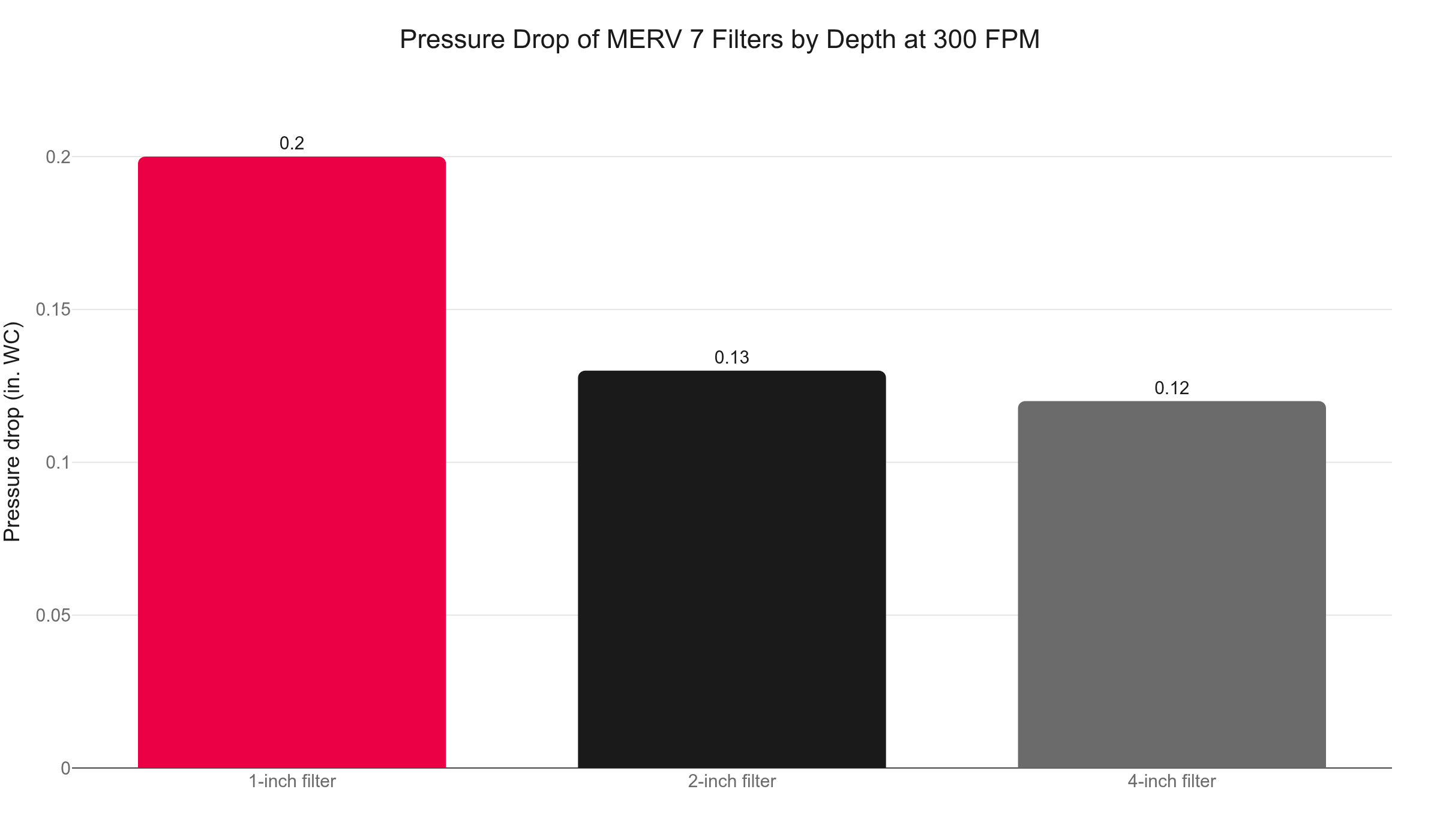
The numbers show it clearly. At an airflow speed of 300 feet per minute (FPM), the Building America guide measured example MERV 7 filters. The 1-inch filter dropped 0.20 in. WC. The 2-inch filter dropped 0.13 in. WC. The 4-inch filter dropped 0.12 in. WC.
The chart below shows the same comparison.
Why does depth help so much? A 4-inch-deep pleat has twice the surface area of a 2-inch pleat. More surface means the same air spreads across more media.
Now apply that to MERV 13. The guide lists a 4-inch-thick MERV 12 filter at about 0.2 in. WC at 300 FPM. At 500 FPM it rises to about 0.35 in. WC. The guide calls 500 FPM the maximum desired for residential HVAC and prefers 200 to 400 FPM.
Read that again. A deeper, higher-rated filter can land near the pressure drop of a thin, lower-rated one. That is why we steer most homeowners toward depth first and the rating second.
One caution: these are example filters from one guide. Every brand differs. Ask for the filter’s published pressure-drop data at your system’s airflow.
Why fit matters as much as depth
A deep filter only works if air passes through it. If the filter is a poor fit, air slips around the frame and skips the media. That defeats the purpose and lets dust reach your blower and coil.
We cover this in detail in our guide to wrong-size furnace filter problems. We also explain the leakage problem in our post on air leaking around the filter. Measure the slot, and buy the exact size.
How do I know what MERV rating my furnace can handle?
Check four things: your furnace manual or label, your filter slot depth, your blower motor type, and your measured static pressure. The manual gives the manufacturer’s limit. A technician’s gauge reading shows how much room your system really has.
Here is the step-by-step path:
- Find the manual or the label. Look for a maximum filter rating or a maximum static pressure. Many manuals list both. If you cannot find it, search the model number on the furnace door.
- Measure the slot. Is it 1 inch, 2 inches, or 4 inches deep? Is it a slim slot in the return duct or a full cabinet? Slot depth sets your options.
- Identify the blower. Is it a PSC or an ECM motor? We explain the difference in the next section.
- Measure static pressure. This is the only way to know your real margin. It also catches duct problems that have nothing to do with the filter.
The EPA recommends “Upgrading to a MERV-13 rated filter, or the highest-rated filter that your HVAC system fan and filter slot can accommodate.” Notice the condition at the end. Your fan and slot set the ceiling.
The EPA also tells users to “consult their HVAC manual or an HVAC professional” before changing filters. We agree. A short visit now costs far less than a motor replacement later.
A single tune-up visit typically runs $95 to $250. Our annual maintenance plans run $195 to $390. Either one is a good time to have static pressure checked.
Does your blower type change the answer?
Yes, a lot. The blower motor in your furnace is either a PSC (permanent split capacitor) or an ECM (electronically commutated motor). Older and basic furnaces often have PSC motors. Newer and higher-efficiency models often have ECM motors.
PSC motors have a single fixed way of working. Per the Building America guide, they “will work up to about 0.5 in. WC,” then “fall off.” In plain terms, airflow drops fast once resistance climbs too high.
ECM motors adjust their speed to hold airflow. The same guide says they are most efficient at 0.3 to 0.5 in. WC. They keep working up to about 1 in. WC, but can burn out as they strain.
That last point surprises people. An ECM motor may hide the problem. It keeps pushing, and you notice nothing until the motor wears out early.
Here is a striking example. The guide notes that a 0.25 in. WC filter in a PSC system can use half of the system’s available static pressure. That is one filter taking half the budget.
What happens when pressure runs too high? The guide lists several risks. Excess static pressure can lower SEER, cause equipment malfunction or motor burnout, and overheat furnaces.
Blower motors are not cheap. Installed, a PSC replacement starts around $1,100, and an ECM replacement starts around $2,200. Those are starting figures, not quotes. Your price depends on the furnace model.
If you want to learn more about the motor itself, read our guide to variable-speed blower motors.
Is MERV 13 too high for a Minnesota furnace?
For a 1-inch filter slot, often yes. For a 4-inch cabinet on a healthy system, usually no. The answer depends on the setup, not on MERV 13 alone.
You may have noticed that two trusted sources seem to disagree. The EPA encourages MERV 13 or the highest rating your system can take. MnCEE, a Minnesota nonprofit, is more cautious.
Here is what MnCEE says. “If your furnace uses an inch-thick filter, be sure to select one with a Minimum Efficiency Reporting Value (MERV) rating of 8 or less.” It adds that when the MERV is higher than 8 for this type of filter, it can negatively affect the air flow through the furnace.
These two views fit together. The EPA sets the goal: filter as well as your system allows. MnCEE describes what that means for the most common thin filter. Both point to the same rule: match the filter to the equipment.
So here is how we sort it:
- 1-inch slot: Stay at MERV 8 or lower unless a technician confirms your margin. This matches MnCEE’s guidance.
- 2-inch slot: Mid-range ratings often work. Confirm with your manual and a pressure reading.
- 4-inch cabinet: MERV 11 to 13 is usually the sweet spot. It gives strong filtration at modest resistance.
If your slot is thin and you want better filtration, you have options. We can often install a deeper media cabinet. We cover that choice below.
Why does January loading matter most?
Because a filter’s resistance grows as it fills with dust. A clean MERV 13 filter and a packed MERV 13 filter behave very differently. In January, your furnace runs longest, so a loaded filter does the most harm.
Think about a cold Twin Cities week. Your furnace cycles for long stretches. The blower moves air the whole time. Dust builds up on the filter every hour of that run.
Most filter comparisons use clean-filter numbers. But your blower faces the loaded number. That is the figure that counts when it is five below zero.
MnCEE is blunt about the stakes. “Forcing it to run with a clogged filter for too long will damage your furnace,” the group warns. It also advises that you replace a high-MERV filter at least every three months to prevent damage.
Replacement timing depends on depth, per MnCEE:
- If your filter is about an inch thick, it likely needs to be replaced every month.
- A filter that is three to six inches thick can likely last several months.
That is another quiet advantage of deep filters. They hold more dust before resistance climbs. You change them less often, and the blower sees less strain between changes.
Our winter habit tip: write the date on the filter frame. Set a monthly phone reminder from November through March. Look at the filter against a light. If you cannot see light through it, replace it.
For a full schedule, see our guide on how often to change your HVAC filter in Minnesota.
Do I need a MERV 13 filter?
Maybe, but not every home does. MERV 13 helps most when someone in the house has allergies or asthma, you have pets, or you want better protection during smoke events. If none of those apply, a well-fitted MERV 8 to 11 filter often does the job.
Higher ratings capture smaller particles. That is the benefit. But the benefit only counts if the air actually moves through the filter and the system keeps its airflow.
The EPA also reminds us that “HVAC systems filter the air only when the fan is running.” A great filter does nothing during the minutes your fan is off. Your fan setting and run time matter too.
Ask yourself a few plain questions:
- Does anyone in the home have breathing sensitivities?
- Do pets shed heavily in your home?
- Do you live near heavy traffic or have recurring smoke concerns?
- Is your slot deep enough to support a higher rating without strain?
If you answer yes to the first three and your slot is deep, MERV 13 may be a good fit. If you answer yes to the first three but have a thin slot, talk to us about a deeper cabinet. Do not force a thick-media filter into a slim slot.
Filters are also only one tool. For a broader look at what each option removes, read our guide to air purifiers versus filters and MERV ratings. Sometimes a separate purifier is the better answer for a specific problem.
A simple decision path
Use this path to choose a safe filter. It reflects how we approach it in your home.
- Measure your slot depth. Is it 1, 2, or 4 inches? Write it down.
- Check the manual. Look for a maximum MERV rating or static pressure limit.
- Identify your blower type. PSC motors need the most caution.
- Start conservative on thin slots. For a 1-inch filter, follow MnCEE’s guidance of MERV 8 or lower.
- Prefer depth over rating. If you want MERV 11 to 13, move to a 4-inch filter in a properly sized cabinet.
- Get a pressure reading. A technician confirms your real margin.
- Set a replacement schedule. Monthly checks in winter. Replace by the three-month mark at the latest for high-MERV filters.
If you follow these seven steps, you avoid the two most common mistakes. The first is forcing a dense filter into a thin slot. The second is forgetting about it until it clogs.
Warning signs your filter is restricting airflow
A restricted filter gives clues. Watch for these:
- Weak airflow from the registers, especially in far rooms
- A furnace that runs longer than usual to reach the set temperature
- A furnace that shuts off early on a safety limit, then restarts
- A filter that looks packed, gray, or bowed inward
- A louder blower or a whistling sound near the return
- Rooms that stay cool even though the furnace is running
One clue alone may point to something else, such as a duct problem. Several together point strongly to a filter or airflow issue.
Start with the simple check. Turn off the furnace, pull the filter, and inspect it. If it is loaded, replace it with the correct size and rating. If the symptoms stay, call us.
Persistent airflow trouble can also come from ducts, closed vents, or a dirty coil. Our guide on high static pressure symptoms and fixes explains those causes. A technician can trace the real source quickly.
What to do if your system cannot handle MERV 13
You still have good choices. Here are the most common fixes we recommend:
- Step down the rating. Moving from MERV 13 to MERV 8 in a 1-inch slot often restores airflow right away.
- Add depth. A 4-inch media filter cabinet lets you use a higher rating at lower resistance. This is our favorite fix for homeowners who want better filtration.
- Fix the ducts. Leaks, crushed flex duct, or undersized returns raise static pressure. Fixing them can open up room for a better filter.
- Clean the system. A dirty blower wheel or coil adds resistance. A tune-up catches both.
- Consider a newer blower. If your furnace is older and has a PSC motor, an upgrade may be worth discussing during a larger replacement.
Some of these fixes are small. Others are larger jobs. If a bigger project makes sense for your home, ask us about financing options. We will walk through the cost and the benefit before you decide.
We also keep the scope clear. We are an HVAC company. We handle heating, air conditioning, indoor air quality, heat pumps, and thermostats. Within that scope, we can tailor a filter plan to your home.
Why homeowners across the Twin Cities call Northern One Hour
We are locally owned and operated, and we serve homeowners in Ramsey, Blaine, Maple Grove, Plymouth, Brooklyn Park, Woodbury, Bloomington, Minneapolis, and St. Paul. We know how hard our winters run on a furnace. We know what a clogged filter looks like in the middle of a cold snap.
We also keep our word on timing. We arrive within the time window you select. If the technician does not show up on time, you do not pay for the service. That is our promise: “Always On Time… Or You Don’t Pay a Dime!(R)”
Our approach to filters is simple. We measure first. We explain what we find in plain language. We recommend the filter that fits your furnace, your slot, and your household. Then we show you how to keep it working all winter.
Not sure whether your system can take a MERV 13 filter? Call (763) 260-6662 or book online. We will check your static pressure, confirm your blower type, and help you pick a safe filter depth and rating.
Frequently Asked Questions
How often should I change a MERV 13 filter in a Minnesota winter? +
What are the signs a filter is restricting my furnace airflow? +
Can I run a MERV 13 filter in my one-inch filter slot? +
Need a technician now?