
Best Furnace Filter for Allergies in Minnesota Homes
Key Takeaways
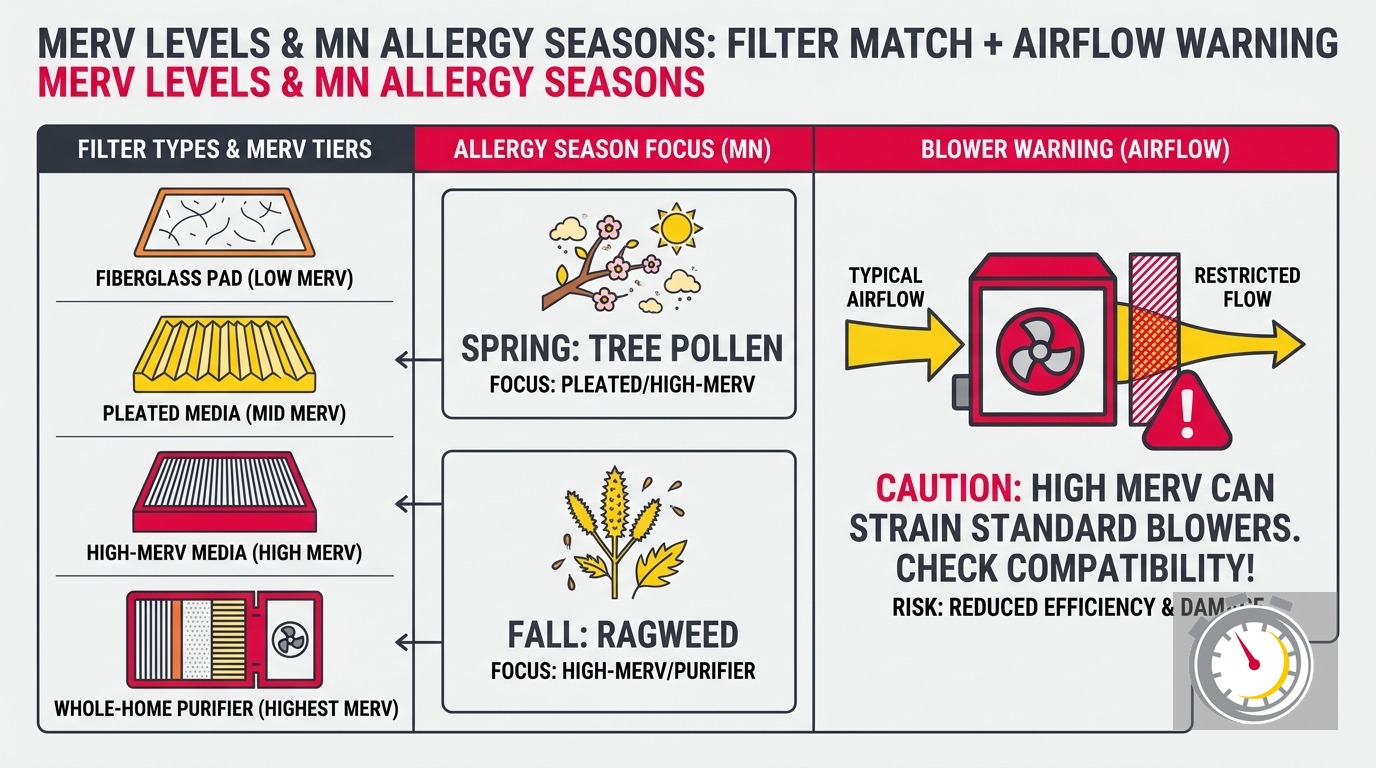
- MERV 13 is the filter most allergy sufferers should aim for, if the system supports it.
- MERV 11 is not “too high” for most homes. It is a common, safe middle ground.
- Denser filters resist airflow. A clogged MERV 13 filter can hurt your furnace more than a clean MERV 8.
- Ragweed season runs from early August through the first hard frost. Run your strongest filter then.
- Spring tree pollen is another high-filtration window. It typically arrives in spring.
- Winter is the danger zone. A packed high-MERV filter left in place through January can strain your blower.
- A 4 or 5 inch media filter often beats a 1 inch pleated filter for both filtration and airflow.
- A technician can measure static pressure and tell you exactly what your system can handle.
The Short Answer
For most Twin Cities homes, a MERV 11 to MERV 13 filter is the best furnace filter for allergies. Pick the highest rating your blower can handle without strain, and change it on schedule.
The right filter shifts with the season. Ragweed in late summer and fall calls for your strongest filter. Winter is when your furnace runs the most, so airflow matters most then.
We are Northern One Hour Heating & Air Conditioning, locally owned and operated, serving homeowners across the Twin Cities. The biggest mistake we see on paper is a dense filter that starves your furnace of air, and the sections below show how to avoid it.
What MERV Rating Is Best for Allergies?
MERV 13 is the best target for allergies if your furnace can handle it. EPA recommends a filter rated MERV 13 or higher, up to the highest rating your system’s fan and filter slot allow. If your system can’t manage MERV 13, MERV 11 is the next best choice.
MERV stands for Minimum Efficiency Reporting Value. It measures how well a filter captures particles. EPA explains that the rating covers particles between 0.3 and 10 microns, and the table runs from MERV 1 to 16. A higher number means the filter catches more particles, including smaller ones.
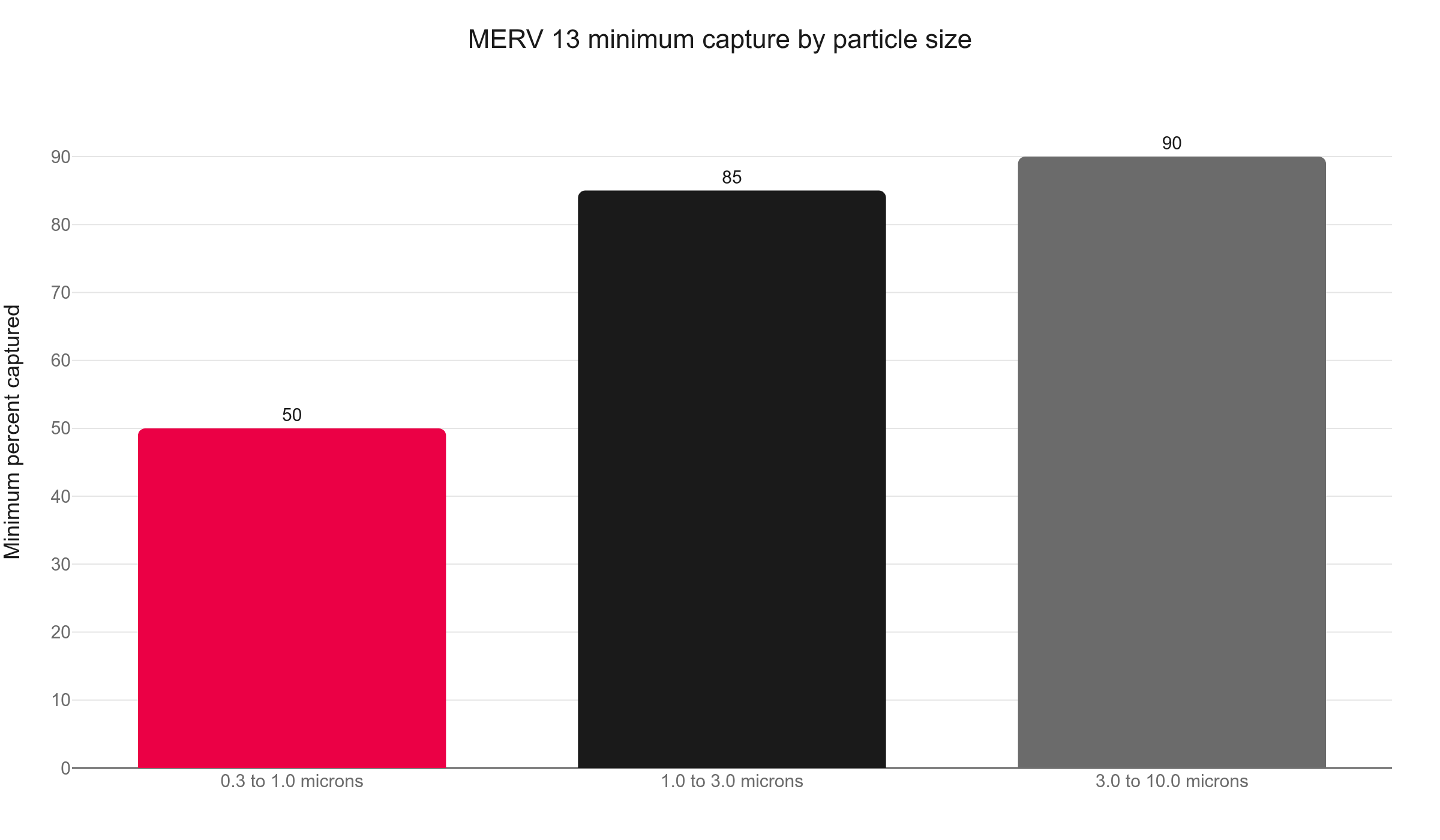
The same EPA page describes what MERV 13 does. It captures at least 50% of particles between 0.30 and 1.0 microns. It captures at least 85% of particles between 1.0 and 3.0 microns. And it captures at least 90% of particles between 3.0 and 10.0 microns.
Why does that matter for allergies? Most pollen grains are larger than the particles in those ranges. Fine dust, mold spores, and pet dander fall closer to them. A MERV 13 filter is built to catch much of that material.
Typical home filters are weaker. PopSci notes that typical residential filters fall between MERV 6 and 12. A basic fiberglass filter sits at the bottom of that range. It protects your furnace but does little for your sinuses.
Think of the rating as a ladder:
- MERV 1 to 4: Basic. These protect equipment and catch very little allergen.
- MERV 5 to 8: Better. These catch larger dust and some pollen.
- MERV 9 to 12: Good. This range catches finer dust and mold spores.
- MERV 13 to 16: Best for allergies. These catch smaller particles, but they also resist airflow the most.
Higher is not always better for your home. The top rungs only work if your blower can pull air through them.
Do Allergen Furnace Filters Really Work?
Yes, a good filter reduces airborne allergens, but only while your system runs. A filter can’t clean air that never passes through it. A MERV 13 filter on a furnace that rarely runs helps less than the same filter on a system that runs often.
Most product pages skip that part. EPA points out that filters only work while the system is running, and HVAC systems usually run less than 25% of the time during heating and cooling seasons. The same page says higher fan speeds and longer run times increase filtration.
So the filter is only one piece. It works best with steady air movement.
Running the fan more has a cost. EPA notes that longer run times raise electricity costs and may make humidity control less reliable during cooling season. In a humid Minnesota July, that matters. Constant fan operation can push moisture off a wet coil and back into your home.
Read labels with some doubt. “Allergen” or “allergy relief” on a package is a marketing term, and it says nothing about the MERV rating. Look for the actual MERV number on the frame.
Here is what a filter can and cannot do:
- It can capture a large share of dust, pollen, mold spores, and dander that pass through it.
- It can keep your furnace and blower cleaner.
- It cannot remove allergens already settled on your carpet, bedding, and furniture.
- It cannot handle gases or odors. Those need different tools.
If you want to go beyond filtration, our guide to how air purifiers and filters compare on MERV ratings explains what each one does.
Is MERV 11 Too High for Home HVAC?
No. MERV 11 is not too high for most home HVAC systems. It sits in the middle of the residential range and works with most blowers. The risk isn’t the number. It’s a dirty or poorly fitted filter that restricts airflow.
You may have read that MERV 11 is plenty. You may also have read EPA’s advice to choose MERV 13 or higher. These don’t conflict. They answer slightly different questions.
“MERV 11 is enough” is a safe default for systems nobody has tested. It protects airflow on older or smaller blowers. EPA’s advice is the target if you want stronger allergy protection, and it carries a limit: go up to the highest rating your system’s fan and filter slot can handle.
EPA also says most furnaces and HVAC systems can accommodate a MERV 13 filter without equipment problems, provided it is replaced frequently. Pay attention to “replaced frequently.” A dense filter fills faster, and a full filter is what causes trouble.
Here is how to reconcile the two:
- Start with MERV 11 if you are unsure about your system.
- Move to MERV 13 if your blower is healthy and your filter slot fits a thick filter.
- Check airflow after the switch. Weak registers are a warning sign.
- Have a technician confirm the choice with a measurement, not a guess.
The best filter is the strongest one your furnace can breathe through. That answer differs from house to house.
How Does a Dense Filter Restrict Airflow?
A dense filter has smaller openings, so air has a harder time getting through. Your blower works harder to move the same amount of air. If the filter is too dense or too clogged, airflow drops, and the furnace can overheat or shut down early.
PopSci puts it simply. It says the more efficient the filter, the more often it should be changed. It also says thicker filters are harder to push air through, and clogged filters limit airflow.
Picture breathing through a cloth mask. Thin cloth is easy. Thick, wet cloth is hard. Your blower faces the same problem with a packed filter.
Technicians call this resistance static pressure. It is the pressure your blower pushes against as it moves air through filters, coils, and ducts. Too much pressure means too little air. Our article on high static pressure symptoms and fixes covers the signs in more detail.
We don’t have an official source with exact airflow loss numbers for filters, so we won’t quote one. You’ll see percentages online, and many are repeated without a clear source. The practical point is enough. Restriction is real, and it grows as the filter loads with dust.
Warning signs of a restrictive filter include:
- Weak airflow at the registers
- A furnace that shuts off before the house warms up
- A blower that sounds strained or louder than usual
- Rooms that feel colder than before you changed filters
- A filter that looks packed within a few weeks
Some filters, like the ones in our guide on MERV 13 filters and airflow restriction, overload easily in a one-inch slot. Thickness matters as much as the rating.
What Should You Run During Ragweed Season?
During ragweed season, run the highest MERV filter your blower can handle. In the Twin Cities, that season runs from early August through the first hard frost. Peak pollen usually comes in early September or the few weeks after. This is your high-filtration window.
MPR News reports that ragweed season extends from early August through the first hard frost, with the peak usually in early September or the few weeks after. That is a long stretch. It overlaps the end of cooling season and the start of heating season.
The season may also be getting longer. The same article quotes Wendy Brunner of the Minnesota Department of Health’s asthma program. She said the ragweed pollen season has increased by 18 to 21 days since 1995. That figure comes from a 2018 article, so treat it as 2018 data.
Here is the plan we suggest:
- Early August: Check your filter. Install a fresh MERV 11 or MERV 13 filter if your system supports it.
- Late August to September: Inspect the filter often. Pollen loads it faster than ordinary household dust.
- Windows: Keep them closed on high-pollen days when you can. An open window defeats a good filter.
- After the first hard frost: Ragweed ends. Review whether you still need your densest filter.
That last point is our own advice, not a study’s. Your furnace runs hardest after frost, so airflow becomes the priority. More on that below.
If other fall air problems worry you, such as smoke from distant fires, see our HVAC wildfire smoke filter guide for Minnesota homes.
What About Spring Tree Pollen?
Spring tree pollen calls for the same approach as ragweed: run the best filter your system can handle. Tree pollen typically arrives in spring, when Twin Cities homes switch between heating and cooling. Check the filter often, because outdoor pollen loads it quickly.
We couldn’t find an official local source for exact tree pollen dates, so we’ll stay general. Minnesotans know the pattern. Trees bloom as the snow melts, and yellow dust shows up on cars and windowsills.
Spring is tricky for your furnace and AC. One morning you run the heat. That afternoon you want cooling. Your system cycles on and off, and your filter works in short bursts.
Here is a simple spring routine:
- Replace your winter filter before pollen season starts.
- Move up to a higher MERV filter if your system supports it.
- Keep windows closed on windy, high-pollen days.
- Check the filter every few weeks, not just every few months.
- Book a spring tune-up before the cooling season starts.
Our post on spring allergy relief with your HVAC system has more ideas for that season.
Why Can a High-MERV Filter Hurt Most in Winter?
Winter is when your furnace runs longest, so a clogged high-MERV filter does the most damage then. A MERV 13 filter installed in fall and forgotten through January can restrict airflow for weeks. That strains the blower and can trip safety limits.
This is the failure we most want you to avoid, and it’s easy to fall into. You install a strong filter for ragweed season. It works well. Then the first cold snap hits and you never look at it again.
Here is what happens next. Your furnace may run for long stretches on a sub-zero Minnesota night. Air passes through the filter nonstop, and the filter loads with dust. Airflow drops. The furnace works harder to heat your home, and the blower strains.
EPA says manufacturers typically recommend replacement every 60 to 90 days, and more often if filters look heavily soiled. A denser filter in a busy heating season often needs checking at the short end of that range.
Use a simple winter rule. Look at your filter once a month. Hold it up to a light. If you can’t see light through it, replace it.
If you notice weak airflow, consider a lower MERV filter in the dead of winter. Ragweed is gone after frost, and your main goal is steady heat. Dust and pet dander are still around, so don’t drop to a bare-bones filter.
Our guide on how often to change your HVAC filter in Minnesota can help you set a schedule that fits your home.
If your furnace shuts off early, blows weak air, or won’t hold temperature, call us. We treat no-heat problems as urgent.
Which Filter Thickness Fits Your Furnace?
The right thickness is the one your filter slot was built for. Filters commonly come in thicknesses from 1 to 5 inches. A deeper 4 or 5 inch media filter usually gives you better filtration with less airflow resistance than a thin 1 inch pleated filter.
EPA says filters commonly come in thicknesses of 1 to 5 inches. That range is wide, and what fits depends on your furnace cabinet.
Why does depth help? A deeper filter has more surface area, so air spreads across more material. It meets less resistance at the same MERV rating. It also holds more dust before it clogs.
Many homes have a slim 1 inch slot. A 1 inch MERV 13 filter packs a lot of material into a thin frame, so it clogs fast and resists airflow. A thick media cabinet solves that, but a professional has to install it.
Fit matters as much as thickness. EPA says the filter should fit snugly, with no air leaking around it, and should not be bent or crushed to make it fit. If air slips around the edge, it skips the filter entirely. Pollen rides right through the gap.
Check these fit points:
- The filter size matches the slot exactly, not roughly.
- The frame sits flat with no gaps along the edges.
- The slot cover is on and sealed.
- The arrow points toward the blower, in the direction of airflow.
Our posts on wrong-size filters and airflow damage and on missing slot covers explain what goes wrong when the fit is off.
How Often Should You Change It?
Plan on changing your filter every 60 to 90 days, and sooner if it looks dirty. Allergy season, pets, and a high MERV rating all shorten that window. For most Twin Cities homes, a visual check every month is the safest habit.
The 60 to 90 day guideline comes from EPA, which says manufacturers typically recommend replacement on that schedule and advises changing filters more often if they look heavily soiled.
Several things speed up loading:
- Ragweed and spring pollen: Outdoor allergens enter on shoes, pets, and open doors.
- Pets: Hair and dander clog filters quickly.
- Home projects: Sanding, drywall work, and remodeling fill filters with dust.
- Higher MERV ratings: Denser filters capture more, so they fill faster.
- Constant fan operation: More air through the filter means more dust collected.
Keep the routine simple. Check on the first of each month. Replace in fall, before ragweed peaks, and again in spring, before tree pollen. Replace sooner if the filter looks gray.
If you have a pet, our guide on filters for pet hair and dander can help you tune the schedule.
What Should a Technician Check Before You Upgrade?
Before you move to a higher MERV filter, a technician should check four things: your blower type, your filter slot depth, your static pressure, and the condition of your coil and ducts. Together these show how much restriction your system can take.
EPA recommends professional advice here. It says a professional HVAC technician can confirm the most efficient filter your system can use.
Most guides stop at “read the manual.” That’s a fine start, but it doesn’t show how your system performs in your home. Here is what a technician measures and why.
Blower type. Some furnaces use a basic single-speed blower. Others use a variable-speed motor that adjusts to resistance. Variable-speed blowers handle denser filters better. Our post on variable-speed blower motor benefits explains the difference.
Filter slot depth. A shallow slot limits you to a 1 inch filter. A deeper cabinet opens the door to a 4 or 5 inch media filter.
Static pressure. This is the key number. A technician measures how hard your blower pushes against your filter and ductwork. If the reading is already high with a clean filter, a denser filter will make it worse.
Coil and duct condition. A dirty coil or leaky ductwork adds its own restriction. Fixing those can free up room for a better filter.
During a furnace tune-up, we can check these items and talk through your filter choice. To get that done before ragweed season, book a furnace tune-up with our team.
If the measurement shows your system can’t handle a dense filter, you have options. A larger media cabinet, duct improvements, or a variable-speed blower can widen the range. For bigger upgrades, we can walk you through financing so cost doesn’t hold you back.
A Twin Cities Seasonal Filter Plan
This year-round plan is our editorial advice, built from the sources above and our experience in Minnesota homes. No study says to swap filters by season, so treat it as a practical framework, not a rule.
Early August (ragweed starts):
- Install your strongest filter that your system supports.
- Check it every few weeks as pollen builds.
September (typical ragweed peak):
- Keep windows closed on high-pollen days.
- Inspect the filter often. Replace it if it looks gray.
After the first hard frost (ragweed ends):
- Replace the filter.
- Make sure airflow still feels strong at every register.
Winter (furnace runs the most):
- Check the filter monthly.
- Replace it at the first sign of loading.
- Drop to a lower MERV if you notice weak airflow.
Spring (tree pollen):
- Put in a fresh, high-MERV filter before the season starts.
- Check it every few weeks.
Summer (cooling season):
- Keep up the 60 to 90 day schedule.
- Be careful with constant fan settings in humid weather.
Match filtration to the season, and never let a dense filter sit unchecked.
When Filters Are Not Enough
A filter can’t solve every allergy problem. If symptoms persist after you upgrade and maintain your filter, look at the rest of your system. Leaky ducts, high humidity, and dirty coils can all feed allergens back into your air.
Consider these next steps:
- Duct condition. Leaky or dirty ducts can pull in dust from attics and crawl spaces.
- Humidity control. Mold and dust mites thrive in damp air. Both are common allergy triggers.
- Air purification. A whole-home option can add a layer beyond your filter. See our air purification services.
- UV light. Some homeowners add UV light to their system. Our guide on whether UV light is worth it in Twin Cities homes covers what it does and does not do.
Know the limits, too. HEPA filters are a different category from MERV-rated filters. EPA says HEPA filters capture at least 99.97% of 0.30 micron particles. That is impressive. But HEPA filters are very dense, and most residential furnace blowers can’t support them.
If you have asthma or severe allergies, talk with your doctor too. We handle the HVAC side. Your doctor handles the health side.
Get Help Picking the Right Filter
Choosing the best furnace filter for allergies shouldn’t be guesswork. The right filter depends on your blower, your filter slot, your ducts, and the season. We can check all four and tell you what your system can handle.
Northern One Hour is locally owned and operated, and we serve homeowners throughout the Twin Cities. We know our winters, our allergy seasons, and the older homes that make filter choices tricky.
We also respect your time. Our promise is “Always On Time… Or You Don’t Pay a Dime!(R)” We arrive within the time window you select. If our technician doesn’t show up on time, you don’t pay for the service.
Don’t wait until a clogged filter leaves you cold in January. Call (763) 260-6662 or book online today, and we’ll get you scheduled fast.
Frequently Asked Questions
Which MERV rating is best for the air filters in your home? +
Can I use a HEPA filter in my furnace? +
Should I run my furnace fan more during allergy season? +
How do I know if my filter is too restrictive? +
Does a thicker filter work better for allergies? +
Need a technician now?