
Best HVAC Filter for Pet Owners: MERV vs. Electrostatic vs. Media Cabinet
Key Takeaways
- Pet dander measures 2.5-10 microns. Cat allergen (Fel d 1) travels on particles under 5 microns and stays airborne for hours.
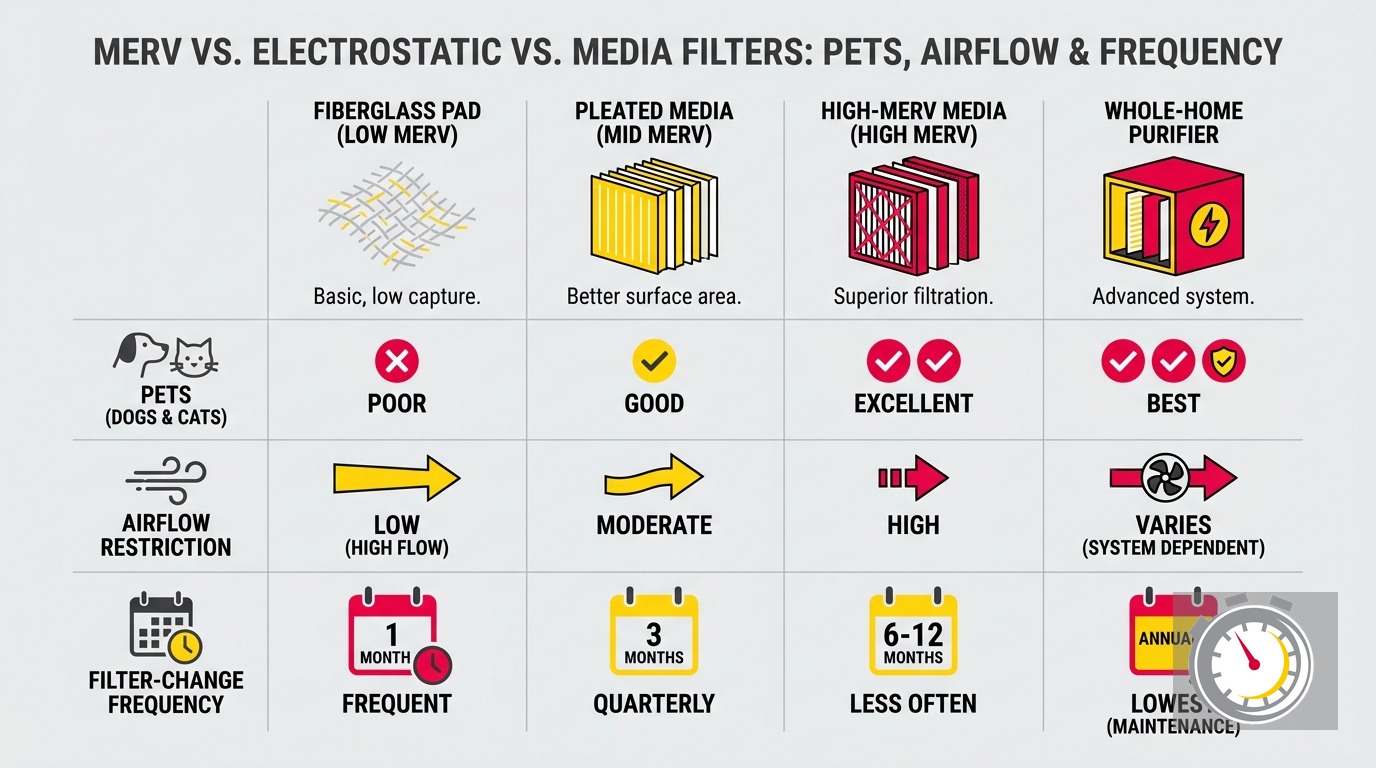
- MERV 11 is the right target for most pet households. It captures 85%+ of 3-10 micron particles and 65% of 1-3 micron particles.
- Your furnace motor type matters as much as your MERV number. Pre-2010 furnaces with PSC motors should cap at MERV 10-11. MERV 13 in a 1” slot on a PSC motor risks frozen coils and motor burnout.
- Washable electrostatic panels underperform. Real-world tests show actual efficiency often falls to MERV 4-6, not the MERV 8 advertised on the box.
- A 4-5” whole-home media cabinet lets you run MERV 11 filtration with almost no added airflow resistance. The filter lasts up to 12 months.
- Change 1” filters every 30 days if you have multiple pets or an allergy sufferer at home.
- Minnesota’s 5-month sealed heating season makes this decision more consequential than in warmer climates.
Why Pet Owners Need a Different Filter Strategy
The standard advice is to change your filter every 90 days. That assumes a typical household. A pet household is not typical.
Your dog or cat sheds continuously. The visible hair lands on your furniture and floors. You can vacuum that. The invisible part is the dander: microscopic skin flakes that your HVAC system pulls into the return air duct on every cycle. In a home with two dogs, your filter loads with dander and fine particles around the clock, every day of the year.
The result: a 90-day filter change schedule in a pet home is often a badly restricted filter by month two. A restricted filter cuts airflow. Reduced airflow makes your furnace run longer to reach the set temperature. It raises your energy bill. Over time, it shortens equipment life.
You control two variables here: which filter you install and how often you change it. Getting both right keeps your air cleaner and your HVAC system healthier. The wrong filter for your furnace type can cause damage that costs far more than a year of filter replacements.
What Does MERV Actually Measure?
MERV (Minimum Efficiency Reporting Value) rates a filter’s ability to capture particles across three size bands. The scale runs from 1 (almost no filtration) to 20 (hospital surgical suite). For residential systems, the practical range is MERV 8 through MERV 13.
Here is how the ratings stack up for pet allergens. Pet dander measures 2.5-10 microns, and cat allergen (Fel d 1) travels on particles under 5 microns and stays airborne for hours. You need a filter that works effectively in that sub-5-micron range.
- MERV 8: Catches 70-85% of 3-10 micron particles. Misses most fine dander and Fel d 1.
- MERV 11: Catches 85%+ of 3-10 micron particles and 65% of 1-3 micron particles. Captures the bulk of pet dander.
- MERV 13: Adds 50%+ capture down to 0.3 microns. Strong against the finest cat allergen particles.
The EPA states that “filters with a MERV between 7 and 13 are likely to be nearly as effective as true HEPA filters” for residential use. The returns above MERV 13 diminish sharply. The same source confirms that “increasing filter efficiency above MERV 13 results in only modest predicted decreases in indoor concentrations.”
For most pet households, MERV 11 is the right target. MERV 13 adds meaningful benefit for allergy sufferers, provided your furnace can handle it safely.
What Is the Best HVAC Filter for Pet Owners?
For most pet homes: a 1” pleated MERV 11, changed every 30-45 days. If your furnace has a variable-speed ECM motor (most systems since 2010), a 1” MERV 13 is a meaningful upgrade. If you want the best long-term outcome with the least ongoing maintenance, a 4-5” whole-home media cabinet at MERV 11 eliminates the airflow-versus-filtration tradeoff entirely.
The right answer depends on three things: your furnace motor type, your filter slot depth, and whether you want to invest in a one-time upgrade or manage monthly replacements.
Pleated media filters are the correct starting category, not washable panels. Most modern pleated filters are manufactured with an electrostatically charged media. This helps capture fine particles without degrading over time the way a reusable panel does. The static charge is part of the material, not a surface treatment that washes off.
Does Your Furnace Motor Type Determine Which Filter Is Safe?
Yes. Your furnace motor type is the most important variable in this decision. It determines the maximum MERV rating your system can safely run in a 1” slot. Every competitor article skips this question, and ignoring it leads homeowners to install filters their furnaces cannot handle.
Two motor types dominate residential installations:
PSC motors (Permanent Split Capacitor) are fixed-speed motors. Most furnaces installed before 2010 have them. A PSC motor cannot increase its speed to compensate for a restrictive filter. When you install a high-MERV 1” filter in a PSC furnace, the motor strains against the resistance. The evaporator coil can ice over from reduced airflow. The motor can overheat and burn out. Short cycling follows, driving up energy costs. The realistic ceiling for PSC-motor systems is MERV 10. MERV 11 is the absolute maximum. MERV 13 in a 1” slot on a PSC motor is not safe for routine use.
ECM motors (Electronically Commutated Motor) are variable-speed motors found in most furnaces built since roughly 2010. An ECM ramps up its RPM to maintain airflow against higher filter resistance. A 1” MERV 13 is generally safe on an ECM system. Even ECM motors have a static pressure ceiling, typically 0.5 to 0.8 inches of water column, so there is still a limit. A technician can confirm where your system sits.
If you do not know your furnace’s motor type, look at the installation date on the data plate near the unit. Pre-2010: assume PSC and stay at MERV 10-11. Post-2010: likely ECM, but verify before installing MERV 13. Our team confirms motor type during every furnace tune-up, so you never have to guess.
What Is Wrong With Washable Electrostatic Filters?
They catch pet hair but miss the fine dander that actually triggers allergies. Independent lab testing of a filter marketed as “MERV 8” found actual efficiency of 0.3% for the finest particles and a true measured MERV of 6, not 8. Most permanent washable electrostatic panels have a true MERV of 1-4 in real-world conditions.
The marketing language compounds the confusion. Claims of “94% efficiency” often refer to large-particle capture only, measured on particles well above the dander range. Fine dander, which is what drives pet allergies, passes through largely uncaptured.
Three technologies get grouped under the word “electrostatic,” and they are not equivalent:
Washable permanent electrostatic panels are the reusable filters you rinse in the sink. The static charge that helps them attract particles weakens after the first wash. ASHRAE, the body that sets HVAC filtration standards, notes that electrostatic filters “may demonstrate high efficiency when clean and a drop in efficiency during their actual use cycle.” A pet home produces a constant dander load. A filter that degrades to MERV 4-6 within weeks is not adequate for that environment.
Electrostatically charged pleated media is a manufacturing process applied to standard pleated filters. This is different and it is fine. Most MERV 11 pleated filters are made this way. The charge is embedded in the filter media, not a surface coating that wears off with washing.
Active electronic air cleaners are whole-home units with voltage-charged collector plates that mount inside the air handler. These are effective, but they are a separate product category, not a replacement for a media filter.
For a pet home, the choice is simple: a pleated MERV 11, changed on schedule, outperforms any washable panel every time.
The Option Nobody Mentions: Whole-Home Media Cabinets
The airflow-versus-filtration tradeoff is real. A higher MERV means more resistance. More resistance means more motor strain. For pet owners with PSC-motor furnaces who need real dander capture, the 1” MERV options run out fast.
The 4-5” whole-home media cabinet is the solution to that tradeoff. It is absent from nearly every article on this topic.
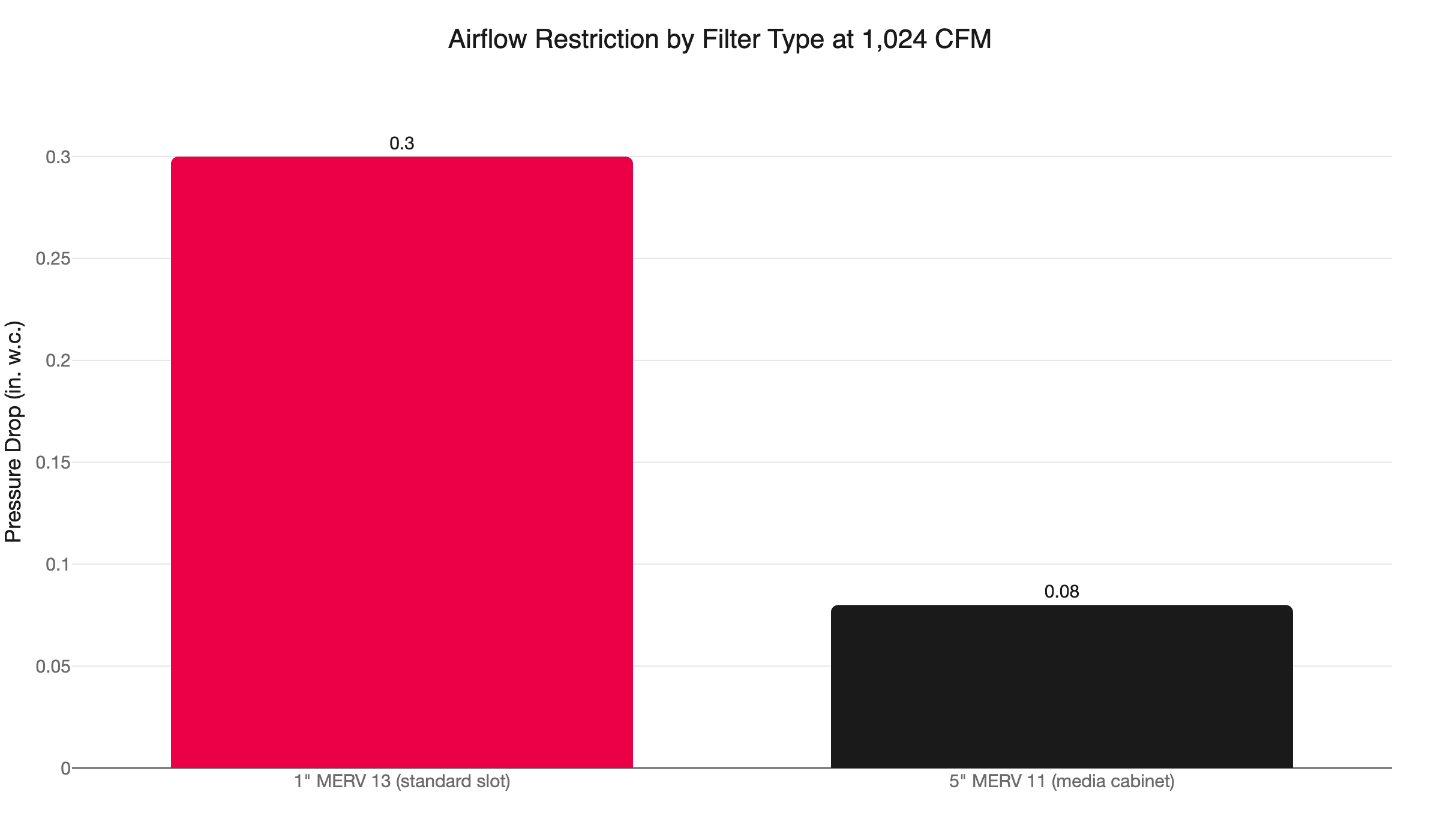
Here is why the math works so decisively. A standard 1” filter has 3-4 square feet of filter media. A 5” media filter has roughly 24.5 square feet. At 1,024 CFM airflow, the pressure drop across a 5” MERV 11 is about 0.08 inches of water column. The same airflow through a 1” MERV 13 produces about 0.30 inches of water column - nearly four times the resistance from the smaller filter.
That difference is felt throughout the system. A 1” MERV 11 filter loaded with 85 grams of dust shows 35-40% airflow restriction. The same dust load spread across a 5” filter causes under 5% restriction. Your motor runs as if the filter barely exists.
With a media cabinet, you get MERV 11 filtration with almost no added strain on any motor type. A PSC-motor furnace handles it safely. An ECM furnace handles it easily. And the filter lasts up to 12 months between changes, even in a pet household.
Installation is a one-time project. A technician mounts the media cabinet in the return-air duct, typically where your existing filter slot is. Cost runs $250-$650 installed. The annual filter cost is comparable to buying 1” filters every 30 days, and often lower. The ongoing effort drops from 12 filter changes a year to one.
For a Twin Cities household with pets, this is the upgrade that makes the most sense long-term.
How Often Should Pet Owners Change Their HVAC Filter?
For a 1” filter: every 60 days in a one-pet home with no allergies; every 30-45 days with multiple pets or one allergy sufferer; every 30 days without exception with multiple pets and an allergy sufferer. For a 4-5” media cabinet: up to 12 months.
A loaded filter fails in two directions at once. It stops capturing new particles - they pass straight through the clogged media. And it restricts airflow, which forces your furnace to run longer cycles and consume more energy to hit set temperature.
The simplest habit: set a phone reminder on the first of every month if you have multiple pets. Pull the filter and hold it up to a light source. If you cannot see light through the media, the filter was already overdue. Replace it that day.
For a closer look at seasonal timing and the warning signs of an overdue filter, see our post on how often to change your HVAC filter in Minnesota.
Why Does Filter Choice Matter More in Minnesota?
Because your home is sealed for five months straight, and dry winter air keeps particles aloft far longer than in milder climates.
From November through March, Minnesota homeowners keep windows closed and weatherstripping tight. The HVAC system runs around the clock. Indoor relative humidity drops to 15-25% during those months. At those humidity levels, fine dander and hair particles stay suspended in the air longer before settling. You clean the bookshelf on Saturday, and by Monday morning it looks dusty again. That is not bad luck. That is dry air keeping particles airborne, and your HVAC system recirculating them through your filter on every cycle.
The EPA’s baseline, that indoor air is 2-5x more polluted than outdoor air, applies year-round. In a Twin Cities home sealed from October to April, that becomes a five-month sustained high-concentration event with no fresh-air dilution. A filter that performs adequately in a home with open windows eight months a year is doing significantly harder work here.
The complete strategy for a Minnesota pet home: the right filter for your furnace type, changed on the correct schedule, paired with a whole-home ventilation strategy. An HRV (heat recovery ventilator) brings in fresh outdoor air while recovering the heat from the outgoing stale air, adding dilution to your filtration. Our post on HRV whole-home ventilation in Minnesota covers how these systems complement each other in a sealed winter home.
Choosing the Best HVAC Filter for Pet Owners: Your Three Options
Here is the decision guide:
Option 1: Pre-2010 furnace, PSC motor Use a 1” pleated MERV 10-11. MERV 11 is the ceiling. Change every 30-45 days with pets. Do not install MERV 13 without a technician confirming your system can handle it. Washable electrostatic panels are not a substitute for pleated media. If you want better allergen capture without risking your motor, step up to a media cabinet rather than a higher MERV 1” filter.
Option 2: Post-2010 furnace, ECM motor A 1” pleated MERV 13 is safe in most cases. Change every 30-45 days with pets in the home. MERV 13 adds meaningful capture of the finest cat allergen particles, which matter most if anyone in the household has allergies. Confirm your motor type before installing.
Option 3: Any furnace, best long-term outcome A 4-5” whole-home media cabinet with a MERV 11 filter. Install it once. Change the filter once a year. Airflow impact is minimal regardless of motor type. Consistent dander capture through every month of a Minnesota winter, with no monthly restocking.
Not sure which option fits your system? Our team is locally owned and based in Ramsey. We serve Minneapolis, St. Paul, Blaine, Maple Grove, Plymouth, Brooklyn Park, Woodbury, Bloomington, and surrounding Twin Cities communities. We can assess your furnace motor type, check your current filter slot, and quote a media cabinet installation, all in a single visit.
Ready to Stop Guessing About Your Filter?
Call (763) 260-6662 or book a service visit online. Whether you want a straight answer about what filter is safe for your furnace or a media cabinet installation that takes the monthly hassle off the table, our team shows up when we say we will.
That is what locally owned service looks like - and it is backed by the promise we make to every Twin Cities homeowner: “Always On Time… Or You Don’t Pay a Dime!(R)”
For a broader look at what we offer for indoor air quality beyond filtration, visit our indoor air quality services page.
Frequently Asked Questions
Can I use a MERV 13 filter in my older furnace? +
Are washable electrostatic filters good for pet dander? +
How often should I change my HVAC filter if I have pets? +
Need a technician now?