
HVAC System for Asthma Sufferers: A Minnesota Home Guide
Key Takeaways
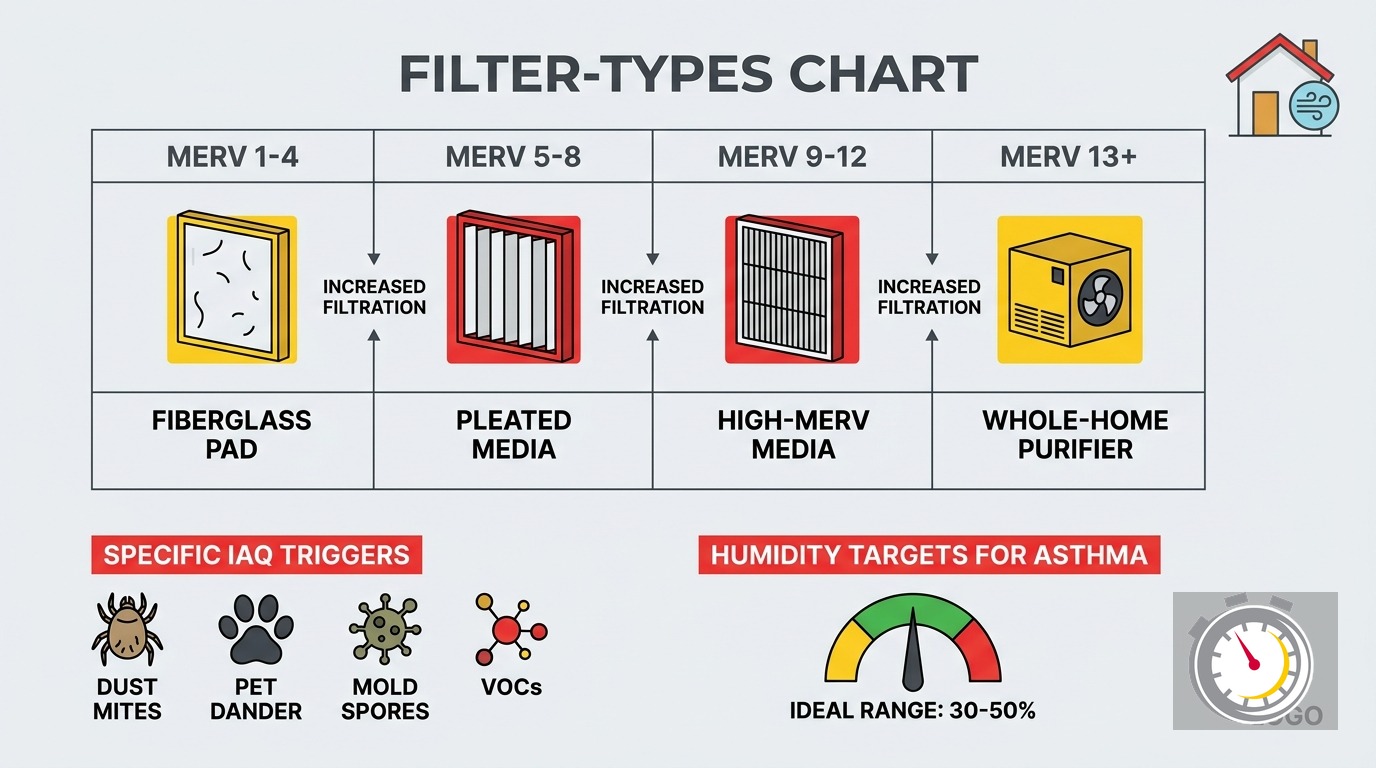
- The EPA recommends MERV 13 filters as the minimum for asthma households with forced-air systems.
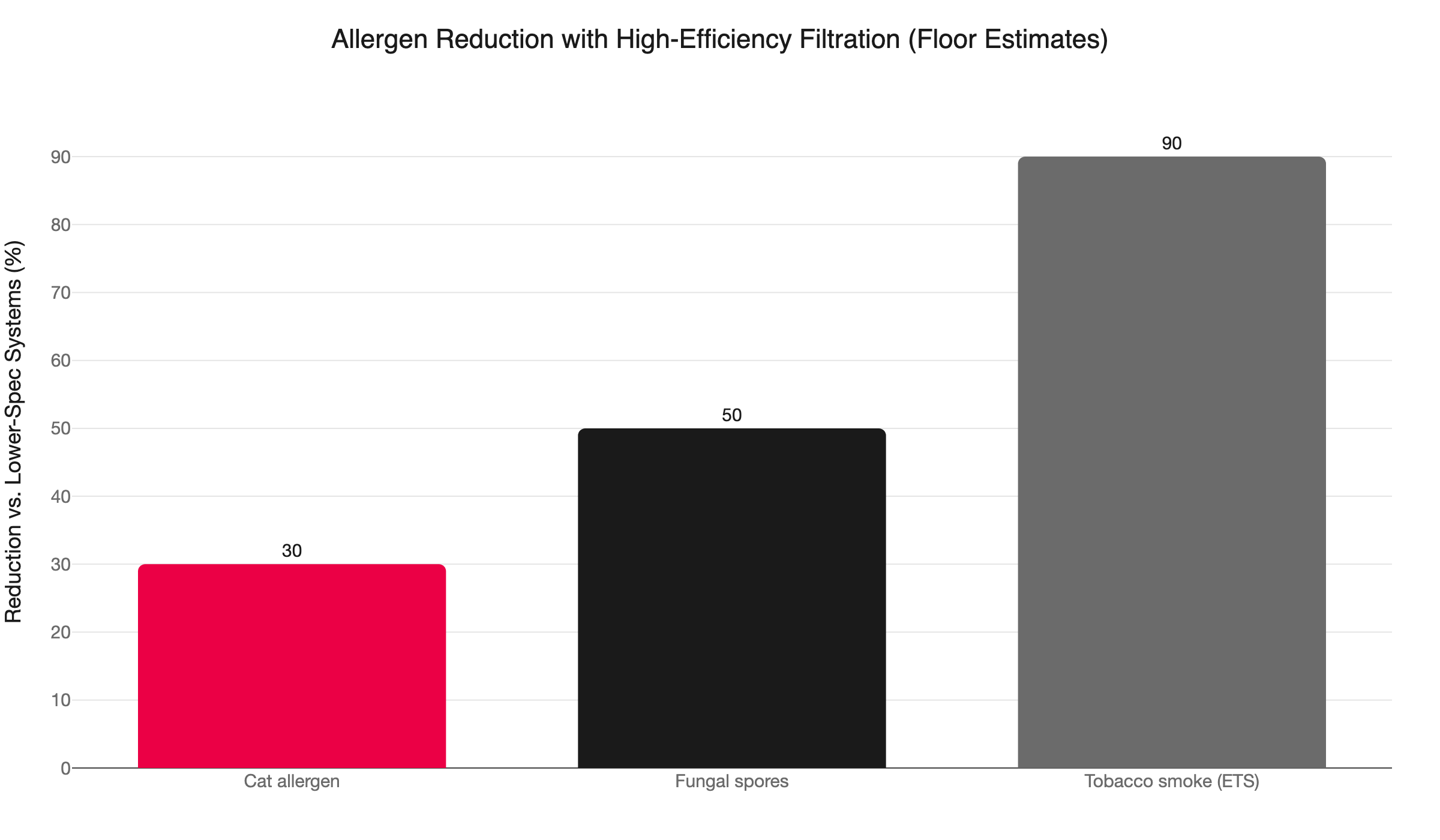
- High-efficiency filtration reduces cat allergen by at least 30%, fungal spore levels by at least 50%, and environmental tobacco smoke by at least 90% compared to lower-spec systems.
- Keep indoor relative humidity between 30% and 50%. Too low dries airways; too high feeds dust mites and mold.
- Gas stoves produce nitrogen dioxide (NO2), an odorless asthma trigger. In sealed Minnesota homes, it accumulates without mechanical ventilation.
- Modern tightly built homes in the Twin Cities likely need an HRV or ERV to maintain healthy indoor air through the heating season.
- Minnesota utility rebates of $300-$500 are available in 2026 for qualifying HRV/ERV installations.
If you manage asthma in your household, the right HVAC system for asthma sufferers is one of the most useful tools you control. More than 418,000 Minnesota adults have been diagnosed with asthma. Nearly half had at least one attack in the past year. Asthma is the third most common chronic disease in Minnesota.
Most resources stop at filter recommendations. They cover MERV ratings and the 30-50% humidity band, then move on. What they miss: the nitrogen dioxide accumulating from your gas stove all winter, the humidity spikes that let dust mites survive even in a well-controlled room, and the mechanical ventilation that tightly sealed Twin Cities homes need from October through April. This guide covers all of it.
What makes an HVAC system good for asthma sufferers?
A good setup for asthma targets four things: particle filtration, humidity control, fresh-air ventilation, and equipment cleanliness. Each addresses a different trigger category. Skipping one leaves a gap the others cannot fill.
Asthma triggers split into two categories. Particles include dust mite allergens, pet dander, mold spores, and pollen. Gases include nitrogen dioxide from gas appliances, VOCs from flooring and furniture, and carbon dioxide from normal occupancy.
Your HVAC filter catches particles. It cannot catch gases. Humidity affects both categories: high indoor humidity grows mites and mold; low humidity dries the mucous membranes that protect airways from the particles that do get through.
Mechanical ventilation - an HRV or ERV - dilutes gases by exchanging stale indoor air for fresh outdoor air. No filter does that job. And all three systems depend on clean equipment. Mold on a coil or debris in ductwork reverses every other gain.
Minnesota adds a specific challenge. From October through April, most homes run sealed against outdoor air. Indoor pollutants have nowhere to go. A home without mechanical ventilation is essentially recirculating the same air all winter, with pollutants accumulating across the entire heating season.
What MERV rating does an asthma household actually need?
The EPA recommends MERV 13 as the minimum for asthma households with forced-air systems. It captures particles in the 0.3-1.0 micron range, covering dust mite feces, pet dander, and most mold spores. A MERV 7 or 8 filter provides limited protection against these specific triggers.
The EPA’s Indoor AirPlus program treats high-efficiency filtration as a core asthma-health measure. Homes with forced-air systems and MERV 13 filtration show:
- At least 30% lower cat allergen levels
- At least 50% fewer airborne fungal spores
- At least 90% lower environmental tobacco smoke
compared to homes running lower-rated filters. The EPA’s residential air cleaner guide notes that MERV 7-13 filters are “nearly as effective as true HEPA” for residential IAQ. Whole-home HEPA filtration requires system modifications that most existing forced-air setups cannot accommodate without professional evaluation.
Two practical cautions before you upgrade:
Check your system’s maximum rated MERV. Older air handlers may be rated for MERV 8 or lower. Installing a MERV 13 filter in an undersized system increases static pressure. That can overheat the blower motor and trigger shutdowns. Ask a technician to confirm the safe maximum before you change filter grades.
Change filters on schedule. A MERV 13 filter loaded with particulate becomes a barrier to airflow. Asthma households should plan on replacement every 60-90 days, not the 90-day default printed on the package.
For a deeper comparison of portable air purifiers versus whole-home filtration, see our guide on air purifiers vs. HVAC filters and MERV ratings.
Why humidity control matters - and why average RH misleads you
Minnesota creates a humidity problem in both directions, and both matter for asthma.
In winter, outdoor air holds very little moisture. As it infiltrates your home and warms up, indoor relative humidity (RH) can fall below 25-30%. Dry indoor air irritates mucous membranes. That reduces the airway’s first-line defense against every trigger in the air.
In summer, outdoor humidity rises. An undersized or poorly maintained AC may not dehumidify well enough to keep indoor RH below 50%. Above that threshold, dust mite colonies expand and mold risk increases.
The American Lung Association recommends keeping indoor RH below 50% to suppress dust mite populations. One controlled study held household RH below 51% for 17 months. Live mite counts dropped from 401 to 8 per gram of dust - roughly a 98% reduction.
Here is the precision most guides skip. A separate study found that mites can survive with as little as 1.5 hours of high RH above 90% per day. A mattress during sleep creates exactly that microclimate. Body heat and perspiration push mattress-surface RH well above the ambient room level, even if your humidistat reads 45%.
Average RH is a misleading metric. Managing humidity for asthma means managing the spikes, not just the average.
Practical steps for Twin Cities homeowners:
- Install a whole-home humidifier to hold winter RH in the 30-40% range. Our guide to whole-home humidifiers for dry winter air covers bypass and steam options for Minnesota homes.
- Run your AC system’s dehumidification mode to hold summer RH below 50%.
- Run bathroom exhaust fans for at least 20 minutes after showers. Steam migrates to sleeping areas, where it creates exactly the high-humidity refuge mites need.
Can a gas stove worsen asthma symptoms?
Yes. Gas stoves produce nitrogen dioxide (NO2), an odorless gas that aggravates asthma. Indoor NO2 levels rise significantly during heating season as homes seal up and ventilation drops. A standard range hood may not remove it.
The EPA identifies indoor NO2 as a significant asthma trigger. Levels climb in winter because homes are sealed and combustion appliances run longer without fresh-air dilution to offset them.
The research numbers are specific. A study found that 44% of homes with gas stoves exceeded the EPA’s outdoor 1-hour NO2 standard of 100 ppb during standardized cooking events. Those conditions apply broadly to any tightly sealed home, including gas-heated Minnesota homes that close up in October and open in April.
A separate intervention study found that replacing a gas stove with an electric model cut kitchen NO2 by 51%. A HEPA-plus-carbon air purifier running during cooking reduced NO2 by 27%. Range hoods alone showed no significant reduction in that study. Most residential range hood models recirculate air back into the kitchen rather than exhausting it outdoors.
If you cook with gas and have an asthmatic household member, four steps help:
- Confirm your range hood exhausts outdoors, not through a recirculation filter.
- Run a carbon-filter air purifier in the kitchen during and after cooking.
- Open a window when outdoor temperatures allow.
- Consider whole-home mechanical ventilation, which dilutes NO2 continuously, not just during cooking.
Does your Minnesota home need mechanical ventilation?
If your home was built or significantly tightened after 2000, almost certainly yes. Modern construction seals the building envelope to reduce energy loss. The tradeoff is that indoor pollutants, combustion gases, and allergens accumulate without deliberate mechanical ventilation to dilute them.
An HRV (heat recovery ventilator) or ERV (energy recovery ventilator) brings fresh outdoor air into your home while recovering around 80% of the heat from the outgoing stale air. You get continuous fresh-air exchange without the energy cost of pumping cold outdoor air directly through your heating system.
For an asthma household, that continuous dilution matters. NO2 from gas appliances, VOCs from flooring and furniture, and CO2 from occupants all drop when fresh-air exchange runs around the clock. Filtration removes particles. An HRV or ERV removes gases and odors that no filter can capture.
This matters especially in Minnesota because our winters are long. Homes stay sealed for five to six months. Without mechanical ventilation, indoor air quality degrades across the entire heating season. Pollutant levels that feel tolerable in November can become genuinely problematic by February.
Our guide on choosing between an ERV and HRV for Minnesota homes covers which unit fits different home moisture conditions and construction types.
Setting up an HVAC system for asthma sufferers: upgrade priorities
Competing upgrade options can make it hard to know where to start. Here is a practical order of operations for most Twin Cities asthma households.
Step 1: Filtration. Confirm your filter is MERV 13 and that your system can handle the added static pressure. This is the lowest-cost, highest-speed-to-impact move. If your system is rated for a lower grade, ask a technician what the safe maximum is before installing.
Step 2: Mechanical ventilation. If you have a tightly built home without an HRV or ERV, this is likely the highest-ROI upgrade for an asthma household. It addresses gas-phase pollutants, combustion byproducts, and accumulated VOCs that filtration cannot touch.
Step 3: Humidity control. A whole-home bypass or steam humidifier handles winter dry air. A whole-home dehumidifier, or a properly functioning AC, handles summer humidity. Both integrate with your forced-air system and run automatically based on a humidistat.
Step 4: Additional purification. UV air purifiers and whole-home HEPA bypass units reduce microbial load on coils and in the airstream. These work best after the first three steps are already in place.
Financing is available for larger IAQ projects, including HRV/ERV installation and whole-home purification systems. Visit our indoor air quality services page for a full overview of what our team installs and maintains.
Are there rebates for IAQ equipment in Minnesota?
Yes, primarily for HRV and ERV systems. Minnesota Power offers a $300 rebate for qualifying units, and CenterPoint Energy offers up to $500. Confirm current program terms directly with your utility before purchasing, as programs and budgets can update mid-year.
Current 2026 programs on record for Minnesota homeowners:
- Minnesota Power: $300 for a qualifying HRV or ERV with at least 60% sensible recovery efficiency at 32 degrees Fahrenheit, January through December 2026. See the Minnesota Power HRV/ERV rebate page for current requirements.
- CenterPoint Energy: $0.50 per CFM, up to $500, for qualifying ERV installations through their prescriptive rebate program.
- Additional Minnesota utilities: Some utilities offer a $400 rebate for HRV/ERV systems that meet a 65% sensible recovery efficiency minimum.
For Xcel Energy customers: Xcel’s 2026 Minnesota program covers heat pumps, central AC upgrades at 18+ SEER2, and smart thermostats. There is currently no Xcel rebate listed for standalone humidifiers, dehumidifiers, or air purifiers. Check the Xcel Energy rebate page directly for any updates.
The federal 25C tax credit covers certain qualifying heat pump and building efficiency upgrades. It does not currently apply to standalone HRV/ERV or whole-home filtration equipment. Confirm your specific project with a tax professional before filing.
How do I know if my HVAC system is making my asthma worse?
The clearest signal: symptoms that consistently worsen when your heating or cooling system runs. Attacks that are markedly worse in winter are another indicator. Other clues include musty odors from supply vents, humidity readings outside the 30-50% range, and a filter overdue for replacement.
A basic self-assessment checklist:
- Symptoms worsen during heating or cooling system operation
- Attacks are more frequent or severe in winter, when the home is sealed
- A musty or dusty odor comes from supply registers when the system first starts
- Your filter has not been changed in more than 90 days
- Indoor humidity consistently reads above 50% or below 30%
- You cook with gas and notice respiratory irritation during or after meals
A carbon monoxide detector and an indoor air quality monitor can help you establish baseline readings. They are not a substitute for a professional inspection. A qualified technician can measure static pressure, check coil cleanliness, inspect ductwork for leaks and contamination, and verify ventilation rates. All of these affect IAQ in ways that are invisible from the supply register.
Ready to improve indoor air quality in your Twin Cities home?
Asthma cannot be managed with a single upgrade. But the right combination of MERV 13 filtration, humidity control, and mechanical ventilation can meaningfully reduce the triggers your household breathes every day.
Northern One Hour is a locally owned and operated HVAC company serving the Twin Cities, including Minneapolis, St. Paul, Ramsey, Blaine, Maple Grove, Plymouth, Brooklyn Park, Woodbury, and Bloomington. We show up when we say we will. That is the commitment behind “Always On Time… Or You Don’t Pay a Dime!(R).”
Call (763) 260-6662 or book online to schedule an indoor air quality consultation. We will assess your existing system, confirm what upgrades your equipment can support, and give you honest recommendations on what makes the most difference for an asthma household - not the most expensive option.
Frequently Asked Questions
What MERV rating do I need for an HVAC system for asthma sufferers? +
What humidity level should I keep indoors if I have asthma? +
Can a gas stove worsen asthma symptoms? +
Does an HRV or ERV help with asthma? +
Need a technician now?