
How to Reduce Dust in House HVAC: 3 Upgrades That Work
Key Takeaways
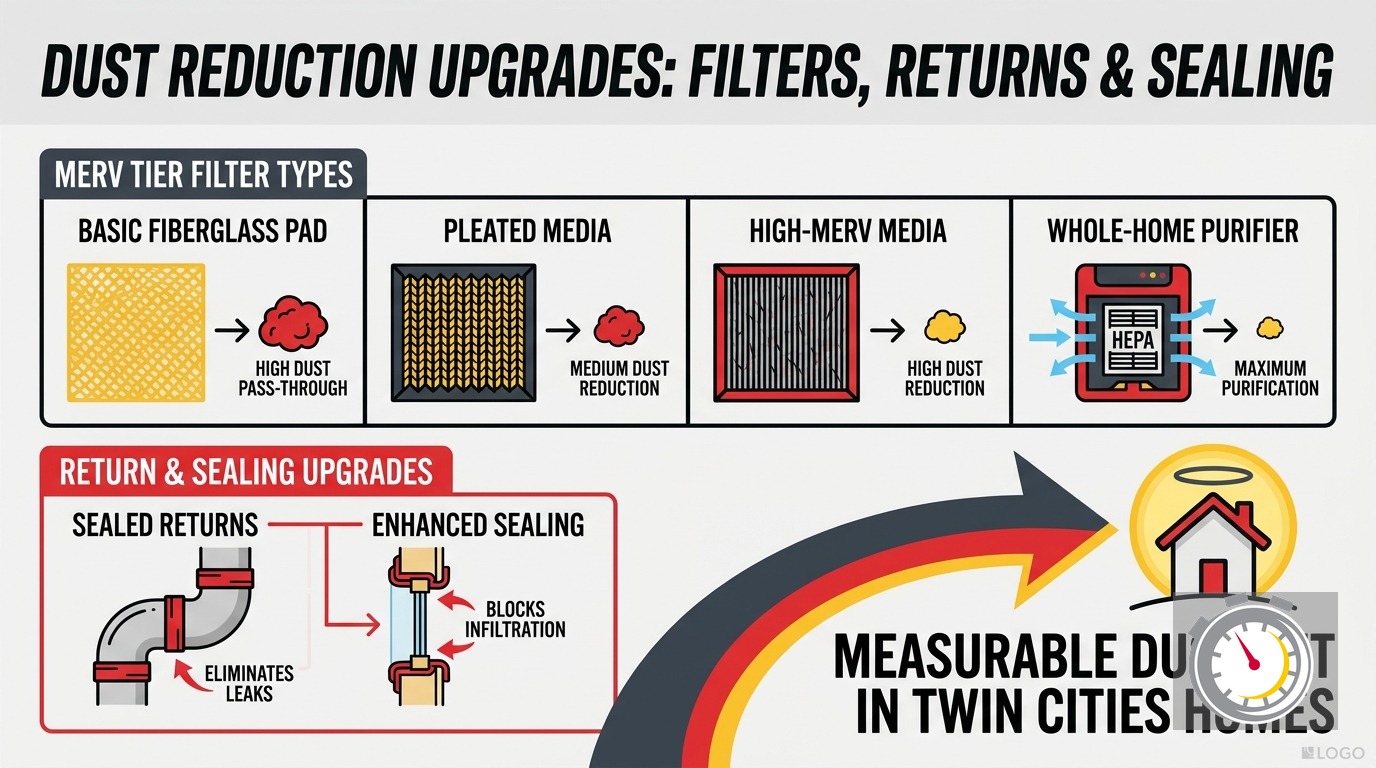
- The EPA recommends MERV 13 or higher for capturing PM2.5, the fine particles of greatest health concern. Most residential furnaces handle it.
- Your filter only works while your system runs, which is less than 25% of the time during heating and cooling seasons. Continuous fan mode changes that.
- One undersized return vent creates negative pressure that pulls dusty air from wall cavities and crawlspaces directly into your air stream. That’s a mechanical fix, not a product purchase.
- Leaky ducts in attics and crawlspaces pull in insulation fibers and soil every time your furnace kicks on. Duct sealing is a dust fix, not just an energy fix.
- Minnesota winters amplify all three problems. More run cycles means faster filter loading, more duct-leak events per season, and more attic air pulled into your home per year.
Why Most Dust-Reduction Advice Falls Short
Search “how to reduce dust in house HVAC” and every result says the same thing. Change your filter. Maybe upgrade to a MERV 8. Schedule a tune-up. That advice isn’t wrong. It’s incomplete in ways that matter here.
In the Twin Cities, a gas furnace runs from October through April. That’s more than five months of heating season. Each cycle is a chance for dust to enter your air stream. A filter catches some of it. But if your return-air path is undersized or your ducts leak into an attic, the filter is working against a problem it was never designed to solve alone.
Three mechanical upgrades change the equation. A smarter filter strategy built around MERV 13. Continuous fan mode, which turns passive filtration into active filtration. And duct sealing, which stops attic and crawlspace air from entering your system in the first place.
All three are grounded in EPA and ENERGY STAR research. All three are jobs our locally owned and operated team in Ramsey, Minnesota, handles across the Twin Cities every week.
What MERV Rating Should You Use to Reduce Dust?
The short answer: The EPA recommends MERV 13 or higher for capturing fine particles of greatest health concern. Most residential furnaces handle MERV 13 without restriction problems if you change the filter every four to six weeks during peak heating season.
Here’s what the MERV scale actually measures. MERV stands for Minimum Efficiency Reporting Value. The scale runs from 1 to 20. Filters in the MERV 8-11 range, which most online guides recommend, capture large particles well. They miss a significant fraction of PM2.5 and PM10. Those are the fine particles that carry mold spores, pollen, and combustion byproducts.
PM2.5 refers to particles 2.5 micrometers in diameter or smaller. They’re small enough to bypass your nose and throat. They reach deep into the lungs. A MERV 13 filter doesn’t eliminate PM2.5 entirely, but it meaningfully reduces the concentration in recirculated air.
The EPA’s guide to air cleaners in the home sets a specific standard. MERV 13 must demonstrate at least 50% removal efficiency for the smallest tested particle range. That’s the minimum for meaningful PM2.5 capture. A MERV 8 filter offers no comparable guarantee.
The usual objection is airflow restriction. A denser filter limits how freely air moves through the system. For most modern residential furnaces, a fresh MERV 13 filter is not a problem. A loaded MERV 13 filter is. The fix is frequency: change it every 30 days during winter. ENERGY STAR recommends monthly filter checks during peak-use seasons for exactly this reason.
One option worth asking about: media filter cabinets. A 4-inch or 5-inch media cabinet mounts at the return-air connection and accepts MERV 13 media. It has far more surface area than a standard 1-inch slot filter. That extra surface area extends replacement intervals even at MERV 13 density, typically to six to twelve months.
For a deeper look at filter types and whole-home filtration options, our guide on air purifiers, filters, and MERV ratings explained covers the full comparison.
Run Your Fan on Circulate Mode
Look at your thermostat. There’s a fan setting, and most people leave it on “Auto.”
Auto means the fan only runs when the system is actively heating or cooling. According to EPA research on home air filtration, that accounts for less than 25% of the time during a typical heating or cooling season. For the other 75%, your filter is completely idle.
Switching to “Circulate” or continuous “On” keeps air moving through the filter even without a heating or cooling call. Dust that settles in a still room gets stirred and recaptured. Particles that enter through a door or window get filtered instead of landing on your furniture.
On a variable-speed blower, continuous fan operation costs less than it sounds. The motor runs at a fraction of its full speed in circulate mode, not at full blast. The added electric cost is modest.
There’s a secondary benefit in a Minnesota winter. Cold exterior walls create air that is slightly cooler and drier near the perimeter of a room. Continuous circulation helps even out those pockets. It doesn’t replace a whole-home humidifier, but it reduces the temperature and humidity stratification that makes dry skin and static electricity worse.
One caveat: if your ducts have significant leakage, running the fan continuously also increases the rate at which you’re pulling in outside air. That’s the duct sealing argument again. These three upgrades are additive. Each one reinforces the others.
Is Your Return Air System Making Your Dust Problem Worse?
The short answer: Yes, in many Twin Cities homes. An undersized or leaky return creates negative pressure. That pressure draws dusty air from wall cavities, attic bypasses, and crawlspaces directly into your air stream. No filter upgrade fixes a pathway problem.
The supply side of your duct system gets all the attention. Those are the vents in your floors, walls, and ceilings. They push conditioned air into rooms. The return side is quieter. It pulls air back to the furnace to be filtered and reconditioned.
When the return side is undersized, your system works like a vacuum with a blocked hose. It pulls air from wherever it can find it. That’s often a wall cavity behind the air handler, a gap around a pipe penetration, or an attic bypass near the furnace. That air has never been filtered. It carries whatever has accumulated in those spaces for years, sometimes decades.
The particles that enter this way skip the filter entirely. They go directly into the blower wheel and through the heat exchanger before reaching your living space. A MERV 13 filter cannot intercept air it never sees.
You might notice this as a house that’s consistently dusty despite regular filter changes. You might also notice a bedroom with a supply vent but no return. In that room, the door has to stay open or air can’t get back to the furnace. That’s a return-air imbalance showing up as both a comfort problem and a dust problem at the same time.
The fix is not a product purchase. It means adding return-air capacity where the system is undersized and sealing air bypasses near the air handler. Identifying the problem requires measuring static pressure on the return side and tracing where the system is drawing from. Our post on return air problems in Twin Cities HVAC systems describes the symptoms in detail and explains what a static pressure diagnostic looks like during a service call.
Does Duct Sealing Actually Reduce Indoor Dust?
The short answer: Yes. Leaky return ducts in attics and crawlspaces pull attic insulation fibers, soil particles, and outdoor particulates into your home every time the furnace runs. Sealing them removes a direct pathway into your air stream.
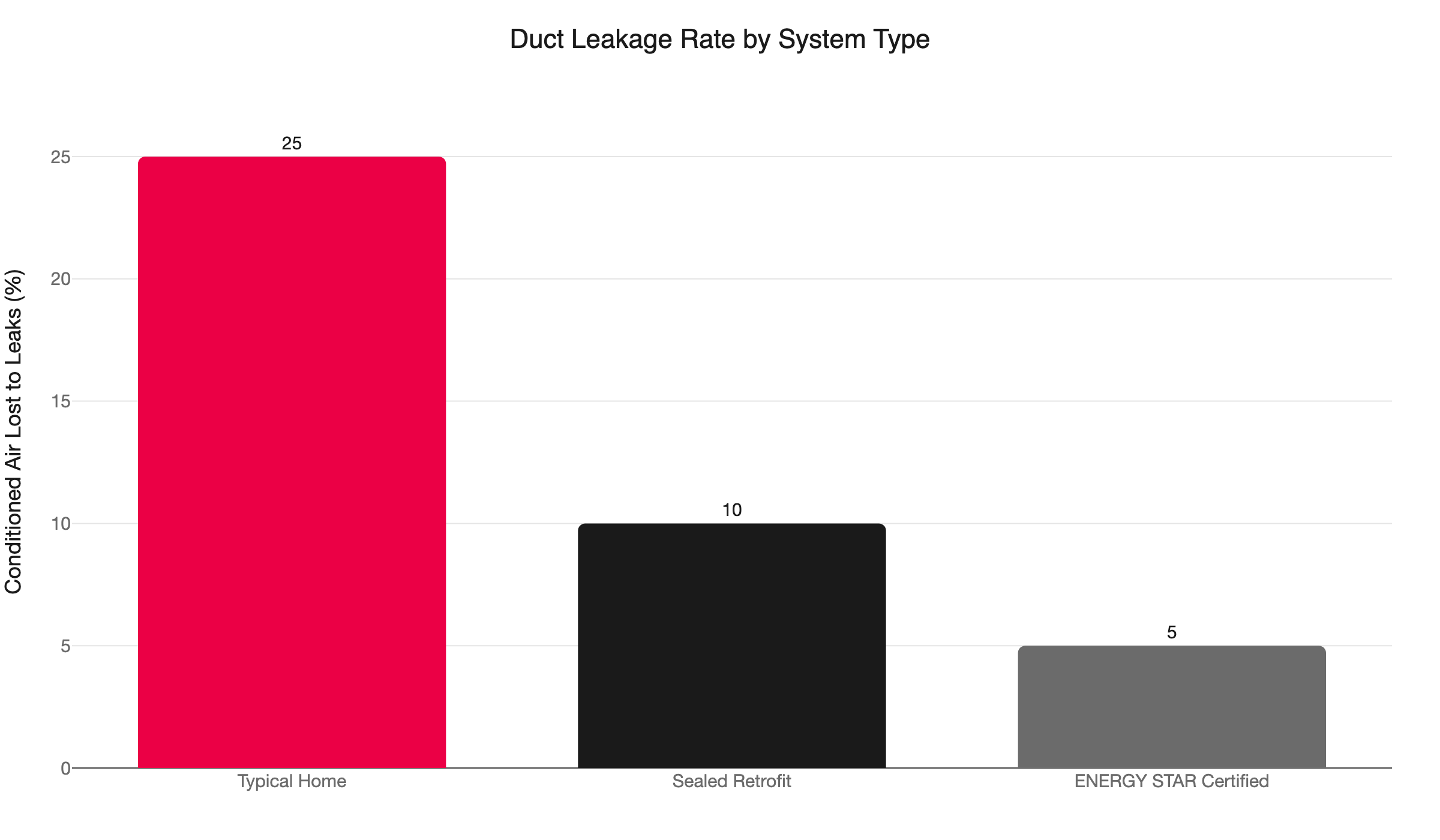
Most homeowners think of duct sealing as an energy fix. The savings are real. ENERGY STAR estimates that duct sealing can improve system efficiency by up to 20%. But the indoor air quality case is just as compelling.
Here’s the mechanics of the problem. Typical U.S. duct systems lose 20-30% of conditioned air through leaks. Those leaks concentrate at joints and connections. Any duct segment running through an attic, crawlspace, unheated basement, or garage is a likely leak location. When a return duct has a leaky joint in the attic, it doesn’t just lose conditioned air. It also draws in whatever surrounds that joint: fiberglass insulation particles, accumulated dust, and unfiltered outdoor air.
That air enters your duct system upstream of the filter. It goes through the blower, through the heat exchanger, and into your living space. Your MERV 13 filter never sees it.
The sealing method matters. Use mastic sealant or metal-backed (foil) tape. Standard hardware-store duct tape is not rated for HVAC use and fails within a few years. A proper duct sealing job starts with a pressure test to locate the leaks, then seals them systematically from the air handler outward toward the farthest registers.
Professional duct sealing for a typical Twin Cities home runs around $1,300. For more on the process and what the diagnostic looks like, our post on leaky ductwork and energy loss walks through each step.
How Minnesota’s Climate Amplifies Every One of These Problems
Most dust-reduction guides are written for a generic American climate. The Twin Cities is not a generic climate.
Minneapolis falls in IECC Climate Zone 6, with a 99% heating design temperature of approximately -16 degrees Fahrenheit. A furnace in Ramsey or Maple Grove doesn’t run a few hours a day. It runs all day, for five or more months straight. That changes the math on every upgrade covered in this post.
Filter loading is faster. A filter rated for 90 days in a mild climate loads in four to six weeks here. A loaded filter has two failure modes. It restricts airflow and forces the blower to work harder. It also develops enough pressure differential to push air around the edges of the filter frame. Either way, dust bypasses the filter. Monthly checks from October through April are appropriate for this climate, not overcautious.
Duct leakage cycles more. Each time the furnace kicks on, any leaky joint pulls in outside air and loses conditioned air. In a mild climate, that’s a few hundred cycles per winter. In Minnesota, it’s closer to a few thousand. The same 5% return-side leak has a much greater cumulative impact here than in a warm-weather state.
Stack effect is stronger. Cold air outside creates a pressure differential that drives warm interior air upward and out of the home. Replacement air enters through any gap the return-air path can reach. In a cold climate, that pressure difference is strong enough to meaningfully amplify return-air infiltration. Sealing duct bypasses near the air handler matters more here than in most of the country.
The payback on all three upgrades is faster in Minnesota because the operating season is so much longer.
What Do These Upgrades Cost in the Twin Cities?
The short answer: MERV 13 filters run $15-$35 each, with roughly $100-$150 per year in filter costs at monthly replacement. Fan mode changes are free. Duct sealing for a typical home runs around $1,300. Return-air assessments start during any standard service call.
Let’s put real numbers on each item.
MERV 13 filter. The filter itself runs $15-$35 depending on size. The added cost comes from replacing it more often. Budget $100-$150 per year for filters if you’re checking monthly from October through April. That’s a modest number for meaningful air-quality improvement.
Fan mode change. No cost. Adjust the setting at your thermostat today. If you have a smart thermostat, look for a “Circulate” or “Fan Schedule” option in the app. Two minutes of setup.
Return-air assessment. Static pressure readings during a routine service call will identify return-side problems. If return capacity needs to be added or bypasses need to be sealed, we’ll give you a clear estimate before any work starts. Transparent pricing is how we operate.
Duct sealing. A professional sealing job on a typical Twin Cities home runs around $1,300. ENERGY STAR-level efficiency gains of up to 20% translate directly to savings on your heating bills. Over five months of heating season, the investment pays back. Add lower dust load and reduced wear on your blower and heat exchanger, and the return looks even better.
Financing. If you’re looking at duct work, return-air upgrades, or any larger HVAC project, ask about financing options when you call. Spreading a $1,300 project over 12 months makes it easy to start this season rather than waiting until next.
What About Air Purifiers and Whole-Home IAQ Equipment?
The short answer: Source control first. Address filter grade, fan mode, return-air paths, and duct leakage before adding downstream equipment. Whole-home air purifiers complement a sealed system. They can’t compensate for a return duct that vacuums attic air into your living space.
Filters, fan mode, return-air sealing, and duct sealing work upstream. They reduce the dust load entering your air stream in the first place. Air purifiers and whole-home IAQ systems work downstream. They catch what the filter misses.
Both approaches are worth doing. But the sequence matters. A whole-home air purifier installed over a leaky return duct is a losing battle.
Once the mechanical side is addressed, our indoor air quality services include whole-home air purification, humidity control, and ventilation systems that pair well with a MERV 13 filter setup. Together, they address a much broader range of contaminants than either approach alone.
Context for why all of this matters: the EPA reports that people spend approximately 90% of their time indoors. Your HVAC system is either your home’s first line of defense against particulates, or it’s a pathway for attic and crawlspace air into your living space. The three upgrades in this post put it on the right side of that equation.
Ready to Reduce the Dust in Your Twin Cities Home?
Northern One Hour is a locally owned and operated HVAC company based in Ramsey, Minnesota. We serve Minneapolis, St. Paul, Blaine, Maple Grove, Plymouth, Brooklyn Park, Woodbury, and the rest of the Twin Cities metro.
Our technicians arrive when they say they will. That’s the promise behind “Always On Time… Or You Don’t Pay a Dime!(R).” It applies to every service call, every duct inspection, and every tune-up we run.
If you’re dusting the same surfaces week after week, the cause is almost always mechanical. A leaky return, undersized duct capacity, or filter loading faster than you realize. We can find it and fix it.
Call (763) 260-6662 or book online to schedule a service visit. We’ll give you a straight answer on what your system actually needs.
Frequently Asked Questions
What MERV rating should I use for my furnace filter to reduce dust? +
Does running my furnace fan continuously damage the equipment? +
How much does duct sealing cost in the Twin Cities? +
Can a leaky return duct really cause more dust inside my home? +
Need a technician now?