
Best Furnace Filter MERV Rating for Home: 8, 11, or 13?
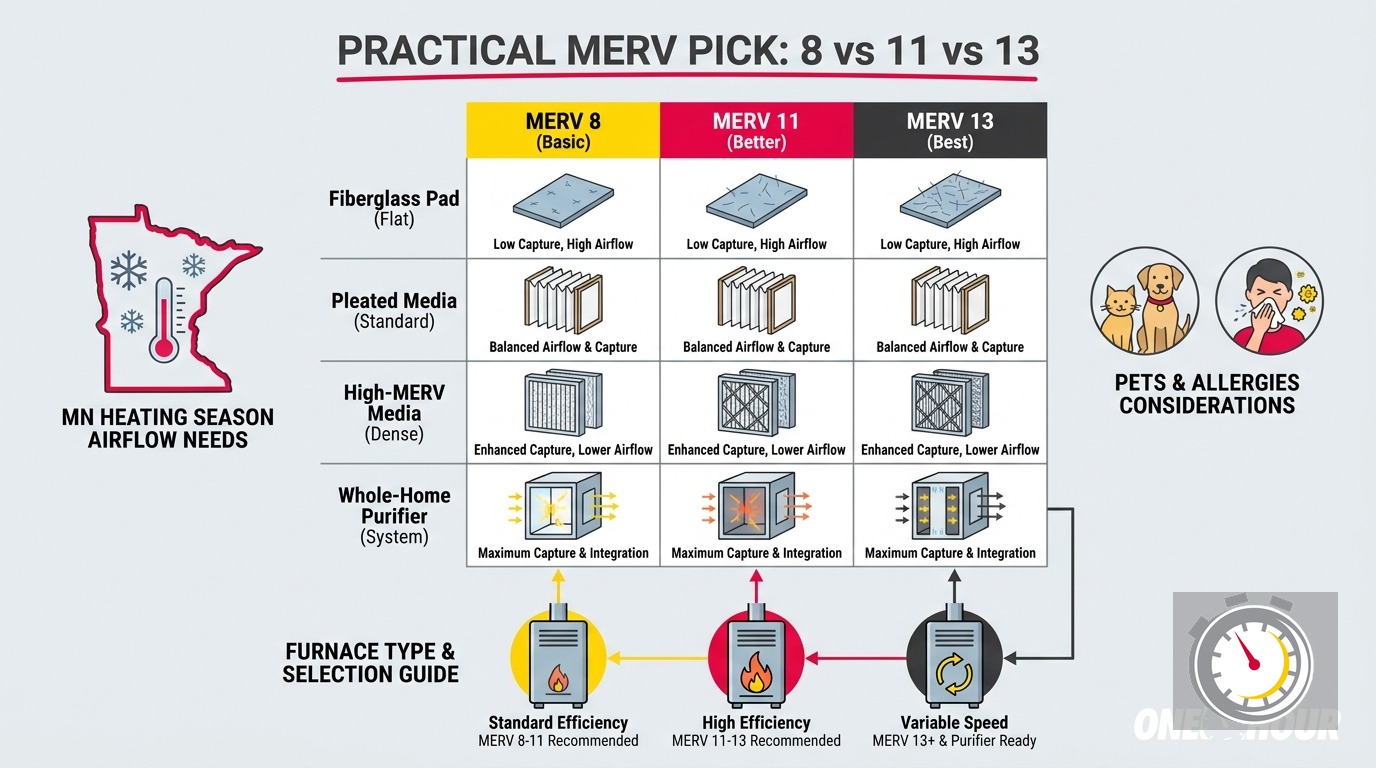
Key Takeaways
- MERV 8 fits most homes with no pets and no allergy concerns.
- MERV 11 is the sweet spot for pets, dust, and mild allergies.
- MERV 13 suits allergies, asthma, and smoke, but only if airflow stays strong.
- Your blower type decides how much filter resistance your system can take.
- Check your filter monthly from December through February.
- If airflow weakens, step down one MERV level.
- A technician can measure static pressure before you move up to MERV 13.
- A higher MERV rating does not help if the filter is dirty.
The Short Answer for Minnesota Homes
For most Twin Cities homes, MERV 8 or MERV 11 is the best furnace filter rating for home use. Choose MERV 11 if you have pets or mild allergies. Choose MERV 13 only when someone has allergies or asthma and your system can handle it.
Your blower matters as much as the rating. A filter that cleans well but starves your furnace of air does more harm than good. That risk peaks in a Minnesota winter, when your furnace runs most of the day.
We are Northern One Hour Heating & Air Conditioning, a locally owned and operated Twin Cities HVAC company. We see filter mistakes in homes across the metro every winter. Below is a simple way to pick the right MERV, test it, and adjust.
What MERV rating do I want for my furnace filter?
Most Minnesota homes do well with MERV 8 to MERV 11. Pick MERV 8 for basic dust protection. Pick MERV 11 for pets and mild allergies. Move to MERV 13 only for allergies, asthma, or smoke, and only if your furnace moves air easily.
MERV stands for Minimum Efficiency Reporting Value. The scale runs from 1 to 20, and a higher MERV rating results in a greater reduction in pollutants, according to the Minnesota Department of Health.
Here is how the three common picks compare.
MERV 8: the baseline.
- Catches dust, pollen, and lint.
- Lets air through easily.
- Works well in older or single-speed systems.
- Fits homes with no pets and no allergy concerns.
MERV 11: the everyday upgrade.
- Catches more fine dust and pet dander than MERV 8.
- Still moves air well in most modern furnaces.
- Fits homes with a dog or cat, or mild seasonal allergies.
- Is our starting point when a homeowner is unsure.
MERV 13: the high-filtration pick.
- Captures the smallest particles best of the three.
- Adds the most resistance to airflow.
- Fits homes with allergies, asthma, or smoke concerns.
- Needs a monthly check and a blower that can keep up.
The EPA leans higher. It advises you to select a filter rated at least MERV 13 or as high as your system will accommodate. That advice has a second half that matters. The same page says to consult a professional HVAC technician to be certain a filter will work with your system.
So we treat MERV 13 as a “when it fits” choice. We would rather confirm your airflow than guess.
Why does Minnesota heating season change the MERV pick?
Minnesota furnaces work harder than furnaces in mild climates. By December, your furnace may run almost nonstop. Your filter loads up faster, and any airflow restriction shows up sooner and costs you more.
CenterPoint Energy notes that in colder climates like Minnesota, furnaces often run continuously by December. The same page lists December through February as peak heating season. It also says to check furnace filters monthly during the heating season.
Two problems can stack up at the same time:
- A clogging filter. Dust builds up and blocks air.
- A restrictive filter. A high MERV adds resistance even when it is brand new.
Together, they can choke your system. ENERGY STAR warns that a dirty filter can increase energy costs and damage your equipment, leading to early failure. Your furnace is the costly part to lose.
In summer, a tight filter is a small risk because your AC runs in shorter bursts. In January, your furnace runs for hours. A filter that works fine in September may be too much for a subzero week.
That does not mean you should avoid MERV 13 in winter. It means you should check it more often and watch for warning signs. A simple test comes below.
How does my furnace blower type change the choice?
Blower type sets how much resistance your system can overcome. ECM and variable-speed blowers can speed up to offset a tighter filter. Older PSC blowers cannot adjust as well. If you have a PSC blower, lean toward MERV 8 or MERV 11.
A blower is the fan that pushes warm air through your ducts. Two main types matter here.
PSC blowers. These are common in older, single-stage furnaces. They run at a fixed speed. Industry guidance says PSC blowers compensate less well for filter resistance. A tight filter can cut airflow.
ECM and variable-speed blowers. These are common in newer, higher-efficiency furnaces. The same guide says ECM blowers can speed up to offset filter resistance. They handle MERV 11 and often MERV 13 with less strain.
That source also says a clean pleated filter adds roughly 0.05 to 0.25 inches of water column to the system. Think of it as a toll your filter charges your airflow. Your furnace has a fixed budget for that toll.
Not sure which blower you have? Look at your furnace’s label or model number, or ask a technician during a visit. Our variable-speed blower guide explains what to look for.
If your system already struggles with airflow, a higher MERV makes it worse. Warning signs include weak vents, hot or cold rooms, and a furnace that runs long. Fix the airflow problem first.
Does a MERV 11 filter catch PM2.5?
Yes, a MERV 11 filter catches some PM2.5, but not as much as MERV 13. PM2.5 means fine particles about 2.5 microns or smaller, like smoke and fine dust. Capture improves as MERV rises. MERV 13 is where small-particle removal becomes much stronger.
The EPA ties MERV 13 to a clear benchmark. Filters with a MERV of 13 and above are required to demonstrate at least 50% removal efficiency for the smallest particles tested. That is why health agencies point to MERV 13 for smoke.
What does that mean for your pick?
- MERV 11 helps with dust, pet dander, and larger pollen. It gives partial help with fine particles.
- MERV 13 is the better tool when fine particles are your main worry.
Fine particles matter most for people with asthma, allergies, or sensitive lungs. If that is your household, MERV 13 is worth a serious look. If it is just everyday dust and a dog, MERV 11 is usually enough.
One caveat: no filter cleans air when your furnace is off. Furnace and HVAC filters work to filter the air only when the system is operating. A great filter in a system that rarely runs does less than you might expect. Winter helps here, since your furnace runs often.
For more on particles and allergy triggers, see our post on the best furnace filter for allergies in Minnesota.
Is MERV or HEPA better?
HEPA filters clean more than any MERV-rated furnace filter, but they usually do not fit a standard furnace. HEPA is tested at the top of the MERV scale. Its dense media blocks too much airflow for most home systems. A MERV 11 or 13 filter is the practical choice.
The Minnesota Department of Health explains the scale. HEPA is MERV 17 to 20 and removes 99.97% of particles at 0.3 microns. On paper, that is excellent performance.
The catch is airflow. A HEPA filter is much denser than a pleated furnace filter. Pushing your whole-home air through it takes a very strong blower and a system built for it. Most residential furnaces are not.
If you want HEPA-level cleaning, you have better options:
- A portable HEPA purifier in a bedroom or living room.
- A whole-home air purification system designed for your ductwork.
- A media cabinet that holds a deeper, higher-rated filter with less resistance.
Each tool has a different job. Our guide on air purifiers versus filters shows where each one works best. You can also explore our indoor air quality services if you want a whole-home approach.
Do more expensive furnace filters really make a difference?
Sometimes, but price alone is a poor guide. The MERV rating on the label tells you more than the price tag. A costly filter can still be the wrong size, the wrong rating, or too restrictive for your blower. Fit, rating, and fresh replacement matter most.
Here is what changes when you pay more:
- Higher MERV rating. This is the main driver of cleaning power.
- Better build. A sturdier frame and tighter seal keep air from slipping around the edges.
- More media. Deeper pleats or thicker filters can hold more dust and may restrict airflow less.
Here is what does not change:
- A premium filter does not fix a dirty one. Dirty is dirty.
- A premium filter does not help if it is the wrong size.
- A premium filter does not make a weak blower stronger.
Size is a quiet problem in many homes. A filter that is too small lets dust bypass the media. Our posts on wrong-size filters and air leaking around the filter cover how to spot this.
Our advice is simple. Buy the right size and the right MERV for your system. Then replace it on schedule. That beats paying extra for a filter you leave in too long.
Which MERV rating is best for homes with pets?
For most pet homes, MERV 11 is the best furnace filter. It captures more pet dander and fine hair-related dust than MERV 8 without a big airflow penalty. Check it more often than usual, since pet hair loads a filter quickly during the heating season.
Pets shed all year, but winter makes it worse in two ways. Your windows stay closed, so dander stays inside. Your furnace also runs more, so it pulls that dander through the filter again and again.
Use these pet guidelines:
- One small pet, short hair: MERV 8 or 11, checked monthly.
- One or two dogs or cats: MERV 11, checked monthly.
- Multiple pets or heavy shedders: MERV 11, checked every two to three weeks in deep winter.
- Pet allergies in the household: MERV 13 if your blower allows it, with close monitoring.
Pet hair also coats the blower wheel and other parts over time. That adds to airflow trouble. Our guide on filters for pet hair and dander goes deeper on this.
A pet home with a PSC blower should lean toward MERV 11 over 13. You can still help the air with regular vacuuming and a portable purifier.
Decision Matrix: Pick Your MERV by Blower, Pets, and Allergies
Use this table as a starting point. Then run the winter test below to confirm.
| Your situation | Blower type | Start with | Step up to |
|---|---|---|---|
| No pets, no allergies | PSC or older single-speed | MERV 8 | MERV 11 if dusty |
| No pets, no allergies | ECM or variable-speed | MERV 8 or 11 | MERV 13 if desired |
| Pets, no allergies | PSC or older single-speed | MERV 8 or 11 | Stay at MERV 11 |
| Pets, no allergies | ECM or variable-speed | MERV 11 | MERV 13 if airflow is strong |
| Allergies or asthma | PSC or older single-speed | MERV 11 | Ask a technician about MERV 13 |
| Allergies or asthma | ECM or variable-speed | MERV 13 | Add air purification |
| Unsure of everything | Unknown | MERV 8 or 11 | Get an airflow check |
Read the table from your blower first. Your blower sets the ceiling. Your pets and allergies set the floor.
When in doubt, start lower and step up. It is easier to move from MERV 8 to 11 after a good test than to recover from a strangled furnace.
The Winter Test: How to Know If Your Filter Is Too Tight
You do not need tools to run a basic winter test. You need a calendar and a little attention. Run it for the first few weeks after any filter change.
Step 1: Install the new filter correctly. Check the arrow. It should point toward the furnace, the same direction air flows. Our guide on which way a filter goes shows how.
Step 2: Check airflow at the vents. Hold your hand over a few registers. Note how strong the air feels. Compare it to how it felt with your old filter.
Step 3: Watch your run times. Does your furnace run noticeably longer to hit the same temperature? That can mean the filter is restricting air.
Step 4: Listen to your system. Whistling at the filter slot, or a straining sound from the blower, is a red flag.
Step 5: Check the filter monthly. ENERGY STAR recommends you inspect, clean, or change air filters once a month in your central air conditioner, furnace, or heat pump. In winter, make that a firm habit. Replace the filter when it looks dirty.
Step 6: Step down if airflow suffers. If you see weak airflow or long run times, drop one MERV level. Go from 13 to 11, or 11 to 8. Then test again.
This one rule solves most filter problems. If the lower MERV fixes it, your system could not handle the higher rating. If it does not, something else is wrong.
For timing tips, see our post on how often to change your HVAC filter in Minnesota.
What about wildfire smoke days?
On smoke days, use MERV 13 or higher if your system can take it, and check the filter more often. The Minnesota Department of Health gives this guidance for smoke. It is a short-term plan. Go back to your normal rating once the air clears.
Smoke is the case where Minnesota health officials name a specific rating. The state advises that you use a MERV 13 rated filter or higher in your heating, ventilating, and air conditioning system. It also says to check the filter at least every month during heavy use and more often during wildfire smoke.
That guidance addresses smoke only. We found no state guidance that sets a MERV for everyday furnace use in heating season. So we focus on your system and your household.
A smoke-day plan:
- Swap to MERV 13 if your blower can handle it.
- Keep windows closed.
- Check the filter every few days if smoke is heavy.
- Run the fan to keep air moving through the filter.
- Go back to your regular filter after the smoke passes.
Smoke season and winter heating season rarely overlap in Minnesota. If you keep MERV 13 on hand for smoke, store a spare so you are ready. We cover more in our post on wildfire smoke and indoor air quality.
When to Call a Pro Before Moving Up to MERV 13
Call a technician before you commit to MERV 13 if any of these apply:
- Your furnace is older and has a PSC blower.
- You already have uneven heat or weak airflow.
- Your furnace runs long cycles or shuts off on a safety limit.
- Someone in your home has asthma, and you want the best result.
- You are not sure what size or type of filter slot you have.
The EPA is clear that a technician is the way to be certain. It says to consult a professional HVAC technician to be certain a filter will work with your system.
During a visit, a technician can:
- Measure static pressure. This number shows how hard your blower works to push air through your ducts and filter.
- Inspect the blower. We check the motor, the wheel, and the wiring.
- Check the filter slot. We look for gaps that let air bypass the filter.
- Recommend a media cabinet. A deeper cabinet holds a thicker filter, so you get higher filtration with less resistance.
A media cabinet is often the best path if you want MERV 13 and your current slot is too tight. Larger upgrades like this can involve a real investment, so ask us about financing options.
A furnace tune-up is the easiest way to start. We check airflow, clean key parts, and tell you what filter your system can handle. For a deeper look at the high-MERV tradeoff, read our post on MERV 13 and airflow restriction.
Why Homeowners Choose Northern One Hour
We are locally owned and operated, and we serve homeowners across the Twin Cities. We know how hard a Minnesota winter is on a furnace and a filter.
We also keep our promise on timing. Our tagline is “Always On Time… Or You Don’t Pay a Dime!(R)” In plain terms, we arrive within the time window you select. If your technician does not show up on time, you do not pay for the service.
You also get honest, transparent pricing and a 100% satisfaction guarantee. If you are unsure about your filter, your blower, or your airflow, we will help you sort it out.
Next Steps
Here is a quick plan you can use this week:
- Find your current filter size and MERV rating.
- Identify your blower type, or ask us to check.
- Use the decision matrix to pick MERV 8, 11, or 13.
- Install the new filter with the arrow pointing toward the furnace.
- Run the winter test for two to four weeks.
- Check the filter monthly from December through February.
- Step down one level if airflow weakens.
The best furnace filter rating is the one your system can use well. For most Minnesota homes, that means MERV 8 or 11, with MERV 13 when allergies or smoke call for it and your airflow allows.
Want a pro to confirm your pick? Call (763) 260-6662 or book online. We will measure your airflow and match your filter to your furnace.
Frequently Asked Questions
How often should I check my furnace filter in winter? +
What should I do if airflow drops after I switch filters? +
Does a higher MERV filter raise my energy bill? +
Can I use a MERV 13 filter in any furnace? +
Need a technician now?