
Which Way Does Furnace Filter Go Arrow Direction? A Guide
Key Takeaways
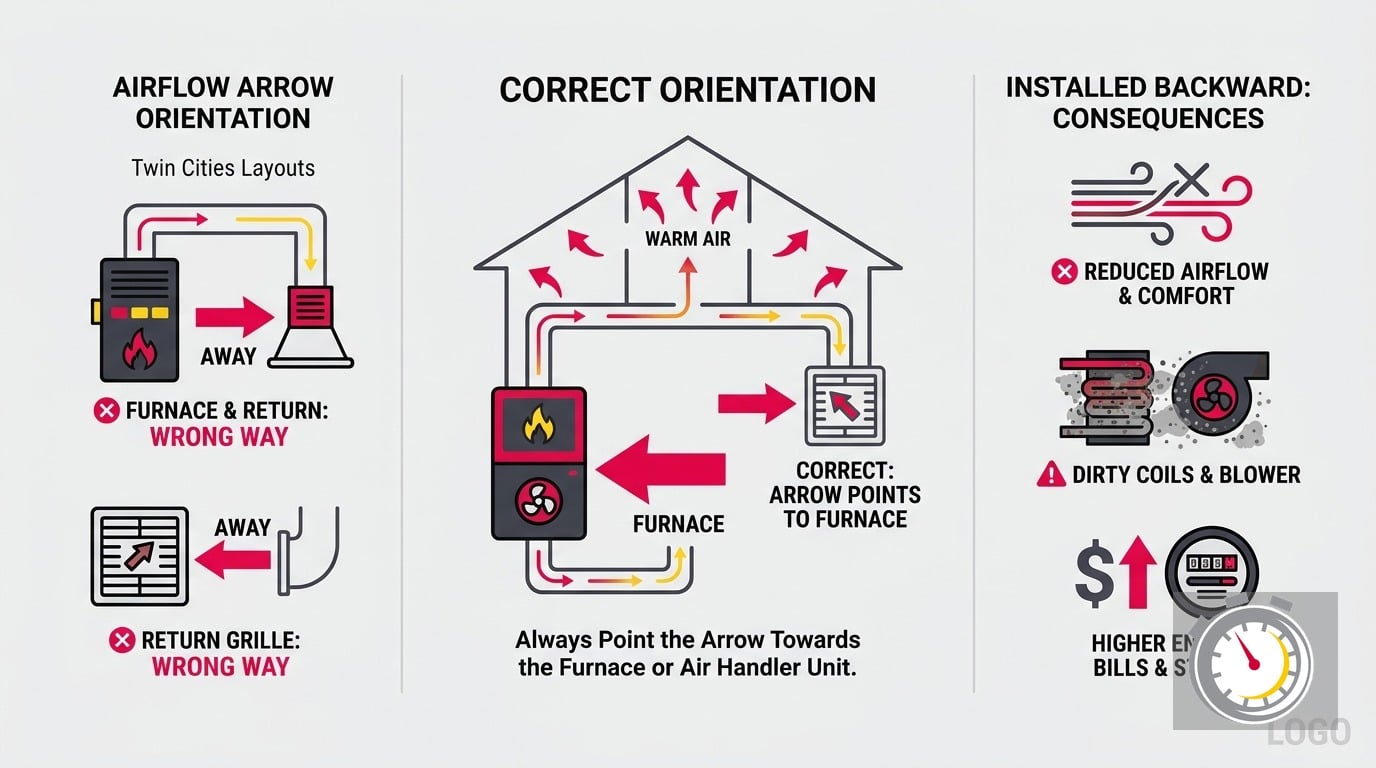
- The arrow on the filter frame points toward the furnace, in the direction the air is moving.
- The filter belongs on the return side, where air enters the furnace.
- If the filter sits in a return grille, the arrow points away from the room and into the duct.
- A backward filter does not usually cause an instant breakdown. It can still reduce filtration and add strain on the blower.
- A standard 1-inch filter should be MERV 8 or lower. Use a 4-inch filter for higher ratings.
- Check your filter every month during Minnesota’s heavy heating months.
- If you are unsure, call Northern One Hour at (763) 260-6662 or book online.
Which way does the furnace filter arrow point?
The arrow points in the direction of airflow, which is toward the furnace. Air travels from your rooms, through the return duct, through the filter, and into the blower. Install the filter so the arrow points into the duct and toward the furnace. The Building America Solution Center gives the same direction, and it holds in every home.
We are Northern One Hour Heating & Air Conditioning, locally owned and operated in Ramsey. We serve homeowners across the Twin Cities. Every winter we find filter mistakes on service calls. Most are easy to fix once you know what to look for.
Does the arrow on a furnace filter point toward the blower motor?
Yes, in almost every home. The blower motor sits inside the furnace, and the arrow points toward the furnace. The filter sits upstream of the blower on the return side, so air passes through it before the blower pulls it in. Point the arrow at the furnace and you are right.
Think of the blower as a vacuum. It pulls air from the house through the return duct. The filter catches dust before that air reaches the blower, the heat exchanger, and the rest of the system.
The arrow says nothing about which side faces “up” or “out.” It describes airflow. Two homes can have filters facing opposite directions in the room and both be correct. What matters is where the furnace sits relative to the filter.
The Building America Solution Center describes the same setup. The new filter goes in the return-side slot near the furnace. The arrow on the frame points in the direction of airflow, toward the furnace.
Here is a quick way to remember it:
- Dirty air comes from the house.
- Clean air goes to the furnace.
- The arrow points to the clean side.
How do you check airflow direction?
Find the duct that carries air from your rooms back to the furnace. That is the return side. Air moves along that duct toward the furnace, so the arrow should point the same way. If the slot sits between the return duct and the furnace, the arrow points at the furnace.
You do not need tools. Just follow the ductwork with your eyes.
Start at the furnace cabinet and look for the large duct that connects to it on the return side. The supply ducts carry heated air out to your rooms. The filter belongs on the return side, between the return duct and the supply duct, as the Center for Energy and Environment explains.
Use this simple check:
- Locate the filter slot or return grille.
- Trace the duct from that slot toward the furnace.
- Picture the air traveling in that direction.
- Make sure the arrow on the filter frame points the same way.
If your slot sits right at the furnace, the arrow points into the furnace cabinet. If the slot sits in a wall or ceiling grille, the arrow points into the wall or ceiling, away from the room.
Not sure which duct is the return? Look at the sizes. Return ducts are often larger than the individual supply runs. A return also draws air in, so you may feel a gentle pull at the grille when the blower runs. Supply registers blow air out.
Still stuck? Take a photo of your furnace and slot. Send it to us or have a technician look during a visit. A quick glance beats guessing.
Where is the filter in common Twin Cities layouts?
It depends on your furnace and your home. Most Twin Cities homes use one of three setups: a basement furnace with a slot at the unit, a closet or attic unit with a slot in the cabinet or duct, or a return grille in a wall or ceiling. The arrow rule is the same in all three.
Basement upflow furnace with a side or bottom return
Many Twin Cities homes, old and new, have a furnace in the basement. It pushes warm air up into the ducts. The return air often enters from the side or the bottom.
On these units, the filter slot is a narrow opening near the blower compartment. It may be on the side of the cabinet or in the return duct just before it meets the furnace. You slide the filter in from the side.
For a side return, the arrow points into the furnace cabinet. For a bottom return, the filter often sits in the return plenum. Air travels up into the furnace, so the arrow points up toward the unit.
Closet or attic horizontal unit
Some homes have a horizontal furnace lying on its side, often in attics, crawl spaces, and utility closets. Air moves left to right or right to left through the unit.
The filter often sits at the return end of the cabinet or in a slot in the return duct. The arrow points toward the furnace, along the direction the air travels through the unit.
Don’t assume the arrow points up or down here. Follow the air. If the return enters on the left, the arrow points right, toward the furnace body.
Wall or ceiling return grille
Many homes have a large return grille in a hallway wall or ceiling. The filter sits inside the grille instead of at the furnace. This setup is common in townhomes, condos, and finished basements.
The arrow points away from the room. Air moves from the room, through the filter, and into the duct behind the grille. So the arrow points into the wall or ceiling.
This layout confuses people most, because the filter looks like it should face the room. It should not. Keep the arrow pointed toward the duct and the furnace.
If the cover on your slot is missing or loose, read our guide on what to do when the filter door is missing. Air that sneaks around the filter skips the filter completely.
How do you install a furnace filter step by step?
Turn the furnace off, pull out the old filter, and note which way its arrow points. Slide the new filter in with the arrow toward the furnace. Close the slot cover and turn the furnace back on. The whole job takes a few minutes.
The Center for Energy and Environment lists these same steps: turn off the furnace, remove the old filter, insert the new one with the airflow arrow pointing toward the furnace, and turn the furnace back on.
Here is the full routine we recommend:
- Turn off the furnace. Use the thermostat or the switch near the unit.
- Remove the old filter. Slide it out slowly so dust stays in the frame.
- Check the size. Read the size printed on the frame edge, such as 16x25x1.
- Note the arrow on the old filter. It shows how the last person installed it.
- Insert the new filter. Point the arrow toward the furnace.
- Seat it fully. The filter should sit flat with no gaps on the sides.
- Close the cover. The cover should snap or latch tight.
- Turn the furnace back on.
A few habits help. Write the date on the frame edge with a marker. Keep a spare filter near the furnace. Take a photo of the slot before you start, so you can compare later.
Match the size exactly. A filter that is too small leaves gaps. One that is too big will not fit. If you are unsure of your size, see our post on what happens with the wrong filter size.
What happens if you put the furnace filter in backward?
A backward filter is not usually an emergency. It filters less well and adds strain on the blower. The frame is built to support the filter media in one direction. Flipped around, the media can sag or pull toward the blower, and it may let more dust through.
No authoritative source we found measures the exact effect of a backward filter. Anyone who gives you a precise percentage is guessing. What we can say is qualitative.
Here is what a backward filter can do:
- Filter less dust. The pleats and support are designed for air to enter from one side. Backward, the media may not catch as much.
- Strain the blower. The filter can restrict airflow more than it should, so the blower works harder.
- Pull the media loose. A thin filter can get tugged toward the blower. That can open gaps or bend the frame.
- Load up unevenly. Dust can build on the wrong side and clog the filter faster.
The risk grows if the filter also gets clogged. According to the Center for Energy and Environment, a clogged filter restricts airflow. The furnace then takes longer to warm the house, runs less efficiently, and may wear out sooner. Running it clogged for too long can damage the furnace.
A backward filter and a dirty filter often show up together. Someone who flips the arrow may also forget to swap the filter on schedule.
Watch for these signs:
- The furnace runs longer than it used to before the house warms up.
- Some rooms feel weaker on airflow at the registers.
- Dust builds up on furniture faster.
- The blower sounds louder or strains.
- The filter looks bent or pulled toward the furnace.
If the blower sounds strained, check the filter first. It is the cheapest fix. If the noise or weak airflow continues after a fresh, correct filter, read about furnace blower motor failure signs and costs. A weak blower can mimic a filter problem.
The fix for a backward filter is simple. Pull it out, flip it, and slide it back in. If the filter is bent or sagging, replace it.
What if your furnace filter has no arrow?
Look at the frame again. Some filters print the arrow on the cardboard edge in small type. Others print “airflow” and a direction. If you find nothing, check for a stamp on the sides, the corners, or the media itself.
Faded arrows are common on older filters. When the arrow is missing, try these steps:
- Check every edge. Rotate the filter and read all four sides.
- Look for a wire or mesh side. Some filters have a support grid on one side. The grid usually faces the downstream side, toward the furnace.
- Compare with the old filter. If the old one still shows an arrow, copy that direction.
- Think about airflow. Decide which side the air enters, then point the filter toward the furnace.
We cannot confirm one universal rule for every brand when no marking exists. If you cannot find the direction, swap in a new filter with a clear arrow. They cost little, and the guesswork goes away.
Next fall, buy filters with a clearly marked arrow.
How do you choose the right MERV rating for a 1-inch or 4-inch slot?
Match the MERV rating to the slot depth. The Center for Energy and Environment says standard 1-inch filters should have a MERV rating of 8 or lower, because a higher rating can reduce airflow. For MERV above 8, use a 4-inch filter.
MERV stands for minimum efficiency reporting value. A higher number means the filter catches smaller particles. It also means air has a harder time passing through, especially in a thin filter.
The Building America Solution Center lists MERV ranges of 1-4, 5-8, 9-12, 13-16, and HEPA-level 17-20. It also recommends using the thickest filter that fits the slot, such as a 4-inch filter over a 1-inch.
In a real home, that looks like this:
- 1-inch slot: Stay at MERV 8 or lower. A thin, dense filter can choke airflow.
- 4-inch slot: You can step up to a higher MERV. The deeper filter has more surface area, so air moves more freely.
- Thick filter in a thin slot: Never force it. A bent filter leaves gaps.
Direction matters more as MERV rises. A dense filter installed backward can restrict airflow even more. Check the arrow every time.
Our post on MERV 13 filters and airflow explains why a high rating can hurt a system that was not built for it.
If you want cleaner air, don’t just buy the highest number. Ask whether your system can handle it. A technician can check this during a tune-up. Our furnace tune-up service includes a look at airflow.
How do you know when your filter needs replacing?
Check it every month, and replace it when you can no longer see light through the media or it looks gray and clogged. The Minnesota Department of Commerce says to check your filter every month, especially during heavy use months.
That advice comes from a bulletin dated Oct. 4, 2016, so treat it as a dated source. It still matches what we see in homes today.
The same bulletin says to change the filter at least every three months. The Building America Solution Center says to replace it every 3 to 6 months to keep airflow unrestricted.
Thickness changes the schedule. The Center for Energy and Environment notes that a 1-inch filter typically needs replacing monthly. A 3-6-inch filter may last several months.
Replace your filter sooner if:
- The media looks gray, fuzzy, or matted.
- You cannot see light through it when you hold it up.
- You have pets that shed.
- Someone in the house has allergies.
- You have been doing dusty projects, like sanding or remodeling.
- The furnace has been running nonstop in a cold snap.
Pick a habit that fits your life. Choose the first of the month, set a phone reminder, and keep spare filters on a shelf by the furnace.
For more on timing, see our guide on how often to change your HVAC filter in Minnesota.
Why Minnesota winters make the filter arrow matter more
Our furnaces run hard for months. A filter problem that stays hidden in a mild climate shows up fast here. Long run times, dry air, and cold snaps all put extra load on the blower.
The Center for Energy and Environment says Minnesotans spend about 60 percent of their utility bills on heating and cooling. When the system runs that much, small airflow problems add up.
A restricted filter wastes energy. It also makes the furnace work longer to reach your set temperature. On a sub-zero night, you do not want that.
Our winters also create habits that hurt filters:
- We seal up the house tight, so dust circulates more.
- We run the furnace for weeks at a time with few breaks.
- We bring in boots, snow, and salt, which add grit.
- We forget the filter once the holidays arrive.
Fall is the best time to reset. Put in a fresh filter before the first hard freeze, check the arrow, and write the date on the frame. Then check it each month until spring.
A tidy filter routine also helps you spot other issues early. If the furnace cycles oddly or the airflow feels weak, you will know the filter is not the cause. That makes a service call faster and cheaper.
Common filter mistakes we see in Twin Cities homes
Most mistakes are small, and all of them are fixable. These are the ones we see most often:
- Arrow pointing the wrong way. This is the one you came here to avoid.
- Wrong size. A filter that is a quarter inch too small lets air slip around the edges.
- Missing slot cover. Air gets pulled in around the filter instead of through it.
- Two filters stacked. Doubling up can choke airflow.
- Too much MERV for a thin slot. A dense 1-inch filter can restrict the system.
- Forgotten filters. A filter left in place all winter is the most common problem of all.
Air leaking around the filter is a related problem. Our post on air leaking around the filter explains how to find and stop it.
Five minutes each month saves strain on the whole system.
When should you call a professional?
Call when the filter is correct and clean, but something still seems off. If the furnace runs long, airflow stays weak, or the blower sounds strained after a fresh filter, a technician can find the cause. That can be a failing motor, blocked return, or duct problem.
You can handle the filter yourself. You do not need a technician to flip an arrow. But some issues sit beyond the filter slot:
- The slot or cover is damaged or missing.
- You cannot tell which side is the return.
- The blower is loud, slow, or struggling.
- The furnace shuts off before the house warms up.
- Rooms stay cold even after a clean filter.
Our furnace repair team can diagnose these problems. We also help if you want a high-MERV filter and need to know whether your system can handle it.
We keep our promises. Northern One Hour is backed by the national One Hour Heating & Air Conditioning franchise, but we are locally owned and operated, and our team lives and works here. Our promise is “Always On Time… Or You Don’t Pay a Dime!(R)” We arrive within the time window you select. If the technician does not show up on time, you do not pay for the service.
That counts when your heat is struggling in January. You should not have to wait around.
Quick filter checklist to save
Keep this list near your furnace:
- Turn off the furnace before you swap the filter.
- Match the size printed on the frame.
- Point the arrow toward the furnace or into the duct.
- Seat the filter flat and close the cover.
- Write the date on the frame.
- Check the filter monthly in winter.
- Replace at least every three months.
- Stay at MERV 8 or lower for a 1-inch filter.
- Use a 4-inch filter if you want a higher MERV rating.
Get help from a local team
If you want a second set of eyes, we are glad to help. Call Northern One Hour at (763) 260-6662 or book online. Our technicians serve Minneapolis, St. Paul, Ramsey, Blaine, Maple Grove, Plymouth, Brooklyn Park, Woodbury, Bloomington, and nearby Twin Cities communities.
We can check your filter, your slot, and your airflow in one visit.
Frequently Asked Questions
Should I turn the furnace off before I swap the filter? +
If my filter sits in the return grille, which way does the arrow point? +
Can I use a higher MERV filter to clean the air better? +
Need a technician now?