
Furnace Filter Door Missing or Loose? Fix It Before Winter
Key Takeaways
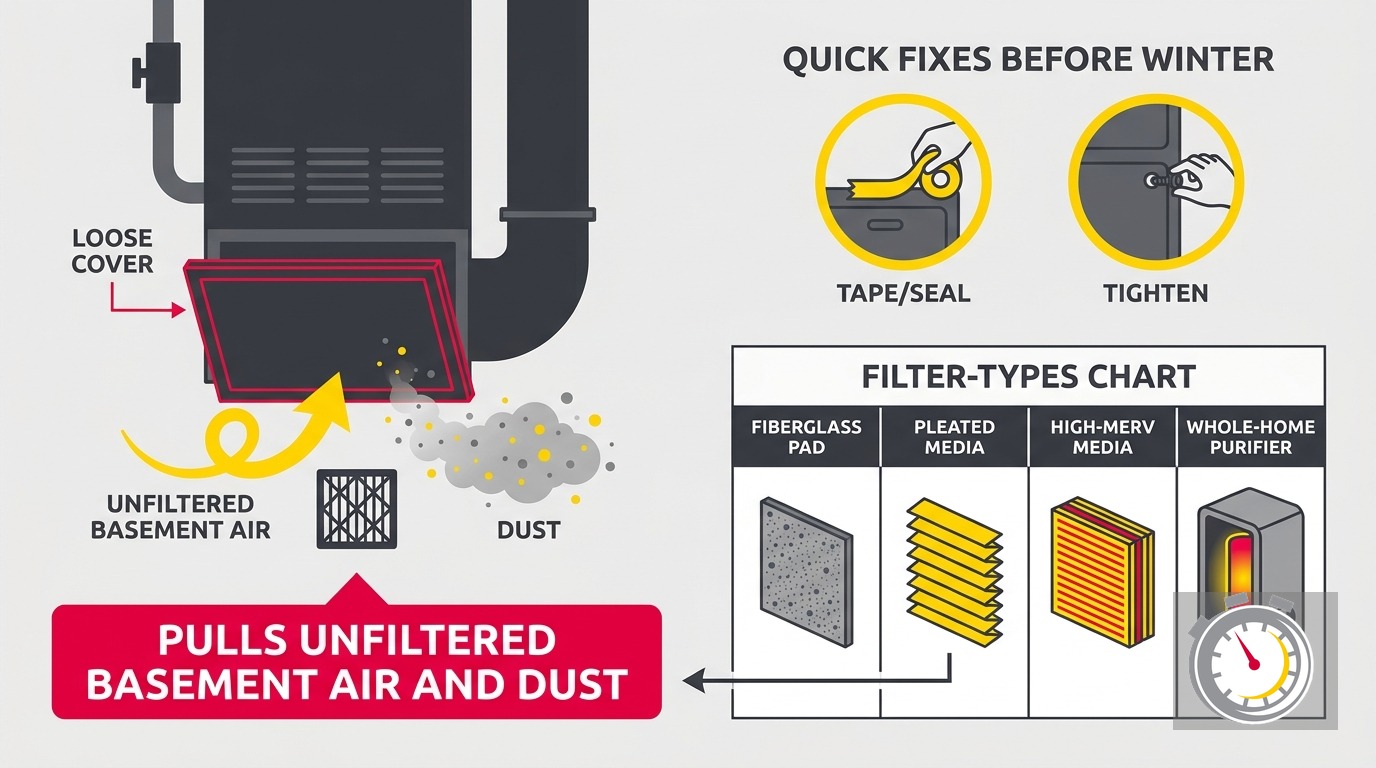
- A loose or missing filter door lets unfiltered air bypass the filter and carry dust into the blower and coil.
- In many Twin Cities homes, that air comes from the basement, crawlspace, or garage. In winter it is cold and dusty.
- Filters should fit snugly so air does not leak around them, according to the EPA.
- Do not bend or crush a filter to make it fit. Buy the right size instead.
- Tape and homemade covers often fail near heat. A manufacturer replacement door is the better fix.
- Do not run the furnace with the door off. Call a technician if the door is a safety interlock, the metal is bent, or you smell combustion.
- Fall is the right time to check. ENERGY STAR advises a heating system check-up before the cold season.
What Happens When a Furnace Filter Door Is Missing or Loose?
A missing or loose filter door lets air skip the filter. Your system pulls unfiltered air from the basement, crawlspace, or garage straight into the blower. Dust gets past the one part meant to stop it. The fix is usually quick and cheap.
Think of your filter as a gate. Air should pass through it on the way to the blower. A gap in the door opens a side entrance.
Air takes the easiest path. A clean filter adds some resistance. A gap adds none. So a good share of your air can slip around the filter unnoticed.
You may not see a problem right away. The furnace still runs and the house still warms. But dust piles up inside the system over weeks and months.
We are a locally owned and operated Twin Cities company, and we see this often in basement furnace rooms.
Where Does the Unfiltered Air Come From in a Twin Cities Home?
Most of it comes from the room around your furnace. In many Twin Cities homes, that room is a basement, crawlspace, or garage. These spaces hold dust, lint, insulation fibers, and cold air. A loose door pulls all of it past the filter.
Basement furnaces are common here. The furnace sits in a utility room or open basement, not in a clean, conditioned living area.
Think about what lives down there:
- Dust from storage boxes and unfinished surfaces
- Lint from the dryer and laundry area
- Fibers from insulation and drywall work
- Cold, damp air along the foundation
- Garage air, if the furnace sits near the garage
None of that belongs in your supply air. The filter catches the particles. A gap sends the air around it.
One DIY page we reviewed makes the same point. A leaky door lets air bypass the filter and carries unconditioned air from basements, crawlspaces, and garages. We use it here only for the angle, not as a source.
The radon angle in Minnesota
Basement air matters for another reason. Soil gas enters a home through its lower levels, and radon is one of those gases.
The Minnesota Department of Health says more than two in five Minnesota homes have radon levels that pose a significant health risk. The EPA action level is 4 pCi/L. MDH recommends that every Minnesota home be tested.
We want to be careful here. MDH does not say radon travels through a furnace return, and we are not making that claim.
The point is simpler. The lower level of your house is where soil gas gets in. It makes sense not to pull that air past your filter and through your system. A snug filter door is one small step toward that.
For more on how your system and house pressure interact, see our guide on radon and HVAC pressure balance in Minnesota homes.
Why Does Winter Make a Loose Filter Cover Worse?
Winter strengthens the pull on lower-level air. Warm air rises and leaves the house. Replacement air enters low, partly from the soil. A leaky filter door adds another low opening for that air. Minnesota’s cold makes the effect stronger.
This is called the stack effect. It works like a chimney. Warm indoor air drifts up and escapes through the attic and upper walls. The house then pulls in replacement air from below.
MDH explains that appliances and exhaust fans, including older furnaces, remove air from the home. That can pull soil gas in through the lower part of the house. The stack effect does the same thing.
Here is why that matters for your furnace:
- The furnace runs more often in a Minnesota winter.
- A longer run time means more air moves through the system.
- More air means more chances to pull dust past a bad seal.
- A basement furnace sits right at the low point of the house.
The season when your furnace works hardest is also when a gap costs you the most.
Cold basement air adds a comfort cost too. The furnace has to warm it. A gap at the filter door can bring in air colder than your return air from upstairs, and that adds load in January.
We have a related post on how air leaks around a filter if you want more on bypass air.
What Damage Can Bypass Air Do to Your Furnace and AC?
Bypass air lets dust reach the blower wheel and the evaporator coil. Dirt there cuts airflow, raises operating costs, and can cause coil icing in cooling season. In extreme cases, poor airflow can risk overheating the heat exchanger. Small gaps add up over time.
InspectApedia puts it plainly. A 3-inch bypass gap at the filter is “pretty much equivalent to having no air filter in place at all.” A door that sits crooked can easily make a gap that size.
The same page lists what unfiltered air can do:
- Clog the blower and the coil
- Reduce airflow
- Raise operating costs
- In extreme cases, risk overheating the heat exchanger
The blower wheel
The blower wheel is a drum with many thin fins, often called a squirrel cage. Dust builds up on those fins.
InspectApedia notes that dust on the squirrel cage reduces output. The blower moves less air for the same effort, and rooms get less heat.
If you suspect this already, read our post on dirty blower wheel symptoms and cleaning.
The evaporator coil
If you have central air, the evaporator coil sits above or beside the furnace, in the same air path. Dust that gets past the filter lands on it.
The same InspectApedia page says dust on the evaporator coil can block airflow and cause coil icing. You may not notice until summer, but the damage starts in fall and winter, when the door is loose.
Our post on the dirty evaporator coil lists the warning signs.
The heat exchanger
Heat exchangers need steady airflow to shed heat. Low airflow can let them run hot. InspectApedia says that in extreme cases, unfiltered air can risk overheating the heat exchanger.
A loose door alone rarely causes this. But dirty parts, a clogged filter, and a gap together stack the odds against your furnace. A safety check catches this kind of problem early.
Is It Safe to Run the Furnace Without the Filter Door?
We advise against it. Without the door, the system pulls unfiltered air from the room, and the open gap can disturb airflow. Some doors also act as safety interlocks that shut off the blower. Replace the door, or call a technician, before you run the furnace for long.
This is our general advice, not something from a fetched source. Your furnace manual has the final word.
Here is how we think about it:
- The filter cannot do its job. With the door off, the filter slot may be open to the room.
- Dust flows straight in. Nothing stops it before the blower.
- The door may be a switch. Many furnaces use the blower door to cut power when it is open. A missing door can leave that switch open.
- Combustion and airflow should stay balanced. Your furnace is designed as a sealed, controlled path.
If your furnace will not start with the door off, that is by design. Do not bypass the switch. Call us instead.
If you smell gas or combustion, stop. Leave the house and call your gas utility or 911 from outside. Our post on carbon monoxide safety during furnace season covers the warning signs.
How Do You Check Your Filter Door in Five Minutes?
Turn the furnace off, find the filter slot, and look at the door. Check that it sits flat, latches shut, and leaves no visible gap. Then check the filter size and airflow arrow. InspectApedia says the fix can take “five minutes with a measuring tape.”
Here is a simple routine.
Step 1: Turn off the furnace
Set the thermostat to off. Flip the furnace switch if it has one. Wait for the blower to stop.
Step 2: Find the filter location
Your filter may sit in a slot on the side of the furnace, in a return duct, or behind a wall grille. Some homes have a media cabinet.
Step 3: Inspect the door
Look for these problems:
- A door that will not stay closed
- A bent or warped edge
- A missing latch, screw, or tab
- Gaps you can see light through
- Foam or gasket that has crumbled
- Tape or homemade covers that have lifted
Step 4: Check the filter
Slide the filter out. Read the printed size on the frame. Measure the slot with a tape measure.
The nominal size on a filter is rounded. A “16x25x1” filter may measure a bit smaller. Match the printed size to what your furnace needs.
Then check for:
- A bent or crushed frame
- Gaps along the edges
- A dirty, clogged face
- An airflow arrow that points the wrong way
The arrow should point toward the blower, in the direction of airflow.
Step 5: Feel for air leaks
Turn the furnace on with the door properly closed. Hold a tissue near the door seams. If the edge pulls the tissue, air is leaking in.
For help with sizing problems, see our guide to wrong size furnace filter problems.
What Are the Quick Fixes Before Winter?
Start with the simple steps. Confirm the filter size and airflow arrow. Use a snug-fit filter instead of a bent one. Replace a bent or missing door with a manufacturer part. Skip makeshift covers. Call a technician if the door is a safety interlock or the metal is damaged.
Work through them in this order.
Fix 1: Confirm the right filter size
Use the size printed on your old filter, or check the furnace manual. Measure the slot to be sure. The EPA says filters should “fit snugly so air does not leak around the filter.”
Fix 2: Do not force a filter to fit
Never bend or crush a filter to squeeze it in. The EPA says the same. A bent filter leaks at the edges.
InspectApedia adds that a bent, oversized filter can collapse into the blower. A small gap then becomes a bigger problem.
Fix 3: Check the airflow arrow
Point the arrow toward the blower. A backward filter can restrict airflow and shed material.
Fix 4: Replace a bent or missing door with a manufacturer part
This is the best fix for most homes. The maker designed the door for your furnace. It fits the cabinet, handles the heat, and works with any safety switch.
Find the model number on the furnace label. Search it with the words “filter door” or “blower door.” Or ask us. We can often identify the part.
Fix 5: Reseat and latch the door
Sometimes the door is fine but sits crooked. Line up the tabs. Push it flat. Check any screws or clips.
Fix 6: Replace a worn gasket
Foam seals wear out. A crumbled gasket lets air slip around the edge. Replace it only with a material approved for the location. Ask a technician if you are unsure.
Fix 7: Set a monthly reminder
ENERGY STAR advises that you “inspect, clean, or change air filters” once a month. Check the door each time.
Our post on how often to change your HVAC filter can help you set a schedule.
Why Do Tape and Magnet Fixes Fall Short?
Heat breaks down tape adhesive, so tape seals tend to fail. Homemade covers and magnets on a furnace cabinet can also ignore heat and the maker’s guidance. A manufacturer door is built for your model. Use makeshift fixes only as a short bridge to a proper repair.
Online, you will find plenty of handyman ideas:
- Weatherstripping around the door edge
- Magnetic covers
- Foil tape across the seam
- Homemade steel panels
Some of these work for a while. Others do not.
The DIY page we reviewed notes that tape fails because the adhesive breaks down from heat. That matches what we see in the field. A tape job often looks fine in October and peels by January.
Here are our concerns with makeshift fixes:
- Heat. A furnace cabinet gets warm. Adhesives and some foams soften or fail.
- Fit. A homemade panel may leave small gaps. Small gaps still pull dust.
- Safety switches. A homemade cover may not trip the interlock correctly.
- Manufacturer guidance. Some guides suggest magnets or metal panels on a furnace cabinet without mentioning heat or the maker’s rules.
- Resale and inspection. A taped door can raise questions during a home sale.
We are not saying never to use weatherstripping. A thin gasket in the right place can help. Treat it as a bridge, then get the correct part.
We found no Minnesota mechanical code, permit, or state rule that covers filter doors. So this comes down to good practice and your furnace manual. Follow the maker’s instructions.
Does Filter Fit and MERV Rating Matter Here?
Yes. A snug fit keeps air flowing through the filter. The right MERV rating balances filtering with airflow. The EPA recommends a filter rated at least MERV 13, or as high as your system will accommodate. Fit and rating work together.
Many homeowners try to fix dust problems with a thicker or higher-rated filter. That can backfire if the filter does not fit.
A great filter in a leaky slot does little. Air takes the easy path around it.
The EPA says most furnaces and HVAC systems can take a MERV 13 filter without equipment problems when filters are replaced frequently. That assumes the filter sits right and the door seals well.
Use this order:
- Fix the door and the seal first.
- Confirm the filter size.
- Choose the highest rating your system allows.
- Replace the filter often, so it does not clog.
A clogged high-rated filter can hurt airflow. A loose door makes that worse, because air may then find the gap instead.
For the trade-offs in Minnesota homes, read whether a MERV 13 filter restricts furnace airflow.
If you have asthma, pets, or allergies, filtering matters even more. Ask us about whole-home air options. We offer indoor air quality services for Twin Cities homes.
When Should You Call a Technician?
Call a technician when the door is a safety interlock, the metal is bent, or you smell combustion. Also call when you cannot find a replacement part. A pro can check airflow, the blower, and the heat exchanger area. Do not guess with safety parts.
Here are clear signs to call:
- The furnace will not start with the door in place
- The door will not latch, even after you reseat it
- The metal frame or cabinet is bent
- You see soot, rust, or scorch marks near the door
- You smell gas, smoke, or burning
- Your carbon monoxide alarm sounds
- The blower is loud, or airflow is weak
- You see heavy dust on the blower or coil
- You cannot identify the replacement part
If you smell gas or your CO alarm sounds, get everyone outside first. Then call for help.
A technician can also tell you whether the loose door caused the dust or just revealed it. Sometimes a return duct leak is the real cause. Sometimes the cabinet itself has gaps.
We handle furnace repair across the Twin Cities. Our team can replace the door, check the blower, and test airflow in one visit.
Why Is Fall the Right Time to Fix This?
Fall comes before the long heating season. ENERGY STAR advises a contractor check of the heating system in the fall and the cooling system in the spring. A fall visit catches a loose door before it gets worse. It also gives you time to order parts.
ENERGY STAR recommends annual pre-season check-ups. Its guidance is to “check the cooling system in the spring and the heating system in the fall.”
That timing suits Minnesota well:
- Your furnace has rested all summer. Dust may have settled.
- Parts may take days to arrive, so early orders help.
- Repair shops and techs get busy in the first cold snap.
- A fix in October costs less stress than a fix in January.
A good fall check covers more than the filter door:
- Filter size and condition
- Blower wheel and motor
- Burner and flame sensor
- Heat exchanger inspection
- Vent and flue connections
- Thermostat operation
- Carbon monoxide readings
Our furnace tune-up service overview shows what a visit includes. A single tune-up visit typically runs $95-$250 in the Twin Cities. Our annual maintenance plans run $195-$390.
To see how a plan compares, read whether an HVAC maintenance plan is worth it.
What Should You Expect From Northern One Hour?
Expect a locally owned and operated team that shows up when it says it will. We arrive within the time window you select. If our technician does not show up on time, you do not pay for the service. We back every job with a 100% satisfaction guarantee.
We are Northern One Hour Heating & Air Conditioning, based in Ramsey, Minnesota. We serve homeowners across the Twin Cities, including Minneapolis, St. Paul, Blaine, Maple Grove, Plymouth, Brooklyn Park, Woodbury, and Bloomington.
Our promise is simple: “Always On Time… Or You Don’t Pay a Dime!(R)” Your time matters, especially when the weather turns cold.
When we visit for a loose filter door, here is what you can expect:
- A clear look at the problem. We check the door, the filter slot, and the cabinet.
- Plain answers. We explain what we see in simple terms.
- Honest pricing. We quote the work before we start.
- The right part. We aim to use a manufacturer door that fits your model.
- A wider safety check. We look at airflow, the blower, and signs of dust buildup.
If the visit uncovers a bigger issue, we will say so. If your furnace is near the end of its life, we will talk through repair versus replacement. For larger jobs, we can walk you through financing options.
A Short Fall Checklist for Your Furnace Filter Area
Use this list as a quick pass this week.
- Turn off the furnace before you open anything
- Check that the filter door sits flat and latches
- Look for bent metal, missing screws, or cracked tabs
- Confirm the filter size against the printed label
- Check the airflow arrow points toward the blower
- Replace any bent or dirty filter
- Remove old tape and peeling patches
- Order a manufacturer door if yours is missing or damaged
- Test your carbon monoxide alarms
- Book a fall heating check-up
Keep the list handy. You can run through it in a few minutes each month.
Fix the Small Gap Before It Becomes a Big Problem
A missing or loose furnace filter door looks minor, but it lets basement, crawlspace, and garage air bypass your filter. Dust reaches the blower and coil, and winter conditions strengthen the pull.
The fixes are usually simple. Check the size. Use a snug filter. Replace a bad door with the right part. Skip tape. Call a pro when safety is in question.
Fall is the best time to act. Ready to get it checked? Call Northern One Hour at (763) 260-6662 or book online. We will schedule a time that works for you, and we will arrive within the window you pick.
Frequently Asked Questions
Can I run my furnace with the filter door off? +
Will a loose filter door make my furnace work harder? +
Can I fix a missing filter door with duct tape? +
What MERV rating should my furnace filter have? +
Should Minnesota homeowners test for radon? +
Need a technician now?