
Furnace Not Running Blower Door Switch: Quick Fix Guide
Key Takeaways
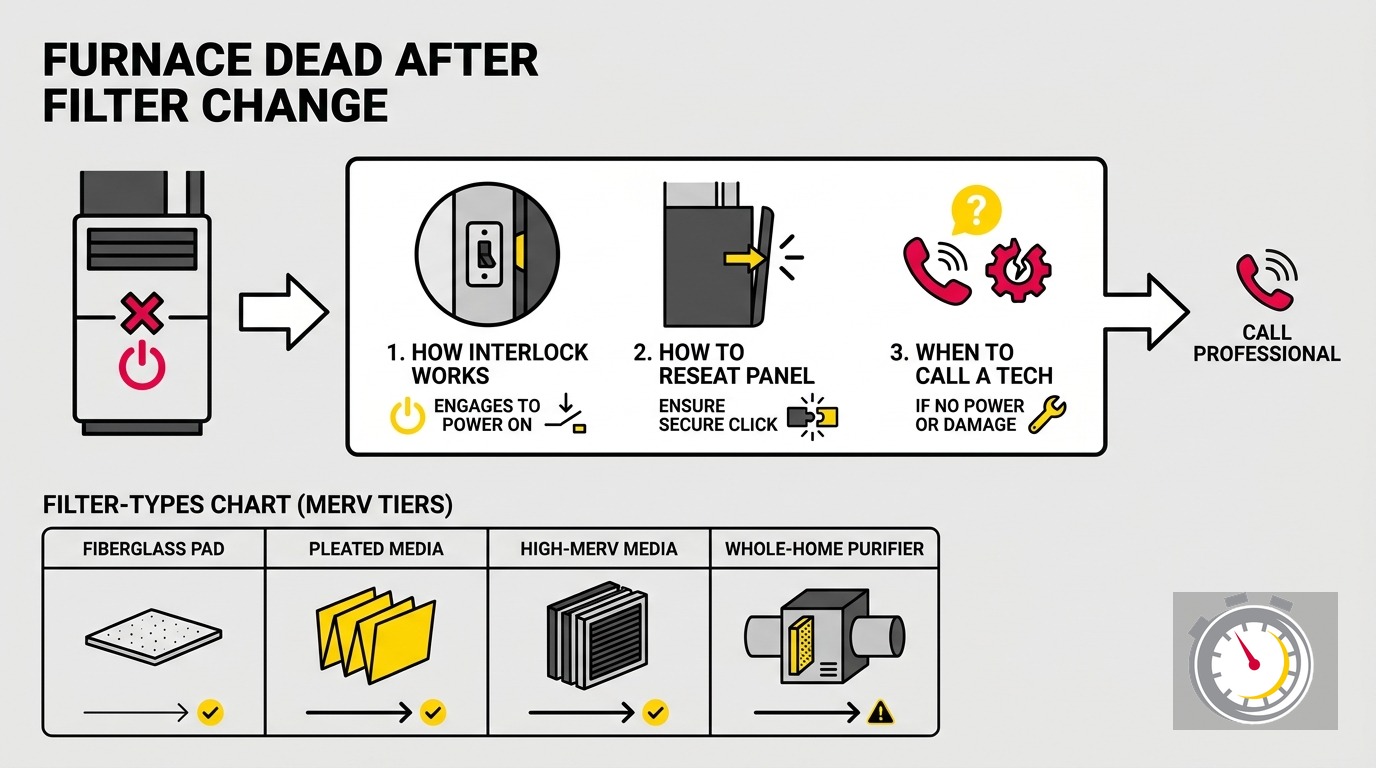
- Most furnaces have a safety switch that cuts power when the blower door is off or misaligned.
- A filter change is the most common reason this switch trips, because many filters sit behind the same panel.
- Turn the furnace power off before you touch the panel. Then lift it out and re-hang it until it seats flat.
- Never tape, jam, or bypass the switch. That risks shock and carbon monoxide exposure.
- Call a technician if the panel is seated and the furnace is still dead, a tab or switch is broken, or lockouts repeat.
- A gas smell or a carbon monoxide alarm is an emergency. Get outside first, then call for help.
- A no-heat furnace in a Minnesota winter is urgent. Do not wait it out.
The Short Answer: A Loose Panel Can Stop Your Furnace
Yes, the blower door switch can keep your furnace from running. You change the filter, close the panel, and the furnace goes dead. No fan. No heat. Often the display is dark, too.
In many cases the panel is not seated quite right. A small safety switch behind it sees an open door and cuts power. Reseating the panel often fixes it in under five minutes.
We are Northern One Hour Heating & Air Conditioning. We are locally owned and operated in Ramsey, and we handle no-heat calls across the Twin Cities all winter.
What Is the Blower Door Switch, and How Does It Work?
Behind your furnace’s blower panel sits a small safety switch, also called a door interlock. When the panel is off or crooked, the switch opens and the furnace shuts down. It protects you from moving parts and live wiring.
Think of the door switch on a microwave. Open the door, and the machine stops.
Most furnaces use a small plunger button. Some use a magnetic switch instead. When the panel is fully seated, it presses the button or sits next to the magnet.
Details vary by brand and age. Some switches interrupt the furnace’s main power. Others interrupt the low-voltage control circuit. Either way, the furnace will not start while the door is open.
Look near the edge of the blower compartment, where the top or side of the panel meets the cabinet. You want a small button, often red or black, with a spring behind it.
Signs the Switch Is the Problem
The door switch is a strong suspect when you see these symptoms:
- The furnace has no response at all when the thermostat calls for heat.
- The blower fan will not start.
- The control board display is dark or blank.
- The problem started right after a filter change or any service work.
- The panel looks slightly out of line with the cabinet.
Plenty of dead furnaces have other causes. But if the timing lines up with a filter change, check this first.
Why Does a Filter Change Make the Furnace Stop?
A filter change often means removing the same panel that holds the door switch. If you put it back slightly crooked or “proud” of the cabinet, the switch never gets pressed. The furnace reads an open door and stays off.
Many Twin Cities furnaces have the filter slot inside or just beside the blower compartment. You pull the panel off, slide the new filter in, and push the panel back on.
It is easy to leave the panel a fraction of an inch out of place. It can look closed and still miss the button. A bent tab or a bit of dust makes that worse.
You did nothing wrong. Changing the filter is the right move. ENERGY STAR advises homeowners to “Inspect, clean, or change air filters once a month in your central air conditioner, furnace, and/or heat pump.” In heavy-use months, that means a lot of panel removals.
The same page notes that “A dirty filter can increase energy costs and damage your equipment, leading to early failure.” So keep changing filters, and learn how the panel seats.
If you are unsure which way the filter goes, our guide on the filter direction arrow can help. Backward filters cause their own airflow trouble.
How Do You Check and Fix a Gas Furnace That Won’t Turn On?
Work from the simple to the complex. Check the thermostat, the furnace power switch, the breaker, and the filter and blower panel. Most no-start calls trace back to one of these. If none of them fix it, stop and call a technician.
Here is a safe order of checks for a gas furnace that will not start. Our furnace not turning on troubleshooting guide covers more detail.
- Check the thermostat. Make sure it is set to Heat. Set the temperature a few degrees above the room. Replace the batteries if the screen is blank.
- Check the furnace power switch. It looks like a light switch on or near the furnace. Someone may have flipped it off during the filter change.
- Check the breaker. Look at the furnace breaker in your panel. If it is tripped, reset it once. If it trips again, stop.
- Check the filter. Make sure a filter is in place and the right size. A clogged filter can shut the furnace down on a safety limit.
- Check the blower panel. Make sure it is fully seated and the switch is pressed.
- Check the gas supply. Confirm the gas shutoff valve at the furnace is open, in line with the pipe.
Do not open the burner compartment or reach into wiring. Do not relight a pilot unless your owner’s manual tells you how and you feel confident.
If you smell gas at any point, leave the home. Do not flip switches. Call from outside.
How Do You Reseat the Blower Panel Step by Step?
Turn off the furnace power first. Lift the panel out, check the switch and tabs, then re-hang the panel so it sits flat against the cabinet. Push in firmly until the switch button is pressed. Then restore power and watch the startup.
Follow these steps in order.
Step 1: Turn Off the Power
Set the thermostat to Off. Flip the furnace power switch to Off. If you cannot find it, shut off the furnace breaker.
The panel covers live parts, so powering down first keeps your hands safe.
Step 2: Remove the Panel Fully
Grip the panel with both hands. Most lift up slightly, then pull out at the bottom. Some use clips or a screw. Follow your furnace’s label if there is one.
Set the panel aside on its edge. Do not lean it where it can fall and bend.
Step 3: Look at the Switch and the Opening
With the panel off, use a flashlight to check these things:
- Find the door switch button. Does it move freely when you press it with a fingertip?
- Look for dust, lint, or debris around the button.
- Check for a cracked plastic housing or a broken spring.
- Look at the cabinet edge for bent tabs or slots.
Do not pull on wires. Do not spray anything into the switch. If the switch is damaged, stop here and call us.
Step 4: Check the Filter
Make sure the filter is seated flat in its slot. The arrow should point toward the furnace, in the direction of airflow. A filter that sticks out can keep the panel from closing fully.
Step 5: Re-Hang the Panel
Line up the top edge or the hooks first. Then swing the bottom in. Push until the panel sits flush with the cabinet on all sides.
You should feel it settle. A small click is a good sign. The panel should not rock or leave a gap.
Watch the switch if you can. The panel should press the button in as it closes. If the panel closes but the button stays out, the panel is not seated right.
Step 6: Restore Power and Watch
Turn the furnace power back on. Then set the thermostat to Heat and raise the setpoint.
A healthy furnace runs a sequence. The inducer fan starts first. Then the burners light. The blower follows after a short delay.
That delay can take a minute or two. Give it time before you decide it failed.
If It Still Won’t Start
Remove the panel and try once more. Seat it slowly. If nothing changes after two careful tries, stop. The switch may be bad, or the problem may be somewhere else.
Why You Should Never Bypass or Tape the Switch
Do not tape the switch down, jam it, or jumper it out to get the furnace running. The switch protects you from shock and moving parts. It also keeps the blower compartment sealed, which matters for safe airflow and combustion.
We know the temptation. It is a cold night, the furnace is dead, and a piece of tape looks like a quick fix.
Here is why it is a bad idea:
- Shock risk. The panel covers energized parts. Running with it off or defeated puts your hands near live wiring.
- Moving parts. The blower wheel spins fast. Fingers and loose clothing do not mix with it.
- Combustion and air problems. A furnace running with an open or loose blower compartment can pull air in the wrong places. That can disturb how gases move through the system.
- Carbon monoxide risk. If the furnace’s airflow or venting is upset, CO can reach living space.
- Hidden problems. A bypass covers up a worn switch or a bent panel. The real fault stays and may get worse.
If the switch is bad, a technician can replace it correctly. That is a small repair.
For a deeper look at the CO side, read our carbon monoxide safety guide for furnace season.
Is It the Door Switch or Something Else?
If the panel is seated and the furnace is still dead, other parts may be at fault. Common culprits are the thermostat, a tripped limit switch, a pressure switch, a blown fuse on the control board, or a failed blower motor. A technician can sort these out quickly.
Here is how to read the clues.
The Furnace Is Totally Dead
No lights, no sounds, no inducer. This points to a power or control issue. The door switch fits this picture. So do a tripped breaker, a bad transformer, and a blown low-voltage fuse.
Check the simple items first. If those are fine, call us.
The Inducer Runs but the Burners Do Not Light
This pattern often points to the pressure switch or the ignition system. The pressure switch confirms that the inducer is moving exhaust properly. If it does not close, the furnace will not fire.
Our guide to pressure switch failure symptoms explains what to look for. Do not try to jump this switch. It protects against unsafe venting.
The Burners Light, Then Shut Off
A furnace that lights and then quits may be hitting a limit or flame issue. Common causes are a dirty flame sensor, a clogged filter, or an overheating limit switch.
If the furnace runs hot and then shuts down, a filter and airflow problem may be the cause. Our limit switch guide is a good next read. Note that the limit switch needs a cooldown. The door switch does not.
The Burners Light but the Blower Never Starts
This sounds like a blower problem. Common causes are a failed motor, a bad capacitor, or a control board fault. The door switch can also play a role if it cuts power to the blower circuit.
Start by confirming the door switch and the fan setting. Then listen. A humming motor that will not spin suggests a capacitor or motor failure. Silence suggests no power reaching the motor.
Stop there. Motor testing involves live voltage and stored electrical charge. Our blower motor failure guide covers the symptoms. For reference, an installed blower motor replacement runs about $1,100 for a PSC motor and $2,200 for an ECM motor. A capacitor repair is far less.
A Quick Comparison
| Symptom | Likely cause | DIY step |
|---|---|---|
| Dead after filter change, dark display | Door switch not pressed | Reseat panel |
| Inducer runs, no flame | Pressure switch or igniter | Call a tech |
| Flame, then shutoff | Flame sensor or limit | Check filter, call if repeats |
| Flame, no blower | Motor, capacitor, or board | Call a tech |
| Humming, no start | Capacitor or inducer | Call a tech |
When Should You Call for Furnace Repair?
Call a technician if the panel is seated and the furnace stays dead, if the switch or a tab is broken, or if the furnace locks out more than once. Call right away for a gas smell or a carbon monoxide alarm. In a Minnesota winter, do not wait.
Call in any of these cases:
- The switch is pressed, and the furnace is still dead.
- The switch, spring, or panel tab is cracked, bent, or missing.
- The furnace restarts, then shuts off again after a few minutes.
- You have reset or reseated the panel twice with no change.
- You see scorch marks, melted wire, or hear popping.
- You smell gas, smoke, or something burning.
- A CO alarm sounds, or anyone feels sick.
Our furnace repair team handles all of these. We can diagnose the door switch, the control board, and the safety circuit in one visit.
Why Winter Timing Matters
A furnace that will not run in a Twin Cities winter is not a “wait until Monday” problem. Indoor temperatures drop fast once the heat stops. Pipes in outside walls and cold corners are at risk.
Older adults, infants, and anyone with health conditions feel the cold sooner. If your home is cooling off and you cannot get heat back, treat it as urgent.
A cold snap can be behind your trouble. Our article on natural gas pressure during a cold snap explains another reason furnaces fail on the coldest days.
What We Do on a Service Visit
We start with the basics: power, the thermostat, and the door switch. Then we test the safety circuit in order. We confirm that the inducer, pressure switch, igniter, and blower all do their jobs.
After the repair, we check that the furnace runs a full cycle. If your furnace is older or has repeat trouble, we may suggest a combustion analysis to confirm it is burning safely.
Our On-Time Promise
We are locally owned and operated. When you book, you pick the time window. We arrive within the window you select. If the technician does not show up on time, you do not pay for the service. That is our promise: “Always On Time… Or You Don’t Pay a Dime!(R)“
What Should You Know About Carbon Monoxide Safety in Minnesota?
Carbon monoxide is a colorless, odorless gas from fuel-burning equipment. Minnesota requires working CO alarms near sleeping areas. If your alarm sounds or you feel ill, get outside and call 911. Any furnace trouble should make you check your alarms.
The facts below come from official sources.
Minnesota law requires an approved, operational CO alarm “installed within ten feet of each room lawfully used for sleeping purposes” in single-family dwellings. Test yours. Replace dead batteries now, not later.
The Consumer Product Safety Commission goes further. It advises you to “Install battery-operated CO alarms or CO alarms with battery backup on every level of the home.” That covers the basement and main floor, not only bedrooms.
The CPSC lists the symptoms as “headache, dizziness, weakness, nausea, vomiting, sleepiness, and confusion.” These can look like the flu. If several people in the home feel the same way, think CO.
On the response, the CPSC is direct: “If you suspect CO poisoning, get outside to fresh air immediately, and then call 911.” Do not stay to troubleshoot.
CO and Your Furnace Panel
A loose door switch is not itself a CO source. But a furnace that someone has bypassed, or one that runs with a gap in the blower compartment, can cause airflow trouble. If you ever ran the furnace with the panel off, schedule a safety check.
Placement matters too. Our guide to CO detector placement near furnaces and boilers shows where alarms work best.
How Can You Avoid This Problem Next Time?
Learn how your panel seats, and make it a habit. Change filters on schedule, and check that the panel is flush after each change. Add an annual professional tune-up. Small routines prevent most filter-change shutdowns.
Try these habits:
- Look before you close. Check the filter sits flat before you replace the panel.
- Feel for the click. Push the panel until it settles flush on all sides.
- Watch the gap. Look along the edges for an even seam.
- Test right away. Turn up the thermostat and confirm the furnace starts before you walk away.
- Keep the area clear. Dust and stored items around the furnace can foul the switch.
- Mark the filter size. Write it on the cabinet so you buy the right one.
Use a Filter That Fits
A wrong-size filter can keep the panel from closing right. It can also let air bypass the filter. If you are not sure of the size, check the old filter’s edge for the printed dimensions.
Schedule an Annual Check-Up
ENERGY STAR recommends you “Keep your cooling and heating system at peak performance by having a contractor do annual pre-season check-ups.” The same page warns, “Airflow problems can reduce your system’s efficiency by up to 15 percent.”
At a tune-up, we check the door switch, the panel fit, the filter, the venting, and the safety controls. We catch worn parts before a January failure. A single tune-up visit typically runs $95 to $250. An annual maintenance plan runs $195 to $390.
Know When Replacement Is the Better Move
If your furnace is old and keeps failing, repeated repairs add up. Ask us for an honest opinion. We give clear pricing and explain your options, including financing for larger jobs.
Call Northern One Hour When the Fix Isn’t Simple
Most door switch problems are easy. Reseat the panel, check the switch, and your heat comes back. When that does not work, you should not have to guess.
The fix, in order:
- Turn off the furnace power.
- Remove the panel and look at the switch and tabs.
- Re-hang the panel until it sits flush and presses the switch.
- Restore power and watch a full startup.
- Stop and call if nothing changes after two tries.
Never tape or bypass the switch. Never ignore a gas smell or a CO alarm.
Northern One Hour Heating & Air Conditioning is locally owned and operated in the Twin Cities. We serve Minneapolis, St. Paul, Ramsey, Blaine, Maple Grove, Plymouth, Brooklyn Park, Woodbury, and Bloomington. Our technicians arrive in the window you select, or you do not pay for the service.
Call (763) 260-6662 or book online to schedule fast. Tell us what happened after your filter change, and we will get your heat back on.
Frequently Asked Questions
How do you test a furnace blower motor? +
How do you test a furnace pressure switch? +
Need a technician now?