Furnace Not Turning On? Your Minnesota No-Heat Walkthrough
Key Takeaways
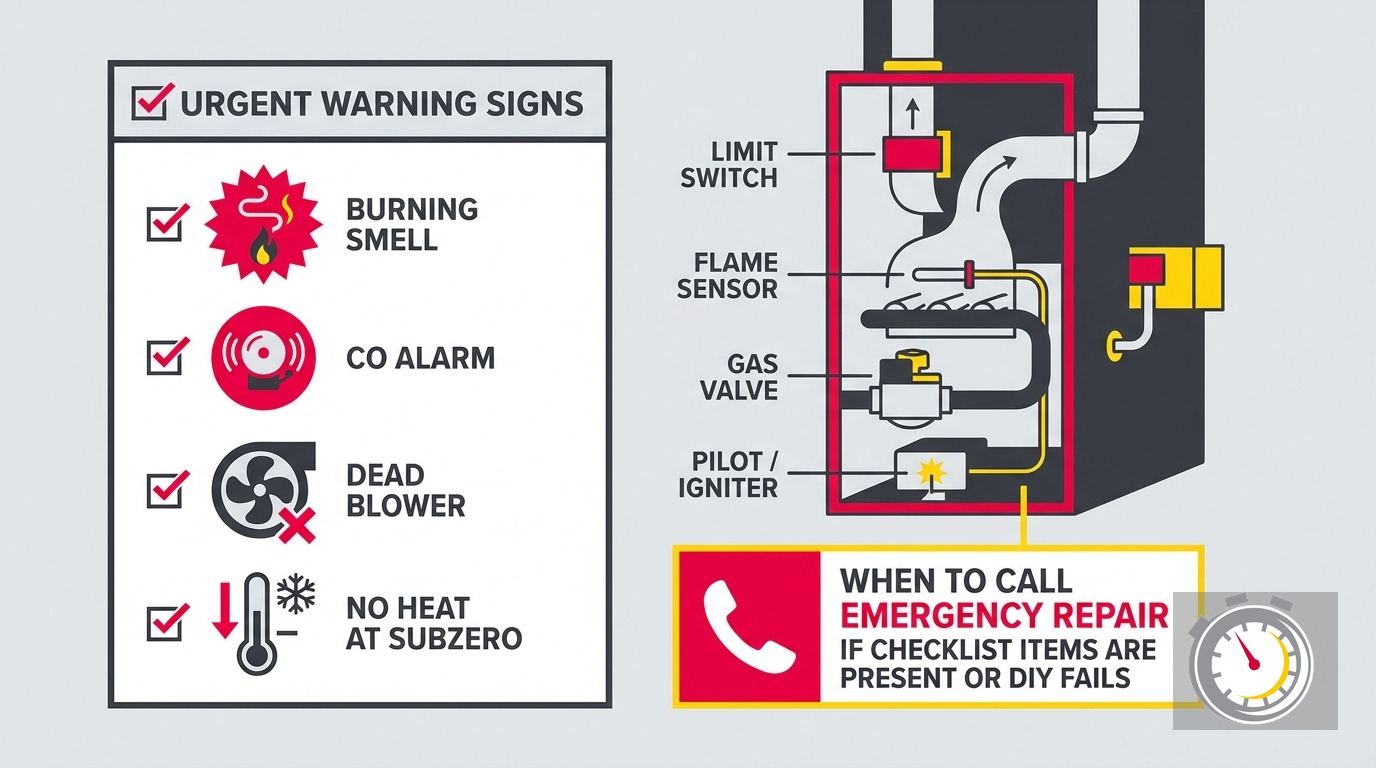
- If you smell rotten eggs or your carbon monoxide alarm sounds, leave the house, then call 911 and your gas utility. Do not troubleshoot.
- Most furnace not turning on calls trace back to a dead thermostat, a tripped breaker, or a dirty flame sensor.
- Modern furnaces blink a flash code that names the fault. Read it before you call.
- Call for emergency repair once indoor temperatures drop toward pipe-freeze risk.
- Minnesota offers real help: the Cold Weather Rule, a $600 furnace tax credit, utility rebates, and the Energy Assistance Program.
It is 2 a.m. in January. The house is cold. You came downstairs to vents blowing nothing but cool air. A furnace not turning on is a genuine emergency in Minnesota, where overnight lows can plunge far below zero. Here is how to work through it, step by step.
Is It Safe to Check the Furnace Yourself?
Yes, for the simple checks. You can safely look at the thermostat, the breaker, the furnace switch, and the air filter. Stop and call for help if you smell gas, hear a carbon monoxide alarm, or spot soot, water, or scorch marks near the unit. Those are danger signs, not do-it-yourself fixes.
Your first move is always safety, not troubleshooting. Natural gas is odorless on its own. Suppliers add a chemical called mercaptan that smells like rotten eggs. If you catch that smell, or your carbon monoxide alarm goes off, leave the house right away. Do not flip switches or use a phone inside. Once you are out and clear, call 911 and your gas utility. We have a fuller guide to carbon monoxide safety during furnace season that covers alarms, symptoms, and next steps.
If there is no smell and no alarm, you are clear to run the basic checks below. Keep kids and pets away from the furnace area. Keep a phone handy. If anything feels off at any point, stop and call us at (763) 260-6662. As a locally owned and operated Twin Cities company, we treat a cold house as the emergency it truly is.
Furnace Not Turning On? Start With These Five-Minute Checks
Walk through five quick checks before you call. Confirm the thermostat is set to heat and the batteries work. Check the breaker panel. Find the furnace switch and flip it on. Look at the air filter. Reset the thermostat. Most no-heat calls end somewhere inside this short list.
These five steps fix a surprising share of cold-house calls. Work through them in order.
Check the thermostat. Make sure it is set to heat, not cool or fan-only. Bump the target temperature a few degrees above the current room reading. Listen for the click. If the screen is blank, swap the batteries. A dead thermostat battery is one of the most common reasons a furnace stays silent.
Check the breaker panel. A tripped breaker is the next suspect. Find your electrical panel and look for any switch sitting in the middle position. Flip it fully off, then back on. If it trips again right away, do not keep resetting it. That points to a short or an overload, and a pro should look at it.
Find the furnace switch. Most furnaces have a light-switch-style toggle on or near the unit. It sits in a basement or hallway and is easy to bump. Make sure it is flipped on. This switch cuts power to the whole furnace, so a bumped switch means total silence.
Check the air filter. A clogged filter chokes airflow. The furnace can overheat, trip a safety switch, and shut itself down. Pull the filter out and hold it up to a light. If you cannot see light through it, replace it. A fresh filter is cheap, and it clears up a lot of no-heat calls.
Reset the system. Turn the thermostat off for one minute, then back to heat. Some furnaces also have a reset button on the side of the cabinet. Press it once. Do not press it over and over. If the furnace fires up, watch it for a few minutes. If it shuts off again, move on to the flash code below.
What Is a Flash Code and How Do I Read It?
A flash code is a string of blinks from a small light on the furnace control board. The blinks map to a fault code printed on a sticker inside the panel, such as three flashes for a pressure switch. Count the blinks, match them to the sticker, and you know where to start.
Modern furnaces rarely fail silently. Most have a small light on the control board, behind the lower front panel, that blinks in a pattern. That pattern is your flash code, and it names the fault.
To read it, you usually need to remove one screw and swing the lower door open. Be gentle. Turn the wall switch off first if you are unsure. Inside, look for a sticker that lists what each blink pattern means. One brand might use two flashes for a flame sensor fault. Another might use three for a pressure switch. Some panels show a steady blink for all-clear and a slow flash for a lockout.
Write the code down before you call. When you tell us three flashes, pressure switch, we arrive already knowing where to look. That shortens your repair and lowers your cost. Do not try to force the board, bypass the switch, or tape over the light. Those steps trade a clean fix for a dangerous one.
A hot-surface igniter is one part the flash code can point to. Modern furnaces use hot-surface igniters instead of a standing pilot. If the igniter cracks, gas will not ignite. That is a distinct failure from the flame sensor, and the code helps tell them apart.
A furnace that tries and fails a set number of times will go into lockout. The light will blink a steady warning, and the unit will wait before it tries again. Lockout is a safety feature, not a quirk. It keeps the furnace from dumping unburned gas into your home. Resetting the power at the wall switch can clear a lockout. If it comes back, the underlying fault is still there. That is your signal to call.
Furnace Not Turning On After the Five Checks? Know the Four Parts
Four parts fail most often. The igniter lights the flame. The flame sensor confirms the flame is burning. The gas valve feeds fuel. The limit switch shuts the unit down if it overheats. Each part fails in its own way, with a symptom you can learn to recognize.
If the five-minute checks and the flash code did not solve it, the problem usually lives in one of four places. Knowing which is which helps you describe the issue and understand the repair.
The igniter: pilot or hot-surface. Older furnaces use a standing pilot, a small flame that stays lit. Newer ones use a hot-surface igniter that glows orange to light the burners. If the pilot is out, or the igniter cracks, the burners never get their spark. The furnace cycles but produces no heat. Relighting an old pilot is a careful, step-by-step job. Replacing an igniter is work for a technician.
The flame sensor. The flame sensor is a thin metal rod near the burners. Its job is to confirm the flame is actually burning before gas keeps flowing. Over time, the rod coats in carbon. When it cannot sense the flame, the gas valve closes as a safety step, and the furnace starts, then stops. That short cycle repeats. A dirty flame sensor, coated in carbon, shuts the gas valve as a precaution and causes that start-then-stop cycling. Cleaning the thin rod near the burners with a fine abrasive often clears it. We walk through the full pattern in our guide to furnace short cycling causes and fixes.
The gas valve. The gas valve opens to feed fuel to the burners. If it sticks closed, or the control board never tells it to open, you get no flame. Gas valves are not a homeowner repair. If the valve has failed, the fix is a replacement, done by a pro with the right tools to test for leaks.
The limit switch. The limit switch is a high-temperature safety trip. When airflow drops, the furnace overheats. A clogged filter or blocked airflow overheats the unit and trips this high-temp safety switch. If your furnace runs for a minute and quits, and the filter is clean, a tripped limit switch is a prime suspect.
Why Does My Furnace Start and Then Shut Off?
That start-then-stop pattern is called short cycling, and a dirty flame sensor is the most common cause. The sensor coats in carbon, cannot confirm the flame, and closes the gas valve as a safety step. The fix is usually a quick clean, not a brand-new part.
This is the single most common no-heat pattern we see across the Twin Cities. The furnace clicks. The blower starts. You feel a flash of hope. Then it dies. Nine times in ten, the flame sensor is the culprit.
The fix is straightforward for a technician. We pull the sensor, clean the carbon off the rod, reinstall it, and test the start cycle. The whole job is quick. What you should not do is ignore it. A furnace that short cycles runs less efficiently, wears out parts faster, and leaves the house cold. It also wastes gas.
Short cycling can have other roots. A dirty flame sensor leads the list, but a clogged filter, a blocked flue, or a failing pressure switch can all cause the same pattern. That is where the flash code earns its keep. The code narrows the list fast.
When Should You Call for Emergency Furnace Repair?
Call right now if you smell gas or your carbon monoxide alarm is sounding. Call soon if the indoor temperature keeps dropping toward freezing. In a Minnesota winter, a cold house can freeze and burst pipes within hours, and a fast call now beats a plumbing disaster later.
Some calls can wait until morning. A no-heat call in January is usually not one of them. Here is how to judge.
Call right now if you smell gas or your carbon monoxide alarm is going off. Those are not wait-until-Monday problems. If you smell rotten eggs, or your CO alarm sounds, evacuate, call 911, and call your utility. Then call us.
Call soon if the indoor temperature is dropping and your home is heading toward freezing. In Minnesota, frozen pipes can burst within hours once the indoor temperature falls far enough. A burst pipe is a far bigger, far more expensive problem than a service call. The math is simple. A fast repair now costs less than water damage later.
Call when you have run the five-minute checks, read the flash code, and the furnace still will not run. You have done the safe, smart groundwork. Hand the rest to a pro.
Our team is ready for emergency furnace repair across the Twin Cities. We back every visit with our on-time promise: Always On Time… Or You Don’t Pay a Dime!(R). When your house is cold at 2 a.m., showing up when we say we will is the whole job.
What Help Does Minnesota Offer for Heating Emergencies?
More than most states. The Cold Weather Rule guards eligible households from winter shutoffs. The Energy Assistance Program can pay to repair or replace a broken furnace. Utilities offer tune-up discounts and thermostat rebates. A federal tax credit can offset the cost of a new high-efficiency furnace.
This is where being a Minnesota homeowner pays off. The state and its utilities offer real help with heating costs, and too few people use it.
The Cold Weather Rule. Minnesota law protects households from winter shutoffs. Under statute 216B.096, the cold-weather period runs Oct. 1 through April 30. Households at or below 50% of the state median income cannot be disconnected. The utility cannot require more than 10% of your household income toward current and past heating bills. Service must be restored within 24 hours of an accepted payment plan.
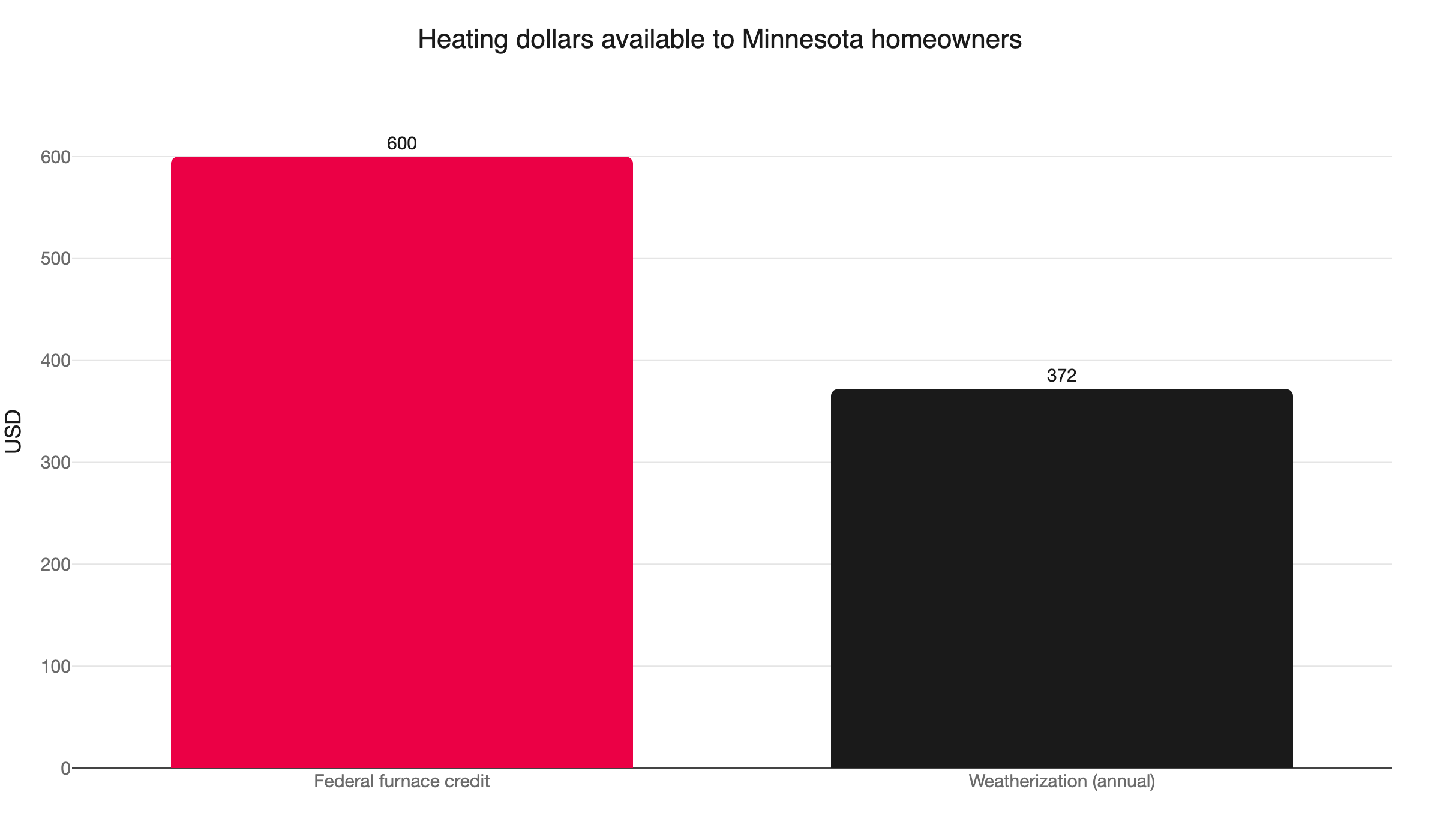
Energy Assistance and weatherization. The federal Low Income Home Energy Assistance Program, run in Minnesota as the Energy Assistance Program, can pay to repair or replace a broken heating system. The Department of Energy says its Weatherization Assistance Program saves eligible households more than $372 a year.
CenterPoint Energy tune-up. If you heat with CenterPoint gas, the Home Service Plus furnace tune-up runs $139.95. It checks the flame sensor and pilot safety timer, the pilot or igniter, and the burner flame and gas input. It also checks the heat exchanger, the full safety-control sequence, and runs a carbon monoxide check. It is open to all homeowners, with no CenterPoint account required. (CenterPoint furnace tune-up)
Thermostat rebate. CenterPoint offers one programmable or smart-thermostat rebate per gas-service address, good for installs between Jan. 1 and Dec. 31, 2026. (CenterPoint thermostat rebate)
Federal furnace tax credit. If you do replace the furnace, the federal government helps. Under IRC 25C, a new high-efficiency gas, propane, or oil furnace or boiler can earn a credit up to $600. The unit must meet the top efficiency tier. Labor counts too, and you claim it on Form 5695.
The utility split in the Twin Cities matters here. CenterPoint delivers most of the gas. Xcel handles most of the electric. Your rebates and assistance programs depend on which utility serves your address.
Repair or Replace: Which Makes Sense?
Repair when the furnace is under roughly 10 to 15 years old and the fix is small. Replace when the heat exchanger is cracked, the unit is old, or repair bills keep stacking. A new high-efficiency furnace can qualify for the federal credit and utility rebates, which softens the price.
A no-heat call often ends in a quick repair. Sometimes it ends in a replacement. Here is how to think about it.
Repair when the furnace is on the younger side, say under roughly 10 to 15 years old, and the fix is small. A cleaned flame sensor, a fresh igniter, or a new filter all point to a unit with years left.
Replace when the heat exchanger is cracked. A cracked heat exchanger means unsafe operation, and the ENERGY STAR heating checklist calls it a stop-using-it condition. Replace when the unit is old, when repair bills keep stacking, or when efficiency has fallen off. We lay out the full numbers in our guide to furnace replacement cost in the Twin Cities.
A new high-efficiency furnace can qualify for the $600 federal credit and the utility rebates above. That softens the price. The right move depends on the age of your unit, the cost of the repair, and how much you spend on gas each winter.
The best repair is the one you never need. Annual tune-ups catch a dirty flame sensor, a weak igniter, or a clogged filter before they leave you cold. A well-maintained furnace is also the most efficient furnace. That keeps your winter gas bills down and extends the life of the unit.
You Will Not Face This Alone
A furnace not turning on is scary at 2 a.m., but you have a clear path. Check safety first. Run the five-minute checks. Read the flash code. Know the four parts. And when it is time to call, call a team that shows up.
We are locally owned and operated in the Twin Cities. We back every visit with our on-time guarantee: Always On Time… Or You Don’t Pay a Dime!(R). Call us at (763) 260-6662, or book online. We will get your heat back on.
Frequently Asked Questions
What should I do first if my furnace won't turn on? +
Why does my furnace start and then shut off right away? +
How do I read my furnace flash code? +
What help does Minnesota offer for heating emergencies? +
Need a technician now?