
Furnace Gas Valve Not Opening Symptoms: What to Check First
Key Takeaways
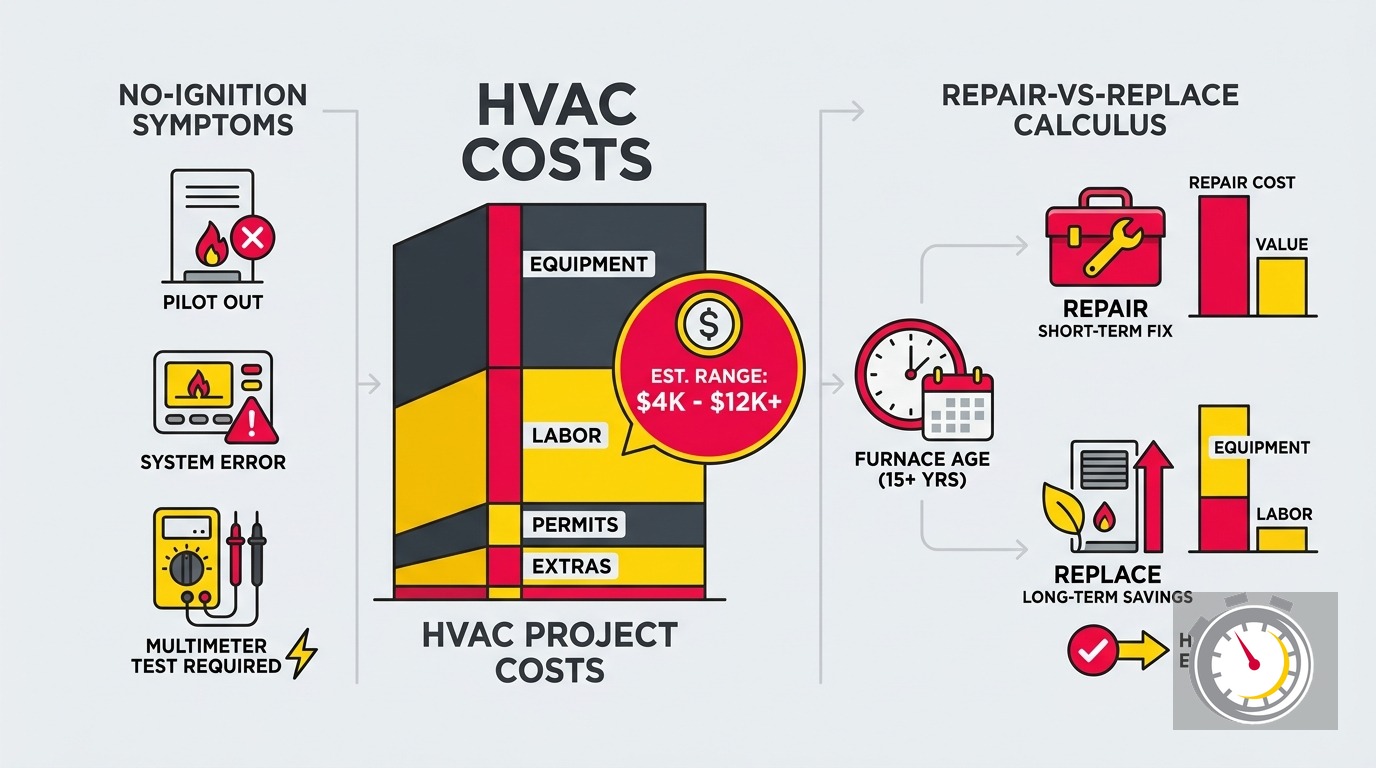
- A glowing igniter with no flame is the most common sign the valve is not opening.
- Before blaming the valve, confirm 24V AC is arriving at its terminals. No voltage means the fault is upstream, not in the valve.
- Two multimeter tests confirm a bad valve: a voltage test during a heat call and a resistance test of the coil (normal range: 40-80 ohms).
- A boom or bang on startup is delayed ignition. Repeated occurrences can crack the heat exchanger - a far more expensive problem.
- Gas valves cannot be repaired in the field. Replacement is the only fix when the valve tests bad.
- Use the Age x Cost rule: furnace age in years times repair cost in dollars. Above $5,000 points toward replacement.
- Minnesota rebates from CenterPoint and Xcel, plus a federal 25C tax credit, can meaningfully offset the cost of a new high-efficiency furnace.
- At -12°F design temperature in the Twin Cities, a furnace failure in January is a freeze risk. Act the same day symptoms appear.
What Are Furnace Gas Valve Not Opening Symptoms?
The short answer: The most recognizable furnace gas valve not opening symptoms are a glowing igniter that produces no flame, no warm air from the vents despite a running system, and a boom or thud when the furnace tries to light. A gas odor near the furnace is a safety emergency requiring an immediate shutoff, not a diagnostic test.
Your furnace runs a fixed startup sequence every time it calls for heat. The draft inducer motor spins up. Pressure switches confirm airflow through the heat exchanger. The hot surface igniter heats to temperature, or a spark igniter fires. Then the control board signals the gas valve to open. Fuel flows. The burner lights.
When the gas valve does not open, fuel never reaches the burners. The igniter glows. Nothing catches. The control board logs a fault and shuts the system down.
Here is exactly what to watch for:
- Igniter glows but no flame forms. The ignition side of the furnace is working. Gas is not flowing.
- No warm air from the vents. The blower may continue to run on a timer, but the air is room temperature or colder.
- Boom, bang, or thud when the furnace starts. This is delayed ignition. The valve is opening slowly. Gas accumulates in the combustion chamber and ignites all at once when the igniter finally catches it.
- Repeated lockout faults. Modern furnaces lock out after two or three failed ignition attempts and display an error code. A valve that will not open is one of several causes.
- Gas odor near the furnace. A valve stuck partially open is leaking fuel. Shut off the manual gas valve near the furnace, leave the building immediately, call your gas company to clear the space, and then call us. Do not attempt to troubleshoot with gas present.
Why Does the Fault Often Lie Upstream, Not in the Gas Valve?
The short answer: The gas valve only opens when the control board sends it a 24V AC signal. That signal only goes out if the inducer is running, the pressure switches have closed, and no safety switch has tripped. If any upstream step fails, the valve never fires - and replacing it changes nothing.
Most homeowners - and some technicians moving quickly - see a no-ignition symptom and reach for the gas valve. Sometimes it is the valve. Often it is not.
Work through this sequence before ordering any parts:
Step 1 - Confirm the thermostat is calling for heat. Set it 5 degrees above room temperature and confirm the system mode is Heat, not Cool or Fan-only. This sounds obvious. It eliminates an easy mistake.
Step 2 - Confirm the draft inducer motor is running. If the inducer is not spinning, the pressure switches stay open, the control board halts the sequence, and the valve never receives its signal. A failed inducer motor, a blocked exhaust flue, or a failed pressure switch all stop things here. Our post on furnace pressure switch failure symptoms explains how to identify each of these upstream faults.
Step 3 - Check for tripped safety switches. A tripped high-limit switch or rollout switch breaks the circuit that powers the gas valve. Both are safety devices, not nuisances. A rollout switch trips because flames traveled where they should not have. Resetting it without finding the cause leaves a real hazard in place.
Step 4 - Measure voltage at the valve terminals. This is the decisive test. With the furnace calling for heat and advancing through the ignition stage, measure AC voltage at the gas valve terminals. When no 24V AC signal is reaching the terminals, the fault is upstream, not in the valve itself. Only when 24V is present and the valve still does not open have you confirmed valve failure.
If voltage is absent and the pressure and limit circuits test out, the control board is the likely culprit. We walk through those symptoms in our furnace control board failure guide.
How Do You Test for Furnace Gas Valve Not Opening Symptoms Using a Multimeter?
The short answer: Two tests confirm a bad valve. During a heat call, check for 24V AC at the valve terminals: voltage present but valve silent confirms valve failure; no voltage means the fault is upstream. With the furnace off and wires disconnected, check coil resistance: 40-80 ohms is normal; open or near-zero means the coil is dead and the valve must be replaced.
Both tests require a basic digital multimeter. They are available at any hardware store for $20-$30.
Voltage test (furnace energized)
Set the multimeter to AC volts. During a call for heat, touch the probes to the gas valve terminals while the furnace is in the ignition stage. You should read approximately 24V AC when the control board is actively signaling the valve to open. No reading means the signal is not arriving. A reading of 24V with the valve remaining silent confirms the valve has failed.
Timing matters here. The control board advances the furnace through stages. The 24V signal to the gas valve appears only during the ignition attempt, not throughout the entire heating cycle. Probe during the ignition attempt, not at random points in the cycle.
Resistance test (furnace off, wires disconnected)
Power down the furnace at the service switch and at the breaker. Disconnect the wires from the valve terminals. Set the multimeter to resistance (ohms). Touch the probes to the valve’s coil terminals.
Standard Honeywell and White-Rodgers gas valves should read 40-80 ohms when the coil is intact. Two readings indicate failure:
- OL (open circuit, infinite resistance): The coil has burned out. No current can flow through it. The valve cannot be energized.
- Near-zero ohms: The coil is shorted. It may draw excess current or blow a fuse on the control board.
Either reading means the valve must be replaced entirely. Gas valves are not field-serviceable. The coil, internal seats, and pressure-relief features inside the valve body are not individual replacement components. When the valve tests bad, you replace the whole unit.
A word on safety: The electrical side of this test is 24V AC, which is low-voltage. But you are working near a gas supply line. If you smell any gas during this process, stop immediately. If you are not comfortable with this work or have any uncertainty, call a licensed technician rather than proceed. This is not a place where guessing is acceptable.
What Does a Boom on Startup Mean for Your Heat Exchanger?
The short answer: A boom or bang when the furnace lights is delayed ignition. The gas valve is opening slowly, letting gas accumulate before it ignites all at once. Each delayed ignition delivers a pressure shock to the combustion chamber. Repeated occurrences fatigue and eventually crack the heat exchanger, which creates a carbon monoxide risk and a much larger repair decision.
Delayed ignition occurs when gas builds up in the combustion chamber before the igniter can light it. When the igniter finally catches the accumulated gas, the entire volume ignites at once. The resulting pressure wave stresses every surface in the combustion chamber, including the heat exchanger walls.
One or two occurrences may leave no lasting damage. Repeated delayed ignitions across one heating season - or across several seasons - fatigue the heat exchanger. Eventually it cracks.
A cracked heat exchanger creates two separate problems. First, combustion gases, including carbon monoxide, can enter the airstream and circulate through your living space. Second, the heat exchanger is not a cheap repair. On many mid-age furnaces, the cost of replacing the heat exchanger approaches or exceeds the replacement value of the entire furnace.
This is why the boom symptom changes the repair calculus. If you are hearing a boom at startup and your furnace is more than 10 years old, ask the technician to inspect the heat exchanger before authorizing the gas valve replacement. Spending $400 on a new valve makes no sense if the exchanger is already cracked. Read our post on cracked heat exchanger signs to understand what inspectors look for and what a crack means for your next step.
How Much Does Gas Valve Replacement Cost?
The short answer: Budget $200-$800 installed. The valve itself runs $75-$300 depending on brand and model. Labor adds $160-$650. OEM parts for discontinued furnace models can push the cost above that upper range.
According to HomeGuide, total installed cost for a gas valve replacement runs $200-$800. Manufacturer warranties typically cover the gas valve for five to ten years from the install date. Outside the warranty window, parts availability varies considerably by brand, model age, and whether the manufacturer continues to produce that part.
Two questions worth asking before you authorize the repair:
Is the furnace still under warranty? Some warranties cover parts only. Others cover parts and labor but require a licensed contractor to keep the coverage valid. An unauthorized repair or DIY attempt can void the remaining warranty entirely. Confirm the terms before any work begins.
Is this the only failing component? A furnace that has been struggling for years may have other components near the end of their service life: the draft inducer, the blower motor, the control board. A second repair six months after the valve replacement may push the total spend past what replacement would have cost.
If the furnace is under 10 years old and otherwise in good condition, a gas valve replacement is typically the right call. If it is pushing 15 years or more, work through the next section before you decide.
Repair or Replace: Running the Numbers for Minnesota
The gas valve repair decision does not exist in isolation. A valve swap on a 20-year-old furnace keeps heat on through this winter. It does not address declining efficiency, other aging components, or the regulatory timeline that affects every furnace purchase in the next few years.
The Age x Cost rule
Multiply the furnace’s age in years by the repair cost in dollars. If the result exceeds $5,000, replacement generally makes more financial sense than repair.
Two examples:
- 17-year furnace with a $400 valve replacement: 17 x 400 = $8,800. The math points toward replacement.
- 9-year furnace with a $450 repair: 9 x 350 = $4,000. The math favors repair.
The efficiency argument
Many Twin Cities homes still run on furnaces rated at 80% AFUE. Moving to a 95%+ AFUE unit cuts annual heating bills by 20-25% in Minnesota. Minnesota’s heating season is one of the longest in the country. That efficiency gain compounds year over year and makes the payback period shorter than most homeowners expect.
There is also a regulatory clock. The Department of Energy finalized a 95% AFUE minimum standard for non-weatherized gas furnaces, taking effect in late 2028. Any furnace replaced before that date and rated below 95% will be below the incoming code floor. Replacing now with a 96% or 97% AFUE system means the new equipment is already ahead of the requirement.
Minnesota urgency
The Minneapolis-St. Paul 99% design temperature is -12°F, placing the region in Climate Zone 6A. A furnace failure in January is a freeze risk, not a scheduling inconvenience. Pipes in an unheated Minnesota home can freeze in hours at those temperatures.
One more note on fuel type: 66% of Minnesota homes heat with natural gas. If your home runs on propane, confirm the replacement valve is rated for propane. Natural gas and propane valves are not interchangeable - installing the wrong one is a genuine safety hazard, not a minor mismatch.
What Rebates Are Available for Furnace Replacement in Minnesota Right Now?
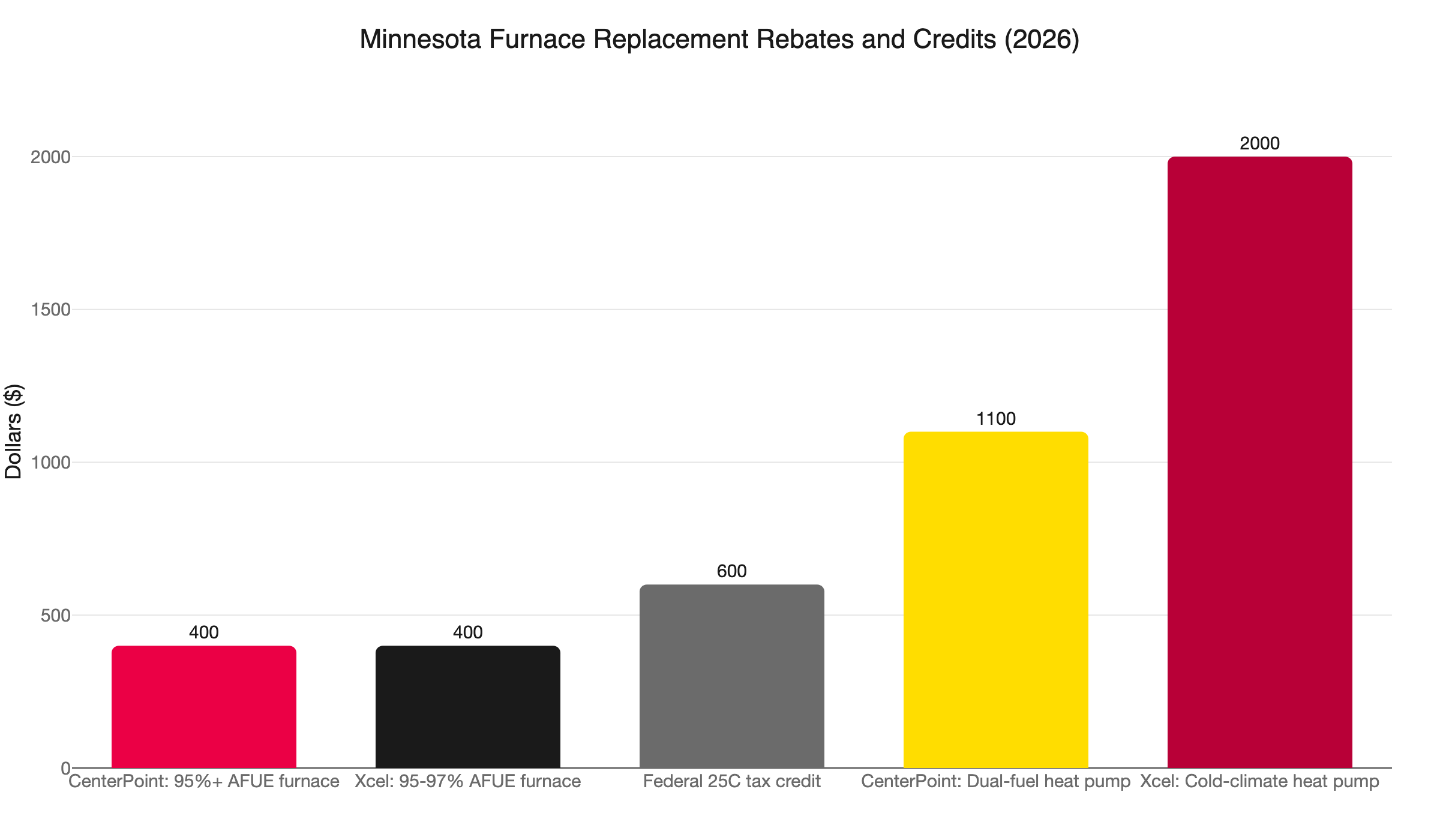
The short answer: CenterPoint Energy customers can receive up to $400 for a 95%+ AFUE furnace. Xcel Energy customers can receive $200-$400. A federal 25C tax credit adds up to $600 on top of those. On a qualifying dual-fuel heat pump system, combined utility rebates can reach $3,100 before the federal credit applies.
If the Age x Cost formula points toward replacement, here is the money currently available to Twin Cities homeowners:
CenterPoint Energy (natural gas customers)
- 95%+ AFUE furnace replacement: up to $400 rebate
- Dual-fuel heat pump paired with a 92%+ AFUE backup furnace: up to $1,100
- Submission deadline: December 31, 2026
- Contact: RebateCenter@CenterPointEnergy.com or 612-399-1545
Xcel Energy (electric customers)
- 95-97% AFUE furnace: $200-$400 rebate
- Cold-climate heat pump with COP at or above 1.75 at 5°F: up to $2,000
- Rebates can stack with CenterPoint on qualifying dual-fuel systems
Federal 25C tax credit
- 30% of qualifying equipment cost, capped at $600 for a high-efficiency furnace
- Reduces your actual tax liability, not just taxable income
- Stackable with both utility rebates above
On a qualifying dual-fuel heat pump system, CenterPoint and Xcel incentives can combine for $3,100 in utility rebates, with the federal credit on top of that. Our complete Minnesota HVAC rebate guide has current program details, eligibility requirements, and step-by-step instructions for applying to both utilities. Ask our team about financing as well. For a larger system replacement, financing can spread the net cost after rebates into manageable monthly payments.
When to Call Northern One Hour
Some of this diagnostic work is within reach for a careful homeowner. The multimeter voltage test, performed at the right moment in the ignition sequence, is a legitimate DIY step. Other situations call for a licensed technician from the start.
Stop and call us instead of proceeding yourself if:
- You smell gas at any point. Close the manual shutoff valve near the furnace, leave the building, and call your gas company. Then call us at (763) 260-6662. Do not re-enter until the utility has cleared the space.
- The furnace is still under manufacturer warranty. Unauthorized testing or repair can void coverage. Confirm before touching anything.
- You are not comfortable with live electrical testing near a gas line. The voltage is low, but the context is not forgiving of mistakes.
- The boom symptom is present and the furnace is more than 10 years old. Heat exchanger inspection requires disassembly and combustion analysis equipment. Do not authorize a valve replacement before that inspection is complete.
- The furnace has locked out multiple times in a short period. Repeated lockouts may indicate faults across multiple components, not a single valve failure.
We are locally owned and operated in Ramsey, serving Minneapolis, St. Paul, Maple Grove, Blaine, Plymouth, Brooklyn Park, Woodbury, Bloomington, and the surrounding Twin Cities area. We show up when we say we will. That is the core of what we do, and it is our promise: “Always On Time… Or You Don’t Pay a Dime!(R)” Every service call is backed by a 100% satisfaction guarantee.
If your furnace is showing any of the symptoms above, schedule a furnace repair visit online or call us at (763) 260-6662. We will run the full diagnostic sequence, inspect the heat exchanger when the situation calls for it, and give you straight numbers on whether repair or replacement is the smarter move for your home and your budget.
Frequently Asked Questions
How can I tell if my furnace gas valve has failed? +
Can a furnace gas valve be repaired instead of replaced? +
What causes the boom sound when my furnace starts? +
What Minnesota rebates are available for furnace replacement in 2026? +
Need a technician now?