Furnace Control Board Failure Symptoms: What to Watch
Key Takeaways
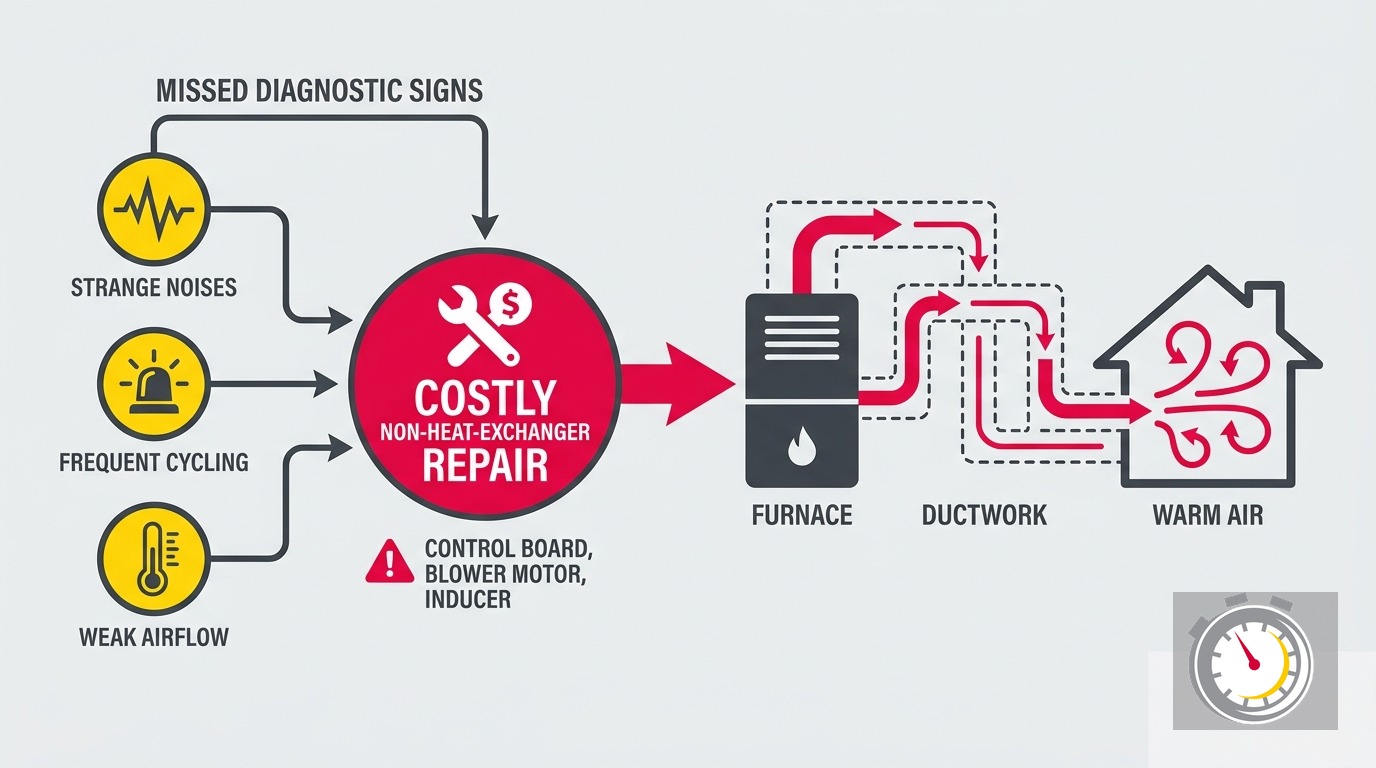
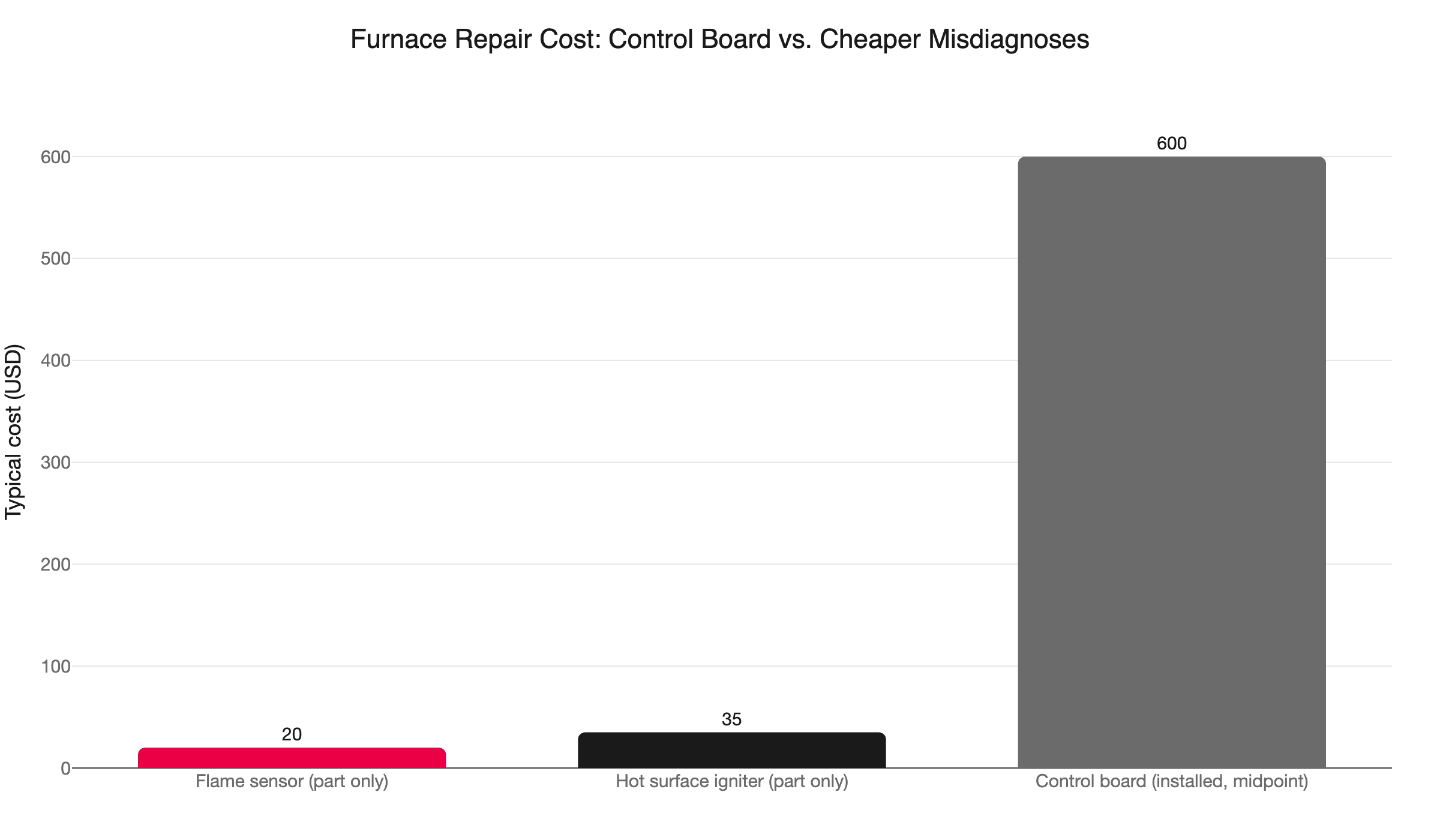
- Furnace control board failure symptoms are nearly identical to those of a dirty flame sensor ($10-30 part) or a failed igniter ($20-50 part). Most misdiagnoses happen here.
- A true board failure shows zero furnace response: no inducer spin-up, no click, no glow. Or the blower runs continuously with no heat cycle.
- A repeating ignite-then-shutdown loop points to the flame sensor, not the board. If you see a brief flame before the shutdown, the board is probably fine.
- Most boards warn you before they fail: self-clearing lockouts, error codes that reset overnight, a furnace that “sometimes doesn’t start.” That intermittent window is the cheapest time to act.
- Skipping filter changes is a direct cause of premature board failure. Repeated overheating trips the high-limit switch, and each trip stresses the board’s components.
- Minnesota’s extreme temperature swings accelerate every one of these failure modes. A furnace that lasts 20 years in a mild climate may need a board at 10-12 years in Minneapolis without preventive maintenance.
- If a board failure pushes you toward replacement, current CenterPoint Energy and Xcel Energy rebates can stack to $800 on a qualifying high-efficiency furnace.
What does a furnace control board actually do?
The control board is the furnace’s central processor. It sequences every step of the heat cycle from start to finish.
When your thermostat calls for heat, the board receives that signal and begins an ordered sequence: it energizes the draft inducer motor, monitors the pressure switch to confirm airflow, fires the hot surface igniter, then watches the flame sensor to verify combustion. Once combustion is confirmed, the board runs the blower at the right timing to push heated air through your home. At the end of the cycle, it shuts everything down in the correct order.
Because the board touches every other component, a board fault can look like a fault in the inducer, the igniter, the flame sensor, or the pressure switch. The board sends signals to all of them. When the board is failing, the signals become erratic, and the symptoms point everywhere at once. That is exactly why board symptoms get misdiagnosed so often.
What are the furnace control board failure symptoms?
The two clearest furnace control board failure symptoms are a completely unresponsive furnace and a blower that runs without producing heat.
No-start: The thermostat calls for heat. Nothing happens. No inducer spinning up, no click, no igniter glow, no hum. The furnace is completely silent and dark. The board has either lost the thermostat signal or cannot energize any downstream component. This is a hard board failure.
Blower stuck on: The blower runs continuously, even when there is no call for heat and even when the air coming out is room temperature. A healthy board shuts the blower relay off at the end of the heat cycle. A board that has lost control of that relay leaves the blower running indefinitely.
Other symptoms that raise board suspicion:
- Repeated short cycling with no consistent lockout pattern
- Error code flashes that disappear by morning and return the next night
- Intermittent no-starts: the furnace works reliably for several days, then misses a start, then works again
- A blank or flickering diagnostic LED on the board’s indicator strip
- A faint burning smell near the furnace with no obvious source elsewhere
- Blower that starts on its own schedule, not on the thermostat’s
Every one of these symptoms can also come from a failed igniter, a dirty flame sensor, a tripped high-limit switch, or a failed pressure switch. That overlap is the core diagnostic challenge. Do not assume the board is the problem based on symptoms alone. A technician who confirms the board diagnosis by watching the sequence can save you several hundred dollars.
How does a technician tell a board failure from a $30 fix?
The answer is in the first 10 seconds after the thermostat calls for heat. The sequence tells the story.
Here is what a technician watches for: If the inducer starts, the igniter glows, and a flame appears briefly before the furnace shuts off and repeats the cycle two or three times before locking out, the problem is almost always the flame sensor, not the board. The sensor cannot confirm the flame to the board, so the board shuts the burner as a safety measure. The board itself is doing exactly what it should. Cleaning the flame sensor resolves the majority of first-occurrence dirty-sensor failures. That sensor is a $10-30 part.
If the igniter glows but no flame appears at all, a failed hot surface igniter is the likely culprit: a $20-50 part.
A true board failure shows up earlier in the sequence: nothing happens at all after the thermostat signal, or the blower runs on its own without any heat cycle ever initiating. The board cannot start the sequence or cannot control it. Those are distinct failure signatures from a bad flame sensor or igniter.
This distinction matters because the symptoms feel identical to the homeowner. The house is cold either way. But the diagnostic path and the repair cost are very different. Catching a dirty flame sensor before it gets misdiagnosed as a board failure is exactly the kind of thing a thorough diagnostic appointment should catch. Our furnace flame sensor guide covers the cleaning process and what replacement costs in the Twin Cities.
The warning window most homeowners miss
Most boards do not fail overnight. They fail slowly, over weeks, with soft signals that read as minor inconveniences until the board finally gives out completely.
In the weeks before a hard failure, watch for:
Self-clearing lockouts. The furnace goes into lockout, you cycle the breaker, and it runs normally for a day or two. Then it locks out again. The pattern repeats. Lockouts that self-clear and return are a classic symptom of intermittent board instability.
Error codes that reset overnight. The diagnostic LED flashes a fault code when you check at 10 p.m. By the next morning, the board has reset and the code is gone. The board is failing to maintain consistent function between power cycles.
Intermittent no-starts. The furnace runs reliably most of the time but occasionally misses a thermostat call with no obvious reason. The next call works fine. This pattern points to a relay or component on the board that is failing under load or temperature and recovering when the demand drops.
These soft signals are the board struggling to maintain stable voltage or relay function as its components degrade. They are also the cheapest time to act. A diagnostic call during the intermittent phase costs a fraction of an emergency call at minus-15 degrees Fahrenheit when the board finally quits. You also have time to weigh repair versus replacement without pressure. A hard failure in January forces the decision in hours. An intermittent failure in October lets you think it through.
If your furnace is showing any of these patterns, do not wait for the hard failure. Call during the window.
What causes a control board to fail?
Boards fail for four main reasons: repeated overheating, power surges, age and vibration, and moisture. The first one is the most preventable.
Dirty filters and repeated high-limit trips. A clogged filter forces the furnace to overheat, which trips the high-limit switch. The switch cuts the burner to protect the heat exchanger. Each trip is a thermal stress cycle on the board’s capacitors and resistors. One or two trips is not a crisis. Repeated tripping over months and years from chronic filter neglect is. Skipping a $5 filter change is a credible path to an $800 board replacement down the road.
Power surges. A surge that does not trip a breaker or even dim your lights can still silently damage the board’s transformer or burn out its internal fuse. The board absorbs the overvoltage, and the damage may not show up as a failure until weeks later. Whole-home surge protection is inexpensive insurance against this specific failure mode.
Age and vibration. Control boards have a typical lifespan of 10-15 years. Over that period, the vibration from the blower motor and inducer gradually cracks solder joints on the board’s circuit traces. Once a joint develops a micro-fracture, the symptom is often intermittent: the furnace works when it is warm, fails when it is cold, because the fracture opens and closes with temperature. This is the mechanical aging that no maintenance prevents entirely, but that preventive care delays.
Moisture. High-efficiency furnaces produce condensate as a byproduct of combustion. A blocked or improperly sloped condensate drain can back up moisture toward the board. Rust on a board’s circuit traces causes permanent, unrepairable damage.
Minnesota winters accelerate every one of these failure modes
Most articles written about furnace control board failure symptoms are written for a general national audience. They do not account for what Minnesota winters actually do to heating equipment.
Twin Cities furnaces operate across a 90-degree-plus indoor-outdoor temperature differential in deep winter. That level of sustained load stresses every component harder than moderate climates do. A furnace that might last 20 years in a warmer region may need a board replacement at 10-12 years in Minneapolis without consistent maintenance.
Freeze-thaw cycling, which happens repeatedly through Minnesota springs and falls, causes metal components inside the furnace to expand and contract. That mechanical cycling accelerates micro-fracture development in the solder joints on the board, exactly as described above. Our winters do not just wear systems down in January. The cycling in shoulder seasons does its own damage.
Our winters also mean the stakes of a board failure are higher than in other climates. A furnace that quits at 2 a.m. in late January is not a managed inconvenience. It is an emergency with emergency pricing to match. The pre-failure warning window is more valuable here than anywhere. Catching intermittent board symptoms during a fall tune-up costs far less than an emergency board swap in February.
We are locally owned and operated in Ramsey, and our team serves the greater Twin Cities area: Minneapolis, St. Paul, Blaine, Maple Grove, Plymouth, Brooklyn Park, Woodbury, Bloomington, and surrounding communities. We understand what Minnesota winters do to heating systems, and we are set up to service them before the season turns. If you want a technician who shows up when they say they will, that is our core commitment: “Always On Time… Or You Don’t Pay a Dime!(R)“
Should you repair or replace your furnace when the board fails?
Furnace age is the deciding variable. The board cost alone does not answer the question.
A furnace under 10 years old with a single isolated board fault is a clear repair candidate. The system has most of its design life ahead of it. Pay for the board replacement and move on. The repair-versus-replace math is straightforward.
A furnace over 15 years old is a different calculation. The board replacement runs $375-1,150 installed. But the furnace is also approaching or past its design life. If the inducer motor, heat exchanger, or igniter are also showing wear, you could spend $600 on a board and then face a $400 igniter failure or a $1,550 inducer motor replacement within two years. At that point, you are investing repeatedly in a declining asset.
Our guide on whether to repair or replace your heating system covers the full decision framework. One firm rule: if your furnace shows signs of a cracked heat exchanger in addition to board symptoms, replacement is the answer. A cracked exchanger is a safety issue, and fixing a board on a furnace with a cracked exchanger does not resolve the carbon monoxide risk.
Worth noting: furnace replacement in Minnesota requires a mechanical permit. A board swap, igniter, or flame sensor replacement does not. Our team handles the permit process on every qualifying replacement job, so you do not have to manage that separately.
What about utility rebates if replacement is the right call?
If the board diagnosis tips the math toward a new furnace, current Minnesota rebates change the cost picture meaningfully.
CenterPoint Energy customers can receive up to $400 on a new 95%+ AFUE gas furnace. Xcel Energy customers receive $200 at 95% AFUE, $300 at 96%, and $400 at 97% AFUE. Households served by both utilities can stack these programs for up to $800 combined on a qualifying replacement installation.
There is also a regulatory shift approaching: the DOE has finalized a rule setting the federal minimum furnace efficiency at 95% AFUE, effective late 2028. If your current furnace is running at 80% AFUE and you are already staring at a $600 board replacement, putting that money toward a 96%+ system captures the rebates, lowers your heating bills, and positions you ahead of the incoming minimum standard.
Our full breakdown of Minnesota HVAC rebates and utility incentives covers the current program details and how to claim them. Our furnace replacement cost guide for the Twin Cities lets you run the full math before your service appointment.
Short cycling, error codes, and other overlapping symptoms
Because the control board manages the entire heat cycle, board problems can show up as almost any other furnace symptom. Two are worth knowing in more detail.
Short cycling is when the furnace starts, runs briefly, shuts off before the house reaches temperature, then starts again. Short cycling has multiple causes: an oversized furnace, a dirty filter, a tripped high-limit switch, or a failing board that is misreading sensor signals. Diagnosis requires watching the sequence, not just observing the symptom.
Error codes are the board’s own diagnostic output. Our furnace error code guide covers the most common flash sequences and what they indicate. A board that is failing often logs codes that do not point cleanly to any single downstream component. Multiple unrelated codes appearing in sequence is itself a clue that the board, not the components it is reporting on, is the source of the problem.
If you are also noticing that your furnace runs but never seems to warm the house evenly, our post on uneven temperatures in cold months covers the broader causes, some of which interact with board and blower control issues.
Call before the board fails completely
A control board in the intermittent phase can be diagnosed on a regular service appointment. A board that has already failed hard means no heat in a Minnesota night, with emergency rates and no time to make a thoughtful repair-versus-replace decision.
The pattern is consistent across every furnace component: catching a problem during a maintenance visit costs far less than catching it during a breakdown. If your furnace is showing intermittent lockouts, self-clearing error codes, a blower that runs on its own, or a no-start that magically resolves by morning, that is your window to act before it becomes an emergency.
Our furnace repair service covers diagnostic calls, board replacement, flame sensor cleaning, and the full repair-versus-replace conversation. We will tell you what we find and what it costs before we touch anything.
Call us at (763) 260-6662 or book online. We will show up when we say we will.
Frequently Asked Questions
How do I know if my furnace control board is bad? +
Can a dirty filter cause a furnace control board to fail? +
How much does it cost to replace a furnace control board? +
Should I repair or replace my furnace when the control board fails? +
Need a technician now?