Furnace Blower Won't Shut Off: 4 Causes and What to Do
Key Takeaways
- Try this first: Switch the thermostat’s fan setting from “ON” to “AUTO.” This is the single most common cause and costs nothing to fix.
- A clogged filter restricts airflow, causes the heat exchanger to overheat, and trips the high-limit switch. The blower stays on until the heat exchanger cools to roughly 100-130°F. That process takes 20-60 minutes.
- Stop and call now if: the blower won’t stop, the furnace is not producing heat, and the furnace is 15 or more years old. That combination can indicate a cracked heat exchanger and a carbon monoxide risk.
- A welded relay on the control board keeps the blower powered even when no heat is called. This requires board replacement and is not a DIY repair.
- Minnesota furnaces run 6-7 months per year. Replace your 1-inch filter every 4-6 weeks during heating season. The national 90-day guideline is too infrequent for a Twin Cities winter.
- If diagnostics reveal the furnace needs replacement, CenterPoint Energy offers up to $400 in rebates for a qualifying 95%+ AFUE furnace. The federal 25C tax credit adds up to $600 more, and the two incentives stack.
Why Won’t My Furnace Blower Shut Off?
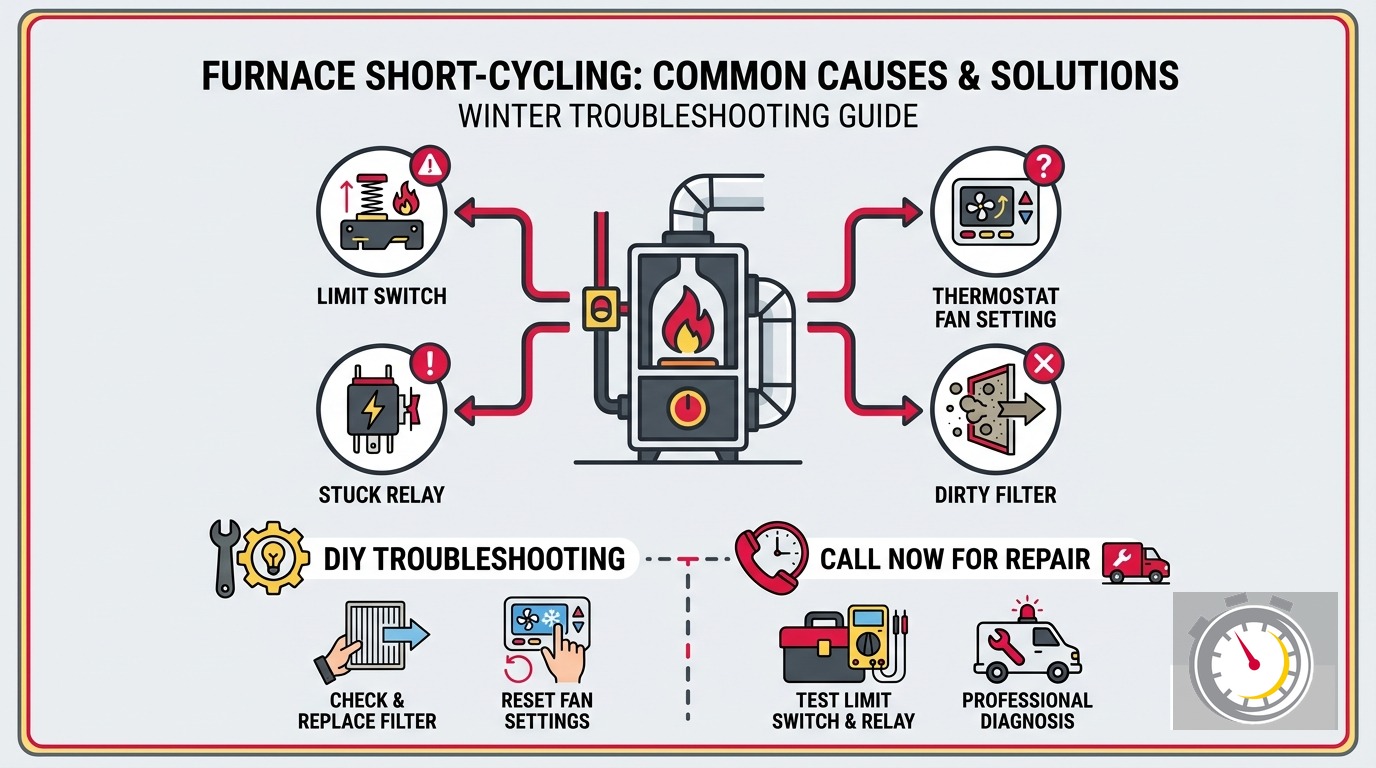
Four causes account for nearly every case: the thermostat fan is set to “ON” instead of “AUTO,” a dirty filter triggered the furnace’s high-limit safety shutoff, the limit switch tripped from overheating, or a relay on the control board has welded shut. Two you can fix yourself in minutes. The other two need a technician.
Your furnace blower is running, but the heat is not on. The house is already warm enough. You have not touched the thermostat in hours. But the fan just keeps going, and you are not sure whether to ignore it, turn off the system, or call someone.
This is one of the more common service calls we receive in the Twin Cities each fall and winter. The cause is almost always one of four things. This guide walks through each one in order: cheapest and most likely first, most serious last.
One of those causes is a safety issue that requires you to stop running the furnace until a technician arrives. It is last on the list because you should always try the two quick DIY checks first. They resolve the problem most of the time.
What’s the First Thing to Check? Your Thermostat’s Fan Setting
Check the fan setting on your thermostat right now. If it reads “ON,” switch it to “AUTO.” “ON” forces the blower to run at all times, regardless of whether the furnace is heating. “AUTO” runs the blower only during a heat call. This single setting is the most common cause of a furnace blower that will not shut off.
Every thermostat has two fan settings. They look like a minor toggle, but the difference in behavior is significant.
When you choose “ON,” the blower motor runs continuously, 24 hours a day, seven days a week. It does not matter whether the furnace has fired or whether your home is already at the setpoint temperature. The fan runs because you told it to run.
This is occasionally intentional. Some homeowners switch to “ON” to improve air circulation on multiple floors or to run air through the filter more often. But if you do not remember making that choice, or if someone else in the house changed it, the fix takes three seconds. Tap “AUTO.”
If the fan was already on “AUTO” and the blower is still running nonstop, the cause is inside the furnace. Move to the next section.
One thing worth noting: a nonstop blower is not free to run. Furnace blower motors draw 400-800 watts. Running that load continuously through a seven-month Minnesota heating season adds real cost to your utility bill. “AUTO” is the right setting for comfort and efficiency.
Could a Dirty Filter Be Keeping the Blower On?
Yes. A clogged filter blocks airflow across the heat exchanger. The heat exchanger overheats. When it overheats, the high-limit switch trips: the burner shuts off, but the blower stays on to cool the heat exchanger to a safe temperature. The blower will not stop until the heat exchanger drops below roughly 100-130°F.
Go to your furnace and pull the filter. Hold it up to a light. If you cannot see light through it, or if the surface looks gray, matted, or packed with hair and debris, replace it.
After installing a fresh filter, turn off the thermostat and give the system 20-30 minutes to cool. Then turn the furnace back on. If the blower runs a normal heat cycle and shuts off afterward, a dirty filter was the cause.
If the blower still will not stop after a filter replacement and a 30-minute cool-down, give it another 30 minutes. The heat exchanger may need more time to drop below the limit reset threshold. If the blower is still running after a full hour, or if the furnace is cycling abnormally, call a technician.
Dirty filters rarely cause problems on their own. They cause problems because the routine of changing them gets skipped. If you have not changed the filter in more than six weeks during heating season, that is likely what happened here. The fix is preventive going forward, not just reactive this time.
What Does a Limit Switch Do, and Why Does It Keep the Blower Running?
The limit switch is a safety device mounted near the heat exchanger. It shuts off the burner when the furnace overheats. A standard fan-limit control trips the burner off at around 200°F and keeps the blower running until the heat exchanger cools to roughly 100-130°F. This is not a malfunction. It is the system protecting itself.
Here is the sequence. Airflow is restricted by a dirty filter or a blocked vent. The heat exchanger temperature climbs. At around 200°F, the high-limit trips. The burner shuts off. The blower keeps running to move air over the heat exchanger and bring the temperature down. The furnace will not restart until the heat exchanger drops below the reset threshold.
That cooling process can take 20 to 60 minutes. During that window, you have a blower running with no heat being produced. From the furnace’s perspective, it is doing exactly what it should.
The important question is: what caused the overheating in the first place?
If the answer is a dirty filter, and you catch it once, replace the filter and let the system reset. Change the filter more frequently going forward.
If the limit trips again on a clean filter, something else is wrong. A failing blower motor that moves less air than it should, blocked return ducts, or too much static pressure in the duct system can all trigger it. Repeated limit trips accelerate heat exchanger wear over time.
A technician will measure airflow across the heat exchanger and check the blower motor’s amp draw. They will also look for duct restrictions or other airflow problems. Our post on limit switch symptoms and how to reset one covers the diagnostic markers in more detail.
When Should You Stop Running the Furnace Entirely? The Carbon Monoxide Warning
Stop running the furnace immediately if the blower won’t stop, the furnace is not producing heat, and the furnace is 15 or more years old. That combination is the warning sign for a flame rollout event triggered by a cracked heat exchanger. A cracked heat exchanger can push carbon monoxide into your living space. Do not restart the furnace until a technician has inspected it.
Most guides that cover a blower that will not stop describe the thermostat setting and the dirty filter clearly. Very few describe the flame rollout scenario in plain terms.
Here it is: the flame rollout switch is a type of limit switch. It trips when flames escape the combustion chamber. That happens when a cracked heat exchanger disrupts normal combustion airflow. When a flame rollout switch trips, the burner shuts down and the blower keeps running. Unlike the standard high-limit switch, the flame rollout switch must be manually reset by a technician. It requires an inspection before the system should run again.
Why does this matter more than the other causes? Because a cracked heat exchanger is a carbon monoxide risk. CO is odorless and colorless. It does not warn you the way a gas smell does. Running the furnace with a cracked heat exchanger routes combustion gases through your home’s air handling system. That is the same system heating your living space.
This is the “call now, not tomorrow” situation. A blower running with no heat is an inconvenience on a 60-degree October afternoon. On a -10°F February night in the Twin Cities, with an older furnace, it is a health and safety issue.
If you smell anything unusual, get everyone out of the house, including pets, and call 911 before calling anyone else. If there is no smell but the furnace is over 15 years old and the blower is running with no heat, turn it off at the thermostat. Call a technician today.
Our post on signs of a cracked heat exchanger in Minnesota covers what to look for and what the inspection involves.
What Is a Stuck Relay, and Is It a DIY Fix?
No. A stuck relay is not a homeowner repair. Relay contacts inside the control board can weld shut after a high-current event, keeping the board sending 120V to the blower motor continuously even when there is no call for heat. The furnace otherwise seems fine. The blower just runs.
Inside the control board, relays act as switches. When the thermostat calls for heat, the board closes a relay to power the blower. When the cycle ends, the relay opens to cut power. If contacts are welded shut from a power surge or a previous fault, the relay stays closed. The blower motor receives power because it is physically receiving power. Nothing the thermostat tells the board changes that.
This cause is less common than the thermostat setting or a dirty filter. But it cannot be diagnosed or fixed from the outside. A technician will read voltage on the blower motor circuit and check which terminals are active. From there, they determine whether the issue is a welded relay, a failed capacitor in the blower circuit, or another board-level fault.
The fix is board replacement. A replacement control board, installed, runs around $750 at the midpoint. Variable-speed and communicating system boards on higher-efficiency furnaces sit above that number.
A blown fuse on the board, a failed capacitor in the blower circuit, or a burned sequencer can produce similar symptoms. Each of these is a board-level or electrical repair. Our post on furnace control board failure symptoms and costs covers the diagnostic signs in more detail.
Do not attempt to access the control board without first turning off the furnace’s dedicated circuit breaker. The blower circuit runs at 120V.
How Does Minnesota’s Long Heating Season Change the Math?
It multiplies the filter-related failure risk. Minneapolis sits in IECC Climate Zone 6A. The city logs 7,000-8,500 heating degree days per year, with a 99% heating design temperature around -16°F. Your furnace runs 6-7 months per year, roughly double the national average. A filter that lasts 90 days in a milder climate gets clogged much faster here.
The 90-day filter replacement guideline is calibrated to all U.S. climates. In the Twin Cities, your furnace runs more hours per day and more months per year. It moves far more air through the filter than a furnace in a warmer climate does in the same period.
For a standard 1-inch filter, 4-6 weeks is the right interval during heating season. Certain household factors shorten that interval further. Pets generate hair and dander that load a filter fast. Recent renovation work, including drywall dust, sawdust, and insulation fibers, can clog a filter within a week. A higher-MERV filter catches more particles, but it restricts airflow faster as it loads, so it needs more frequent changes than a standard fiberglass filter.
One habit that prevents a lot of service calls: write the installation date on the new filter when you put it in. Pull it out and look at it at the four-week mark. You will quickly develop a feel for what a loaded filter looks like in your specific home, and you will stop guessing.
Our guide on how often to change your HVAC filter in Minnesota covers filter types, MERV ratings, and the household variables that affect the right replacement interval.
How Much Does It Cost to Fix a Furnace Blower That Won’t Shut Off?
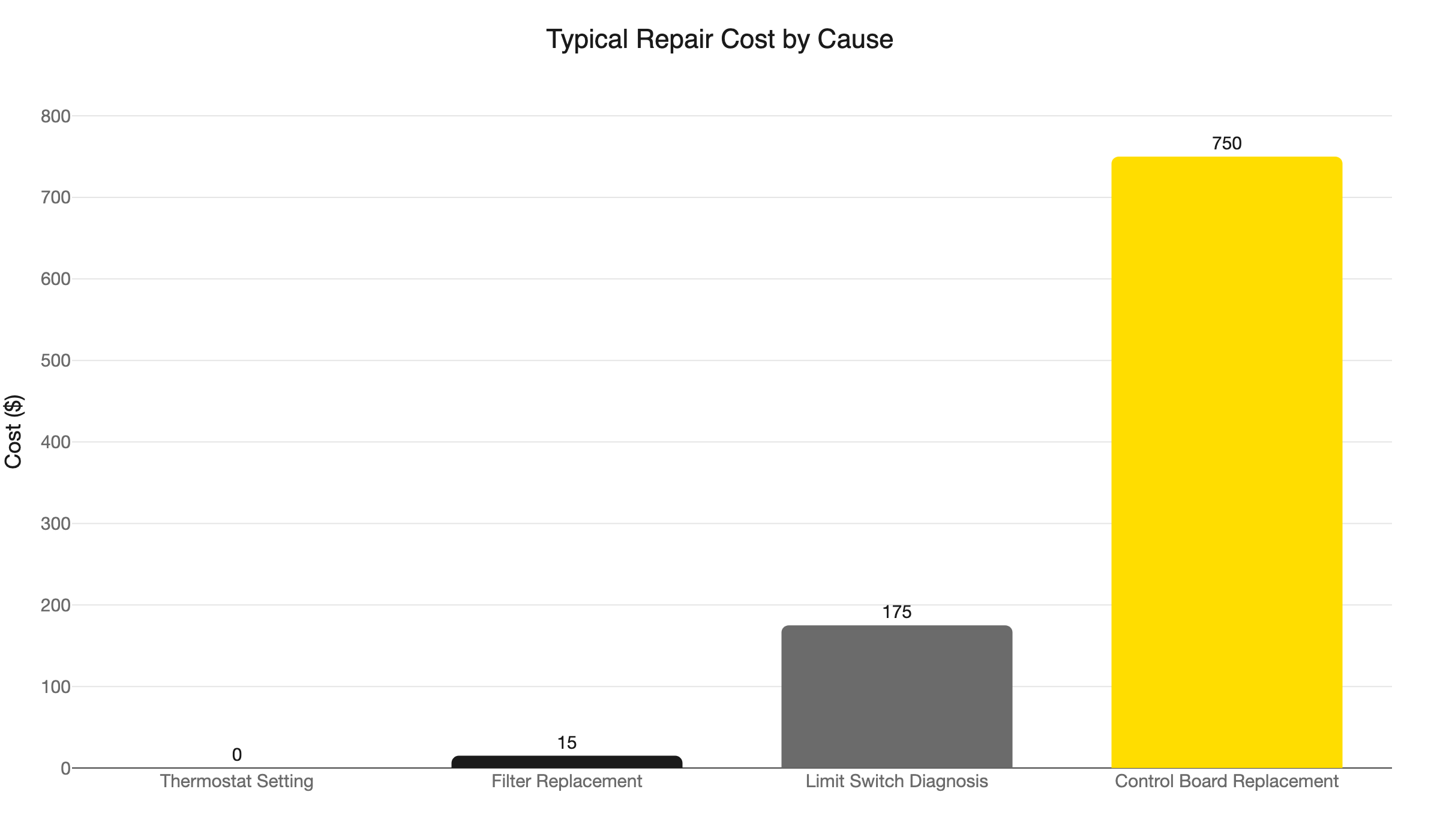
Cost depends on the cause. A thermostat setting change is $0. A filter replacement is $5-$20. From there, costs rise with diagnostic complexity and parts.
A service call to diagnose a limit switch trip or a stuck relay runs $95-$250. That range covers the technician’s time and the diagnosis. If the limit switch itself has failed outright (rather than just tripped), replacement is typically included within that range.
A control board replacement runs around $750 installed at the midpoint. Variable-speed or communicating boards on higher-efficiency models sit above that.
If the diagnosis points to a cracked heat exchanger, the economics change significantly. On a furnace 15 or more years old, heat exchanger repair often approaches or exceeds the cost of a new furnace. A new furnace installed in the Twin Cities runs $3,900-$7,800 for a mid-tier unit. An 80% AFUE unit starts around $4,950. A 95-96% AFUE unit starts around $6,500.
If replacement is the outcome, ask about available incentives before signing anything. CenterPoint Energy currently offers up to $400 for a qualifying 95%+ AFUE furnace replacement, plus an extra $100 for an ECM blower motor. Income-qualified households can receive up to $1,200. The federal 25C tax credit adds 30% of project cost, up to $600 for a qualifying furnace. Those two incentives stack. Applications for the CenterPoint rebate are open through December 31, 2026.
We offer financing options on furnace replacement. When you call, ask what is available for your situation.
Schedule Service with Northern One Hour
Here is the decision checklist if your furnace blower will not shut off:
- Check the thermostat fan setting. Switch from “ON” to “AUTO” if needed. Wait two minutes.
- Pull the filter. If it is clogged, replace it, turn the system off, wait 30 minutes, then restart.
- If neither step resolves it, call a technician.
- If the blower is running with no heat and the furnace is over 15 years old, call now. Do not wait until morning.
We are locally owned and operated in Ramsey, MN, serving Minneapolis, St. Paul, Blaine, Maple Grove, Plymouth, Brooklyn Park, Woodbury, Bloomington, and the surrounding Twin Cities metro. When we book a visit, we show up at the time we said. That is the promise: “Always On Time… Or You Don’t Pay a Dime!(R)”
Call (763) 260-6662 or schedule furnace repair online. We provide transparent, upfront pricing before any work begins, and every job is backed by our 100% satisfaction guarantee.
Frequently Asked Questions
Why is my furnace blower running when the heat is off? +
Is it bad if the furnace blower runs nonstop? +
How much does it cost to fix a furnace blower that won't turn off? +
Why does the furnace blower keep running a few minutes after the heat shuts off? +
Need a technician now?