Furnace Limit Switch Failure Symptoms: Minnesota Guide
Key Takeaways
- A single limit switch trip usually points to restricted airflow. Replace the filter first.
- Repeated trips after a fresh filter are a diagnostic signal, not a switch malfunction.
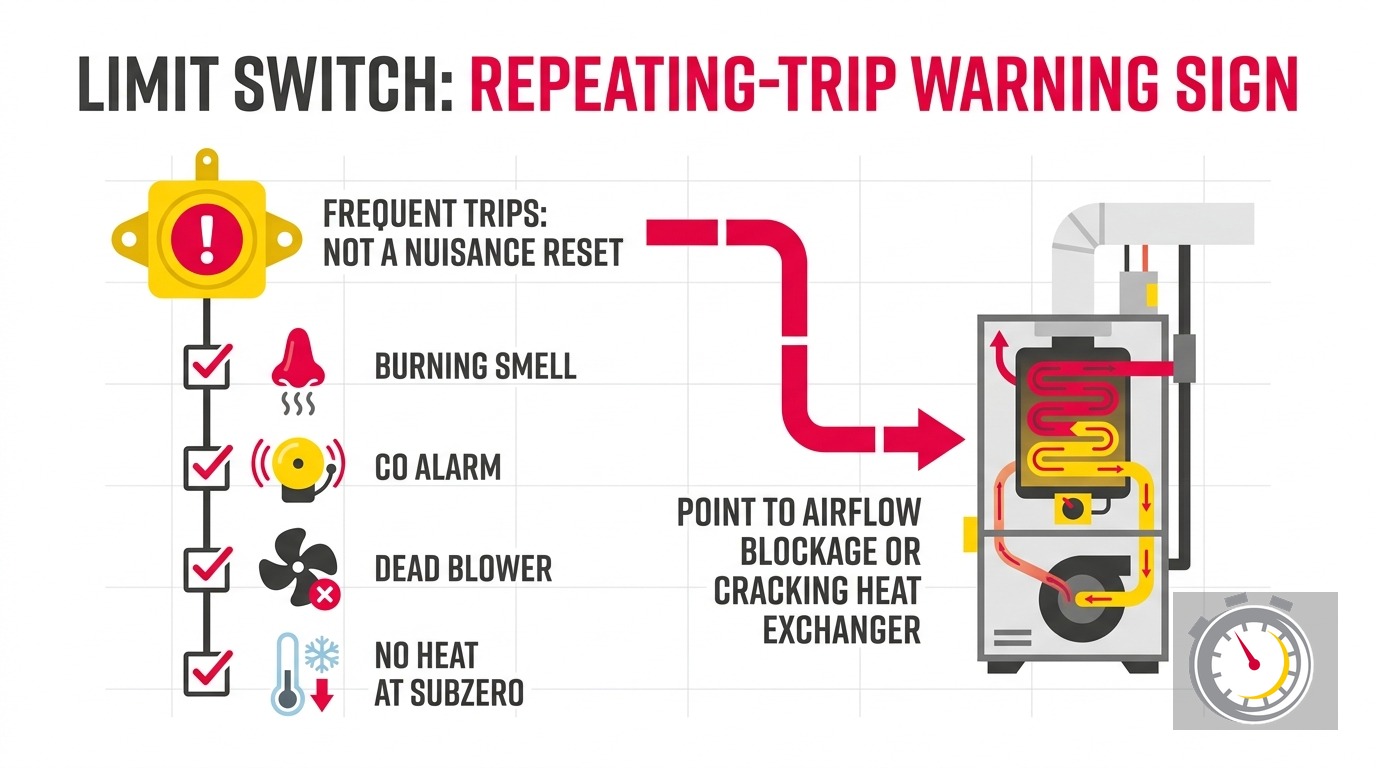
- The most dangerous cause of repeated trips is a heat exchanger that is overheating and beginning to crack.
- A cracked heat exchanger allows combustion gases, including carbon monoxide, into your home’s air supply.
- Minnesota data shows 14 Minnesotans die from CO poisoning every year; 300 more visit emergency rooms.
- On high-efficiency furnaces, a snow-blocked combustion air intake is a Minnesota-specific cause that no national guide covers.
- If the switch trips more than once after a filter change and cleared vents, call a technician. Do not keep resetting.
Your furnace limit switch tripped last night. You pressed the reset button, the heat came back on, and you went to bed. That is what most Minnesota homeowners do. It is also exactly when a nuisance turns into a hazard.
The limit switch is not malfunctioning when it trips. It is working. Its job is to shut the furnace down before the heat exchanger gets hot enough to crack. A single trip on a dirty filter is a warning you can handle yourself. A switch that trips again two days later - after you already changed the filter - is not a repeat nuisance. It is a diagnosis.
In Minnesota, where furnaces run five to six months at sustained high demand, the difference between those two scenarios matters more than it does almost anywhere else.
What Does a Furnace Limit Switch Do?
The limit switch is a heat-activated safety device in the supply plenum. It shuts the burners off when plenum temperature exceeds roughly 160 F - before the heat exchanger overheats and cracks. It stays closed during normal operation and opens only when something is wrong with airflow or heat exchange.
The switch sits between the blower and the heat exchanger. When your furnace blower moves air across the heat exchanger at the right volume, that air stays in the 100-140 F range as it enters your duct system. The limit switch stays closed, the burners keep running, and you stay warm.
When airflow drops - from a clogged filter, a closed vent, a slow blower motor, or a blocked combustion air intake - the heat exchanger has nowhere to push its heat. Temperature in the plenum climbs past 160 F. The limit switch opens, cutting power to the burners. The blower often continues running briefly to pull heat away from the exchanger before the system shuts down completely.
That shutdown is correct behavior. The switch is doing its job. The problem is what you do next.
Furnace Limit Switch Failure Symptoms Minnesota: One Trip vs. Repeated Trips
One trip followed by a filter change and no further trips means the restriction was the filter. Repeated trips within days of each other - especially after the filter is already fresh - are the furnace limit switch failure symptoms Minnesota technicians use to diagnose the next layer of problems.
The cause of a single trip is almost always a dirty filter. Fix the filter, the problem is gone. But if the furnace trips again and then again, the cause is one of three things:
- Airflow is still restricted despite the new filter: closed vents, blocked return grilles, or a failing blower.
- A Minnesota-specific blockage: snow or ice covering the combustion air intake pipe on a high-efficiency furnace.
- The heat exchanger is already damaged from previous overheating, and the switch is doing everything correctly while the furnace fails.
Each scenario has a different fix. None of them are a broken limit switch.
Why Does the Limit Switch Keep Tripping?
The switch keeps tripping because the root cause of the overheating was never resolved. A fresh filter fixes a dirty-filter problem. It does not fix a blocked vent, a slow blower, a clogged combustion air intake, or a heat exchanger that is already compromised.
Working through the causes in order prevents replacing parts that are not the problem.
The Four Causes Behind Repeated Trips
1. Airflow Restriction Beyond the Filter
A new filter that is too restrictive causes trips just as reliably as a dirty one. MERV 13 filters trap more particles, but many older blower motors cannot pull air through that density at full volume. The result is the same as a dirty filter: restricted airflow, rising plenum temperature, and a limit switch that trips.
Check that every supply and return vent in the house is open. Closing vents in unused rooms is a common homeowner habit, but it actually raises static pressure and reduces airflow rather than saving energy. Also check the return air path: furniture pushed against a return grille, a rug over a floor return, or a bedroom door closed in a room with a supply vent but no dedicated return. Each one chokes the airflow loop.
Fix cost: usually zero. Open the vents, move the furniture, drop to a MERV 8 filter.
2. Blocked Combustion Air Intake (A Minnesota-Specific Cause)
High-efficiency furnaces (90%+ AFUE) draw combustion air from outside through a dedicated PVC pipe. In Minnesota winters, that pipe can be buried under a snowdrift or blocked by ice buildup after a melt-freeze cycle. When combustion air is restricted, the burner runs hotter than designed, the heat exchanger temperature climbs faster, and the limit switch trips.
This does not show up in national troubleshooting guides because it is a Minnesota problem. After heavy snowfall, walk the perimeter of your home and find the white PVC pipes exiting the foundation. They typically run in pairs: one for combustion air in, one for exhaust out. Both must stay clear. Clearing snow from the openings is a DIY task. If you suspect ice blockage inside the pipe, that requires a technician.
The Minnesota Dept. of Public Safety specifically recommends clearing snow and debris from furnace vents to prevent carbon monoxide buildup - a recommendation that applies directly to the combustion air intakes on modern high-efficiency systems.
3. Blower Motor Problems
The blower motor moves air across the heat exchanger. If it is running slow due to worn bearings, a failing capacitor, or a dirty blower wheel, airflow drops even with a clean filter and open vents. The heat exchanger overheats and the limit trips.
A dirty blower wheel accumulates dust on its fins and loses the ability to move air at rated volume. The signs of a failing blower motor often include noise - humming, grinding, or a labored start-up - before the motor fails outright. But a motor running slow without obvious noise can cause repeated limit trips for weeks before it fully stops.
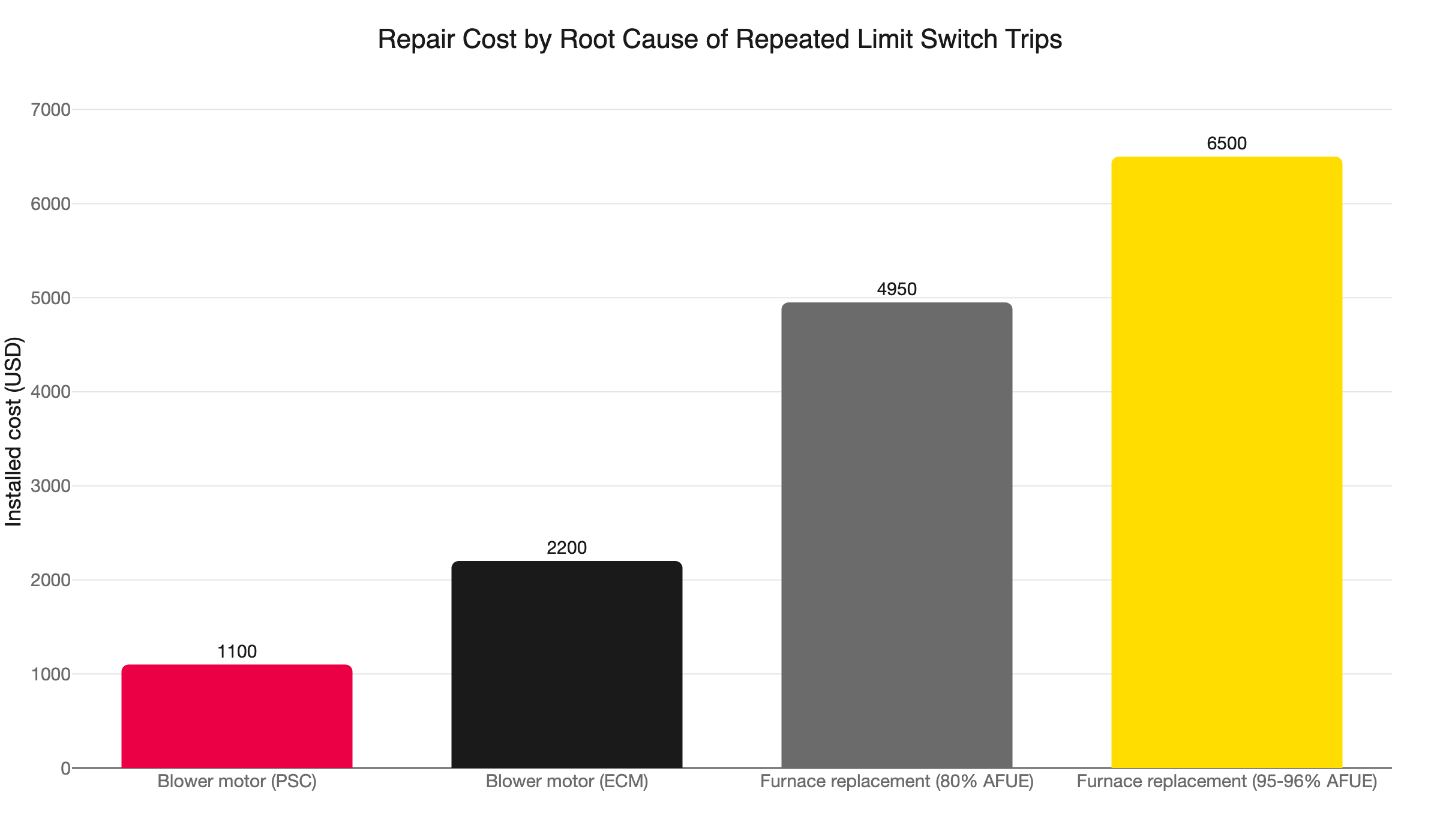
Installed repair cost: $1,100 for a standard PSC motor, up to $2,200 for an ECM variable-speed motor.
4. A Cracking Heat Exchanger
If the filter is fresh, vents are open, the blower tests at full speed, and the limit switch still keeps tripping, the heat exchanger is the next thing to look at. If it is cracked, the furnace is done.
HVAC Training Shop explains that repeated overheating is the primary mechanism behind heat exchanger cracking. The limit switch exists to prevent that overheating. When the switch trips and a homeowner resets rather than diagnosing, the heat exchanger overheats again. Each cycle adds thermal stress. Cracks propagate.
PickHVAC confirms that a cracked heat exchanger “essentially ruins the furnace” and opens a pathway for flue gases - including carbon monoxide - to enter the supply air stream. The blower then distributes that air to every room in the house.
The effective repair cost is furnace replacement: $3,900-$7,800 installed depending on efficiency tier and equipment size.
Is the Limit Switch Broken, or Is It Doing Its Job?
In almost all repeated-trip cases, the limit switch is not defective. It is responding correctly to an abnormal operating condition. A defective switch is one that trips at normal plenum temperatures - something a technician can verify in minutes with a meter. That scenario is uncommon.
The dangerous assumption is that the switch is the problem. It leads to resetting repeatedly or replacing the switch without diagnosing the upstream cause. A new limit switch installed in front of a cracked heat exchanger will trip just as reliably as the old one - because the heat exchanger is still overheating.
If a technician tests the switch and confirms it trips below normal temperature thresholds, replacement is the right call. The switch itself is an inexpensive part; the service call is the cost. But diagnosis comes before parts.
Why Is a Cracked Heat Exchanger a Carbon Monoxide Risk?
A crack in the heat exchanger allows combustion byproducts - including carbon monoxide - to mix with the air your blower circulates through the house. CO is colorless and odorless. By the time a family has symptoms, the concentration may already be dangerous.
This is where the repeated-trip pattern escalates from an expensive repair problem to a safety problem. The carbon monoxide risk from a cracked heat exchanger is not theoretical - it is the mechanism behind real Minnesota fatalities every winter.
Minnesota Dept. of Public Safety data shows 14 Minnesotans die from CO poisoning annually; 300 more visit emergency rooms every year. Per Minnesota Health Department tracking, ER visits for CO poisoning more than double between September and November, peaking in February. The months of highest heating demand are the months of highest CO incident rates.
Minnesota law (Minn. Stat. §§ 299F.50-299F.51) requires working CO alarms near every sleeping area in all single and multi-family residences. If you do not have them in place, that is step one. Several Twin Cities suburbs - Eagan, Hopkins, Maple Grove, White Bear Lake, and others - run free CO alarm programs through a Minnesota DPS partnership. Contact your city directly to ask if yours participates.
A CO alarm is a backup. A professional heat exchanger inspection is the prevention. Both matter.
Why Is Resetting the Limit Switch Especially Risky in a Minnesota Winter?
At -10 F with a furnace that keeps shutting off, every reset feels like survival. But each reset in a polar vortex adds another thermal cycle to a heat exchanger that may already be cracked - and CO seeps into living space hours before anyone wakes up with symptoms.
Twin Cities furnaces run five to six months of heating season at sustained high demand. A 15-year-old furnace in Minnesota has logged far more thermal cycles than the same model in Dallas or Atlanta. The heat exchanger has expanded and contracted more times. The thermal fatigue accumulates.
The urgency of a January night at -15 F is exactly when a propagating crack goes undetected. The switch trips. The homeowner is in survival mode. They reset it. The heat runs a few more hours. The switch trips again. They reset again. Each cycle stresses the heat exchanger further. CO seeps into living space in the early morning hours before anyone wakes up with a headache.
The right move at 2 a.m. is to call an emergency HVAC line and use portable electric space heaters in key rooms while waiting for a technician. Space heaters bridge the gap safely. They are not a reason to keep running a furnace whose own safety device keeps shutting it down.
What Should You Do When the Limit Switch Trips?
Replace the filter. Check all vents. Clear the combustion air intake on high-efficiency furnaces. Press the reset button once. If the furnace trips again within 24-48 hours, do not press reset again - call a technician. A second trip after a fresh filter points to a cause that requires professional diagnosis.
Here is the sequence:
- Replace the filter. If it is visibly dirty or you cannot remember the last change, swap it now. This resolves most single-trip events.
- Check every supply and return vent. Walk the house. Open any closed vents. Move furniture or rugs blocking return grilles.
- Check the combustion air intake pipes on high-efficiency furnaces. After any heavy snowfall, walk outside and confirm both the intake and exhaust PVC pipes are clear.
- Press the reset button once. Monitor the furnace for 24-48 hours.
- If it trips again, call a technician. Do not reset a second time without a diagnosis.
The Minnesota Dept. of Public Safety recommends annual professional inspection of fuel-burning equipment before cold weather. That inspection is the right time to catch a limit switch tripping below normal thresholds, a blower motor showing early wear, or heat exchanger stress before it cracks through.
When Does Repeated Tripping Mean Replacement Instead of Repair?
A confirmed cracked heat exchanger on a furnace 15 years or older almost always means replacement is the better financial decision. Replacing only the heat exchanger can cost as much as a new furnace, with the rest of the aging system unchanged and still at risk.
The math is not complicated. A heat exchanger replacement leaves the inducer motor, control board, blower motor, and gas valve all in place - every one of them as old as the system that just failed. Any one of them can be the next service call.
Northern One Hour installs furnaces starting at $4,950 for an 80% AFUE unit, $6,500 for a 95-96% model, and $9,100 for a top-tier 97-98% variable-speed system. Financing is available. For most homeowners replacing a system that is 15 years or older, the efficiency gain recovers a meaningful portion of the replacement cost over the next several heating seasons.
If you are weighing the numbers, our technicians walk through that comparison on-site and give you a clear picture before any decision.
How Northern One Hour Can Help
Northern One Hour Heating & Air Conditioning is locally owned and operated in Ramsey, MN. Our technicians serve Minneapolis, St. Paul, Blaine, Maple Grove, Plymouth, Brooklyn Park, Woodbury, Bloomington, and the broader Twin Cities metro.
When a limit switch keeps tripping, we diagnose the cause before recommending any repair. We do not replace switches without understanding why the switch tripped. We check the filter, the airflow path, the blower, and the heat exchanger - in that order - and explain what we find before any work begins.
“Always On Time… Or You Don’t Pay a Dime!(R)”
Call (763) 260-6662 or schedule a furnace repair online. For a pre-season inspection before the next cold snap, our furnace tune-up service covers airflow, heat exchanger condition, and limit switch function - the three things a repeated trip is telling you to check.
Frequently Asked Questions
How do I know if my furnace limit switch is faulty versus just doing its job? +
Can I reset my furnace limit switch myself? +
What does it cost to fix a furnace limit switch problem in Minnesota? +
Need a technician now?