
HVAC Maintenance Plan Worth It? An Honest Twin Cities Look
Key Takeaways
- HVAC maintenance plans typically cost $150-$300 per year and cover two seasonal tune-ups, priority scheduling, and a repair discount.
- Heating and cooling account for as much as half of all household energy use. A neglected system loses efficiency quietly, month after month.
- Minnesota’s -12°F design temperature means a January HVAC failure is not just uncomfortable. It can mean frozen pipes and structural damage.
- A plan typically pays for itself when it replaces two separate tune-up fees or avoids a single emergency dispatch call.
- Most manufacturers require documented annual maintenance to keep extended warranties valid. Skipping service can void coverage on a system that cost $7,800-$15,600 to install.
- Newer systems with active manufacturer and home warranties may see thinner return. We cover that honestly below.
What Does an HVAC Maintenance Plan Include?
In short: Most plans cover two seasonal visits - one before heating season, one before cooling season - plus priority scheduling and a 10-15% repair discount. Some add filter replacements or waive after-hours fees for members. Two seasonal visits is the baseline to expect from any reputable plan.
A maintenance plan is a service agreement between you and your HVAC company. You pay one annual fee. In return, the company schedules two proactive visits: one in fall before heating season, and one in spring before cooling season. Each visit follows a defined inspection checklist covering the components most likely to cause problems if they go unserviced.
On the heating side, a tune-up typically covers checking heat exchangers for cracks, testing ignitors and flame sensors, measuring gas pressure, cleaning burners, inspecting the flue, and verifying electrical connections. On the cooling side, it covers checking refrigerant charge, cleaning the condenser coil, inspecting the blower and capacitors, and measuring system pressures.
Beyond the visits, plans typically include:
- Priority scheduling - members move ahead of non-members when service slots fill up
- Repair discounts - commonly 10-15% off parts and labor on any repair call during the plan year
- Reduced or waived after-hours fees - some plans eliminate the emergency dispatch surcharge for members
Northern One Hour’s heating maintenance service and air conditioning maintenance cover both seasonal windows. The goal is to inspect and tune your system before you need it most - not while you are already in the middle of a cold snap or a heat wave.
Is an HVAC Maintenance Plan Worth It?
In short: For most Twin Cities homeowners, yes. Two tune-up visits, priority scheduling, and repair discounts cover or exceed the plan cost in a typical year. The case is strongest for systems older than three years without a comprehensive home warranty covering HVAC.
Whether a plan is worth it depends on your system’s age, what other coverage you carry, and how much a mid-January breakdown would actually cost you. The short answer favors the plan for most households. The longer answer needs honest math and a few real caveats - both of which follow.
Start with the energy case. Heating and cooling account for as much as half of all household energy use. A system running with a dirty coil, low refrigerant, or a worn capacitor does not fail dramatically on day one. It degrades slowly. Efficiency drops. Your utility bills creep up. That waste accumulates for months before anything visibly breaks. Annual maintenance keeps the system calibrated and running at the efficiency it was built to deliver.
A system that runs clean and calibrated is less likely to develop the kind of progressive wear that leads to expensive repairs. That is a probabilistic statement, not a guarantee. But maintained systems fail less often and less expensively than neglected ones. Annual service is how you put your system on the better side of that distribution.
Then there is the repair-avoidance side. A tune-up catches the parts starting to wear before they cascade into larger failures. That is the subject of the next section.
Why Do Small Problems Turn Into Big Repairs?
In short: HVAC failures rarely happen in isolation. One worn part stresses the next. A $20 capacitor going soft forces the motor to draw excess current, which eventually kills a $2,000 compressor. A tune-up catches the capacitor before that chain starts.
This is the cascade failure problem. It is the single most concrete argument for annual service. It is also the part that most plan-comparison articles never explain specifically.
Here is how it unfolds. A weakening capacitor forces the motor to draw excess current. The motor runs hotter than it should. Meanwhile, a dirty evaporator coil restricts airflow. Restricted airflow leads to ice buildup on the coil. After the ice thaws, the compressor must work against a higher load. Add a loose electrical connection that causes intermittent shutdowns - the kind that are hard to trace later. Each problem feeds the next.
The capacitor is a $20-$50 part. Catching it during a tune-up means a quick swap and a note in the service record. Missing it for two or three seasons means the compressor absorbs that stress until it fails. A compressor replacement typically runs $1,950-$2,600 or more. On an older system, that cost often triggers a full replacement conversation rather than a repair call.
This is not a hypothetical. It is the pattern technicians see regularly. A tune-up visit does not just clean the coil and test the thermostat. It finds the part that is getting tired before that part takes something expensive down with it.
For a full inspection checklist and what to expect at each visit, see our guide to furnace tune-ups and what they include.
What Makes Minnesota’s Climate Different?
In short: The Twin Cities design temperature is -12°F. A January breakdown is not just discomfort - it risks frozen pipes and structural damage. The risk calculation here is materially different from markets where most online HVAC advice originates.
Most of the HVAC maintenance content circulating online was written for Ohio, New Jersey, or similarly mild markets. Those comparisons do not transfer to Minnesota.
The Minneapolis-St. Paul design temperature is -12°F, Climate Zone 6A (Cold, Moist). Duluth’s design temperature is -21°F. These numbers represent the 99th percentile cold: the temperature load your heating system must carry reliably on the worst nights of the year. When a system fails at -12°F, you are not waiting a few hours in a cool house. Interior temperatures fall quickly. Pipes begin to freeze before the house reaches equilibrium. That is not an inconvenience. It is a structural and insurance event.
Add the summer side. Twin Cities summers regularly push 95°F or higher. This is not just a heating state. The air conditioning system carries real load from June through August. Both systems earn their annual tune-ups, and both systems are subject to the cascade failure logic described above.
Then there is the dual-fuel context. About 66% of Minnesota homes heat with natural gas. But dual-fuel heat pump systems - a heat pump paired with a gas furnace backup - are increasingly common here, particularly among homeowners who have taken advantage of Xcel Energy and CenterPoint utility rebates. CenterPoint has offered up to $1,100 for ducted dual-fuel systems in existing homes. Combined with Xcel incentives, qualified dual-fuel systems have been eligible for up to $3,100 stacked. That is a significant capital investment. A maintenance plan that covers both seasonal visits - heating and cooling - is how you protect it.
A dual-fuel home has two systems to maintain. A plan covering both visits addresses that more completely than a single tune-up would.
Does a Maintenance Plan Protect My Manufacturer Warranty?
In short: Yes - and skipping annual service may void that warranty. Most manufacturers require documented maintenance to keep extended coverage valid. On a system costing $7,800-$15,600 to install, that is a significant financial exposure to create for yourself.
This is the point most plan-comparison articles skip entirely. A maintenance plan is not just tune-ups and scheduling perks. It is documentation.
Many manufacturers require documented annual maintenance to keep extended warranties valid. If your system fails in year four and you cannot produce service records, the manufacturer may deny the warranty claim. A maintenance plan generates those records automatically. Every visit produces a dated service report tied to your specific equipment - what was inspected, what readings were taken, what was adjusted or replaced, and the date of service. That is the kind of paper trail that satisfies a warranty adjuster.
This matters especially for homeowners who recently upgraded under a utility rebate program. If you invested in a new system with help from Xcel Energy or CenterPoint incentives, that system came with a manufacturer warranty. Documented annual service is how you keep that warranty enforceable over its full term. Skipping service to save $150-$300 per year can forfeit warranty protection on a system worth far more.
What Does Priority Service Really Mean?
In short: During a polar vortex, non-member HVAC wait times in the Twin Cities can stretch 4-7 days across the metro. Priority scheduling moves plan members to the front of that queue. At -20°F, that difference is not abstract - it is the line between a scheduled appointment and a structural emergency.
This is the most Minnesota-specific argument for a maintenance plan. You will not find it in articles written for milder markets, because those markets do not have the same demand spike pattern.
When a polar vortex drops temperatures to -20°F or lower across the entire metro, every HVAC company is overwhelmed simultaneously. Technicians are dispatched around the clock. New service calls from non-members go into a queue that stretches four to seven days. Seven days without heat at -20°F is not a heating inconvenience. It is a pipe-freeze emergency, a hotel stay, or both.
Plan members with priority scheduling move ahead of that queue. When you call as a member, your service appointment is slotted ahead of non-member calls in the same window. On the night your furnace stops at midnight in January, that priority is a concrete operational difference, not a marketing point.
Being proactive is the other half of the equation. If you get your furnace inspected every fall, the odds of a January failure drop meaningfully. The maintenance visit in October finds the problem; the polar vortex in January does not. For a full guide to winter readiness, see our post on preventing winter breakdowns before they happen.
The Honest Math: Plan Cost vs. What You’d Pay Without One
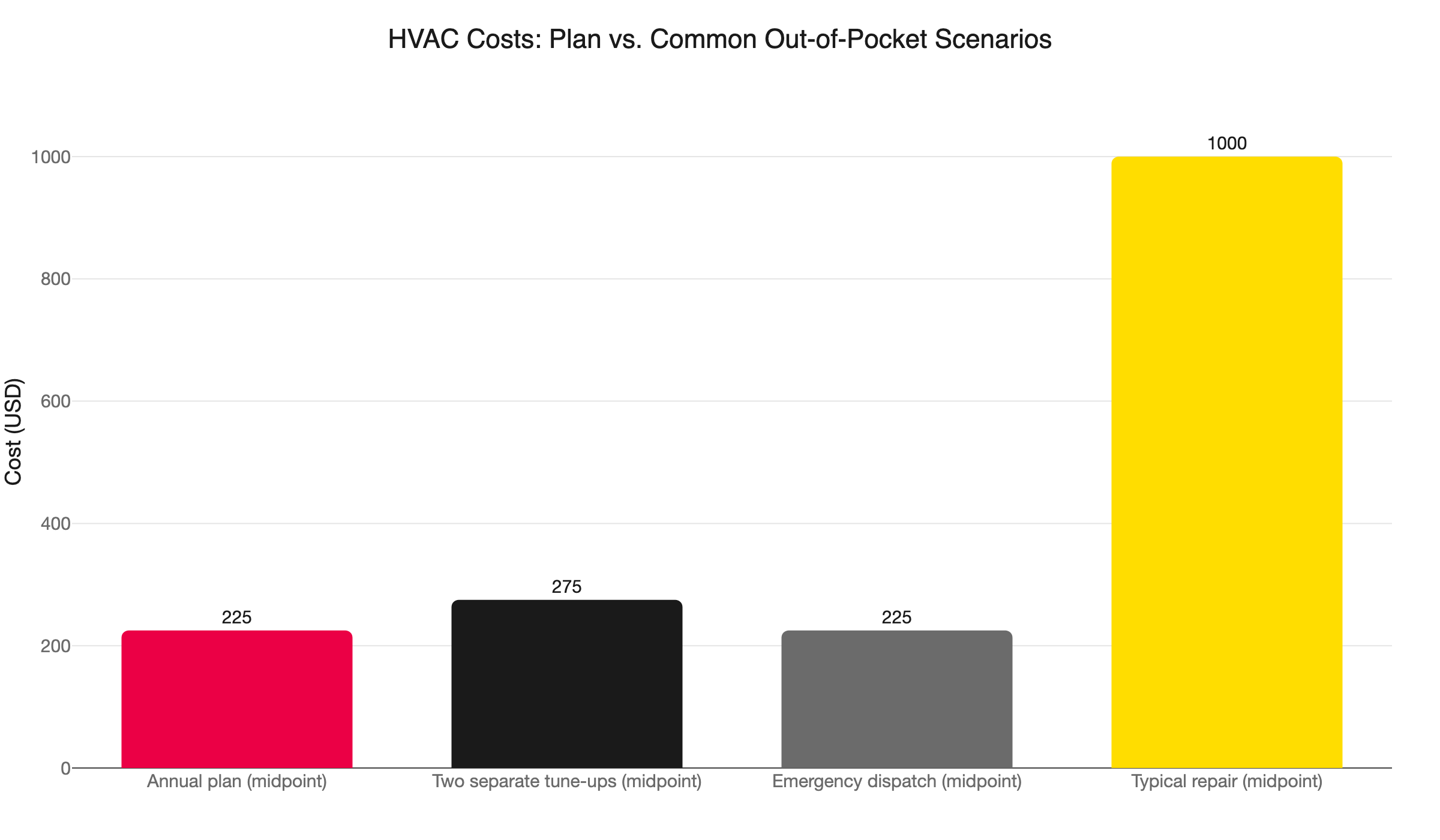
Typical plans run $150-$300 per year, with most households landing around $225 annually. Two separate tune-up visits without a plan run $95-$250 each, totaling $195-$500 combined. At the midpoint - around $350 combined - you are already at or above the typical plan cost for the visits alone. The plan adds priority scheduling and the repair discount on top of that.
The math tips sharply in the plan’s favor if you ever call for off-hours service. An emergency dispatch fee commonly runs $150-$300 before a technician touches anything. Plans that waive or reduce that fee for members can recover the entire annual plan cost on a single emergency call.
Then consider the repair discount. At a midpoint repair cost of around $1,300, a 10-15% member discount saves $130-$195 per job. That discount applies every time you call for repair service during the plan year - not just once.
Put it together: two tune-up visits covered, one emergency dispatch fee waived, one repair discounted. The plan has returned its cost and then some. It does not guarantee you will avoid repairs entirely. What it does is make each repair less expensive, get a technician to you faster, and reduce the odds that a small worn part grows into a compressor replacement.
Who Gets the Most Value from a Maintenance Plan?
A plan delivers the clearest return for:
- Systems 3-10 years old. Old enough for components to develop wear; young enough that repair is still the right answer. This is the highest-value window.
- Systems older than 10 years. Cascade failure risk is higher. Emergency calls are more likely. Priority access becomes more valuable as the system ages.
- Dual-fuel heat pump households. Two systems mean two seasonal checkpoints. A plan covering both is a more complete answer than a single tune-up.
- Households without a comprehensive home warranty. If you are self-insuring on HVAC repair and replacement, the plan is part of your risk management.
- Homeowners who recently upgraded with utility rebates. Protecting a capital investment and keeping the manufacturer warranty enforceable are strong reasons to commit to documented annual service.
Who Might Not Need a Plan Right Now?
This is the section the other articles skip. Not every household is the right fit, and saying so plainly is more useful than a uniform pitch.
A plan offers thinner return for:
- Systems under three years old with active manufacturer warranties. Your factory coverage is already strong. The plan adds convenience and priority access - but not the warranty-protection argument that applies to older equipment.
- Homeowners with comprehensive home warranties covering HVAC repair and replacement. If a home warranty picks up those costs, the financial case for an additional service agreement is weaker. Check your home warranty terms before signing up.
- Renters whose landlords handle HVAC. If the system is not your responsibility, a personal maintenance plan is not your purchase.
Even in these cases, the priority-scheduling benefit has real value in a Minnesota winter. If budget is the constraint, these are the households where the math is closest and the decision is genuinely optional rather than obvious.
Get Started with Northern One Hour
We are locally owned and operated, based in Ramsey, MN, and serving homeowners across the greater Twin Cities. Every service call - plan member or not - runs on the same standard: “Always On Time… Or You Don’t Pay a Dime!(R)”
A maintenance plan is how you stay ahead of repairs, keep your warranty documentation current, and hold a place near the front of the schedule when January turns brutal. Two seasonal visits, priority access, and a repair discount - for less than the cost of a single emergency dispatch call in most years.
Call us at (763) 260-6662 or book a maintenance visit online. We will walk you through the plan options and match the right service level to your system and your home.
Frequently Asked Questions
What does an HVAC maintenance plan typically include? +
How much does an HVAC maintenance plan cost per year? +
Does skipping HVAC maintenance void my manufacturer warranty? +
Who doesn't benefit much from an HVAC maintenance plan? +
How long is the HVAC wait without a plan during a polar vortex? +
Need a technician now?