
HVAC Second Opinion Twin Cities: Red Flags and How to Ask
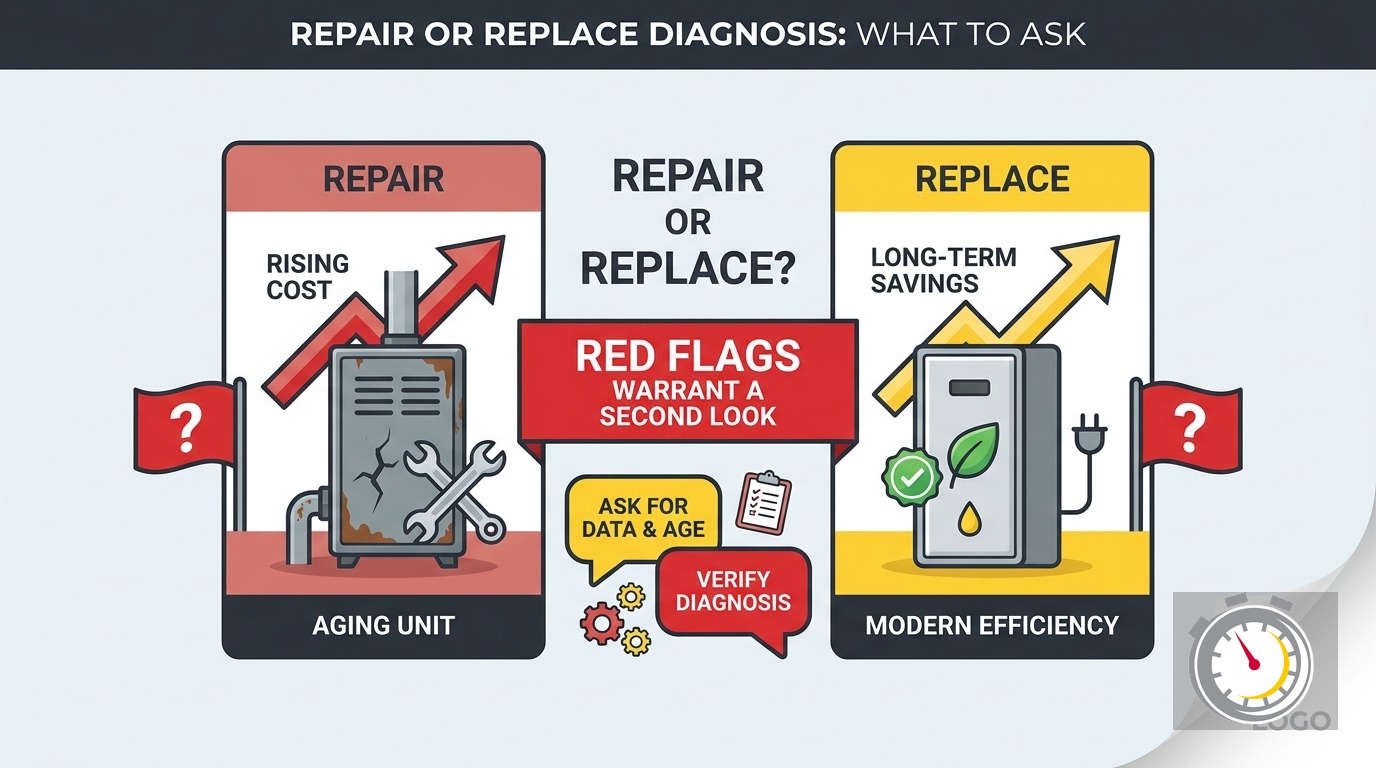
Key Takeaways
- Get a second opinion any time replacement is recommended on a system under 15 years old, or a repair exceeds a few hundred dollars.
- A cracked heat exchanger must be confirmed with a combustion analyzer and inspection camera. A visual inspection alone is not sufficient.
- The 50% Rule and the $5,000 Rule are two fast benchmarks for evaluating repair-versus-replace decisions.
- Minnesota requires a mechanical permit for virtually every equipment replacement. A contractor who skips that conversation is a red flag.
- A second opinion from a Trade Ally contractor may unlock federal tax credits and utility rebates the first tech never mentioned, potentially $3,000 to $5,000 in combined savings.
- Most reputable technicians will not object when you ask for 24 hours to verify a diagnosis. A defensive reaction is itself useful information.
When Should You Get an HVAC Second Opinion in Twin Cities?
Get a second opinion any time a technician recommends replacing a system under 15 years old, quotes a single repair over a few hundred dollars, or diagnoses a cracked heat exchanger without showing you camera footage or combustion readings. Those three scenarios account for most high-dollar misdiagnoses in the Twin Cities HVAC market.
Your heating and cooling system is one of the largest mechanical assets in your home. A furnace replacement in the Twin Cities runs $4,500 to $11,000 installed. A central AC replacement costs $6,500 to $13,000. A second diagnostic visit takes about 30 minutes and can pay for itself many times over, even when the first technician was completely right.
Minnesota’s climate makes accurate diagnosis more urgent here than in most markets. Our design temperature of -20°F means furnaces log more operating hours than the same equipment would in a moderate-winter state. A 12-year-old furnace in Plymouth has worked harder than a 12-year-old furnace in Atlanta. Age-based rules of thumb still apply, but our winters compress the upper end of typical lifespan ranges. A unit that might push 18 years in a mild climate may start showing stress at 14 or 15 here.
What Are the Red Flags That Warrant an HVAC Second Opinion?
Any diagnosis where the technician did not run the equipment, open the cabinet, or show you physical evidence of the problem is worth questioning. A legitimate technician expects you to verify their work.
Here is the checklist. Two or more of these on a single service call means you should make another call before signing anything:
- Replacement recommended without running the system or opening the cabinet
- Estimate delivered verbally with no written, itemized breakdown
- Cracked heat exchanger diagnosed by sight alone, with no camera footage or CO readings
- Refrigerant added without showing measured levels before and after
- “Limited time” pricing pressure or urgency to decide the same day
- No mention of a permit for a full equipment replacement
- Refusal or inability to show photos, readings, or a written report of the problem
- A defensive or offended reaction when you say you want another opinion
That last item deserves extra attention. Reputable technicians get asked for second opinions routinely. They do not take it personally. A tech who pushes back hard when you ask for 24 hours to think is telling you something important about how their company operates. Consider that reaction part of the diagnosis.
The Cracked Heat Exchanger: The Most Common Scare Diagnosis
The cracked heat exchanger is the single most-cited upsell in residential HVAC. It works because the carbon monoxide safety concern is real and frightening. A homeowner who hears “CO risk” often stops asking questions and reaches for their wallet.
Here is what a legitimate diagnosis actually requires. A visual inspection alone is not sufficient to confirm a crack. A proper diagnosis uses a combustion analyzer to measure CO levels in the cabinet and living space, plus an inspection camera to document the problem. Ask the technician which method they used. Ask to see the photo or the readings. A trustworthy tech will put a phone in your hand with the image on it.
Even a confirmed crack is not automatically a case for full system replacement. Many homeowners who sought a second opinion found nothing wrong. Most furnace heat exchangers carry a lifetime limited warranty from the manufacturer. If your furnace is under 15 years old, a confirmed crack may mean a labor-only heat exchanger swap at roughly $650 to $1,950, not a full system replacement at $4,500 to $11,000. A full breakdown of diagnosis methods, costs, and warranty coverage is here.
Before agreeing to anything, ask which diagnostic method the technician used. If they cannot or will not show you evidence, stop the conversation and call someone else. For more on what a proper heat exchanger diagnosis involves, see: Cracked heat exchanger: signs and what to do in Minnesota.
Are Refrigerant Claims a Red Flag?
Yes, in specific patterns. A contractor who claims you need refrigerant on every visit, or who “finds a leak” without showing you the location, is following a pattern worth questioning. A legitimate technician measures refrigerant levels before adding anything and provides written documentation of where the leak was found. If a tech cannot show you those measurements before and after any refrigerant work, ask for them before authorizing anything.
One legitimate reason refrigerant costs spike: systems built before 2020 may still use R-22, which is no longer manufactured in the United States. R-22 recharge costs can make repair look unaffordable on paper. That situation is real, but you should understand what you are paying for and why before agreeing to a costly recharge on an aging system. Our post on AC refrigerant leaks and what to watch for in Minnesota covers how to read a proper refrigerant diagnosis report.
Does Minnesota Require a Permit for HVAC Replacement?
Yes, in virtually all cities and townships statewide. A mechanical permit is required for any furnace or AC replacement, including a direct swap of the same model and size. A contractor who tells you a permit is not needed for a full replacement is either misinformed or hoping you will not check.
The requirement comes from the Minnesota State Mechanical Code, Chapter 1346. Unpermitted work can void your homeowner’s insurance and create problems when you sell the house. A future buyer’s inspector will find it. You can verify a contractor’s active mechanical license at dli.mn.gov/license-and-registration-lookup. Do that before the technician arrives, not after.
How Do the 50% Rule and the $5,000 Rule Work?
Both rules give you a fast benchmark for evaluating repair-versus-replace decisions without needing an engineering background. Use them together, not in isolation.
The 50% Rule: If a single repair exceeds 50% of the installed cost of a new system, replacement is typically the smarter financial call. If a repair quote pushes past that threshold on a new central AC, you are over the line.
The Age-Times-Cost Rule: Multiply the equipment’s age in years by the repair cost in dollars. If the product exceeds a set threshold, lean toward replacement. An older system facing a substantial repair can easily push past that threshold, making replacement the more sensible investment. That clears the threshold and favors replacement. An 8-year-old unit needing the same $500 repair gives you 4,000, well below the line.
Two Minnesota-specific caveats. First, our winters run furnaces harder than moderate-climate states, so a 10-year-old system in Eden Prairie may have accumulated wear equivalent to a 12-year-old system in a milder market. Apply the rules, but shade them toward the conservative end. Second, AC systems and furnaces both have a finite service life under typical conditions. A unit under 10 years old on its first major issue almost always warrants repair, not replacement, under both rules regardless.
These are starting points. A second opinion from a technician you trust can confirm which side of the line you actually sit on before you commit to anything.
Are You Leaving Rebate Money on the Table?
This is where a second opinion pays off even when the first diagnosis was accurate. Replacement decisions unlock federal tax credits and utility rebates that many technicians do not mention. A tech who skips this part of the conversation may simply not be tracking the programs, or may not be enrolled as a Trade Ally contractor.
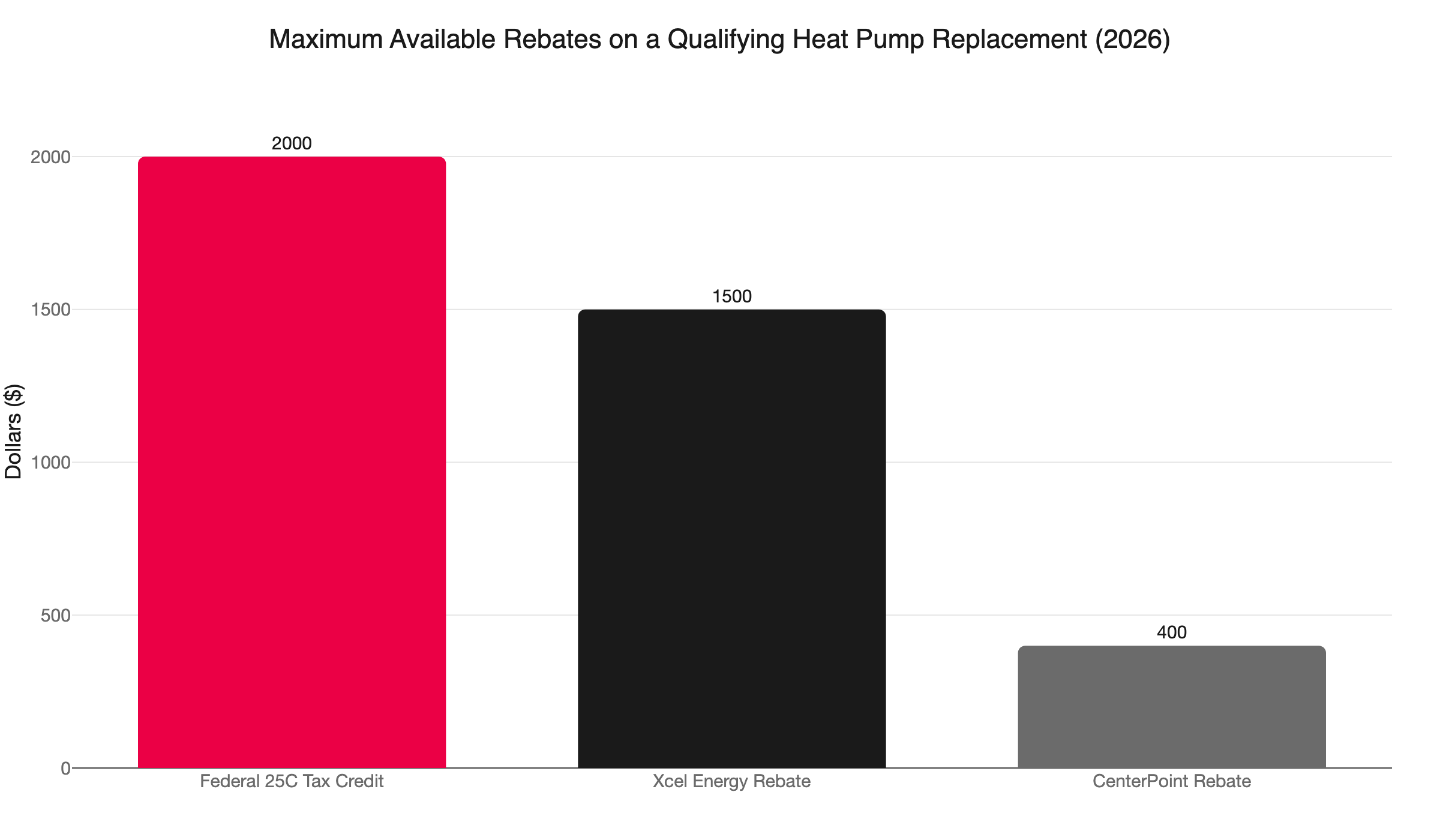
Federal 25C tax credits (current law):
- Qualifying central air conditioner replacement: up to $600 credit
- Qualifying heat pump replacement: up to $2,000 credit
- Annual aggregate cap across all energy-efficiency improvements: $3,200
2026 utility rebates for Twin Cities homeowners:
- Xcel Energy: up to $1,500 on cold-climate heat pumps; $200 to $600 on qualifying high-efficiency central AC. Gas furnace rebates ended as of January 1, 2026. Verify current amounts at xcelenergy.com/rebates before any replacement decision.
- CenterPoint Energy: up to $400 for standard households, or up to $1,200 for income-qualified households, for a 95%+ AFUE furnace installed by a Trade Ally contractor.
A Trade Ally contractor can stack all three programs. A qualifying heat pump replacement that captures every available program can net $3,000 to $5,000 in combined credits and rebates. If the first technician recommended replacement without walking you through any of this, a second opinion may recover real money before you sign a contract.
See our full guides on HVAC rebates for Xcel and CenterPoint customers in Minnesota and IRA tax credits for high-efficiency heating and cooling.
How Do You Ask for an HVAC Second Opinion Without Burning the Relationship?
Say it plainly and professionally. Something like: “I want to be a good decision-maker on something this significant. Can you give me 24 hours to review this and potentially have a colleague confirm your findings?” A reputable technician will not object. Most will respect it.
This is the angle that no Twin Cities competitor page addresses. The mechanics of getting a second opinion are simple. The social friction is what stops homeowners from actually following through, and that friction costs real money.
Here is the reality. Any technician confident in their diagnosis welcomes confirmation. A homeowner who fully understands and agrees with a recommendation completes the work and refers friends. A tech who reacts with pressure or irritation to the script above is signaling that they are counting on urgency to close the sale. That reaction is information.
A few additional questions that open the conversation without accusation:
- “Can I have the written diagnosis with the part numbers before we schedule?”
- “What warranty covers this repair if another technician confirms the diagnosis?”
- “Who is the equipment manufacturer? I’d like to check the warranty status before we go further.”
None of these questions are aggressive. They are what any careful consumer should ask before spending thousands of dollars. You owe the first company a professional conversation. You do not owe them a check before you understand what you are buying.
What Does a Legitimate HVAC Diagnosis Actually Include?
A trustworthy technician shows their work. Here is what a solid diagnostic visit includes:
- Written, itemized estimate. Labor and parts broken out separately. Model numbers of any replacement components listed so you can verify them.
- Physical evidence of the problem. An inspection camera photo, CO analyzer readings, refrigerant measurements on paper, or a combination of these.
- System run time. The technician should have run the equipment and observed it operating. A diagnosis from across the room is not a diagnosis.
- Repair-versus-replace math. If replacement is the recommendation, the tech should walk you through the financial logic, including the 50% Rule or age-times-cost math.
- Permit mentioned proactively. For any full equipment replacement, the permit requirement should come up before the quote is signed.
- Rebate and credit awareness. A Trade Ally contractor knows what programs apply to your situation and will bring them up unprompted.
If the first visit did not include most of this, a second call is not just reasonable. It is responsible home ownership.
Why Our Team Welcomes Second Opinions
Northern One Hour is a locally owned and operated HVAC company based in Ramsey, serving the entire Twin Cities metro from Minneapolis and St. Paul to Maple Grove, Woodbury, Blaine, and beyond. We do not win business by hoping homeowners skip the verification step. We win it by showing our work.
When our technicians diagnose a cracked heat exchanger, we show you the camera image and the combustion analyzer readings. When we service a refrigerant system, we document measured levels before and after, in writing. When we recommend replacement, we walk you through the financial math, the permit requirement, and the rebates and credits available to you before we ask you to sign anything.
If you called another company first and want a second look, call us at (763) 260-6662 or book a visit online. We treat the previous diagnosis with respect, run our own independent assessment, and give you a straight answer. “Always On Time… Or You Don’t Pay a Dime!(R)” is the standard we hold every visit to, including the ones where we are the second set of eyes.
Frequently Asked Questions
When should I get an HVAC second opinion in the Twin Cities? +
What is the $5,000 Rule for HVAC repair vs. replacement? +
Does Minnesota require a permit to replace a furnace or AC? +
How do I ask for a second opinion without offending the first technician? +
Need a technician now?