
IRA HVAC Tax Credits Minnesota: What Most Homeowners Missed
Key Takeaways
- The federal 25C energy-efficient home improvement credit ended December 31, 2025. You cannot claim it for HVAC equipment installed in 2026 or later.
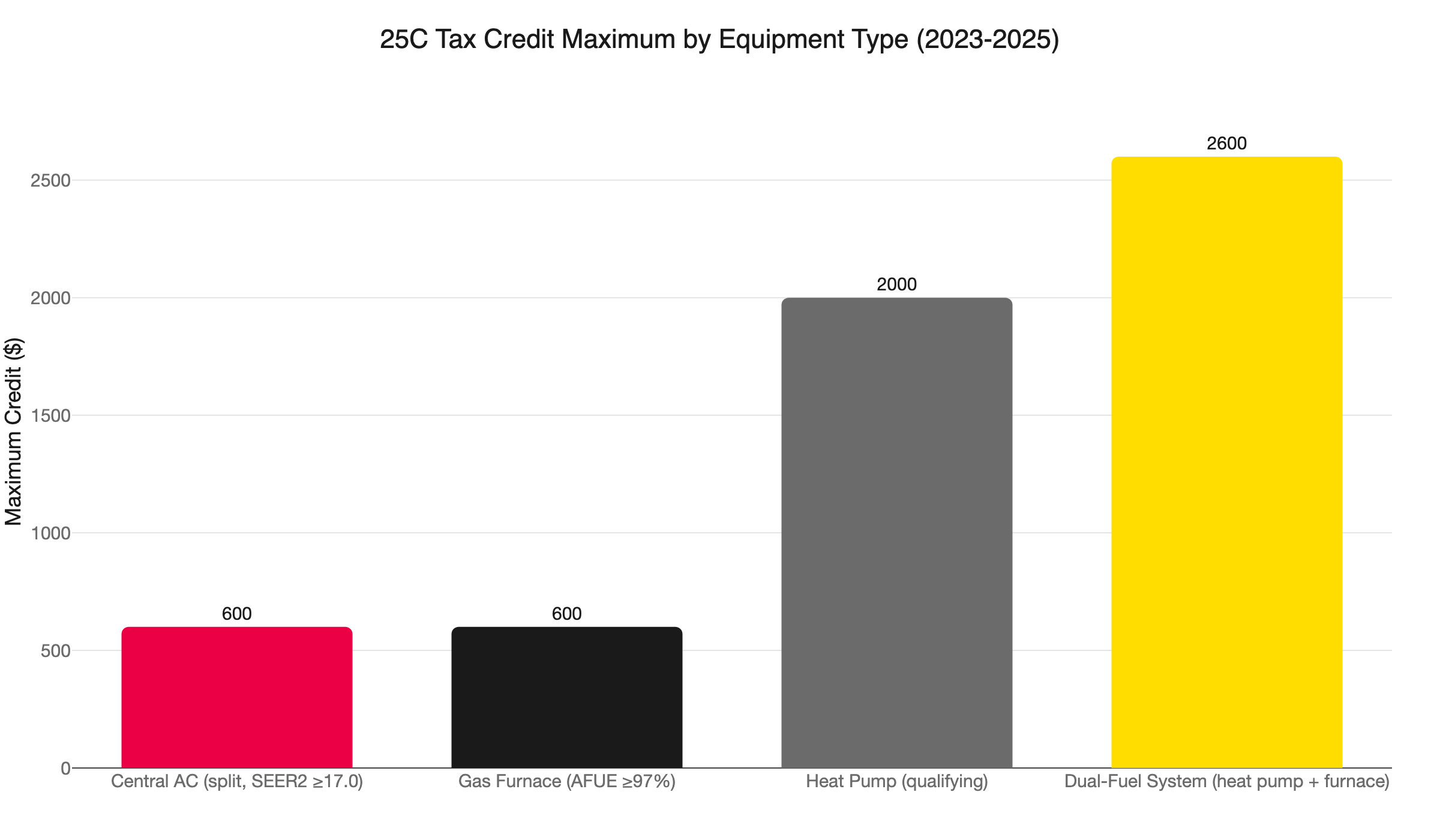
- The credit had two tracks: a $600 cap for furnaces and central ACs, and a separate $2,000 cap for heat pumps. Most homeowners never knew the furnace track existed.
- Gas furnaces required AFUE 97% or higher to qualify. The commonly assumed 95% AFUE threshold did not meet the bar.
- Split-system central ACs required SEER2 17.0 or higher and EER2 12.0 or higher - much higher than standard ENERGY STAR certification.
- Starting with tax year 2025, the IRS required a Qualified Manufacturer Identification Number (QMID) on the return. Many filers never received one from their contractor.
- If you installed a qualifying system in 2025 and didn’t claim the credit, an amended return may still be an option. Talk to a tax professional.
- For 2026 installs in the Twin Cities, the real incentives are CenterPoint Energy rebates for high-efficiency gas furnaces, Xcel Energy rebates for cold-climate heat pumps, and the Minnesota HEAR program for income-qualified households.
The Credit Is Gone for New Installs - But the Confusion Isn’t
Search “IRA HVAC tax credits Minnesota” today and most results claim the 25C credit runs through 2032. That is wrong.
Congress terminated the credit for new installations after December 31, 2025. The legislation was signed July 4, 2025. The IRS page for the Energy Efficient Home Improvement Credit now describes it as available “until 2025.” Energy Star’s central AC page states the credit period ran “January 1, 2023 through December 31, 2025.”
That outdated information has real consequences. Some Minnesota homeowners who replaced a furnace or AC between 2023 and 2025 missed a credit they could have claimed. Others claimed it on equipment that didn’t qualify. A few got the math wrong by leaving labor costs out of the calculation. Still others didn’t know the furnace track existed at all.
This post is for all of those homeowners. If you replaced a system in 2025 and didn’t claim, there may still be a path. If you’re planning a 2026 replacement, the federal credit is gone - but real incentives still exist in Minnesota.
What IRA HVAC Tax Credits Minnesota Homeowners Could Actually Claim
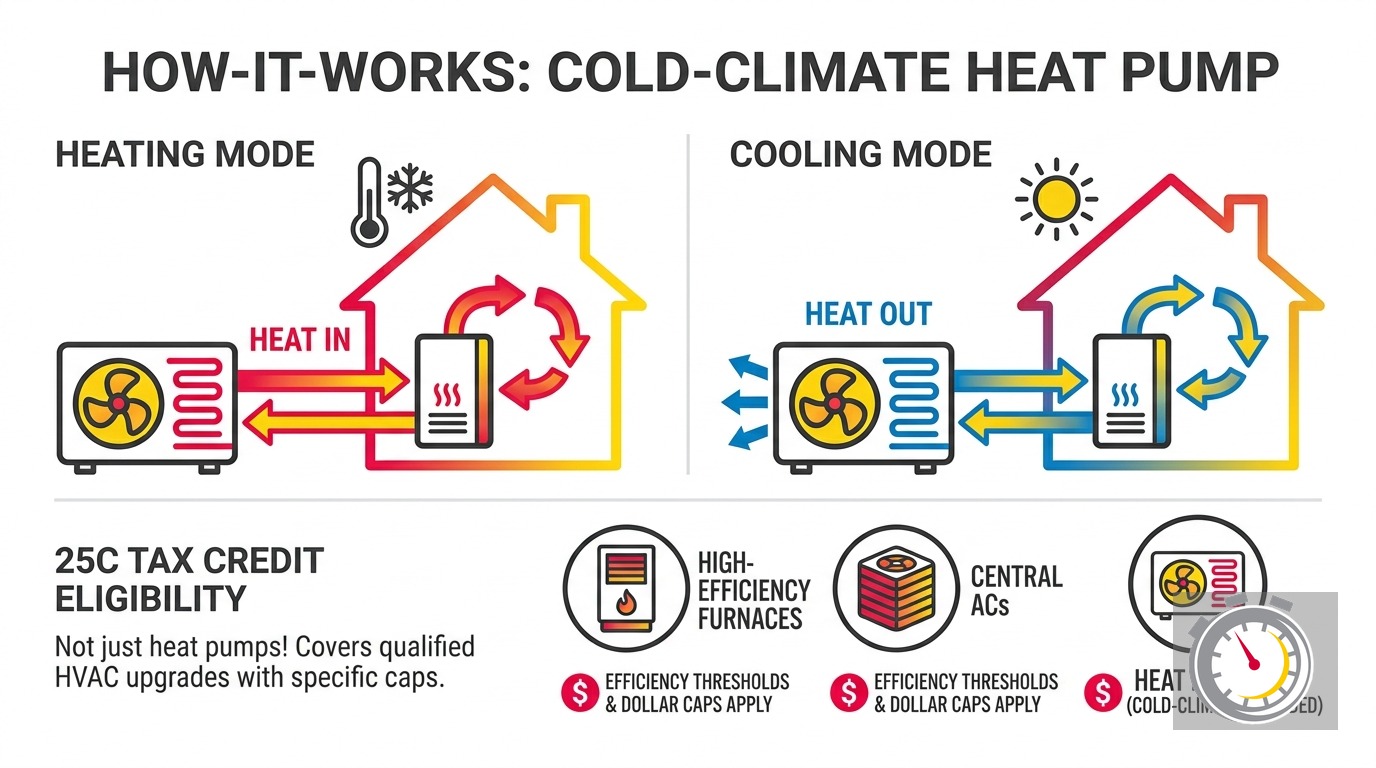
The short answer: The 25C credit covered central air conditioners, gas furnaces, oil furnaces, propane furnaces, and qualifying heat pumps. For HVAC specifically, there were two separate tracks with two separate dollar caps. Most Minnesota homeowners only ever heard about one of them.
Most coverage of IRA HVAC tax credits focused on heat pumps. The heat pump track had a $2,000 annual cap. That figure got the attention.
But there was a parallel track for furnaces and central ACs. The cap was $600 per item. The credit still calculated at 30% of installed cost, including labor. And it applied to equipment many Twin Cities homeowners were already buying for efficiency reasons - not because they knew a credit existed.
That $600 track is what the majority of Minnesota homeowners missed. Contractors didn’t always flag it. Online coverage rarely led with it. Homeowners who replaced a high-efficiency gas furnace or central AC often assumed the credit wasn’t for them - or had no idea it was available.
It was for them, if their equipment hit the thresholds. Those thresholds are where things got complicated.
Were Furnaces and ACs Worth More Than $600 Under the Credit?
The short answer: For a standalone furnace or central AC, the maximum was $600. But a qualifying heat pump installed alongside a qualifying furnace - a dual-fuel or hybrid system - stacked both credits: up to $2,000 for the heat pump plus $600 for the furnace, for a combined $2,600 maximum. Most homeowners and even some contractors didn’t know that combination was possible.
That dual-fuel configuration is especially relevant in the Twin Cities. Minnesota winters regularly reach -15°F to -20°F. A cold-climate heat pump handles most of the heating load in typical conditions. The gas furnace covers the coldest stretches, when temperatures fall below the heat pump’s efficient range.
That system is practical for Minnesota’s climate and, when the 25C credit was active, among the highest-value configurations for tax purposes. The MN ASHP Collaborative documented this stacking possibility explicitly, noting it was a combination most homeowners and contractors were unaware of.
If you installed a qualifying dual-fuel system in 2025 and only claimed the heat pump portion, you may have left $600 on the table for the furnace component.
Why Did Most Furnaces and ACs Not Qualify for IRA HVAC Tax Credits in Minnesota?
The short answer: The efficiency thresholds were much higher than most people assumed. Gas furnaces needed AFUE 97% or higher. Split-system central ACs needed SEER2 17.0 or higher and EER2 12.0 or higher. Standard ENERGY STAR certification doesn’t reach either bar.
This is where most eligible claims were missed - and where ineligible claims were filed by mistake.
For gas furnaces: The IRS required the highest CEE (Consortium for Energy Efficiency) efficiency tier, explicitly excluding any “advanced tier.” Energy Star’s furnace page puts the requirement at AFUE 97% or higher. The furnace that most homeowners and contractors assumed was “high efficiency” - a 95% AFUE unit, common in the market, compliant with standard ENERGY STAR requirements - did not qualify.
A 96% AFUE furnace also did not qualify.
That single percentage point disqualified a large share of furnaces installed between 2023 and 2025. Some homeowners claimed the credit on equipment that fell short. Others skipped it on a 97% unit that genuinely qualified.
If you replaced a furnace between 2023 and 2025, start with one question: what AFUE rating did the installed unit have? Your paperwork or your contractor’s invoice will have it. If the answer is 97% or higher - and the unit carried ENERGY STAR certification from a qualified manufacturer - you likely had a legitimate credit.
For split-system central ACs: Energy Star set the threshold at SEER2 17.0 and EER2 12.0, effective January 1, 2025. Packaged units needed SEER2 16.0 and EER2 11.5. Standard ENERGY STAR AC certification does not reach those numbers. Many high-efficiency central AC units sold and installed in 2024 and 2025 fell short.
If you replaced a central AC in 2024 or 2025, look up the SEER2 and EER2 ratings on the model installed. Your paperwork or the manufacturer’s product sheet has both numbers. If they clear both thresholds, and the unit came from a qualified manufacturer, you may have had a legitimate credit - and possibly still do.
Our guide to AC and furnace replacement costs in the Twin Cities explains efficiency ratings and how they factor into equipment selection if you’re evaluating options now.
What Other Rules Killed Valid Claims - Even With Qualifying Equipment?
The short answer: Three rules tripped up filers whose equipment genuinely qualified. The credit is nonrefundable, so you can’t receive more than your tax liability. There’s no carryforward, so unused credit disappears. And starting in 2025, the IRS required a Qualified Manufacturer Identification Number (QMID) on the return - a step many filers missed entirely.
The nonrefundable cap. The 25C credit reduces what you owe. It does not produce a refund if the credit exceeds your tax bill. If your 2025 federal tax liability was $400 and you qualified for the full $600 furnace credit, you captured $400 of it. The remaining $200 was gone. No carryforward to 2026.
The IRS page is explicit on both points. Homeowners who assumed unused credit would roll forward were mistaken. So were those who expected a larger refund.
The QMID requirement. Starting with tax year 2025, the IRS required homeowners to report a Qualified Manufacturer Identification Number on their return. Manufacturers were supposed to supply this number at point of sale. In practice, many homeowners never received it, and many contractors didn’t know it was required.
Without a QMID on the return, the 25C claim is incomplete - even when the equipment fully qualifies.
The MN ASHP Collaborative flagged this requirement in detail. If you filed for a 2025 installation without a QMID, review the situation with a tax professional before the amendment window closes.
One note on labor. The 30% calculation applied to total installed cost, including labor. If you estimated the credit on equipment cost alone, you may have underclaimed on a return that was otherwise valid.
If You Installed in 2025 and Didn’t Claim, Is It Too Late?
The short answer: Not necessarily. If you filed your 2025 return with an extension, you may still be within the original window. If you already filed, IRS Form 1040-X allows an amendment - generally available within three years of the original filing deadline. A tax professional can tell you whether the credit is worth pursuing for your specific situation.
This applies to homeowners who:
- Installed a qualifying furnace (AFUE 97% or higher) or central AC (SEER2 17.0 or higher and EER2 12.0 or higher) between January 1 and December 31, 2025.
- Did not claim the 25C credit on their 2025 return, or claimed it on equipment that didn’t qualify.
- Have enough federal tax liability to benefit from a nonrefundable credit.
The math: 30% of total installed cost (including labor), capped at $600 for a qualifying furnace or central AC. For a qualifying heat pump installed in 2025, the cap was $2,000. For a qualifying dual-fuel system, up to $2,600 combined.
None of this applies to a 2026 installation. The credit ended December 31, 2025.
To check your 2025 equipment, start with the model number. Look up the AFUE or SEER2 and EER2 specifications. Then ask your contractor whether the manufacturer was on the IRS qualified manufacturer list.
What IRA HVAC Tax Credits Are Available in Minnesota Right Now?
The short answer: None at the federal level. The 25C credit ended December 31, 2025, and no federal replacement has been enacted. But for 2026 installs in the Twin Cities, three meaningful incentive categories remain: CenterPoint Energy rebates for high-efficiency gas furnaces, Xcel Energy rebates for qualifying cold-climate heat pumps, and the Minnesota HEAR program for income-qualified households.
The framing matters. Searching for IRA HVAC tax credits in Minnesota in 2026 returns mostly outdated results. The federal credit is gone. But incentives exist through utility and state channels - they just require different paperwork and different equipment decisions.
CenterPoint Energy rebates. CenterPoint is the dominant natural gas provider in the Twin Cities metro. For 2026, CenterPoint offers rebates for qualifying high-efficiency gas furnaces. Standard rebates run approximately $400 for 95% AFUE or higher equipment. Income-qualified households may qualify for more. A dual-fuel system using a qualifying backup furnace may qualify under a separate tier.
Confirm current amounts directly with CenterPoint before planning around any specific figure. Rebate programs can change.
Xcel Energy rebates. Xcel is the dominant electric provider in the metro. As of January 1, 2026, Xcel discontinued rebates for gas furnaces and boilers. A straight gas furnace replacement no longer qualifies for any Xcel rebate. But Xcel continues to offer rebates up to $2,000 for qualifying cold-climate heat pumps in Minnesota.
Most Twin Cities homeowners have both CenterPoint gas service and Xcel electric service. A qualifying dual-fuel system captures rebates from both utilities. That’s one heat pump and one qualifying gas furnace - two rebate programs on a single install.
Our post on current Xcel and CenterPoint rebates for Minnesota homeowners covers how these programs work and what questions to ask before you commit to equipment.
Minnesota HEAR program. The Home Electrification and Appliance Rebate program is Minnesota’s income-qualified electrification incentive. It’s administered by the Department of Commerce at mn.gov/commerce. Households below 80% of Area Median Income may qualify for up to 100% of project costs. Households between 80% and 150% AMI may qualify for 50%. HEAR is specifically for electrification - not gas-only replacements.
Confirm current eligibility and amounts with the Department of Commerce before counting on HEAR coverage in your planning.
Should You Consider a Heat Pump Instead of a Gas Furnace in the Twin Cities?
The short answer: The 2026 rebate picture favors dual-fuel over a straight gas replacement. Xcel no longer rebates gas-only furnace installs. A qualifying cold-climate heat pump paired with a qualifying gas backup furnace can stack rebates from both Xcel and CenterPoint - and delivers real efficiency gains in milder weather.
Minnesota’s Climate Zone 6-7 conditions make equipment selection critical. A heat pump must be rated for cold-climate operation at -15°F to -20°F. Units that aren’t rated for those temperatures fall back to the gas furnace more often, reducing the efficiency benefit you’re paying for.
Our post on cold-climate heat pump performance in Minnesota covers how to evaluate cold-weather ratings for specific models and what to prioritize in this market.
Our post on dual-fuel heat pump and gas furnace hybrid systems covers how these systems operate, when they make financial sense for a Twin Cities home, and what the installation involves.
For homeowners weighing the decision: a qualified local HVAC contractor can run the numbers on operating costs, available rebates, and what your existing ductwork and electrical service can support before you commit to a direction.
Talk to Northern One Hour Before Your Next HVAC Purchase
Whether you’re working backward on a missed 2025 credit or planning a 2026 replacement, the next step is the same. Get the right information before you buy.
The 25C credit had thresholds that disqualified most equipment - including equipment contractors and homeowners assumed was eligible. The 2026 incentive landscape has shifted toward electrification. Dual-fuel systems in dual-utility households have real stacking opportunities that a gas-only replacement can’t match.
As a locally owned and operated Twin Cities HVAC company, we know how these rebate programs work in this market. We know the efficiency thresholds that trigger CenterPoint rebates, the cold-climate ratings Xcel accepts, and which equipment configurations let you stack both. We’re not going to recommend a furnace that falls one percentage point short of a rebate you could have captured.
If the project involves a larger system investment, we can also walk you through financing options that make higher-efficiency equipment more accessible upfront - especially when rebate checks take weeks to arrive.
Our promise is “Always On Time… Or You Don’t Pay a Dime!(R)” That applies to every service call. It also applies to giving you a straight answer about what incentives are real and what is outdated information.
Call us at (763) 260-6662 or book online to talk through your options before your next HVAC purchase.
Frequently Asked Questions
Can I still claim the 25C credit for a furnace I installed in 2025? +
What AFUE rating does a gas furnace need to qualify for the 25C tax credit? +
Are there still HVAC rebates available in Minnesota in 2026? +
What is the QMID requirement for the 25C tax credit? +
Need a technician now?