
How to Compare HVAC Quotes: 3 Questions Before You Sign
Key Takeaways
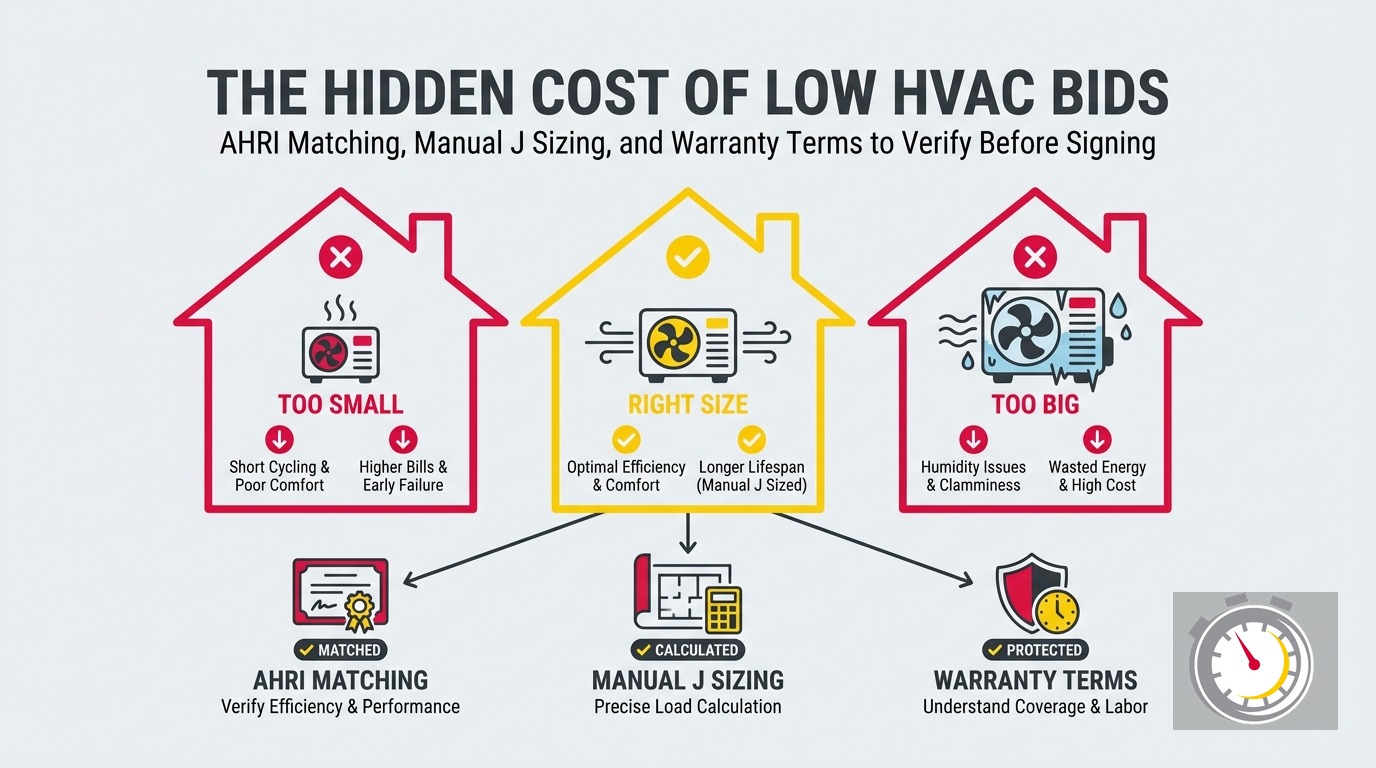
- A quote without a Manual J load calculation may be quoting the wrong equipment size entirely. Wrong size means comfort problems from day one.
- AHRI certification confirms the outdoor unit and indoor components were tested as a matched pair. Without it, the efficiency rating on the quote may not apply to your installed system.
- “We stand behind our work” is not a labor warranty. Ask for specific years and covered repairs in writing.
- Non-ENERGY STAR equipment disqualifies you from utility rebates worth $300 to $2,000 or more. That gap does not appear on any quote.
- Minnesota requires a mechanical permit for HVAC replacement. A contractor who offers to skip it transfers real liability to you.
- The cheapest bid on paper is sometimes the most expensive bid over the life of the equipment.
You Have Three Quotes. Here Is How to Compare HVAC Quotes the Right Way.
You called three contractors. You have three numbers on the kitchen table. The lowest bid is $1,200 less than the next one and nearly $2,000 below the highest.
The temptation is to call the higher bidders and ask them to match it. Before you do that, ask three specific questions. The answers will tell you whether the quotes are actually comparing the same job, the same equipment, and the same protection after the job is done.
Most general home-advice sites tell you to get multiple quotes, check reviews, and choose a licensed contractor. All of that is correct. But it stops short of the technical questions that separate a complete bid from a low one.
The gap between a good bid and a low bid is almost never about markup. It is almost always about what the low bid left out: a sizing calculation, a component specification, or a warranty term that does not appear on the price sheet.
Here are the three questions to ask, what a good answer sounds like, and what a bad answer tells you.
Did the Contractor Do a Manual J Load Calculation?
The short answer: Manual J is the engineering calculation that determines how much heating and cooling your home actually needs. Without one, the contractor may be quoting the wrong size entirely. A wrong-sized system causes comfort and efficiency problems that cannot be fixed without replacing the equipment.
The ACCA Manual J 8th Edition is the national ANSI-recognized standard for residential load calculations. National building codes and most state and local jurisdictions require it before any HVAC installation.
A proper Manual J accounts for your home’s square footage, ceiling height, insulation levels in the walls and attic, window area and orientation, air sealing quality, and local climate design temperatures.
That last factor matters more in the Twin Cities than most places. This region sits in ASHRAE Climate Zone 6A. The design heating temperature is -16°F. The design cooling temperature is 91°F dry bulb. Your system needs to handle both extremes reliably, season after season.
When a contractor skips the Manual J, they typically do one of two things. They size the replacement to match the existing system, assuming whoever installed it the first time was right. Or they use square footage rules of thumb that ignore insulation, air sealing, and window load.
Both approaches may miss the actual load. Older systems in the Twin Cities were oversized more often than not. A like-for-like swap can lock in the same problem.
There is another angle to consider. The home you live in today may be different from the home the original system was sized for. Renovations, added insulation, replaced windows, or a finished basement all change the load. A Manual J on the current home reflects those changes. A like-for-like swap does not.
What a bad answer sounds like: “We’ll match your current system.” Or: “We’ve done hundreds of homes this size, we know what they need.”
What a good answer sounds like: “Here’s the Manual J output. Your home calculates to X tons for cooling and Y BTU for heating.”
If a contractor cannot produce a Manual J, their quote may be for the wrong equipment. The price they gave you is not directly comparable to a quote based on an actual sizing calculation.
For more on why right-sizing matters across all seasons, see our guide on HVAC sizing and the Manual J calculation.
What Happens When a System Is Oversized?
The short answer: An oversized AC short-cycles. It hits the temperature setpoint quickly and shuts off before removing enough humidity. In Minnesota’s July, a house can read 72°F on the thermostat and still feel clammy and uncomfortable all day.
The Twin Cities has July and August dew points that regularly hit 65 to 70°F. That range is among the highest in the continental United States outside the Gulf Coast.
Humidity removal requires the AC to run in longer, sustained cycles. An oversized system does not do that. It satisfies the temperature call fast, then shuts off. The moisture stays in the air. The discomfort stays.
Many homeowners assume the system is undersized when this happens. They push the setpoint lower. The system short-cycles even harder. The comfort problem gets worse, not better.
An oversized furnace causes a parallel problem in winter. Short-cycles stress the heat exchanger and reduce real-world efficiency. You can pay for a 97% AFUE furnace and not see it in your utility bills. Short-cycling prevents the furnace from completing a full combustion run, which is when most of that efficiency is captured.
Both problems are invisible during the quote comparison phase. They show up in the first full season.
This is why the Manual J is not a bureaucratic formality. It is the calculation that ties the equipment to your actual home.
Is This an AHRI-Certified Matched System?
The short answer: AHRI certification means the outdoor unit and indoor components were tested as a pair. They meet the stated efficiency rating together. A mismatched system may deliver 13 to 14 SEER2 even though the quote specifies 16. You pay the premium price and receive lower-tier performance.
The Air-Conditioning, Heating, and Refrigeration Institute runs third-party certification testing for HVAC equipment. SEER2, EER2, and HSPF2 ratings apply to specific tested combinations. Not to individual components. One outdoor unit paired with one specific air handler or coil at a defined airflow rate.
Low bids often achieve their price by mixing brands or substituting a “compatible” coil. The substitute coil may fit physically and operate without fault codes. But the installed efficiency is no longer certified. The 16 SEER2 rating belongs to the tested pair, not to the outdoor unit alone.
Over a 15- to 20-year equipment life, the difference between a certified 16 SEER2 and an actual 13 SEER2 adds up across every single cooling season.
There is a warranty angle as well. Manufacturer warranty terms often require that the installed equipment matches the certified combination. A mismatched system may void or limit the parts warranty on top of delivering lower performance. A low bid that installs mismatched components may cost you twice: once in operating efficiency and once when a warranty claim is denied.
How to verify: The AHRI Directory at ahridirectory.org is a free public tool. A legitimate contractor should be able to give you the AHRI certificate number for the exact equipment combination on the quote. Enter it yourself to confirm.
What a bad answer sounds like: “It’s compatible equipment, it will work fine together.”
What a good answer sounds like: “Here’s the AHRI certificate number. Look it up at ahridirectory.org.”
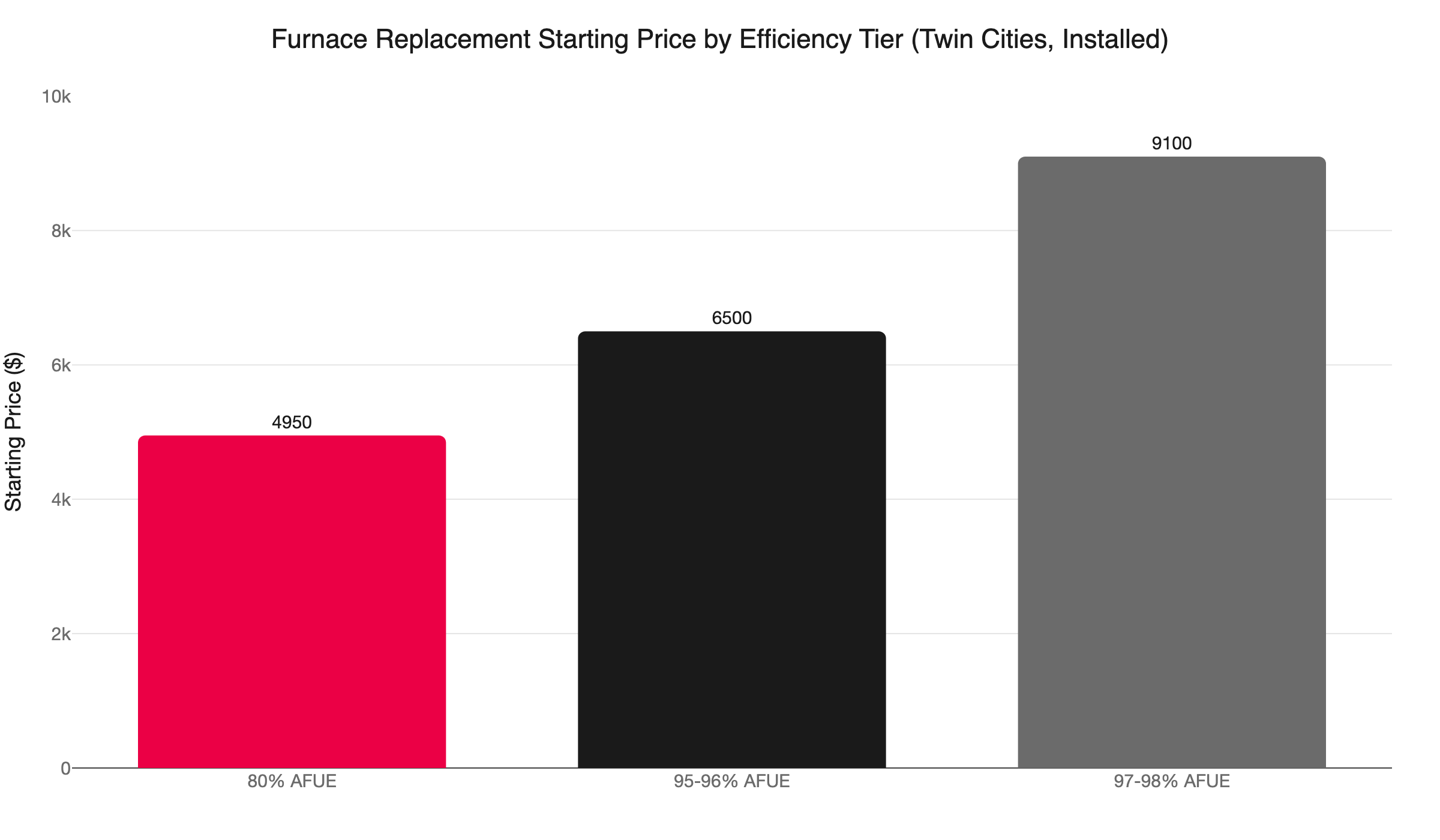
A note on equipment tiers and pricing: the price difference between efficiency levels is real and intentional. Installed furnace replacements in the Twin Cities start around $4,950 for an 80% AFUE system, $6,500 for a 95-96% AFUE, and $9,100 for a 97-98% AFUE. If a quote comes in well below those starting ranges, ask exactly which efficiency tier is on the proposal and whether the components are AHRI-certified as a matched set.
What Does the Labor Warranty Actually Cover?
The short answer: Equipment warranties cover parts. They do not cover the labor to install a replacement part. Get the labor warranty terms in writing: coverage years, what is included, and how to file a claim. “We stand behind our work” is not a warranty. It is a phrase that costs the contractor nothing.
Most manufacturers offer a 5- to 10-year parts warranty on registered equipment. That covers the component. It does not cover the technician who shows up to install the replacement.
After the installation warranty expires, a repair visit can run from a few hundred dollars for a simple component swap to over $1,000 for a more involved repair. After-hours emergency calls add $180 to $270 per hour on top of standard rates.
A low bid that comes with no written labor warranty transfers all of that repair exposure to you after year one. The $1,200 you saved on the front end can disappear quickly on the first uncovered repair.
What a bad answer sounds like: “We stand behind our work. Just call us if anything comes up.” No written document behind it.
What a good answer sounds like: A written warranty document that specifies the coverage period, which repairs are included, which are excluded, and how to make a claim.
Ask for that document before you sign. If a contractor does not have one, factor what that unprotected repair exposure looks like over a five-year window. Then compare that number to the gap in the bids.
Will This Equipment Qualify for Rebates?
The short answer: A contractor who quotes non-ENERGY STAR equipment disqualifies you from utility rebates. Those rebates do not appear on any quote. But they can reduce the effective cost of the qualifying system by $300 to $2,000 or more, depending on equipment type and your utility provider.
The ENERGY STAR Rebate Finder is a free public tool. Enter your Twin Cities zip code and it will show current rebates available for qualifying heat pumps, central AC, and furnaces through Xcel Energy, CenterPoint, and other local utilities.
Current rebate amounts change seasonally. Verify the current figures directly at xcelenergy.com and centerpointenergy.com before finalizing your comparison. Those dollars belong in the side-by-side calculation, not in a footnote.
A note on the federal tax credit:
The 25C Energy Efficient Home Improvement Credit covered qualifying HVAC equipment installed January 1, 2023 through December 31, 2025. For eligible heat pumps, the credit was up to $2,000 per year. For other qualifying efficiency improvements, it was up to $1,200 per year. The IRS Energy Efficient Home Improvement Credit page covers the full criteria and eligible property types.
For 2026 installations, the credit has lapsed under current IRS guidance. Confirm with a tax professional whether Congress has extended it for your installation date. Do not count it in your budget until you have that confirmation from a qualified source.
For a detailed look at stacking federal, state, and utility incentives, see our post on IRA tax credits for high-efficiency HVAC in Minnesota.
Did the Contractor Pull a Permit?
The short answer: HVAC replacement requires a mechanical permit in Minnesota. A contractor who offers to skip it is reducing the bid by transferring risk to you. No permit means no inspection. An uninspected installation can void manufacturer warranties and create disclosure problems at resale.
The Minnesota Department of Labor and Industry governs mechanical licensing and permits in the state. A permitted installation is inspected by a licensed inspector who verifies the work meets code.
That inspection protects you in two concrete ways.
First, it catches installation errors before they run silently for years. A combustion air issue, an improper vent connection, or a condensate drain problem that goes uninspected can create a carbon monoxide risk or persistent efficiency losses. The inspection catches that before the system runs its first full heating or cooling season.
Second, Minnesota has real estate disclosure requirements. An unpermitted installation that surfaces during a home sale can delay or complicate the transaction. The upfront savings from skipping the permit are a small fraction of the potential cost if it surfaces at closing.
Northern One Hour always pulls a permit on every installation. It is part of doing the job correctly, not a line item we offer to remove for a lower price.
For more on the permit process and what it covers, see our guide on when an HVAC permit is required in Minnesota.
How to Compare HVAC Quotes: Putting the Three Questions Together
You now have a fourth column in your comparison. It is not a price. It is the answers to three specific questions.
- Did the contractor do a Manual J? Can they show you the output?
- Is this an AHRI-certified matched system? Can they provide the certificate number?
- What does the labor warranty cover? Is it documented in writing?
A contractor who can answer all three with supporting documentation is quoting a complete job. One who cannot may be quoting a lower price for a less complete installation.
It is fair to go back to a contractor with these questions after the first meeting. A contractor who is quoting a complete job will not be thrown by them. One who gives vague answers or changes the subject was probably leaving out the details that make those questions relevant.
The $1,200 gap between bids is worth examining. Sometimes it reflects genuinely lower overhead. More often it reflects one of the three omissions covered here: no Manual J, mismatched components that will not deliver rated efficiency, or no labor warranty after year one.
The cheapest bid on paper is sometimes the most expensive bid over the life of the equipment.
For a broader look at the warning signs to watch across the entire contractor selection process, read our post on HVAC contractor red flags in the Twin Cities.
Ready to Walk Through Your Quotes?
Northern One Hour is locally owned and operated in Ramsey, Minnesota. We serve homeowners across the Twin Cities, including Minneapolis, St. Paul, Maple Grove, Blaine, Plymouth, Brooklyn Park, Woodbury, and Bloomington.
When we quote a job, we run a Manual J. We spec AHRI-certified matched systems. We pull permits on every installation. And we back our work with written labor warranties.
Our guarantee means exactly what it says: “Always On Time… Or You Don’t Pay a Dime!(R).” It applies to the quote visit and every service call after.
Call us at (763) 260-6662 or book online to schedule a quote. We will show you the Manual J output, the AHRI certificate number, and the warranty terms before you sign anything.
Frequently Asked Questions
What is Manual J and why does it matter for my HVAC quote? +
How do I check if an HVAC system is AHRI certified? +
Does Minnesota require a permit for HVAC replacement? +
Is the federal HVAC tax credit available in 2026? +
Need a technician now?