
How to Prepare for HVAC Service Appointment: Checklist
Key Takeaways
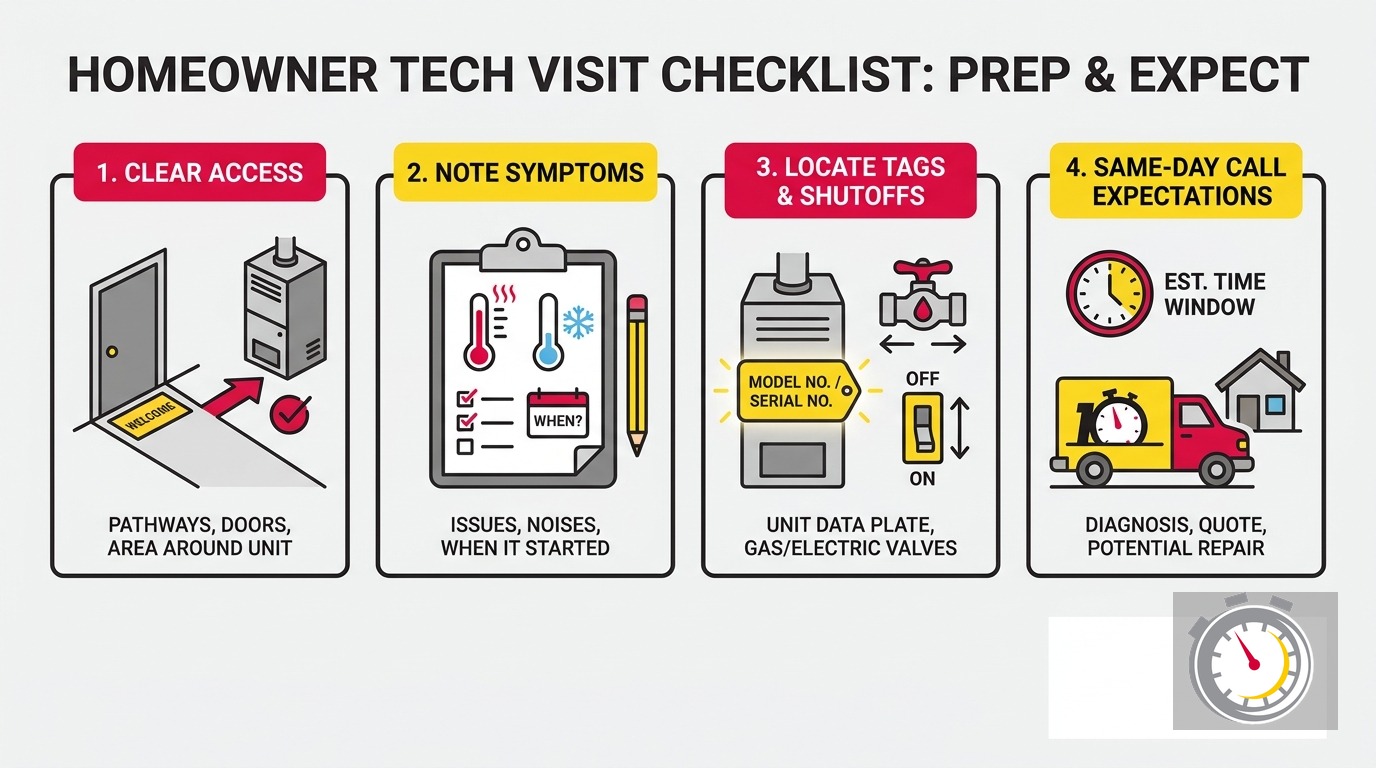
- Clear a path to the furnace, air handler, and outdoor unit before the visit.
- Write down symptoms, sounds, smells, and when they happen. Problems often stop on cue when the technician walks in.
- Photograph the model and serial tag so we can look up parts before we arrive.
- Locate your furnace switch, breaker, and gas shutoff. Do not use them unless told to.
- If you smell gas, leave on foot and call from outside. Do not wait for your appointment.
- Answer confirmation texts and calls on visit day.
- Some repairs need a part we do not carry on the truck. A second visit is sometimes part of the job.
- Our promise is simple: “Always On Time… Or You Don’t Pay a Dime!(R)” We arrive within the window you pick, or you do not pay for the service.
The Short Answer
Preparing for an HVAC visit takes about 15 minutes. Clear a path to the equipment. Write down what you have noticed. Photograph the model tag. Find your furnace switch, breaker, and gas shutoff, but do not operate them. Then keep your phone nearby.
The payoff is real. The technician spends the visit fixing your system, not hunting for it.
We are Northern One Hour Heating & Air Conditioning, a locally owned and operated Twin Cities company. Every winter we see the same few prep gaps, and this guide covers them.
When Should You Get Your HVAC Serviced?
Service your cooling system in spring and your heating system in fall. ENERGY STAR recommends this timing, with a contractor handling the annual check-up. Repairs are different. Book those the day a problem shows up.
In the Twin Cities, the fall visit matters most. A furnace that sat idle all summer can fail on the first cold night, when every heating company in town is busy at once.
Here is a simple calendar:
- September or October: Heating check-up before the first hard freeze.
- April or May: Cooling check-up before the first humid stretch.
- Every month: Check your filter. ENERGY STAR lists this as the one monthly homeowner task.
- Any time: Call for repair when something sounds, smells, or acts wrong.
The ENERGY STAR checklist spells out what a contractor covers in these visits: electrical connections, the condensate drain, gas connections, and the burner and heat exchanger. You cannot safely check most of that yourself.
Want to know what a tune-up includes? Our furnace tune-up service page lays it out. If your system is already acting up, our furnace repair team can help.
How Do You Clear Access for the Technician?
Give the technician a clear path from your front door to every piece of equipment. Move storage, laundry, and boxes away from the furnace. Trim plants around the outdoor unit. Confine pets. Make sure your house number is visible from the street.
Those basics are standard advice. One major equipment maker suggests trimming vegetation about two feet back from outdoor units. It also recommends confining pets and keeping your house number visible.
Here is what we add for Minnesota homes.
Indoors
- Clear at least a few feet of floor space around the furnace or boiler.
- Move shelves, paint cans, and holiday bins. Never store flammables near a furnace.
- Clear the path through the basement or utility room, including stairs.
- Check the lighting. A dead bulb over a furnace slows the visit.
- If your unit is in an attic or crawl space, clear the way and tell us about tight access.
Outdoors
- Shovel a path to the outdoor unit if you have an air conditioner or heat pump.
- Clear snow and ice from your furnace’s outdoor air intake and exhaust pipes, if you have a high-efficiency model.
- Clear snow around the gas meter.
- Salt or sand the walkway. Technicians carry tools and parts up icy steps.
A caution on that last group. We could not tie the intake and meter advice to a utility source, so treat it as our field experience. It is not a rule. It costs you five minutes with a shovel. For more, see our posts on a blocked high-efficiency furnace exhaust vent and heat pump snow clearance.
Pets and kids
Dogs often bark at strangers and block basement stairs. Put pets in a closed room before the technician arrives. If a pet cannot be confined, tell us and we will plan around it.
Your phone
Another manufacturer advises answering technician confirmation texts. It also suggests turning off “Silence Unknown Callers” on visit day. We agree. Our dispatcher may call from a number you do not recognize when your technician is nearby.
What Symptoms Should You Write Down?
Write down what you see, hear, and smell, plus when it happens. Note the time of day, the outdoor temperature, and whether it happens at startup or mid-cycle. Noises and smells often vanish before the technician arrives. Your notes tell us what to look for.
You do not need technical words. Plain language works best. “A loud bang right after the furnace starts” tells us more than a guess at the cause.
Use this list as a starting point:
- What is wrong? No heat, weak heat, no cooling, uneven rooms, or high bills.
- What do you hear? Banging, squealing, humming, clicking, or rattling.
- What do you smell? Burning dust, hot metal, a musty odor, or anything like rotten eggs.
- What do you see? Water, ice, frost, error lights, or a blank thermostat.
- When does it happen? Morning, night, only on very cold days, or only after a cycle runs a while.
- How long has it been going on? One day, one week, or all season.
- What changed? A new filter, a storm, a power flicker, or a recent repair.
If you can, take a short video with your phone. A 20-second clip of the noise helps a lot.
If you see a blinking light on your furnace, count the flashes and write down the pattern. Our furnace error code guide explains what many patterns mean.
Have your history ready
Gather what you can find:
- Past service invoices
- Warranty paperwork
- The date of the last filter change
- The install date, if you know it
Not sure how old your system is? Our guide on finding your HVAC system’s age can help.
Check the filter
A dirty filter causes many service calls. ENERGY STAR says airflow problems can reduce your system’s efficiency by up to 15 percent. Look at your filter before we arrive. If it is clogged, replace it and tell us.
How often should you change it? One manufacturer advises about every three months, and more often with pets. Our filter change guide covers Minnesota homes in more detail.
Check your registers too. The same manufacturer warns that closing more than 20% of registers can strain the system. Open any you closed. We cover this in our post on closing vents in unused rooms.
Where Do You Find the Model and Serial Tag?
Look for a silver or white label on the equipment. On a furnace, it sits on the inside of the cabinet door or on the side panel. On an outdoor unit, it is on the side of the cabinet. Take a clear photo of each tag with your phone.
Most prep guides miss this. Some tell you to “note the model number” without saying where it lives. Here is the plain version.
Furnace or boiler
- Open the front panel. Most pop off or lift up. Do not remove anything held by screws unless you are comfortable doing so.
- Look on the inside of the door and on the inner wall.
- You may see two labels. One is the equipment tag. The other is a wiring diagram.
- If you cannot find the tag, look for a smaller sticker on the outer cabinet.
Outdoor air conditioner or heat pump
- Walk to the unit and look at the side panel near the electrical connection.
- The tag is often near the ground or the service valves.
- In winter, brush off snow and frost first.
Air handler or coil
- Look on the access panel or the cabinet side.
- Attic units can be hard to reach. Do not climb into tight spaces alone.
What to photograph
- The whole tag, in focus, with no glare
- The model number
- The serial number
- Any date printed on the tag
Turn on your flash if the light is poor. Take a second photo from farther back so we can see which unit it is.
Why bother? The model number lets us look up the right parts and specs before we arrive, which can cut down on second visits. The serial number often helps date the system and check its warranty.
Skip the photo if the panel is hot or the unit is running and you are unsure. Never reach into a running furnace. A photo of the outside label is enough to start.
What Should You Locate but Never Touch?
Find your furnace power switch, your electrical breaker, your gas shutoff valve, and your thermostat. Know where each one is. Do not operate them on your own unless a technician or utility tells you to. Knowing their locations saves time, especially in an emergency.
Think of this as “locate-only.” You are learning where things are, nothing more.
1. The furnace power switch
Most furnaces have a switch that looks like a light switch. It is often on the furnace or on a nearby wall or joist. Find it, and do not flip it unless we ask. For furnace trouble, our furnace not turning on guide lists safe checks.
2. The breaker
Find the panel and the breaker that feeds your furnace and your air conditioner. Look for a label. If it is missing, tell us. Do not keep resetting a tripping breaker. One that keeps tripping is a warning sign. See our post on why an AC keeps tripping the breaker.
3. The gas shutoff
Find the valve on the gas line near your furnace. It usually has a handle. Know where it is, but do not turn it. Our gas shutoff location guide shows what to look for.
This is the valve at the appliance. The gas meter is separate, and you should not operate it. If you smell gas, leave and call. Do not fiddle with valves.
4. The condensate drain and pump
High-efficiency furnaces and air conditioners make water. That water leaves through a drain line or a small pump. Know where yours ends. If you see water on the floor, take a photo and do not guess at the cause. Our guides on a clogged AC condensate drain and a furnace water leak explain what we look for.
5. The thermostat
Know what kind you have. Note whether the screen is on, blank, or showing a message. Write down your current settings and photograph the screen. If it is blank, see our blank thermostat guide.
What If You Smell Gas or Your CO Alarm Sounds?
If you smell gas, leave right away and call from outside. Do not flip switches, use a phone inside, or start a car. Then call your gas utility and 911 from a safe distance. If a carbon monoxide alarm sounds, get everyone outside and call 911.
Do not wait for your appointment. This section matters more than any other.
Gas smell
CenterPoint Energy says to “Leave immediately on foot!” It says to avoid electric switches, phones (including cell phones), and starting a car. Then contact CenterPoint at 888-876-5786 and call 911 from a safe distance. It also says not to try to repair the leak yourself.
Follow these steps in order:
- Leave the home on foot. Take everyone, including pets, if you can do so quickly.
- Do not touch light switches, garage door openers, or appliances.
- Do not use your phone until you are outside and away from the house.
- Call your gas utility and 911 from a safe distance.
- Stay out until you are cleared to go back in.
If your utility is not CenterPoint, use the emergency number on your gas bill. Keep it in your phone now. Our guide on what to do if you smell gas near your furnace goes further.
Carbon monoxide
Carbon monoxide is a colorless, odorless gas. A working alarm is your only warning.
Minnesota law, Minn. Stat. 299F.51, calls for an “approved and operational carbon monoxide alarm installed within ten feet of each room” lawfully used for sleeping. It also says “No person shall remove batteries from, or in any way render inoperable, a required carbon monoxide alarm.”
Before any visit, do a quick check:
- Press the test button on each alarm.
- Replace dead batteries or expired units now.
- If an alarm is chirping, replace the battery. Do not remove it.
- Check that an alarm sits near each sleeping area.
If an alarm sounds, go outside first and call 911. Do not stop to open windows or find the cause. See our guides on CO detector placement and furnace season CO safety.
What Happens on a Same-Day No-Heat Call?
On a same-day no-heat call, a dispatcher asks about your symptoms and your safety. Then they schedule a window. The technician diagnoses the problem, explains your options, and fixes it when parts allow. Some jobs need a part from a supplier, which can mean a second visit.
A no-heat call in a Minnesota winter feels urgent because it is. Here is how the day usually goes.
Step 1: The call
The dispatcher will ask a few things:
- Is the home safe? Any gas smell or CO alarm?
- What is the furnace doing? Silent, running without heat, or cycling?
- What is the indoor temperature right now?
- Is anyone in the home elderly, very young, or medically fragile?
- Do you have the model information handy?
This is where your notes pay off. Clear answers help us send the right technician with the right parts.
Step 2: The appointment window
You pick a time window, and our promise is tied to it. We arrive within the window you select. If the technician does not show up on time, you do not pay for the service. Our post on why on-time service matters explains why we built the company around it.
Same-day slots depend on the schedule. During a cold snap, they fill fast. Call early in the day when you can.
After-hours or emergency visits can carry a premium. For us, that is typically $180 to $270 per hour on top of standard rates. Ask about it when you call.
Step 3: Arrival
The technician greets you and asks what you noticed. Then they head to the equipment. They will check:
- Power and thermostat settings
- The filter and airflow
- The ignition and safety components
- Gas, vent, and drain connections, as the problem points
Stay nearby, but give them room to work. Answer questions and mention anything you noted.
Step 4: Diagnosis and options
Next comes the explanation. A good technician tells you what failed, why, and what the options are. Ask for the price before the work begins. Ask what is repair and what is optional.
For common repairs, see our furnace repair cost guide. For bigger decisions, our post on repair or replace can help.
Step 5: Repair, or a second visit
Many repairs finish in one visit. Some do not. One manufacturer notes that some parts may require a supply run or a second visit. The other manufacturer says the same. That is true here too.
If a part is not on the truck, we will tell you. Ask what to do in the meantime, and how to stay safe and warm. If the home is too cold to wait, say so. Our furnace-out emergency steps cover how to protect your home and family overnight.
A routine maintenance visit is shorter. The same manufacturer says visits run about 1 to 2 hours. Plan for that, and expect the technician to walk through the whole system.
Step 6: Wrap-up
Before the technician leaves, ask:
- What did you find and fix?
- Is anything else likely to fail soon?
- What should I watch for in the next few days?
- Do I get a written summary?
Keep that summary with your records. It helps with warranty claims and a future sale. See our post on keeping HVAC records.
Want more on warning signs? Read our emergency furnace repair signs.
Are HVAC Service Plans Worth It?
For many Twin Cities homeowners, yes. A plan locks in your yearly heating and cooling check-ups, which ENERGY STAR recommends. It also makes you less likely to skip them. Whether it pays off depends on your system’s age, what the plan covers, and how you use it.
Our annual maintenance plans run about $195 to $390. A single tune-up visit runs about $95 to $250. A plan can cost less than two separate visits, and it covers both seasons.
A good plan should give you:
- A heating check-up and a cooling check-up each year
- A clear list of what each visit covers
- Easy scheduling, so you do not forget
- Written notes on your system’s condition
A plan helps most when:
- Your system is five or more years old.
- You tend to put off service.
- You want a record for a future sale or a warranty claim.
A plan helps least when your system is brand new and you already book visits on time. Read the fine print on any plan. Look at what each visit includes and what repairs cost.
We take a deeper look in our post, is an HVAC maintenance plan worth it. A plan is not the same as a warranty. For that question, see our guide on whether an extended warranty is worth it.
Skipping service has a cost too. Our post on what happens when you skip HVAC maintenance explains.
Do You Get Upfront Pricing Before the Work?
Ask for the price before any repair starts. Northern One Hour stands for honest, transparent pricing and a 100% satisfaction guarantee. You should know what you are agreeing to before you say yes. Take your time, and ask questions until the numbers make sense.
Here is how to protect yourself with any company:
- Ask for a written estimate that lists parts and labor.
- Ask whether a diagnostic fee applies and what it covers.
- Ask what is required now and what can wait.
- Ask about after-hours charges before you book.
- Ask about financing for larger jobs like a furnace or AC replacement.
For a sense of real costs, see our guides on furnace replacement cost and AC replacement cost. Our financing options post covers payment choices. If you get a quote that feels off, our post on getting a second opinion helps.
Your Printable Checklist
Use this list the day before your visit.
The day before
- Confirm your appointment window.
- Save our number, (763) 260-6662, in your phone.
- Write down symptoms, sounds, smells, and timing.
- Gather past service records and warranty papers.
- Check your filter and replace it if it is dirty.
- Open any closed registers.
- Test your CO alarms.
The morning of
- Clear a path to the furnace, air handler, and outdoor unit.
- Move storage away from the equipment.
- Shovel the walkway and the outdoor unit in winter.
- Clear the furnace intake, exhaust, and gas meter of snow and ice.
- Make your house number visible.
- Confine pets.
- Turn off “Silence Unknown Callers.”
Before the technician arrives
- Photograph the model and serial tags.
- Locate the furnace switch, breaker, and gas shutoff. Do not touch them.
- Photograph the thermostat screen.
- Make sure an adult will be home.
If anything feels unsafe
- Gas smell: leave on foot, then call your utility and 911.
- CO alarm: get outside, then call 911.
Ready to Book?
A little prep gets you faster answers. It also lets us spend more of the visit on your repair.
We are locally owned and operated, and we serve homeowners across the Twin Cities. That includes Minneapolis, St. Paul, Ramsey, Blaine, Maple Grove, Plymouth, Brooklyn Park, Woodbury, and Bloomington. We know what a January cold snap does to a furnace.
Our promise is clear: “Always On Time… Or You Don’t Pay a Dime!(R)” We arrive within the window you choose. If the technician does not show up on time, you do not pay for the service.
Call (763) 260-6662 or book online to schedule fast. If you are planning a bigger job, ask about financing.
Need heating help now? See our heating repair services. Cooling trouble? Visit our air conditioning repair page.
Frequently Asked Questions
Are HVAC service contracts worth it? +
Do I need to be home for the HVAC visit? +
Should I turn my system off before the technician arrives? +
Need a technician now?