
How to Tell How Old Your Furnace Is: Read the Serial Number
Key Takeaways
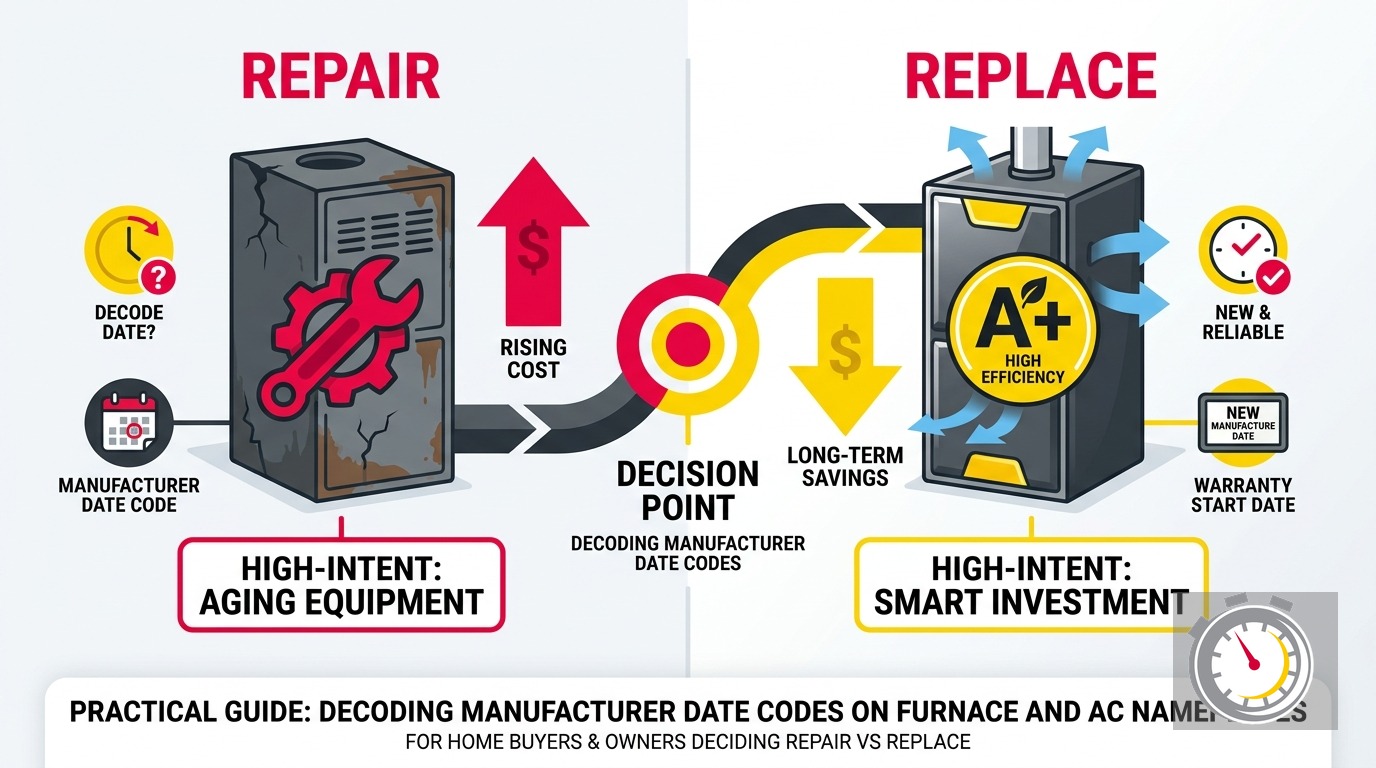
- The manufacture date is encoded in the serial number on your furnace’s data plate. Most brands pack it into the first two to four characters.
- Carrier/Bryant/Payne use a week-year format. Goodman/Amana use year-month. Rheem/Ruud use a letter-digit code. Lennox prints the date in plain text.
- Manufacture date and install date are not the same thing. A furnace can sit in a distributor warehouse for months before it goes into your home.
- The DOE median service life for a residential gas furnace is 18 years. Minnesota winters push furnaces harder than most climates.
- If one repair costs more than 50% of the price of a new furnace, lean toward replacement. The $6,500 rule is a useful second check.
- Xcel Energy and CenterPoint Energy both offer 2026 rebates on high-efficiency furnaces. The federal 25C tax credit expired December 31, 2025.
Why Does Furnace Age Matter More in Minnesota?
In short: The Twin Cities plan for a design temperature of -12°F. Your furnace runs roughly 3,000 heating hours per year here. A furnace in a warmer climate might log closer to 2,000. Those extra hours accumulate wear faster than the calendar suggests.
About 66% of Minnesota homes heat with natural gas. That means most Twin Cities homes are relying on a gas furnace to carry the full winter load. When HVAC guides talk about furnace lifespan in general terms, they are often picturing a milder climate. Our winters are not mild.
Efficiency is the other part of the picture. Furnaces 15 or more years old can carry AFUE ratings as low as 56%. Current high-efficiency equipment runs at 90% AFUE or higher. When you pay to heat a home through a Minnesota winter, that efficiency gap shows up on your gas bill every month from October through April.
Knowing your furnace’s age is the starting point for any honest assessment.
How Do I Find My Furnace’s Age?
In short: Open the furnace cabinet and look for a metal data plate on the inside panel, usually near the blower compartment or burner assembly. The serial number on that plate contains the manufacture date. You need the brand name and the serial number.
The data plate is always present on residential manufactured equipment. It is roughly the size of a playing card. It shows:
- Brand name and model number
- Serial number
- Rated AFUE (the efficiency percentage)
- Electrical and gas supply specifications
Take a photo of the full plate before you start decoding. Labels on older furnaces can be faded, and characters that look similar, like “0” and “O” or “1” and “l,” can cause a misread if you are working from memory.
Some furnaces also have a service tag attached by a previous technician. That tag records service history and is useful context, but the service date is not the manufacture date.
How Do I Decode My Furnace’s Serial Number?
In short: Find your brand below and apply the decode format to the first two to four characters of the serial number. Most brands encode the manufacture year in those opening characters, alongside the month or week of production.
There is no universal serial number format across manufacturers. Each brand developed its own encoding system. The hvacbase.org serial number decoder covers dozens of brands in depth and is worth bookmarking. The most common brands in Twin Cities homes follow below.
Brand-by-Brand Serial Number Cheat Sheet
Carrier, Bryant, and Payne
Format: first four digits encode week, then year (WWYY).
Example: a serial starting with 3216 = week 32 of 2016.
The first two digits are the production week (01 through 52). The next two digits are the two-digit year. A serial starting with 0824 means week 8 of 2024.
Goodman and Amana
Format: first four digits encode year, then month (YYMM).
Example: 2205 = May 2022.
The first two digits are the two-digit year. The next two are the month: 01 = January, 12 = December.
Rheem and Ruud
Format: first two characters encode month (letter code) plus last digit of the year.
Example: K4 = October 2024.
Each letter maps to a month. A = January, B = February, and so on. The letter I is skipped to avoid confusion with the number 1, which puts K at October. The digit following is the last digit of the manufacture year. If the unit was installed in the 2020s and the digit is 4, the year is 2024.
Lennox
No decoding needed. Lennox prints “MFG DATE: MM/YYYY” in plain text on the data plate.
If the label reads “MFG DATE: 03/2014,” the furnace was manufactured in March 2014.
York
Format: first two characters encode the year using a proprietary letter cycle, followed by a digit.
Example: X3 = 2023.
York’s year-letter cycle is not publicly standardized. Use the hvacbase.org decoder or contact York with the full model number to confirm.
Heil, Tempstar, and ICP
These three brands share the same parent company and the same serial format.
Format: one letter (year code) followed by two digits (week of production).
Example: N16 = week 16 of 2017. N maps to 2017 in the ICP letter cycle.
Trane and American Standard
Trane’s serial number format changed across production eras. The year is encoded in the first character block, but the lookup table differs by generation. Use Trane’s official online decoder or cross-reference the model number in the AHRI directory to confirm the manufacture year and original rated AFUE.
Bosch
Format: first four digits encode year, then week (YYWW).
Example: 2318 = week 18 of 2023.
The first two digits are the two-digit year. The last two are the production week.
What If My Brand Is Not on the List?
In short: Search “[brand name] furnace serial number decoder” online or call the manufacturer’s support line with the full model number and serial number. They will give you the manufacture date directly. The AHRI directory at ahridirectory.org can also confirm the original rated AFUE for any certified unit by model number.
A few older brands changed hands multiple times over the past 30 years. When a company was acquired, the parent sometimes changed the serial format. For equipment manufactured before 2000, treat any decode result as approximate. Have a technician verify the unit’s age and condition in person.
What Is the Difference Between Manufacture Date and Install Date?
In short: The manufacture date is when the furnace left the factory. The install date is when it went into your home. The gap is commonly six to twelve months. A home inspector reports age from the serial number, not from permit or utility records. These two numbers are not always the same.
This distinction matters in three ways.
Warranty coverage typically starts at installation, not manufacture. If your furnace was built in October and installed the following April, the warranty clock started in April. Time in a distribution warehouse does not consume your coverage period.
Actual wear depends on run time, not manufacture date. A furnace sitting in a distributor’s facility accumulates zero heating cycles. The true age of the equipment, from a wear standpoint, is how long it has been running in your home.
Home inspection reports cite the serial-based manufacture date. That is the conservative number. If you are buying a home, the furnace may have slightly less wear than the reported age implies. The inspection number still sets the negotiation baseline.
Buying a Home? What to Do Before Your Response Deadline
Your inspection report says the furnace is 17 years old. Your response deadline is tomorrow morning. Here is how to use that information.
Step 1: Get the serial number.
The inspection report may include it. If not, your agent can photograph the data plate during a walkthrough before your deadline.
Step 2: Confirm the manufacture year and note the rated AFUE.
A unit made in 2007 rated at 80% AFUE is a different conversation than a 2007 unit rated at 95% AFUE. Efficiency tells you something about how the unit was specified and maintained over its life.
Step 3: Use the age to anchor your negotiation.
A furnace at 15 years or older is at or near median end of service life. That is a legitimate basis for a request. Common approaches include:
- A repair credit of $1,500 to $3,000 applied at closing
- A purchase price reduction to account for near-term replacement
- Seller-funded replacement before closing, with the transferable warranty going to the buyer
Step 4: Book a pre-purchase HVAC inspection.
An hour-long inspection goes beyond age. A technician checks the heat exchanger for cracks, tests the flue for carbon monoxide, and gives you a condition report specific to the unit. Our HVAC checklist for buying a home in Minnesota walks through what to request and what answers to look for.
How Old Is Too Old for a Furnace?
In short: The DOE median service life for a residential gas furnace is 18 years, with a range of 15 to 30 years depending on maintenance. In Minnesota’s climate, plan for the lower end of that range. At 15 years, start the replacement conversation. At 18 or older, plan for it.
Age is the fastest screening tool. It is not the only measure. A 12-year-old furnace with no maintenance history may be in worse shape than a well-maintained 18-year-old unit. Age gives you the headline number. Condition and repair history fill in the rest.
Signs that age is catching up with a furnace:
- Utility bills rising with no change in usage or weather patterns
- Two or more repairs in the past two heating seasons
- Uneven heat throughout the house, with some rooms warm and others cold even with the thermostat up
- Unusual noises: banging, rattling, or a persistent hum from the blower
- Yellow or flickering burner flame instead of a steady blue
- Short cycling: the furnace fires up and shuts off before the home reaches temperature
Our guide on when to replace rather than repair your furnace covers each of these warning signs in more depth.
Should I Repair or Replace My Furnace?
In short: Two rules help. If a single repair costs more than 50% of the price of a new furnace, lean toward replacement. The $6,500 rule says to multiply system age in years by the repair cost in dollars. If the product exceeds $6,500, lean toward replacement.
The repair-vs-replace guide from Tim’s Heating and Refrigeration is a solid Minnesota-specific resource for working through this math in detail.
Here is how the $6,500 rule plays out in practice.
Your furnace is 16 years old. The repair is quoted at $550. Multiply 16 by 425 and you get $8,800. That is above $6,500, which pushes toward replacement.
Same furnace, but the repair is a $195 flame sensor cleaning. Sixteen times 150 equals $3,100. Under $6,500. The repair makes more sense.
The 50% rule is a second check. A new mid-efficiency gas furnace installed in the Twin Cities typically runs $4,500 to $7,800. See our furnace replacement cost guide for current pricing ranges by home size and equipment tier. If a single repair is quoted above $2,600 on a mid-range system, you are often in replacement territory.
One exception skips the math entirely: a cracked heat exchanger is never repaired. See the next section.
What About Carbon Monoxide and Heat Exchanger Risk?
In short: A cracked heat exchanger can allow combustion gases, including carbon monoxide, to enter your home’s airstream. It is not repairable. The furnace must be shut down immediately and replaced. This is the one scenario where the right answer is not a cost calculation.
The heat exchanger is the barrier between combustion gases and the air your family breathes. When it cracks, those pathways can merge. Carbon monoxide is colorless and odorless. Exposure can reach dangerous levels before anyone notices symptoms.
Older furnaces are more likely to have developed cracks. Annual maintenance is the primary defense. A technician can inspect the exchanger with a combustion analyzer and flag any compromise before it becomes a health issue.
Warning signs that warrant an immediate call:
- Soot deposits near the furnace or at supply registers throughout the house
- CO detector alarms anywhere in the home
- Household members experiencing unexplained headaches, nausea, or fatigue indoors
- Visible corrosion or discoloration around the burner assembly
Read our full guide on cracked heat exchanger signs in Minnesota for a complete list of symptoms and next steps. If you have any concern, call (763) 260-6662 now. We treat safety calls as urgent.
2026 Minnesota Rebates and Incentives
If your furnace’s age makes replacement the right call, financial help is available.
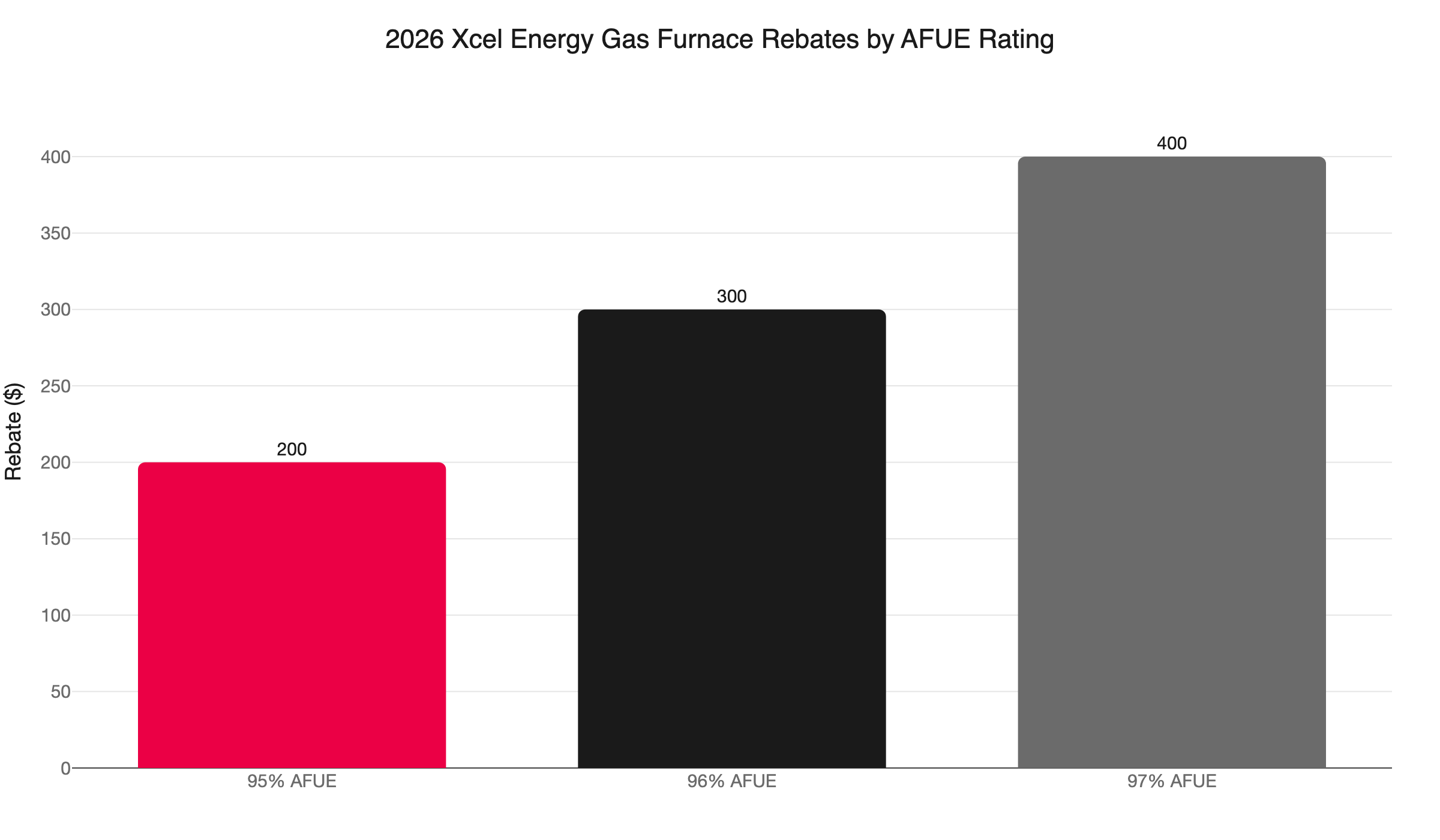
Xcel Energy 2026 gas furnace rebates:
- 95% AFUE: $200
- 96% AFUE: $300
- 97% AFUE: $400
CenterPoint Energy 2026 rebate:
- 95% AFUE or higher: up to $400
- Income-qualified households: up to $1,200
Verify current amounts at xcelenergy.com and centerpointenergy.com before you commit. A 2026 Minnesota furnace rebate guide from Metro Heating provides a useful third-party cross-reference for both utility programs.
One thing worth knowing before you plan around the federal credit: the IRS Section 25C Energy Efficient Home Improvement Credit for furnaces expired December 31, 2025. The One Big Beautiful Bill Act, signed July 4, 2025, ended it nine years early. Equipment installed in 2026 or later earns no federal tax credit. Utility rebates are the primary financial incentive available right now.
Financing is available for qualifying replacement installations. Ask about options when you call.
Get a Straight Answer on Your Furnace
You do not need a technician to read the data plate. A flashlight, five minutes, and the cheat sheet above get you to the manufacture year.
What you do with that number is where we come in.
Northern One Hour is locally owned and operated in Ramsey, MN. We serve Minneapolis, St. Paul, Blaine, Maple Grove, Plymouth, Brooklyn Park, and the surrounding Twin Cities communities. Whether you need a repair assessment, an efficiency check, or a full replacement quote, our team shows up when we say we will.
“Always On Time… Or You Don’t Pay a Dime!(R).”
Call (763) 260-6662 or book online.
Frequently Asked Questions
What does the serial number on a furnace tell you? +
Where is the serial number on a furnace? +
How old is too old for a furnace in Minnesota? +
Can furnace age help me negotiate when buying a home? +
Need a technician now?