
How to Shut Off Gas to Your Furnace (and When Not To)
Key Takeaways
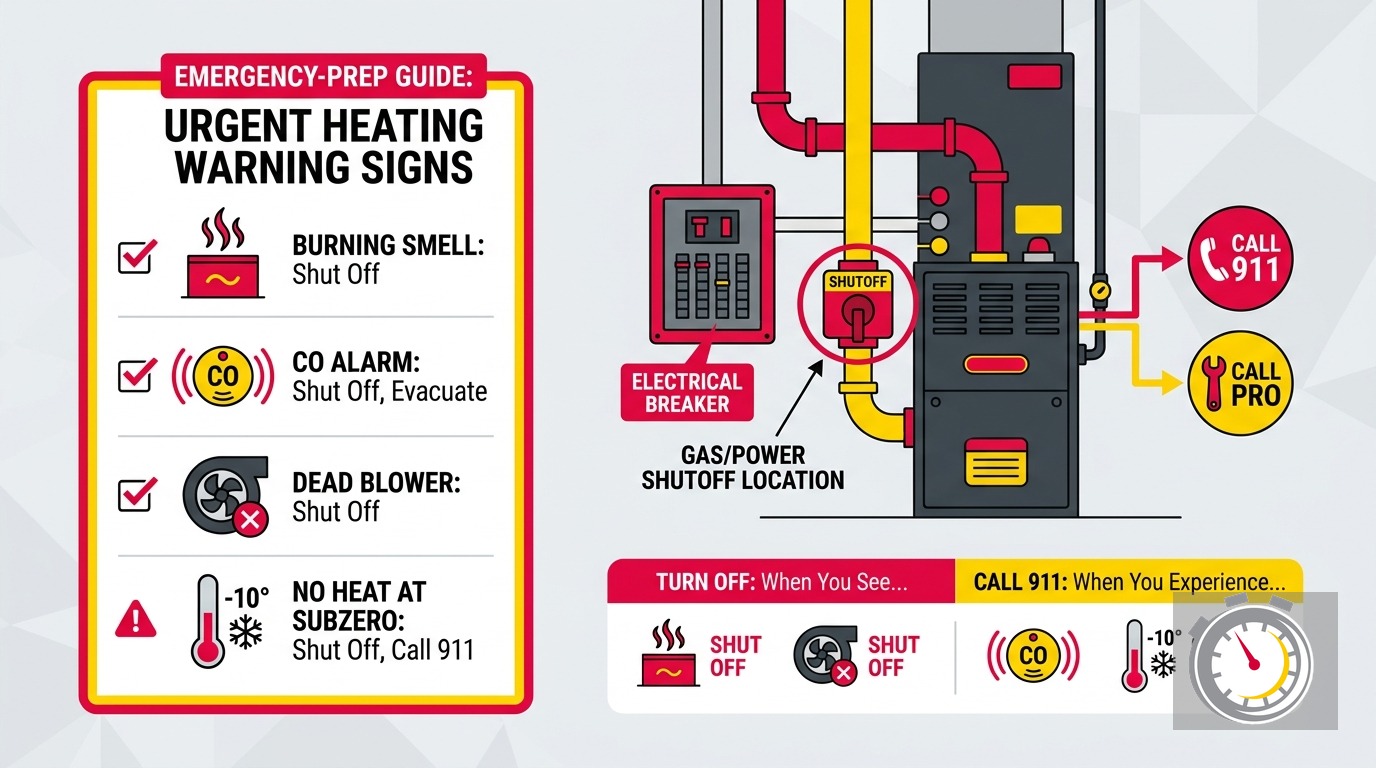
- The appliance shutoff is a yellow-handled quarter-turn lever on the black gas pipe, within 6 feet of your furnace. Lever parallel to the pipe means gas is on. Lever crossing the pipe means gas is off.
- Turn the appliance valve off before scheduled furnace service. Do not touch it during a gas emergency.
- Strong gas smell: leave immediately. Do not flip switches, use your phone, or start a car in an attached garage. Call CenterPoint at 612-372-5050 from outside.
- The gas meter shutoff is almost never the homeowner’s call. After a meter shutoff, the utility must restore service before any gas appliance in the home works again - and that can mean no heat overnight in a Minnesota winter.
- CO and natural gas are different emergencies. Gas smells like rotten eggs. CO is colorless and odorless. Both require immediate evacuation, but CO goes straight to 911 with no appliance-shutoff step.
- Do not shut off the gas to your furnace for the summer. Modern furnaces do not fire unless the thermostat calls for heat. The off-season valve position has no effect on safety.
What Does the Gas Shutoff Valve on a Furnace Look Like?
The appliance shutoff is a quarter-turn ball valve with a yellow lever handle on the black iron or steel gas pipe that feeds your furnace. When the lever runs parallel to the pipe, gas is on. Turn it 90 degrees so the lever crosses the pipe, and gas stops.
IRC Section G2420.5 requires this valve to be within 6 feet of the appliance, in the same room as the furnace, accessible without tools, and upstream of the flexible connector that attaches to the unit. Minnesota adopted the 2018 IRC, so this requirement applies to homes here.
The valve body is often stamped with the word “GAS.” Some older Twin Cities homes have a round wheel-style valve instead of a lever. Both types work - turn the wheel clockwise to close it - but the quarter-turn lever is the current code standard and the one most technicians install when doing replacement work.
If your valve looks corroded, if the handle spins without resistance, or if you cannot find one near the furnace at all, flag that at your next service visit. A valve you cannot operate quickly is one that cannot help you when you need it.
Where Is the Appliance Shutoff Located?
Trace the black gas pipe from where it connects to your furnace. The shutoff valve is on that pipe, within a few feet of the appliance. In most Twin Cities basements, the gas line drops from the ceiling or runs along the wall before connecting to the furnace at the bottom.
In a finished utility room, the valve must remain accessible without tools and without moving anything - that is a code requirement. If a cabinet panel, shelving unit, or stored items block access, that is worth correcting before you ever need the valve in a hurry.
One distinction worth noting: if your home has a gas water heater, range, or gas fireplace, each of those appliances has its own shutoff valve on its own supply branch. Closing the furnace valve shuts off gas to the furnace only. Your other appliances keep running normally.
The Three-Layer Valve System: Which Layer Is Which?
Most homes have three points where gas can be cut off. Knowing which is which prevents a serious mistake under pressure.
Layer 1: The appliance shutoff valve. The yellow-handled lever on the pipe behind or beside your furnace. This is the only valve most homeowners will ever need to operate. Closing it stops gas to the furnace only - nothing else in the house loses service.
Layer 2: The indoor main shutoff. Usually near where the gas line enters the home, sometimes in the basement near the meter, sometimes in a utility room. This cuts all gas to the house. It is rarely needed by homeowners and is best left to a technician in most situations.
Layer 3: The gas meter shutoff. Located outside at the meter. CenterPoint Energy is explicit: do not shut off the meter yourself during a suspected leak. Evacuate first, then call from outside. After a meter shutoff, a utility technician must come to the property, inspect, and restore service. No gas appliance in the home works until that happens.
There is a seasonal weight to this in Minnesota. The Cold Weather Rule runs October 1 through April 30 and restricts utilities from disconnecting residential heating service without due process. It applies to utility-initiated disconnections, not to emergency responses or homeowner-triggered shutoffs. A meter shutoff in January, for any reason, requires a utility truck and inspection visit before heat returns. That can take hours. Pulling the wrong lever in a heating emergency has real consequences for the household overnight.
The meter shutoff exists for extreme situations: structural fires, major line breaks, or catastrophic damage to the house. For virtually every scenario a homeowner will actually encounter, Layer 1 is all that matters.
Can You Turn the Gas Off Yourself?
Yes, at the appliance valve. The quarter-turn lever is designed for homeowner use. Close it before scheduled furnace service, before furnace replacement, or when your technician asks. What you should not do is approach the gas meter during an active emergency - the right move is to leave and call the utility.
Metro Twin Cities: 612-372-5050. Greater Minnesota: 1-800-296-9815. Minnesota Energy Resources customers in some outstate areas: 800-889-4970.
A utility technician carries combustible gas detection equipment that can pinpoint exactly where a leak is - at the appliance, in the flex connector, in the supply line, or at the meter. That 15-minute field assessment is more valuable than anything a homeowner can determine by smell alone. Do not shortcut it by trying to manage the meter yourself.
What Should You Do If You Smell Gas?
If the smell is strong, spreading through the house, or accompanied by a hissing sound: leave immediately. Do not flip switches, use your phone, or start a car in an attached garage. Call CenterPoint at 612-372-5050 from outside. Do not re-enter until the utility clears the building.
CenterPoint Energy states: “Leave immediately on foot. Do not use electric switches, telephones (including cell phones), drive or start a car, or do anything that could cause a spark.” Flipping a light switch off creates a small arc at the contacts. Dialing a cell phone generates a radio signal. Either is enough to ignite accumulated gas.
The rotten-egg smell comes from mercaptan, an odorant CenterPoint adds to natural gas because natural gas itself is colorless and odorless. If you smell it, the detection system is working. Act on it.
A faint smell limited to the area directly in front of the furnace, with no spreading and no hissing, is a lower-risk scenario. Even so, do not investigate with the furnace running. Open a window, avoid any ignition sources in the area, and call for service before the next heating cycle. A technician can confirm whether it is a minor fitting issue or something more serious.
Natural gas is lighter than air, which means it tends to rise and dissipate when ventilation is available. That is a partial advantage over propane, which settles to the floor - but it is not a reason to stay in a space where gas is accumulating.
In winter, the calculus around opening windows and leaving the house feels harder. It still applies. A gas emergency is worth a cold house.
What Is the Difference Between a Gas Leak and Carbon Monoxide?
Natural gas produces a detectable rotten-egg odor. Carbon monoxide is colorless and odorless. Both require immediate evacuation. But CO calls for 911 directly, with no appliance-shutoff step. Confusing the two means applying the wrong emergency protocol to a dangerous situation.
The CPSC reports that sustained CO exposure above 150-200 ppm can cause disorientation, unconsciousness, and death, and that more than 200 Americans die each year from CO produced by non-automotive consumer products. At 70 ppm, headache, fatigue, and nausea become noticeable. By the time you feel sick, the exposure is already serious.
There is no appliance-shutoff step with CO. If your CO alarm sounds, get every person and pet out immediately. Call 911 from outside. Do not go back in for any reason until emergency responders clear the building.
CO alarms should be installed on every level of your home and outside every sleeping area, with battery backup. The CPSC advises against placing them near heating vents or fuel-burning appliances. Our guide on carbon monoxide safety during furnace season covers placement specifics and what to do when an alarm activates.
A useful way to keep the two protocols straight: a gas leak and CO exposure share the same first step - get out. After that, a gas leak calls the utility; CO calls 911.
Should You Shut Off the Gas to Your Furnace in the Summer?
No. Leave the appliance valve open year-round unless a technician instructs otherwise. Modern furnaces do not fire unless the thermostat calls for heat. Closing the valve in the off-season adds no safety benefit and sets up an easy mistake when fall arrives.
The furnace has internal safety controls that keep the gas valve inside the unit closed unless the ignition sequence actively calls for it. The appliance shutoff valve plays no role in the off-season. A furnace sitting idle in July is not generating new leak risk.
There is also a practical hazard to seasonal shutoffs. If the valve is closed in May and forgotten, the furnace will fail to light when you turn the heat on in October. The resulting service call will trace back to a closed valve - fixable in minutes, but the kind of avoidable problem that wastes a fall afternoon.
The one exception: a qualified contractor may advise closing the gas supply to specific appliances before extended travel or major renovation work that involves the gas lines. Follow their guidance when they give it. This is a situation-specific recommendation, not a general summer practice.
How Do You Shut Off the Appliance Valve?
Turn the yellow lever 90 degrees so it crosses the pipe. The valve is fully closed when the handle runs perpendicular to the pipe. It will reach a firm mechanical stop - do not force it past that point.
Here is the full sequence:
- Locate the yellow-handled lever on the black gas pipe near your furnace.
- Confirm the current position. Lever parallel to the pipe means gas is on.
- Rotate the lever a quarter turn - 90 degrees - until it crosses the pipe.
- Feel for the firm stop. Gas is now off.
- If the handle will not turn by hand, stop. Do not apply a wrench. A stuck valve may indicate corrosion and needs inspection, not more force.
To restore gas, return the lever to parallel. Wait for the thermostat to call for heat - the furnace will run through its normal ignition sequence. If it fails to light after a cycle or two, call for service. Most modern furnaces lock out after three failed ignition attempts and require a manual reset before trying again.
If you closed the valve before a repair visit, leave it closed and let the technician reopen it. They will verify the connection work before gas flows back through the appliance.
What Happens After the Gas Is Shut Off?
Closing the appliance valve stops gas to the furnace only. Your water heater, range, and other gas appliances keep running normally. After you reopen the valve and the thermostat calls for heat, the furnace runs its normal startup sequence.
A meter-level shutoff is a different situation entirely. Every gas appliance in the home loses service. Restoration requires an on-site utility inspection and cannot be done by the homeowner. There is no bypass.
During heating season this matters urgently. The Cold Weather Rule restricts arbitrary utility-initiated disconnections during the October through April window, but it does not accelerate emergency response timelines. If a meter shutoff happens in winter for any reason, contact the utility immediately to get a restoration timeline on the calendar.
This connects to a related failure mode worth knowing about: your furnace suddenly stops firing and there is no gas smell and no alarm. In that case, the problem is almost certainly mechanical or electrical, not a gas supply issue. But in some cases, the issue is upstream of the appliance valve entirely. Our post on what happens when a frozen gas meter shuts off your furnace covers that specific Twin Cities winter scenario, where the fix involves the utility rather than an HVAC technician.
When Does the Appliance Shutoff Actually Come Into Play?
The appliance valve is the right tool in a narrow, defined set of situations:
- Before scheduled furnace service or repair. Some technicians ask homeowners to close the valve before they arrive. Others do it themselves on arrival. Either way, you will likely interact with this valve during an annual tune-up.
- Before furnace replacement. When a new furnace is installed, the old gas supply is closed at the appliance level while the swap happens. The installer manages this, but knowing the valve location speeds up the pre-work conversation.
- Relighting a standing-pilot furnace. If your older furnace has a standing pilot that has gone out, the manufacturer relight instructions on the furnace label may include steps at the appliance valve. Follow the label, not a general guide.
- Extended vacancy, on contractor advice. If a qualified contractor recommends closing the valve before a long trip or major renovation, follow their guidance. This is not the standard recommendation for most households.
It is not the right tool for responding to a gas smell, a hissing sound, or any situation where you are not certain. In those cases, leave the valve alone and leave the house.
Recognizing when NOT to use the valve matters as much as knowing when to use it. If your furnace stops working and there is no gas smell and no alarm, the issue is most likely mechanical or electrical - not a gas supply problem. Closing the appliance valve in that situation does nothing to help and creates one more step to undo before the furnace can run again.
If your furnace has been showing signs of trouble - a blower that keeps running without producing heat, error codes, or unexplained smells - those are reasons to call for service before something minor becomes an emergency.
Schedule Annual Service to Know Your System Before You Need To
The homeowners who handle gas emergencies calmly are usually the ones who have already walked through the system with a technician. An annual furnace tune-up is the right time to locate the appliance valve together, get the gas connections inspected, verify CO alarm placement, and confirm the furnace is firing cleanly before the heart of the heating season.
Minnesota Energy Resources recommends having a qualified contractor inspect furnaces, vents, appliance connectors, and chimneys at least every other year. For most Twin Cities homes, annual is the better interval. Minnesota furnaces run hard from October through April, and small problems do not announce themselves at convenient times.
Our team is locally owned and operated in Ramsey, MN. We serve Minneapolis, St. Paul, Blaine, Maple Grove, Plymouth, Brooklyn Park, Woodbury, Bloomington, and the surrounding Twin Cities metro. When you schedule a visit, we arrive in the time window you choose. That is the commitment behind “Always On Time… Or You Don’t Pay a Dime!(R).”
Schedule a furnace tune-up or call (763) 260-6662 to get on the calendar. Have a gas connection concern? Mention it when you call and we will make sure the technician comes prepared.
Frequently Asked Questions
Is it safe to turn off power to my furnace? +
Why would I ever need to shut off a gas furnace? +
Need a technician now?