
Water Leaking From Furnace? 4 Causes and Costs in MN
Key Takeaways
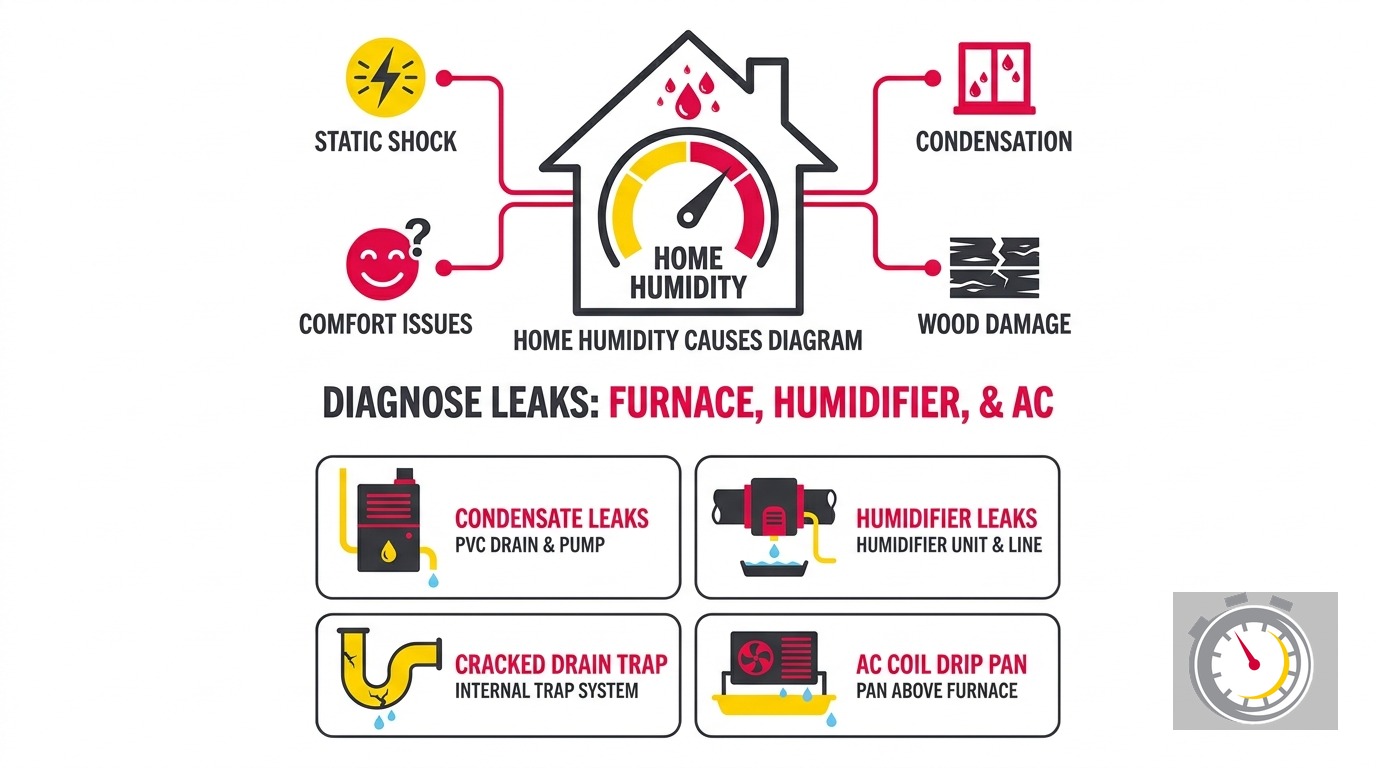
- Four sources cause nearly every furnace water leak: condensate, humidifier, cracked trap, and an AC coil pan above the furnace.
- A leak that appears while the AC runs in summer is probably not a furnace problem.
- High-efficiency furnaces make water on purpose. A clog or crack in the drain path sends it to the floor.
- Humidifier leaks often leave white mineral crust. Condensate leaks usually leave clear water.
- Many minor drain fixes cost $195-$500. A cracked heat exchanger is a different, larger problem.
- Turn the furnace off at the thermostat if water is steady or near electrical parts.
- Call (763) 260-6662 or book online for fast, on-time service.
Why is water leaking from my furnace?
Almost every furnace water leak comes from one of four places: condensate from a high-efficiency furnace, a leaking humidifier, a cracked or loose drain trap, or an AC coil drip pan sitting above the furnace. Timing and location tell you which one.
Start with two questions. Is it winter or summer? Is the water at the bottom of the furnace, at the humidifier, or dripping from the cabinet above?
We are a locally owned and operated Twin Cities heating and cooling company. We see this call every winter and every cooling season. Most of the time the fix is small. The trick is finding the right source before anyone replaces a part that works fine.
Is it a condensate leak from a high-efficiency furnace?
If your furnace has a white PVC exhaust pipe and runs in winter, condensate is the most likely cause. A high-efficiency furnace pulls so much heat from its exhaust that water vapor turns to liquid. That liquid has to drain away. When the drain path fails, water pools at the furnace base.
A condensing furnace wrings extra heat out of its exhaust gases. Manufacturer guidance describes high-efficiency furnaces as having AFUE ratings of “90% or higher.”
That efficiency produces water. The same source says a 60,000 BTU/h furnace at full input uses “about 0.6 therms” of gas per hour. It can produce “roughly 0.7 gallons” of water vapor per hour, before counting how much actually condenses.
So a healthy condensing furnace sends a steady trickle to a drain. Think of it like a dehumidifier. It works well until something blocks the drain.
Where the water goes
The condensate leaves the furnace through a few parts:
- The collector box and inducer area. Exhaust gases cool here and drop water.
- A drain hose. Flexible tubing carries water from the furnace to the trap.
- The trap. A small loop of pipe holds a water seal so exhaust cannot escape through the drain.
- The drain line. White PVC pipe runs to a floor drain, laundry sink, or condensate pump.
A clog, crack, or loose clamp anywhere along that path causes a leak.
What a condensate leak looks like
- Clear water near the base of the furnace
- A puddle that appears only while the furnace runs
- Water that grows during long, cold runs
- A gurgling sound near the drain
- A furnace that shuts down with an error code
Algae, dust, and sludge cause most clogs. A hose that has slipped off its fitting is another common culprit.
If your furnace uses a pump, read our guide on furnace condensate pump failure signs. Pumps fail often because they sit in damp basements and run all winter.
Could the humidifier be the source?
Yes. A whole-home humidifier is the second most common source. It sits on your furnace or ductwork and feeds water into the airstream. If water shows up near the humidifier, its drain, its supply line, or the saddle valve, suspect the humidifier first.
Humidifiers run on a steady water supply. A stuck valve, cracked drain tube, or clogged water panel can overflow into the furnace cabinet. The water runs down and looks like a furnace leak.
Look for these clues:
- Water near the humidifier body or the duct it mounts to
- White or chalky crust around fittings
- A water panel caked with scale
- Rusty streaks below the humidifier
- A supply line that drips at the saddle valve
Minnesota water is often hard, so minerals leave scale on panels, valves, and drain lines. In our experience, humidifier water leaves more crust than condensate does. That is a general field observation, not a sourced fact.
Try a simple test. Close the humidifier’s water supply valve and turn the humidifier off. Run the furnace for a day. If the leak stops, the humidifier was the source.
Our post on whole-home humidifier cleaning and maintenance shows how to clean the unit safely. If scale is the problem, see humidifier hard water scale buildup.
A humidifier leak is not an emergency. Still, shut off the water supply to stop the damage. Water inside a furnace cabinet can corrode parts and trip safety controls.
Could a cracked or loose drain trap be causing the leak?
Yes. A cracked trap, a loose clamp, or a dislodged hose causes leaks even when the drain line is clear. The furnace makes the right amount of water, but it escapes before reaching the drain. Because the rest of the system looks normal, this cause is easy to miss.
Traps take a beating. They sit near the floor and get bumped when people rearrange storage. Plastic turns brittle after years of heat cycles.
Design matters too. The Building America guidance from PNNL says the drain line needs a trap with a minimum 2-inch drop from the pan, plus 2 more inches for the trap seal. It also calls for a clean-out with a removable cap.
A clean-out saves time. Without one, a technician has to cut pipe to clear a clog. With one, clearing the line takes minutes.
Signs of a trap problem include:
- Water dripping from the trap itself
- A trap that looks cracked, warped, or discolored
- A hose clamp that has loosened
- Drips at the connection between hose and trap
- Water that appears even after the drain line is cleared
Slope and pipe size matter
A drain line must slope downhill. If it sags, water sits and grows algae. PNNL notes that manufacturers often recommend ¼ inch per foot of pitch, and code allows ⅛ inch per foot. It also lists a minimum drain pipe diameter of ¾ inch.
A line that bellies or runs level will clog again. When we replace a trap, we check the whole run for sags.
Is the AC coil drip pan above the furnace dripping?
Possibly, if the leak shows up in summer. Many Twin Cities homes have an AC evaporator coil sitting on top of the furnace. The coil makes condensation while cooling, and a pan catches it. If that pan or its drain clogs, water drips onto the furnace.
This leak fools many homeowners. The water lands on the furnace, so it looks like a furnace leak. The furnace may not even be running.
Clues that point to the AC coil:
- The leak appears only when the AC runs
- Water drips from the seam between the coil cabinet and the furnace
- The leak gets worse on humid days
- The condensate line outside the cabinet is wet or stained
- The AC may ice up or stop cooling
For more detail, read our posts on an AC drain pan that is full or overflowing and what to do about a clogged AC condensate drain line.
Float switches and secondary pans
Good installations include backup protection. PNNL explains that the IRC requires a secondary drain pan where a blocked drain and primary pan overflow could damage building components. The IMC and IRC call for an auxiliary pan at least 1½ inches deep.
Equipment without a secondary pan still needs protection. The same guide says it needs a water-level detection device, often called a float switch, that shuts the equipment off before overflow.
Does yours have one? If your AC stops working and there is water in the pan, the float switch may have done its job. That is a good sign.
One more detail. PNNL says no trap should be installed on the auxiliary pan drain pipe. A poor trap on a draw-through system can pull in hot attic air and may stop the pan from draining. Bad drain design causes some leaks, and we fix those at the source.
How do I tell which of the four leaks I have?
Use timing, location, and what the water looks like. Winter leaks near the furnace base point to condensate or the trap. Water near the humidifier points to the humidifier. Summer leaks from above the furnace point to the AC coil pan. White crust points to humidifier minerals.
Work through this path in order.
Step 1: What season is it?
- Furnace running in winter: go to Step 2.
- AC running in summer: check the AC coil pan and its drain first.
Step 2: Do you have a humidifier on the furnace or duct?
- Yes, and water is near it: shut off its water and retest.
- No humidifier, or it is dry: go to Step 3.
Step 3: Is the furnace a high-efficiency model with white PVC pipes?
- Yes: look at the trap, hose, and drain line.
- No, it has a metal flue: a condensate leak is less likely. Look harder at the humidifier and any nearby plumbing.
Step 4: Where does the water start?
- At the trap or drain hose: loose or cracked part.
- At the collector box or inducer area: blocked drain or failed seal.
- From the seam above the furnace: AC coil pan.
- From inside the cabinet, with no other source: call a pro.
What the water itself tells you
This is a general observation, not a sourced fact. Condensate is slightly acidic and can leave residue over time. Humidifier water often leaves mineral scale. Clear water with no crust points to condensate. Chalky crust points to a humidifier. Treat it as a clue, not proof.
If the source is still unclear, stop guessing. A technician can test each path in one visit.
What can I safely check myself?
You can check a few things without tools. Turn the furnace off at the thermostat first. Then look at the drain line, the trap, the humidifier, and the floor around the unit. Do not open sealed panels or touch wiring. If you smell gas, leave and call your gas utility.
Safe checks include:
- Look for a kinked, sagging, or disconnected drain hose
- Check the condensate pump for water in its tank
- Press the pump’s test float, if it has one
- Look at the humidifier water panel for scale
- Check the AC drain line outside for dripping
- Check the furnace filter, since a dirty one can cause AC coils to freeze
A frozen coil melts and overflows the pan. Our guide on a frozen evaporator coil explains why.
What not to do
- Do not pour bleach or harsh chemicals into the drain line.
- Do not remove cabinet panels while the furnace is on.
- Do not tape over a leak and keep running the furnace.
- Do not bypass a float switch to keep the system running.
Tape hides the cause. Water that pools inside the cabinet can short a control board, and that turns a $195-$500 repair into a much larger bill.
If you want a pro to handle it, see our furnace repair service page.
Does Minnesota code care where furnace condensate goes?
Yes. Condensate disposal is a plumbing code matter in Minnesota. Under Minnesota Rules 4714.0814, condensate from “air washers, air-cooling coils, fuel-burning condensing appliances” must be collected and discharged to an approved plumbing fixture or disposal area.
The same rule adds detail. If condensate goes into the drainage system, it needs an indirect waste pipe. That pipe must slope at least 1/8 inch per foot or 1 percent, and it must be an approved corrosion-resistant material.
Condensate pipes must also connect indirectly through an air gap or air break. The rule says condensate waste “shall not drain over a public way or in areas causing a nuisance.”
Two cautions. The page we reviewed is a 2016 version, so check the current rule text. Also, this is plumbing code, not mechanical code. We do HVAC only. If a drain problem involves a house plumbing line, we point you to our sister Northern plumbing brand.
Some furnace manuals call for a condensate neutralizer only if local code requires one. We do not say it is mandatory. Learn more in our post on condensate neutralizers for high-efficiency furnaces. For permits, check with your city.
What fails first on a furnace?
Simple parts fail before big ones. Filters clog, igniters and flame sensors wear out, and inducer motors, capacitors, and drain parts follow. Condensate drains clog long before a heat exchanger fails. That is good news, because most water leaks come from cheap parts, not major components.
Here is the typical order of trouble on a gas furnace:
- Filters. They clog fast, especially in dusty homes or with pets.
- Flame sensors and igniters. Soot and heat wear them down.
- Drain parts. Traps, hoses, and lines clog or crack in condensing models.
- Motors and capacitors. Inducer and blower motors wear with hours of use.
- Control boards and switches. These fail from heat, moisture, or age.
- Heat exchangers. They fail last, usually after many years.
The same manufacturer source says heat exchangers can last about 15 to 20 years with proper maintenance. A cracked one is rare, but it is serious. Water from a failing exchanger often comes with soot, odd smells, or a CO alarm.
Read our posts on cracked heat exchanger signs and furnace draft inducer motor failure for more detail.
Most furnace leaks are not heat exchanger failures, so there is no need to panic.
How much does it cost to fix a leaky furnace?
Most leak repairs are modest. Expect about $195-$500 for a typical drain fix, such as clearing a clogged line, replacing a trap or hose, or swapping a small part. Costs rise if a motor, pump, or control part has failed. A cracked heat exchanger is a different problem entirely.
Costs depend on the cause. Here are Twin Cities ranges, installed, with parts and labor:
| Cause | What the fix usually involves | Typical cost |
|---|---|---|
| Clogged drain line or loose hose | Clear the line, reseat the hose | $195-$500 |
| Cracked trap | Replace trap and check slope | $195-$500 |
| Humidifier leak | Clean, replace panel or valve | $195-$500 |
| AC coil pan drain clog | Clear the drain, test float switch | $195-$500 |
| Draft inducer motor | Replace motor | $375-$900 |
| Blower motor | Replace PSC or ECM motor | $1,100-$2,200 |
| Control board | Replace board | about $750 |
These are real selling ranges, not national averages. Final pricing depends on your equipment, access, and what the technician finds. We give you the price before work begins.
Clearing and cleaning often fits inside a regular service visit. A single tune-up visit runs $95-$250. An annual maintenance plan runs $195-$390 and includes checking the drain path before problems start. See our furnace tune-up cost guide for what a visit includes.
When repair stops making sense
Replace rather than repair when a heat exchanger cracks or the furnace is near the end of its life. A new furnace in the Twin Cities runs $3,900-$7,800 installed. By tier, starting prices are $4,950 for 80% AFUE, $6,500 for 95-96%, and $9,100 for 97-98%.
Compare costs in our furnace replacement cost guide. If a larger job comes up, ask us about financing. We can walk you through options before you decide.
Do you need help right away? After-hours or emergency visits add $180-$270 per hour on top of standard rates. If the leak can wait until morning, shut the furnace off, protect the floor, and book a daytime visit.
When is a furnace leak an emergency?
Most leaks are not emergencies, but a few are urgent. Treat it as urgent if water reaches electrical parts, the leak is heavy and steady, the furnace shows soot or scorch marks, or a carbon monoxide alarm sounds. A CO alarm means leave the home and call 911.
Call us promptly when you see:
- Water pooling around wiring or the control board
- Rust streaks inside the furnace cabinet
- A furnace that keeps shutting down
- A flooded basement floor near the furnace
- Burning or chemical smells with the leak
A carbon monoxide alarm is never a “wait and see” signal. Our posts on carbon monoxide safety during furnace season and what to do when a CO alarm goes off near your furnace cover the right steps.
For a slow drip with no other symptoms, turn the furnace off, set a pan under the leak, and call. Do not run a leaking furnace for days.
What makes Twin Cities furnaces more likely to leak?
Cold weather stresses drain systems. Condensate lines that run through cold basements, garages, or crawl spaces can freeze in winter. A frozen line blocks drainage, and water backs up into the furnace. This is general field experience, not a sourced Minnesota rule.
Our winters also push furnaces into long cycles. More run time means more condensate. A drain line with a small clog may cope in October and fail in January.
Here are Twin Cities patterns we see:
- Condensate lines in unheated spaces that freeze on sub-zero nights
- Humidifiers set too high during dry cold snaps
- Hard water scale that clogs humidifier parts
- AC coils above furnaces that clog after a humid summer
- Condensate pumps that fail after many seasons
Our guide on high-efficiency furnace condensate drains that freeze covers the cold-weather case in detail.
Simple prevention for Minnesota homes
- Schedule a furnace tune-up each fall.
- Replace filters on schedule.
- Clean or replace the humidifier water panel each season.
- Keep the area around the furnace clear.
- Make sure condensate lines slope downhill and stay insulated where needed.
- Test the condensate pump before winter and before summer.
Why call a locally owned team for a furnace leak?
You get a technician who knows Twin Cities homes. Northern One Hour Heating & Air Conditioning is locally owned and operated in Ramsey, with the backing of a national franchise. We serve Minneapolis, St. Paul, Blaine, Maple Grove, Plymouth, Brooklyn Park, Woodbury, and Bloomington.
A leak is stressful. Water, electrical parts, and a cold house are a bad mix. You want someone who shows up when they say they will.
That is our promise. “Always On Time… Or You Don’t Pay a Dime!(R)” means we arrive within the time window you select. If the technician is late, you do not pay for the service. Read more in our post on why on-time service matters.
When we arrive, here is what happens:
- We confirm which of the four sources is leaking.
- We explain the cause in plain language.
- We give you a clear price before any work.
- We fix the leak and test the full drain path.
- We check the float switch, pan, and trap for backup protection.
We are HVAC only. We do not do electrical or plumbing work. If your leak traces to a house plumbing line, we tell you honestly and point you to our sister Northern plumbing brand.
What should I do right now?
Take these steps today:
- Turn the furnace off at the thermostat if the leak is steady.
- Put a towel or pan under the water.
- Note the season, the location, and the water’s look.
- Check the humidifier and its water supply.
- Look for loose hoses or a cracked trap.
- Shut off power at the switch if water is near wiring.
- Call (763) 260-6662 or book online.
A small leak can ruin a floor or a control board if you let it sit. Most fixes are quick, and the repair costs far less than the damage a hidden leak causes.
If you want help with the leak, call furnace repair at (763) 260-6662 or book online. We will find the source, explain it plainly, and get your heat running right.
Frequently Asked Questions
How often should a furnace be serviced? +
Is water leaking from my furnace dangerous? +
Why is my furnace leaking water only in summer? +
Need a technician now?