
Furnace Flooded Basement: What to Do in a Minnesota Home
Key Takeaways
- Do not enter a flooded basement until the gas and electricity are shut off. Call your utilities first.
- If you smell gas, leave the house right away and call your gas emergency line from outside.
- Gas control valves that were under water must be replaced. They cannot be repaired.
- Submerged breakers, GFCIs, fuses, smoke detectors, and carbon monoxide alarms also need replacement.
- Motors, burners, venting, and control boards need a technician’s evaluation. Some parts are saved. Some are not.
- Your utility restores service only after a qualified contractor says your appliances are safe.
- Standard homeowners insurance usually excludes flood damage. Check your policy for sump-backup coverage today.
- A flooded furnace in winter is a no-heat emergency. Call a licensed HVAC company as soon as it is safe.
Why Spring Melt Can Flood a Furnace Room
Twin Cities basements flood for a few common reasons. In spring, the big one is snowmelt.
In April 2026, some Minnesota communities had more than a foot of snow that could flow toward basements as it melted. Frozen ground cannot soak up that water, so it runs toward your foundation.
Then the sump pump has to do its job. The same report quotes a restoration owner who says homeowners often do not realize their sump pump has failed. A power outage, a stuck float, or a worn motor can kill a pump. You find out when the water rises.
Furnaces and water heaters usually sit on a basement slab. A few inches of water can reach the burners, the blower motor, the control board, and the gas valve.
We are Northern One Hour Heating & Air Conditioning, locally owned and operated in Ramsey. We have helped Twin Cities homeowners through wet basements and cold nights.
What should you do first when you find water around your furnace?
Stay out of the water, keep everyone away from the basement, and call your utilities. Do not touch the furnace, the breaker panel, or any cord. Water and electricity can kill you. A gas leak can also build up unseen.
Start with safety, not with bailing water or saving the furnace. Here is the order we recommend:
- Do not walk into standing water if any appliance, outlet, or cord is wet or submerged.
- Do not flip breakers or touch the panel if you must stand in water to reach it.
- Smell for gas from the top of the stairs. Do not light anything.
- Call your gas utility and your electric utility.
- Move your family and pets out of any area where you smell gas or feel unwell.
- Take photos from a safe spot for your insurance claim.
If you can reach the main gas shutoff without entering water, you may close it. Our guide on how to turn off the gas to your furnace shows where the valves usually sit.
Never wade into a flooded basement to throw a switch. Let the utility do it.
What if you smell gas or think there is carbon monoxide?
Leave the building immediately. Do not use light switches, phones inside, or appliances. Once outside, call your gas emergency line. For carbon monoxide symptoms or an alarm, leave and call 911.
Minnesota Energy Resources is direct about this. If you smell natural gas, leave immediately and do not operate gas or electric appliances. Their 24-hour gas emergency number is 800-889-4970. For carbon monoxide, the same page says to leave the building and call 911.
If you have a different gas utility, call that company’s emergency line instead. The number is on your bill and often on the meter.
Why does flooding raise the gas risk? The CPSC explains that silt and corrosion from floodwater can damage gas valves and cause gas leaks. A valve can look fine and still leak when gas flows again.
Carbon monoxide is the other hidden danger. It has no smell, and flooded venting can trap exhaust. Our carbon monoxide safety guide covers the warning signs in more detail.
Who shuts off the gas and power to a flooded basement?
Your utilities do. Call your gas company before you enter the basement and ask them to shut off the gas. Call your electric company to cut power. Do not restore either one yourself.
Most online guides skip this step. They say “turn off the power” and leave you standing in the basement doorway.
Minnesota Energy Resources says to call them to turn off your natural gas before you enter a flooded basement. The same page says to call your electric utility to turn off electricity.
Here is a simple call list:
- Gas utility: Ask for a shutoff and tell them the basement is flooded.
- Electric utility: Ask them to disconnect power if water has reached outlets or the panel.
- Your HVAC company: Book the inspection now. Good crews fill up fast after a melt event.
- Your insurance agent: Report the loss and ask what documents they need.
Service comes back in a set order. A qualified contractor inspects your appliances first. Your utility restores service once they are inspected and safe. Do not skip the contractor.
Which furnace parts must always be replaced after flooding?
Gas control valves, submerged circuit breakers, GFCIs, fuses, smoke detectors, and carbon monoxide alarms must be replaced. The CPSC calls submerged safety devices unfit for continued use. Do not try to dry them out.
The most useful rule in any flood guide comes from the U.S. Consumer Product Safety Commission. Its release says gas control valves on furnaces, water heaters, and other gas appliances that were under water should be replaced. The release is from 2001, but the physics have not changed.
The same release lists other items to replace:
- Circuit breakers, GFCIs, and fuses that were submerged
- Smoke detectors that were submerged
- Carbon monoxide alarms that were submerged
The CPSC calls submerged safety devices “unfit for continued use and cannot be repaired.” It calls discarding and replacing breakers, GFCIs, and fuses “the only safe action.”
The release gives no depth or time cutoff. There is no “it only touched the bottom inch” exception. If a gas valve sat in water, replace it.
A new gas valve can feel like an upsell, but it isn’t one. The valve stops gas from flowing when the furnace is off. You want that part to be new.
To see how a failing valve behaves in normal use, read our post on furnace gas valve failure and replacement.
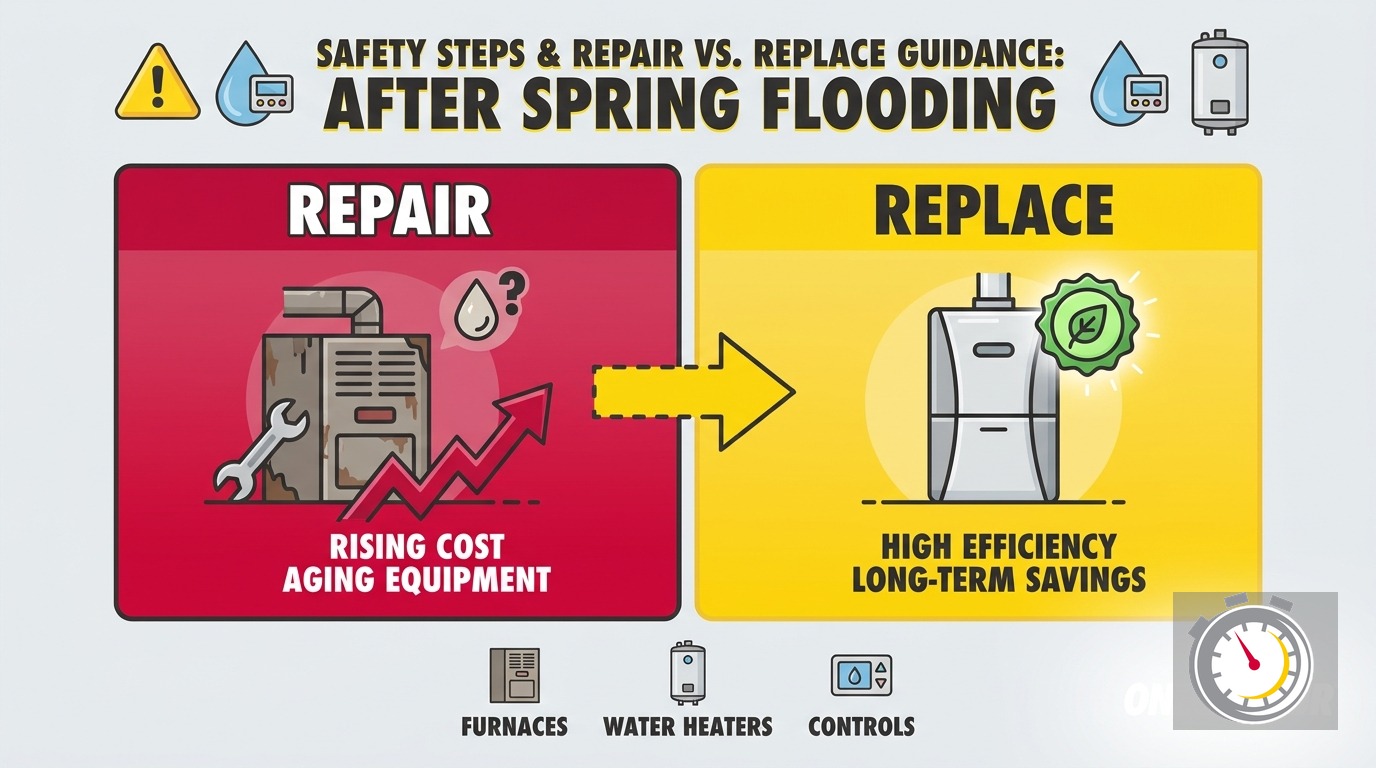
Can a flooded furnace be repaired, or does it need to be replaced?
Sometimes it can be repaired. The gas valve is always replaced. Motors, boards, burners, and venting depend on how high the water rose and how long it sat. If damage is broad or the unit is old, replacement is often smarter.
There is no single answer. The CPSC says a qualified technician should check submerged fans, motors, electric circuits, and venting before use. It also says entire appliances may need replacement.
Here is the decision rule we use. It is a guide, not a promise. Every flooded furnace gets its own evaluation.
Lean toward repair when:
- Water only reached the lower cabinet and did not touch the control board.
- The furnace is under about 10 years old.
- The blower motor and inducer are above the waterline.
- The gas valve is the only major part that must be replaced.
Lean toward replacement when:
- Water covered the control board, blower, or inducer.
- The unit is near the end of its life. Our guide on how long furnaces last in Minnesota can help you judge.
- Rust, mud, or silt got into the burners or heat exchanger area.
- Repair costs would climb close to a new system.
Fixing an old furnace after a flood is like putting a new roof on a house with a bad foundation. One part works, and three others fail next winter. We will tell you if repair is the better deal. We will also tell you if it is not.
What does a technician check on a flooded furnace?
A technician checks the gas valve, burners, venting, blower and inducer motors, control board, wiring, and safety switches. They also test for gas leaks and combustion safety before anyone restarts the furnace.
A real flood inspection is more than a quick look. Here is what we check.
Gas train. We replace the gas valve. We check the lines and fittings for rust or leaks, and we test every joint.
Burners and heat exchanger area. The Indiana State Department of Health advises that burners should be removed if possible, cleaned, and dried to prevent rust and clogged orifices. Clogged orifices cause poor flames and unsafe combustion.
Venting and chimney. The same page says the smoke pipe and chimney should be inspected and cleaned if necessary. Water, silt, or debris in a vent can block exhaust. On high-efficiency units, we also check the plastic vent and drain.
Motors. A wet blower or inducer motor may fail weeks later, not on day one. We test each one. Some can be dried and cleaned, but many are cheaper to replace.
Control board and wiring. Boards do not like water. Even a board that powers up may fail early from corrosion. We check connectors and wiring for moisture.
Safety switches. Pressure switches, limit switches, and rollout switches protect your home. We test them all.
The Indiana page also says that all heating-system parts exposed to floodwater should be thoroughly cleaned and dried. Drying takes time. Rushing a restart turns small damage into big damage.
What about water heaters, boilers, and dryers?
They need the same caution. Gas water heaters and dryers have gas control valves that should be replaced if submerged. Boilers need a full inspection. Electric water heaters involve wiring and should go to a licensed electrician.
Most flood guides talk only about the furnace. Your basement likely has more.
Minnesota Energy Resources tells homeowners to hire a qualified contractor to inspect appliances such as gas furnaces, water heaters, and dryers. The utility will not turn service back on until those appliances are inspected and safe.
Gas water heaters. The CPSC says gas control valves on water heaters that were under water should be replaced. The tank may be fine. The valve is not.
Gas dryers. The same rule applies to the gas valve. Have it checked before you run a load.
Boilers. If you heat with hot water, a flooded boiler needs a full evaluation of the gas valve, controls, circulator, and zone valves. Our boiler repair and maintenance team handles this work. Replacement of a condensing boiler typically runs $9,100-$15,600 installed.
Electric water heaters. This is electrical work. Northern One Hour does HVAC only, so we do not replace electric water heaters. Call a licensed electrician, or contact our sister Northern brands for electrical and plumbing help.
How much does it cost to fix or replace a flooded furnace?
Costs range widely. Small repairs run from about $95 to $900. A blower motor can reach $2,200. A full furnace replacement typically runs $3,900-$7,800 installed in the Twin Cities. Higher-efficiency models cost more.
Prices depend on what the water touched. Here are typical Twin Cities ranges for common flood-related jobs. They are ballpark figures, not quotes.
- Flame sensor or igniter service: $95-$325
- Draft inducer motor: $375-$900, and brand-specific models can run $500-$1,650
- Control board, installed: about $750
- Blower motor, installed: about $1,100 for a PSC motor and about $2,200 for an ECM motor
- Furnace replacement, installed: $3,900-$7,800
Efficiency changes the price of a new furnace. An 80% AFUE furnace starts around $4,950. A 95-96% model starts around $6,500. A 97-98% model starts around $9,100.
After-hours work carries a premium of $180-$270 per hour on top of standard rates. We tell you before we start.
Add up the repairs. If three or four of these parts are on the list, a new system often makes more sense. Our furnace replacement cost guide breaks down what drives the price.
Financing is available for larger jobs, so a sudden replacement does not have to be paid in one hit. Ask our team about options when you book.
Will homeowners insurance cover a flooded furnace?
It depends on the water source. Standard policies often cover sudden water damage from roof leaks, but usually exclude flood damage. Sump-pump backup is a separate add-on on many policies. Call your agent early and document everything.
This question catches many homeowners off guard. The WCCO report says standard home insurance usually excludes flood insurance. It also says flood policies have a 30-day waiting period, so you cannot buy one after the water is already at your door.
The Insurance Federation of Minnesota, quoted in the same article, says standard policies typically cover sudden water damage from roof leaks from rain or melting snow, including ice dams. They typically do not cover external flooding such as rising ground water.
So where does a basement flood from a failed sump pump land? It depends on your policy. Check whether you have sump-backup coverage. That add-on often decides the claim.
Here is how to protect your claim:
- Take photos and video before you move anything.
- Keep damaged parts if your adjuster wants to see them.
- Save every receipt and written estimate.
- Ask us for a written inspection report. We provide one.
- Do not throw out a gas valve or control board until your adjuster says you can.
Our post on homeowners insurance and HVAC coverage in Minnesota explains what policies commonly cover and where gaps appear.
What if your furnace floods in the middle of winter?
Treat it as a no-heat emergency. Stay safe first. Then keep your family warm in a dry upper floor, protect your pipes, and call an HVAC company that offers fast service. Never use a gas oven or grill for heat.
Spring melt is not the only flood risk. A burst pipe or a failed sump pump in January can put water around your furnace too. In Minnesota, that means a cold house fast.
Here is how to get through the first night:
- Close doors to a single warm room on an upper floor.
- Use blankets and layers before you use any heater.
- If you use a space heater, plug it into a dry outlet far from water. Never run it unattended.
- Never use a gas oven, camp stove, or grill to heat the home. Carbon monoxide builds fast.
- Open cabinet doors under sinks on exterior walls to keep pipes from freezing.
- Check on older neighbors and family members who may be at risk.
Frozen pipes can double the damage. Read our guide on frozen pipes and HVAC failure risk if the house is losing heat.
In an emergency, time matters. Our promise is simple: “Always On Time… Or You Don’t Pay a Dime!(R)” We arrive within the time window you select. If our technician does not show up on time, you do not pay for the service. A cold house cannot wait, so we keep that promise.
How do you keep a sump failure from flooding your furnace again?
Test your sump pump each spring, add a battery backup, clear snow from your foundation, and raise your furnace if you can. Small steps now are far cheaper than replacing a furnace later.
You cannot stop every storm. You can make your basement tougher.
Test the pump. The WCCO report gives a simple test. Pour a bucket of water into the pit and check that it drains. Do it before the melt, not during it.
Clear the perimeter. The same article advises clearing a few feet of snow from around your foundation. That gives meltwater less reason to head for your walls.
Add a battery backup. Heavy melt often comes with storms and outages. A battery backup keeps the pump running when the grid does not. A water-powered or battery system can be the difference between a damp floor and a ruined furnace.
Check your insurance. Ask about sump-backup coverage now. Do not wait for the water.
Raise the equipment. When we install or replace a furnace in a flood-prone basement, we can often set it on a raised platform. A few extra inches can keep burners and the control board out of shallow water. Ask about this when you plan a furnace replacement.
Watch humidity. Even a dry basement can feel damp after a wet spring, and moisture hurts equipment over time. Our guide on basement humidity control in summer shows what helps.
What Not to Do After a Furnace Flood
Some mistakes are common. Avoid them.
- Do not restart the furnace to “see if it works.” A wet board or damaged valve can create a fire or gas hazard.
- Do not reset breakers that were underwater. The CPSC says replacing them is the only safe action.
- Do not hire the lowest bidder without checking licensing. Flood work is safety work.
- Do not skip the utility call. Service cannot be restored without an inspection.
- Do not assume a dry-looking unit is fine. Silt and corrosion hide inside valves and boards.
- Do not wait on insurance paperwork to get an inspection. Get the safety work done, and document it.
If you are unsure about a contractor, our list of HVAC contractor red flags is a useful check.
Permits and Paperwork
Replacing a furnace or water heater often requires a mechanical permit. Rules vary by city. Some cities allow emergency work to start before the permit is filed, but the details differ.
Call your city building department to confirm what applies in your area. Our team can walk you through the process, and we handle the paperwork on jobs we install.
Keep copies of every permit, invoice, and inspection report. You will want them for insurance and for the day you sell the home.
Why Call Northern One Hour After a Flood
A flooded furnace is stressful. You need a clear plan and a crew you can trust.
We are locally owned and operated in the Twin Cities. We live in the same winters and the same spring melts you do. We know how fast a basement can turn from a laundry room into a lake.
Here is what you get when you call us:
- A safety-first inspection of the furnace, venting, and controls
- Honest advice on repair versus replacement, with prices you can see
- Written findings you can hand to your insurance adjuster
- Financing for larger jobs, so a sudden replacement is easier to manage
- Our on-time promise: “Always On Time… Or You Don’t Pay a Dime!(R)” We arrive within the window you pick. If we are late, you do not pay for the service.
Your first calls are your gas and electric utilities. Your next call is us.
Call (763) 260-6662 or book online to schedule a flood inspection. We will help you get the heat back on safely.
Frequently Asked Questions
Can I turn on a furnace that was under water? +
Does a flooded furnace always need to be replaced? +
Who turns off the gas to a flooded basement? +
Does homeowners insurance cover a flooded furnace? +
Need a technician now?