
Furnace Tune-Up Cost Minnesota: What Homeowners Pay
Key Takeaways
- A furnace tune-up in Minnesota runs $99 to $235, with a Minneapolis market average around $155.
- A thorough inspection takes 45 to 90 minutes. Anything under 30 minutes is not a complete tune-up.
- CenterPoint Energy customers can claim a $25 prepaid Mastercard rebate after a qualifying tune-up, once every other year per system.
- Book in September or October, before contractor schedules fill for the winter rush.
- Minnesota furnaces may run 12 or more hours per day in a typical January. At a design temperature of -9°F for Minneapolis-St. Paul, the furnace is life-safety equipment, not a seasonal comfort appliance.
- Every tune-up includes a heat exchanger inspection. A cracked exchanger lets carbon monoxide into the living space. Safety codes require shutting the system down until it is replaced.
What Does a Furnace Tune-Up Cost in Minnesota?
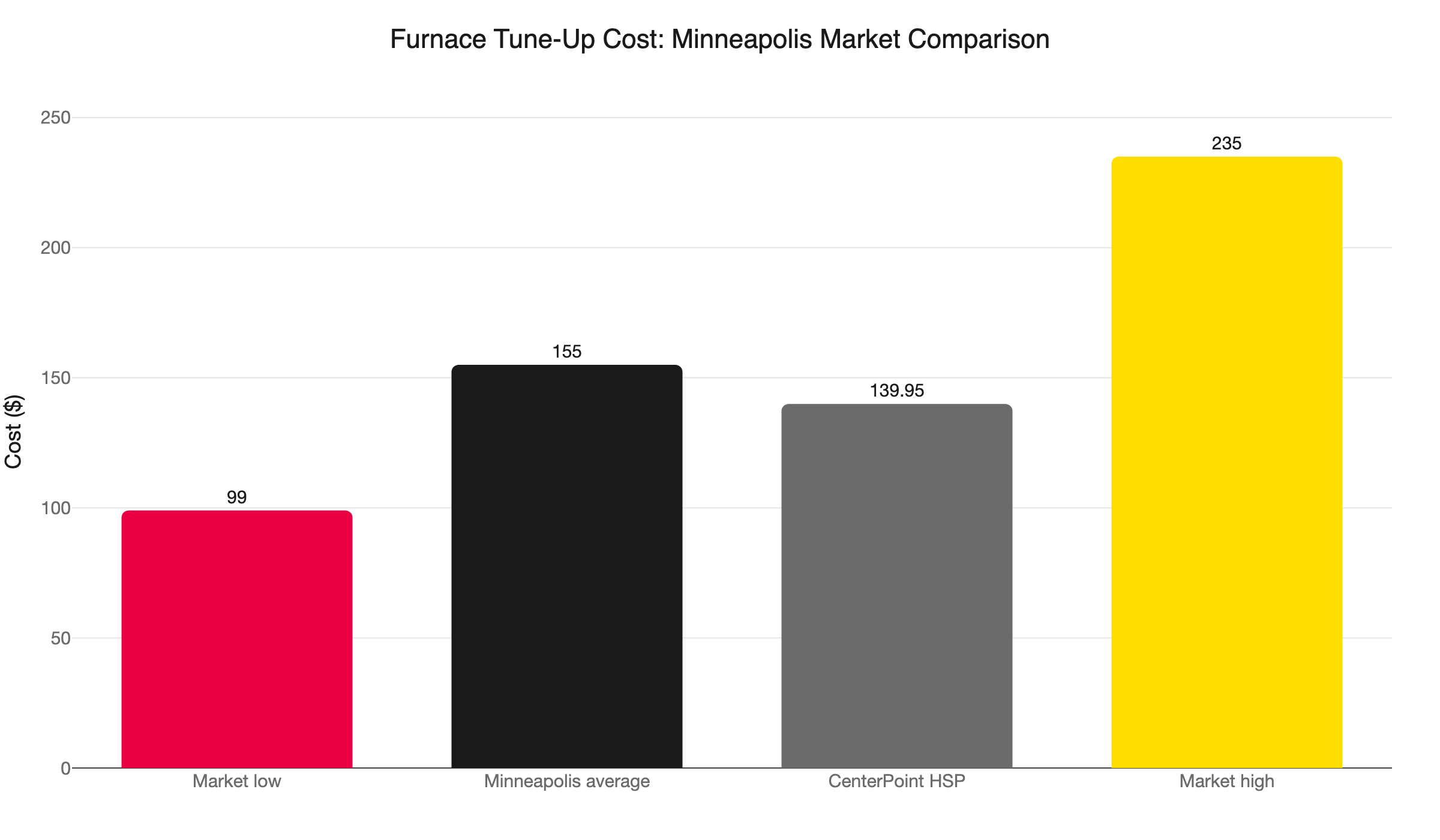
The short answer: The Minneapolis-area market runs $99 to $235, averaging around $155 per visit. Most reputable local HVAC companies land between $100 and $160 for a single-system visit. CenterPoint Energy Home Service Plus charges $139.95 per unit, with additional units at $104.95 each.
A few variables push you higher or lower in that range. High-efficiency furnaces with variable-speed components take longer to test. Systems with PVC exhaust venting add a condensate drain inspection. Travel distance matters less in the metro than in outer-ring communities, but it can add a small premium for homes farther from a service hub.
Be careful with unusually low advertised prices. A $49 tune-up listed online is almost always a lead-generation tactic. Those visits run short, skip major checklist items, and often end in a high-pressure upsell on components that may not need replacing. The price you pay also reflects what happens after. A $130 tune-up from a company with fair follow-up rates is a better value than a $50 visit from one that marks up every part it recommends.
According to furnace.direct’s Minnesota guide, a visit that wraps up unusually quickly is a red flag. A complete inspection takes 45 to 90 minutes. That is time you should expect the technician to spend.
Annual maintenance plans bundle the fall furnace tune-up with a spring AC tune-up. The typical range in the Minneapolis market is $150 to $250 per year. At Northern One Hour, plans run $195 to $390 depending on system configuration. The combined plan usually costs less than two separate single-visit calls, and it includes priority scheduling, which matters a great deal when your furnace stops working at -10°F in January.
Current scheduling options are at our furnace tune-ups service page.
What Does the Tech Actually Check?
The short answer: A full tune-up covers the heat exchanger, burner flame and gas pressure, ignitor, flame sensor, flue and vent system, electrical connections, safety controls, blower wheel, temperature rise, thermostat calibration, and filter condition. Each item has a specific purpose. Working through the complete checklist takes 45 to 90 minutes.
Here is what each step involves and why it matters.
Heat exchanger. The tech inspects for cracks or pinholes using a camera probe and a combustion analyzer. This is the most consequential item on the list. A cracked heat exchanger allows carbon monoxide and flue gases to enter the living space. You cannot detect it by smell or sight. Safety codes require shutting the system down until the exchanger is replaced. If a tune-up surfaces a heat exchanger concern, our post comparing heat exchanger repair cost versus a new furnace in Minnesota walks through the decision in detail.
Burner flame and gas pressure. The tech reads the flame pattern - a steady blue flame is correct, a rolling yellow flame is not - and checks gas pressure with a manometer against the manufacturer’s specification. Off-spec pressure causes incomplete combustion, which reduces efficiency and increases carbon monoxide output.
Ignitor and flame sensor. These two parts fail more often than almost any other furnace component. The ignitor is checked for cracks. The flame sensor is tested for carbon buildup. A dirty flame sensor is one of the most common causes of a furnace that lights, runs for 30 seconds, and then shuts off.
Flue and vent system. The tech inspects for blockages, corrosion, and improper pitch throughout the vent piping. On high-efficiency furnaces (90%+) with PVC exhaust venting, the condensate drain inspection is added. In Minnesota winters, a clogged or frozen condensate line is a common cause of high-efficiency furnace shutdowns. It is a failure mode specific to 90%+ efficiency systems that most generic tune-up guides skip entirely.
Electrical connections and safety controls. Loose wiring and corroded terminals are common on systems 10 years or older. The tech tightens connections and tests the limit switch and pressure switches. These are the safety components that prevent overheating and downstream heat exchanger damage.
Blower wheel and static pressure. A dirty blower wheel coated in dust and debris reduces airflow across the heat exchanger and forces the system to run longer for the same heating output. The tech inspects the wheel and measures static pressure to confirm airflow is within the system’s design range.
Temperature rise. The tech measures the difference between return-air temperature and supply-air temperature. If that differential falls outside the manufacturer’s specified range, something is wrong with combustion, airflow, or both.
Thermostat calibration and wiring. A check that the thermostat reads accurately and is wired correctly. A miscalibrated thermostat adds unnecessary run time to an otherwise well-tuned furnace.
Filter condition. The tech notes if the filter needs replacement. This is something you can handle yourself between annual visits. Our filter replacement frequency guide covers the right schedule for different filter types and household conditions.
This level of inspection is what separates a genuine tune-up from a quick visual check. The checklist above is consistent with what industry technicians document in published walkthroughs, including Apex Clean Air’s fall tune-up breakdown and the Jackson Comfort technician checklist.
When Should You Schedule a Furnace Tune-Up in Minnesota?
The short answer: September or October. That is the window before heating companies fill their schedules for the winter rush. Waiting until November means limited availability. An emergency repair call in January carries after-hours rates of $180 to $270 per hour on top of the standard service cost.
Minnesota’s heating season is long and demanding. Minneapolis logs 7,399 heating degree days per year based on NOAA’s 1991-2020 normals. That is nearly double the national average of around 4,500. The ASHRAE 99% design temperature for Minneapolis-St. Paul is -9°F. The system is engineered to hold a comfortable interior temperature against conditions that harsh.
When it drops to -9°F outside, the furnace is not a comfort appliance. It is life-safety equipment. And it runs hard. Furnaces in Minnesota may run 12 or more hours per day during a typical January. A partially clogged condensate drain, a slightly dirty flame sensor, or a loose electrical connection carries far more risk under sustained load than it does in early October.
Fall tune-ups also give you time to plan. If the tech finds an aging heat exchanger or a blower motor approaching failure, you have weeks to compare replacement quotes, review rebate options, and make a considered decision. A breakdown at -15°F in February does not afford you that time.
Book before the system runs for the first cold morning of fall. In the Twin Cities, that window falls in September or early October. It is the right time from both a scheduling standpoint and a planning standpoint.
What Happens When You Skip the Annual Tune-Up?
The short answer: Efficiency erodes, small problems compound into expensive repairs, and safety risks go undetected. Proper maintenance can reduce energy consumption by 5% to 15%, and a cracked heat exchanger - the most serious safety risk - produces no visible symptoms. It is only reliably caught during a proper inspection.
Skipping a tune-up does not cause immediate failure. The effects accumulate. The DOE estimates that proper HVAC maintenance can meaningfully reduce energy consumption. On a Minnesota furnace running from October through April, that range is meaningful on an annual utility bill. ENERGY STAR data shows a certified high-efficiency northern-climate gas furnace saves an average of $160 per year versus a baseline model. A poorly maintained system gives back much of that efficiency advantage through degraded combustion, reduced airflow, and worn components.
The bigger cost is deferred repair. A flame sensor cleaned during a $150 tune-up costs far less than the after-hours service call when it fails on a cold Sunday night. A heat exchanger caught during an annual inspection gives you time to plan. One caught after carbon monoxide has been entering the living space is an emergency with no good timing.
Most manufacturers also require documented annual maintenance to keep the warranty active. A major component failure on an unmaintained system may fall outside warranty coverage, turning a repair that should have been covered into a full out-of-pocket cost.
The CenterPoint $25 Rebate: Does It Apply to You?
The short answer: If you are a CenterPoint Energy customer, yes. A qualifying tune-up makes you eligible for a $25 prepaid Mastercard rebate, once every other year per system. The technician submits the rebate online. Ask when you schedule whether the planned visit meets the qualifying checklist.
The qualifying inspection must include a CO test, flame check, flue inspection, igniter and sensor check, filter check, motor lubrication, and controls check. Your technician submits the rebate claim online on your behalf. Full details are at Thrifty Minnesota.
The rebate does not offset the full cost of a tune-up, but it is money back on work you were going to do anyway. If your household qualifies for CenterPoint’s income-based assistance programs, there may be additional options worth asking about when you call.
If the tune-up turns up something more serious, the replacement rebate picture improves the cost math. CenterPoint offers $300 for a 94 to 95.9% AFUE replacement and $400 for 96%+, with income-qualified households eligible for up to $1,200. Xcel Energy’s rebate runs $200 to $400 depending on efficiency tier. Our Xcel and CenterPoint rebate guide covers how to stack the available programs.
How Long Should a Proper Tune-Up Take?
The short answer: 45 to 90 minutes. A visit that wraps up in under 30 minutes is not a complete inspection. The heat exchanger check alone, done with a combustion analyzer, takes time. A blower wheel inspection requires opening the unit and looking at the wheel directly.
Speed is not a sign of skill here. When you call to schedule, ask how long a typical tune-up visit runs. If the answer is vague or well under 45 minutes, that tells you what you are actually buying. A technician who books four tune-ups in two hours is not doing the job the same way as one who books two.
At Northern One Hour, we schedule the full time so the visit covers every item on the checklist. If the tech finds something during the inspection, you get a clear explanation of what was found and what the options are before any additional work is authorized.
Is an Annual Maintenance Plan Worth It?
The short answer: For most Twin Cities homeowners with both a furnace and central AC, yes. A plan at $195 to $390 covers both systems with two scheduled visits, typically costs less than two separate single-visit calls, and includes priority scheduling. If your equipment is 5 or more years old, the plan tends to pay for itself in avoided repair costs within a few years.
A standalone tune-up makes more sense if your equipment is new and still under the manufacturer’s warranty, and you are comfortable tracking your own maintenance calendar. For most homeowners with systems 5 or more years old, the annual plan is the simpler and usually cheaper option.
If you are weighing the two choices, our post on what an AC tune-up includes and costs in Minnesota runs the same checklist analysis for the cooling side. Reading both gives you a full picture of what a combined plan covers.
Priority scheduling is the benefit that is easiest to underestimate before you need it. When the furnace stops working on a cold night, a maintenance plan customer moves to the front of the service queue. In Minnesota, that is worth more than it sounds.
Book Your Fall Tune-Up Before the Rush
We are locally owned and operated in Ramsey, serving Minneapolis, St. Paul, Blaine, Maple Grove, Plymouth, Brooklyn Park, Woodbury, Bloomington, and the wider Twin Cities metro.
When you book with Northern One Hour, you pick the arrival window. If our technician does not arrive in that window, you do not pay for the service. That is what “Always On Time… Or You Don’t Pay a Dime!(R)” means in practice: a commitment tied to every appointment.
After the inspection, the technician walks you through the findings. You get a clear explanation of what the system is doing well, what needs attention, and what can wait - before any additional work is authorized.
Fall slots fill up as the heating season approaches. Calling in September or early October gives you the most flexibility on timing. Call (763) 260-6662 or book online through our furnace tune-up service page.
If the inspection turns up something more serious, we can help you think through the options. Our post on whether to replace just the AC or bundle it with the furnace is a good starting point if equipment age has become part of the conversation.
Frequently Asked Questions
Are furnace prices going up in 2026? +
Is it cheaper to replace the AC and furnace at the same time? +
Need a technician now?