
Heat Exchanger Replacement Cost Minnesota: Repair or Replace?
Key Takeaways
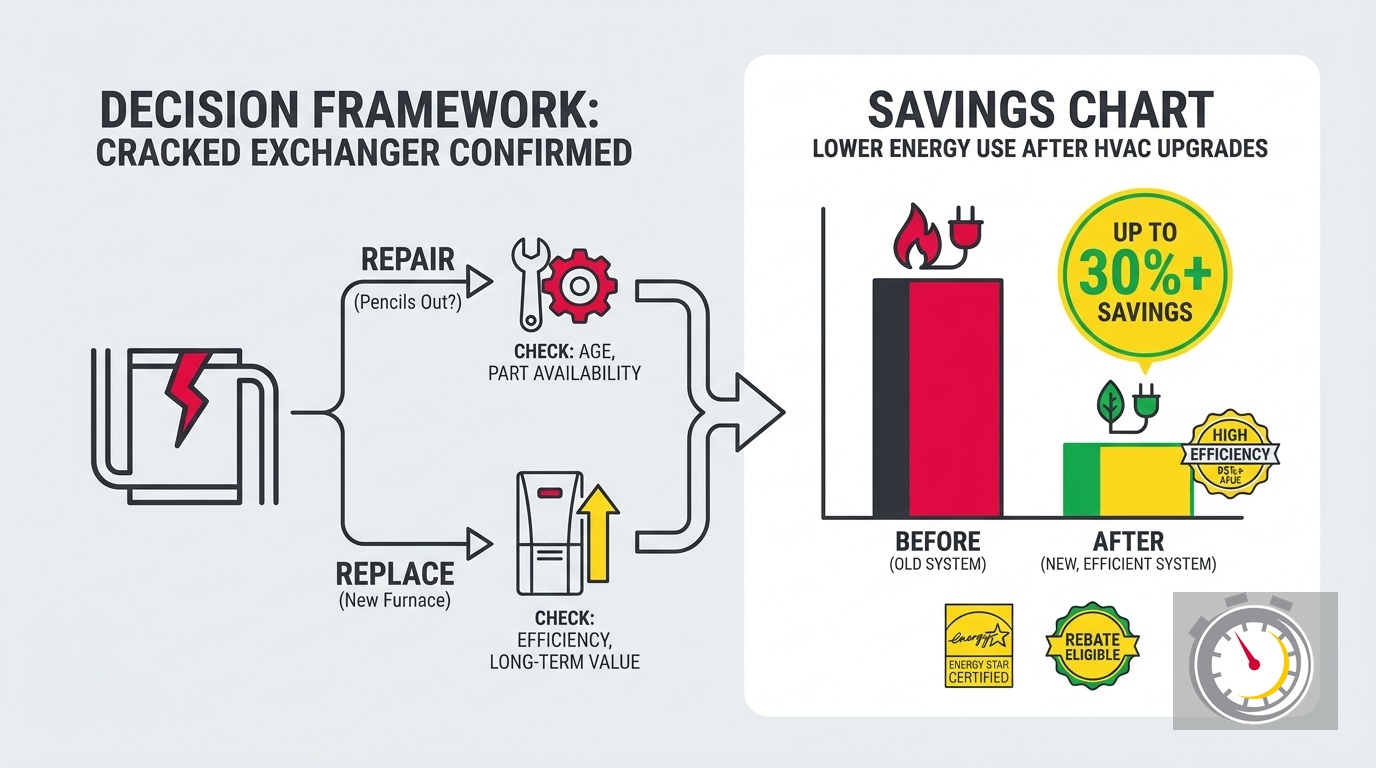
- Heat exchanger replacement cost in Minnesota runs $1,000-$3,000 for parts and labor. On a furnace under 10 years old with an active parts warranty, you may pay labor only - roughly $650-$2,150.
- On a furnace 12 years or older, heat exchanger repair often exceeds 50% of the cost of a new unit. At that point, replacement is usually the smarter call.
- OEM heat exchanger assemblies are frequently discontinued for furnaces 15 years or older. If the part is not available, repair is not a real option at any price.
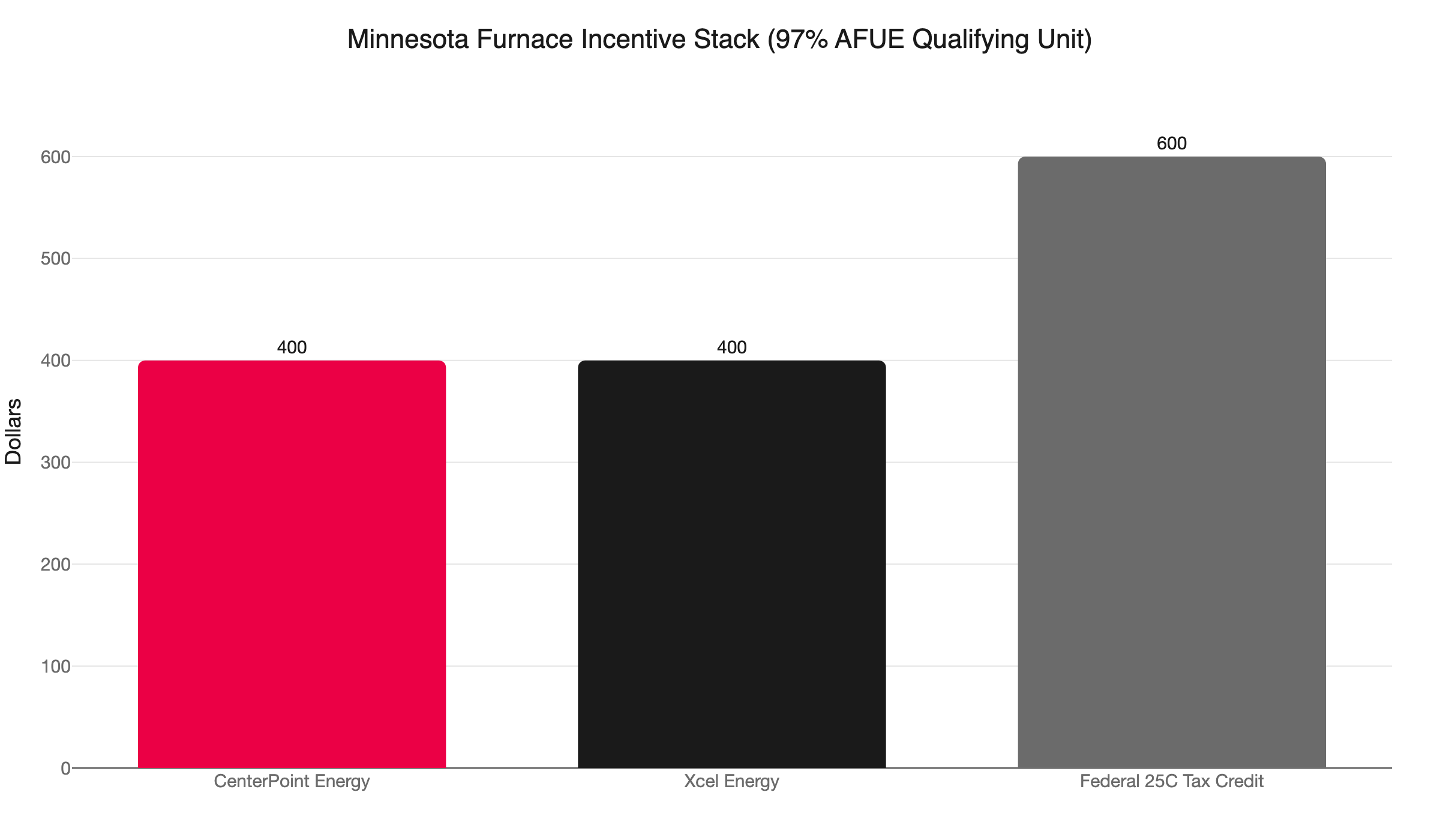
- A qualifying 97% AFUE furnace can unlock up to $1,400 in stacked incentives: $400 from CenterPoint Energy, $400 from Xcel Energy, and $600 from the federal 25C tax credit.
- A DOE rule effective late 2028 raises the federal minimum furnace efficiency to 95% AFUE. An 80% unit you repair today will fall below that floor when it eventually needs replacing again.
- Get a written diagnosis with combustion analysis results or borescope images before authorizing any work.
What Is a Heat Exchanger, and Why Does a Crack Matter?
The short answer: The heat exchanger is the metal chamber that separates combustion gases from the air your family breathes. A crack allows carbon monoxide into your living space. That is an evacuation-level safety event - not a “keep an eye on it” situation.
Your furnace burns gas to generate heat. The heat exchanger captures that heat and transfers it to the air moving through your ductwork. At the same time, it keeps combustion byproducts - including carbon monoxide - contained and vented outside. When the exchanger cracks, that separation fails.
CO is odorless and colorless. You cannot detect it without a working detector. Before you relight any furnace tagged for a cracked heat exchanger, verify that CO detectors are working on every level of your home. Replace any detector that is more than seven years old. If any CO alarm is sounding, get everyone out and call 911 first. That step comes before any repair-or-replace decision.
Once the immediate safety question is handled, you are left with a financial decision. This post walks you through that decision in four sequential steps. Skipping any one of them can cost you money - or lead you to a repair that was never a real option.
How Much Does Heat Exchanger Replacement Cost in Minnesota?
The short answer: Parts run $350-$850 and labor runs $650-$2,150, for a total of roughly $1,000-$3,000 depending on your furnace brand, model, and how accessible the exchanger assembly is.
That range is wide for a reason. Heat exchangers are not universal parts. A secondary heat exchanger on a 96% AFUE condensing furnace is a completely different assembly than the primary on an older 80% unit. The labor hours also swing based on your setup. An exchanger buried in a tight mechanical closet takes considerably longer to reach than the same part in an open basement.
Here is the number that puts the whole range in context. If your repair quote lands at $2,500 and a new mid-tier furnace installed in the Twin Cities starts around $4,950, you are spending more than 50% of replacement cost to keep an old unit running. The four steps below help you determine whether that math applies to your situation - and what to do about it if it does.
Should You Check the Warranty Before Calling for an Estimate?
The short answer: Yes, and do it first. Heat exchanger warranties on major brands typically run 10-20 years, or lifetime on that specific component. A covered part transforms your out-of-pocket cost from $1,000-$3,000 to labor only.
Heat exchanger warranties are often the longest warranties on any component of a furnace. Manufacturers treat the exchanger as the structural core of the unit, and their warranty terms reflect that. If your furnace is seven years old and the heat exchanger carries a 20-year parts warranty, the component itself costs you nothing. You pay for the technician’s time, which typically runs $650-$2,150. That is a very different conversation than the full parts-and-labor range.
How to check your warranty:
- Locate the data plate on your furnace. It lists the manufacture date, model number, and serial number.
- Look up your specific model on the manufacturer’s website. Warranty terms vary by product line, not just brand.
- If you registered the unit at purchase, your warranty card or online account has the details on file.
- A licensed contractor can pull warranty terms from the model number during a diagnostic visit.
If the part is under warranty and the exchanger is available, repair is almost certainly the right call. If the warranty is expired or the unit was never registered, move to Step 2.
What If the OEM Part Is No Longer Available?
The short answer: If the manufacturer has discontinued the heat exchanger assembly for your model, repair is not a viable option regardless of your warranty status or budget. You are replacing the furnace.
This is the question most homeowners - and some contractors - skip. It is also the one that most often turns “should I repair or replace?” into a decision that has already been made for you.
Older furnaces frequently have no OEM heat exchanger assembly available. Manufacturers discontinue these assemblies on a rolling basis as product lines age out of production. When the OEM part is gone, your contractor is left with three paths, none of them good:
- Source an aftermarket or pulled-used assembly. These carry no manufacturer backing and no meaningful service history.
- Hunt for new-old-stock across multiple distributors. This can take weeks and frequently comes up empty.
- Replace the furnace.
Ask your contractor directly: “Is the OEM heat exchanger for my model and serial number currently in stock, and what is the lead time?” A clear answer to that question narrows your options fast. If the part is unavailable or backordered by weeks, the decision has already been made. Skip the remaining math steps and move to planning a replacement.
How Do You Know When a New Furnace Makes More Financial Sense?
The short answer: Two thresholds help. If repair cost is at or above 50% of replacement cost on a furnace over 10 years old, replace. Or multiply the furnace’s age by the repair cost in dollars - if that number is high, replacement is typically the better call.
Newer furnaces with an active warranty are repair candidates. Furnaces well past their expected service life lean strongly toward replacement.
Let us run both tests on a concrete example. Say your furnace is 14 years old and the repair quote is $2,000.
- 50% rule: A mid-tier replacement starts at $4,950 installed. $2,000 is roughly 40% of that - technically under the threshold.
- Age x cost: 14 x $2,000 = $28,000. That is well over the $5,000 threshold.
Both tests together give a clearer picture than either one alone. A 14-year-old furnace this close to the 50% rule, with an age-cost score that high, is not a repair candidate. Repair costs also rarely stop at one event. You are buying time on a system that is already at or past its reliable service life.
What does a new furnace cost in Minnesota?
Installed prices in the Twin Cities start around $4,950 for a standard 80% AFUE unit, $6,500 for a 95-96% AFUE model, and $9,100 or more for a top-tier 97-98% AFUE furnace. Our full furnace replacement cost guide for Twin Cities homeowners breaks those ranges down by tier. The actual quote depends on your home’s size, existing ductwork condition, and the model your contractor installs.
The efficiency argument in Minnesota is stronger than the national numbers suggest
Our heating season runs six months or more. Minneapolis homeowners run their furnaces from October through April, sometimes longer. That extended run time changes the payback math on efficiency upgrades considerably compared to national averages.
Upgrading from 80% to 96%+ AFUE in Minnesota saves approximately $150-$250 per year in gas costs at average usage. In a high-usage home with an aging 80% unit, the savings can run higher. Over a decade, that is $1,500-$2,500 in recovered costs - before any rebates. Our breakdown of furnace AFUE ratings and what they mean for Minnesota homeowners shows the full math, including how the savings grow in colder zip codes and larger homes.
What Does the 2028 Efficiency Mandate Mean for Your Decision?
A piece of the decision that most homeowners do not hear about: the DOE finalized a rule that raises the minimum efficiency standard for non-weatherized residential gas furnaces to 95% AFUE, effective late 2028.
Here is what that means in practice. If you repair an 80% AFUE furnace today, you still own an 80% AFUE furnace when this rule takes effect. Existing equipment is grandfathered - you are not forced to replace it. But when that furnace eventually fails or needs significant work again, a licensed contractor cannot install a new 80% unit in its place. You will be choosing a replacement under that constraint, rather than on your own terms and timeline.
There is also a resale consideration. A home with a flagged-below-minimum furnace will draw questions during an inspection and may require disclosure depending on how the transaction is structured.
The mandate does not change the repair-or-replace math by itself. But if the numbers are already pointing toward replacement, it removes any remaining reason to land on the lower-efficiency option when choosing a new unit.
What Rebates Can Minnesota Homeowners Stack on a New Furnace?
The short answer: Up to $1,400 in stacked incentives is available right now for a qualifying 97% AFUE furnace - $400 from CenterPoint Energy, $400 from Xcel Energy, and $600 from the federal 25C tax credit.
Here is how each piece works.
CenterPoint Energy (natural gas customers)
CenterPoint offers up to $400 for a 95%+ AFUE furnace installation. Income-qualified households can receive up to $1,200. The rebate requires a participating contractor and a completed Trade Ally enrollment form submitted at the time of installation. The check arrives 6-10 weeks after the job is complete.
Xcel Energy
Xcel offers $300 for a 96% AFUE unit and $400 for a 97% AFUE unit. The same contractor participation and paperwork requirements apply as with CenterPoint. If you have both gas from CenterPoint and electric from Xcel, both rebates can be claimed on a single qualifying installation.
Federal 25C Tax Credit
The Inflation Reduction Act expanded the 25C credit. You can claim 30% of qualifying costs, up to $600 for a furnace, within the $1,200 annual cap shared with other home energy efficiency improvements. The unit must meet the CEE highest efficiency tier. File IRS Form 5695 with your return and include the manufacturer’s Qualified Manufacturer ID (QMID) code. There is no carryover of unused credit to the following tax year.
Stack them: $400 CenterPoint + $400 Xcel + $600 federal = $1,400 off a qualifying 97% AFUE furnace.
Both utility rebates require your contractor to be enrolled as a Trade Ally. Confirm that before the installation date, not after. Our full guide to Xcel and CenterPoint HVAC rebates for Minnesota homeowners covers current amounts, eligibility requirements, and step-by-step claim instructions.
Financing is also worth a conversation if the upfront cost is the sticking point even after rebates. Ask our team about current options when you call.
What Heat Exchanger Replacement Cost in Minnesota Looks Like Across Three Scenarios
The four steps above collapse into three common situations. Here is how each one plays out.
Scenario A: 7-year-old furnace, active parts warranty
The exchanger is covered under warranty. Labor runs $650-$2,150. A new furnace starts at $4,950. The repair cost lands well under 50% of replacement, and the furnace has years of productive life ahead. The age-cost formula (7 x $1,400 = $9,800) passes the $5,000 threshold on paper, but warranty coverage is the overriding factor when the part itself costs nothing. Repair is the right call.
Scenario B: 13-year-old furnace, warranty expired, OEM part in stock
Repair quote: $2,200. New furnace starts at $4,950. The repair is 44% of replacement - borderline on the 50% rule but technically under it. The age-cost formula (13 x $2,200 = $28,600) is far over $5,000. This is almost certainly an 80% AFUE unit. A 96% replacement saves $150-$250 per year in gas costs and positions you ahead of the 2028 mandate. Combined rebates can take $1,000-$1,400 off the new unit.
Decision: Replace. Target 96-97% AFUE to maximize rebate eligibility.
Scenario C: 17-year-old furnace, OEM part discontinued
No OEM exchanger is available. Aftermarket sourcing carries unknown quality and no warranty backing. The unit is at or past the end of its expected service life regardless.
Decision: Replace. This is not a close call - the repair option was never real.
What Should I Demand Before Authorizing Any Work?
The short answer: A written diagnosis that includes combustion analysis results or borescope images showing the crack. Do not authorize repair or replacement based on a verbal diagnosis alone.
Reputable contractors document what they find. A written diagnosis with combustion analysis or borescope images is the standard before authorizing any work. Those images confirm the crack is real, show its location and extent, and give you something concrete to reference if you want a second opinion. If a contractor pressures you to decide on the spot without documentation, that is a red flag worth taking seriously. Our post on signs of a cracked heat exchanger in Minnesota homes covers what a thorough technician is actually looking for during a diagnostic visit.
One more thing on the physics. Metal fatigue from thermal cycling is systemic, not localized. The furnace heats and cools thousands of times through a Minnesota heating season. A repair that patches one crack does not stop the metal from developing new ones elsewhere in the assembly. On an older furnace, the exchanger failure is often a symptom of an aging system, not an isolated defect.
What to Do Right Now
A cracked heat exchanger diagnosis in the middle of a Minnesota winter puts you in a time-pressured spot. Here is the sequence:
- If any CO alarm is sounding, get everyone out immediately and call 911. Do nothing else first.
- Check CO detectors on every level. Replace any that are more than seven years old.
- Do not relight the furnace until a qualified technician clears it.
- Find the data plate on your furnace and note the manufacture date, model number, and serial number.
- Look up your warranty terms online, or ask your contractor to pull them by model number during the diagnostic visit.
- Ask the contractor directly: “Is the OEM heat exchanger for this model currently in stock?”
- Run the 50% rule and the age-times-cost formula against your specific quote.
- If replacement makes sense, ask about 96-97% AFUE options and confirm your contractor is a Trade Ally for both CenterPoint and Xcel before the job is scheduled.
Northern One Hour Heating & Air Conditioning is locally owned and operated in Ramsey, MN. Our team serves the Twin Cities and the surrounding metro - Minneapolis, St. Paul, Blaine, Maple Grove, Plymouth, Brooklyn Park, Woodbury, Bloomington, and beyond. We diagnose with documentation, price transparently, and show up when we say we will. “Always On Time… Or You Don’t Pay a Dime!(R)”
Call us at (763) 260-6662 or book online to schedule a diagnostic visit. We will help you work through the decision - not push you toward one.
Frequently Asked Questions
How much does heat exchanger replacement cost in Minnesota? +
Should I repair my heat exchanger or buy a new furnace? +
What rebates are available for a new furnace in Minnesota? +
Is a cracked heat exchanger dangerous? +
Need a technician now?