
Replace Just the AC or Furnace Together: Twin Cities Guide
Key Takeaways
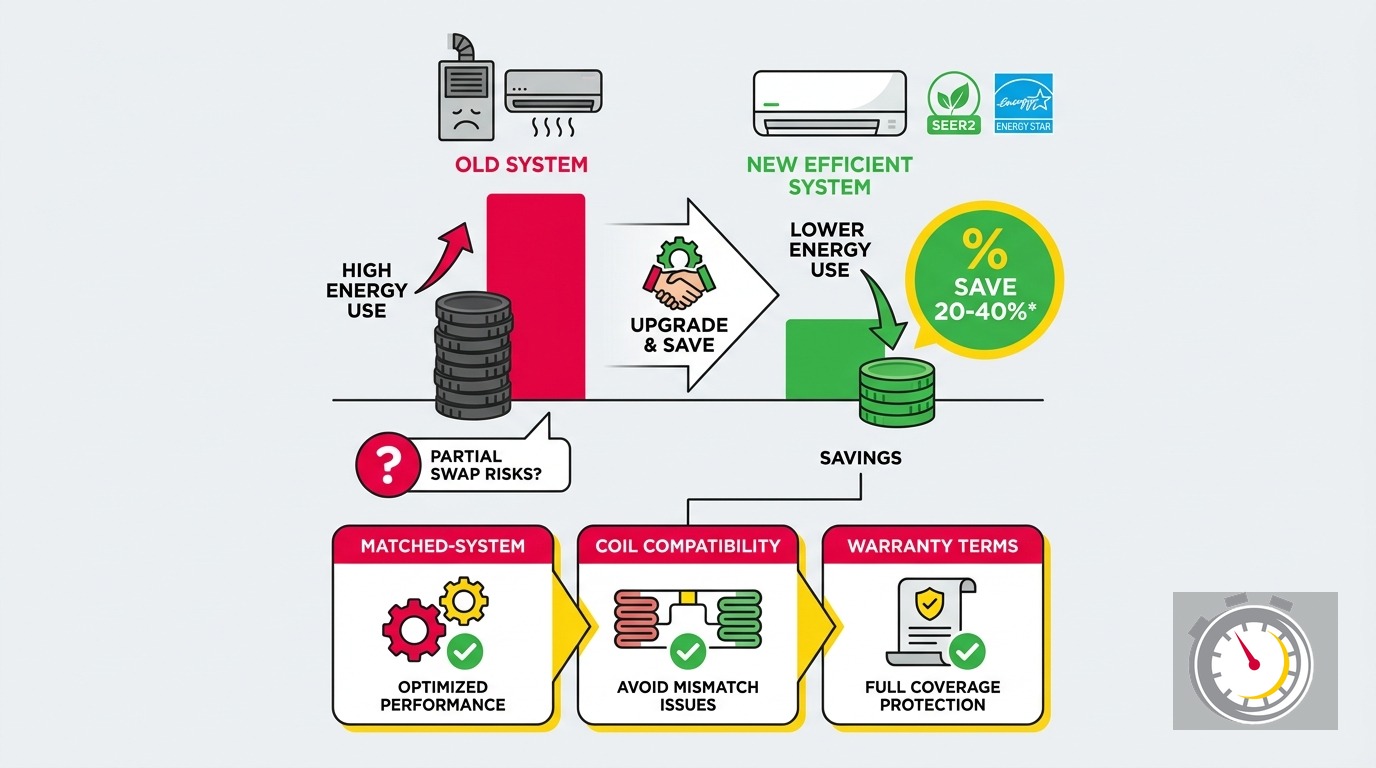
- Pairing a new AC with an old, unmatched furnace coil costs you 20-30% of the new unit’s rated efficiency before it runs its first cycle.
- Replacing the outdoor condenser without a matched indoor coil voids the manufacturer’s warranty. All repairs come out of pocket from day one.
- Every furnace and AC replacement in Minnesota requires a mechanical permit. Only a DLI-licensed contractor can pull it.
- Minneapolis and St. Paul require 90% AFUE for replacement furnaces. Most suburbs default to the statewide 80% minimum.
- Xcel Energy discontinued its gas furnace rebate as of January 1, 2026. Stacked utility rebates are only available when you replace both systems.
- Replacing both systems in one visit typically costs less than two separate jobs and unlocks incentives you cannot stack any other way.
Should You Replace Just the AC or Furnace Together, or Both?
Short answer: If one system is near end of life and the other has fewer than five years left, replace both. If the second system is genuinely new and the indoor coil is already matched to the replacement condenser, a partial swap can work - but it is a narrow window.
This question sounds simple. Your AC died, your furnace still runs. Why spend money you do not have to? Or your furnace quit in January and you want to defer the AC until summer. Both instincts are reasonable. But the answer depends on four things most homeowners do not know to ask about: matched-system certification, warranty terms, Minnesota code minimums, and how utility rebates stack in 2026.
We are locally owned and operated in Ramsey, serving Minneapolis, St. Paul, Blaine, Maple Grove, Plymouth, Brooklyn Park, and the surrounding Twin Cities area. We see this decision play out across hundreds of homes every year. Here is what you need to know before you make it.
What Is a Matched HVAC System, and Why Does It Matter?
Short answer: A matched system is a specific outdoor condenser paired with a specific indoor coil, tested together and registered in the AHRI Directory. That registration is what earns the SEER2 efficiency rating on the equipment label. An unregistered pairing cannot claim that rating.
Your central air system has two refrigerant-side components: the outdoor condenser (the unit beside your house) and the indoor evaporator coil (the A-frame unit above your furnace). Manufacturers test these components as a pair and submit the results to the Air-Conditioning, Heating, and Refrigeration Institute (AHRI). The AHRI Directory certifies each tested combination and assigns its SEER2 and EER2 ratings.
When you replace just the condenser and leave the old coil in place, the combination was never tested together. The efficiency rating on the new unit’s label applies to the certified pairing - not to your specific combination. You cannot claim that rating, because it does not cover what you installed.
This matters for two concrete reasons.
First, you paid for efficiency you will not get. According to research from CenterPoint Energy, an old furnace blower paired with a new high-efficiency AC can reduce the new unit’s efficiency by an estimated 20-30%. A 16 SEER2 system carrying that penalty runs closer to 12 SEER2. That gap shows up on your utility bill every month.
Second, federal minimum efficiency standards are tested on matched pairs. The federal minimum for new central ACs in northern states, including Minnesota, is 14 SEER2 as of 2023. An unregistered pairing cannot demonstrate compliance with that standard, which affects whether the installation clears permit inspection.
What Happens When You Pair a New AC With an Old Furnace Coil?
Short answer: Reduced cooling capacity, poor humidity control, and premature component failure - on top of the efficiency loss. The parts working hardest to compensate for the mismatch are the parts that fail first.
An old evaporator coil can be undersized, fouled from years of use, or built for a different refrigerant charge. Even a physically compatible coil causes performance problems when it was sized for a different system capacity.
Research on mismatched HVAC systems documents the failure modes homeowners encounter:
- Reduced cooling capacity. The system cannot move heat efficiently. Your home does not reach setpoint even when the AC runs continuously.
- Humidity control problems. An old coil that cannot keep pace with the new compressor’s output leaves excess moisture in the air. In a Minnesota summer, that makes a warm house feel significantly worse.
- Premature component failure. The compressor and fan motor work harder to compensate for the mismatch. Thermal stress accumulates faster than it would on a properly matched system.
The efficiency and comfort losses start immediately. Component failures take longer to appear, but they follow a predictable pattern. Our post on AC compressor signs and repair costs in the Twin Cities covers what that repair looks like when it arrives.
Minnesota’s climate adds pressure to this problem. High summer humidity means your AC carries a real latent load. A coil that cannot keep up during our sticky August weeks is not just uncomfortable. It runs the compressor harder and accelerates wear.
Does a Mismatched System Void the Warranty?
Short answer: Yes. Replacing the outdoor condenser without a matched indoor coil voids the manufacturer’s warranty per AHRI standards. Every repair after installation becomes an out-of-pocket expense, regardless of how new the equipment is.
This is not a technicality manufacturers rarely enforce. Warranty coverage on HVAC equipment is explicitly tied to the AHRI-certified pair. If the installation does not match a registered combination, the warranty language excludes it - in writing.
Per AHRI standards, a mismatched pairing voids the manufacturer’s warranty on the equipment. Any compressor failure, refrigerant leak, or coil problem that develops is your bill to pay, not the manufacturer’s. On a central AC system that costs $7,500-$10,400 installed, that exposure adds up quickly.
Brand mixing creates the same problem. A condenser from one manufacturer paired with a coil from another is a mismatched system, even if the coil is brand new. The combination is simply not in the AHRI Directory. Same-manufacturer, AHRI-registered pairings are the only path to full warranty protection.
Factor in the warranty exposure when comparing a partial swap to a full replacement. A single out-of-warranty compressor repair can run $1,950-$4,500. That savings from skipping the second system can disappear with one service call.
What Does Minnesota Code Require for a Partial Replacement?
Short answer: A mechanical permit is required for every furnace and AC replacement in Minnesota, including like-for-like swaps. Minneapolis, St. Paul, and Edina impose stricter AFUE minimums than the statewide floor - and that often closes the cost gap between replacing one system and replacing both.
Every HVAC replacement in Minnesota requires a mechanical permit issued by the local jurisdiction. Only a DLI-licensed HVAC contractor can pull it. Permit cost is typically $75-$200 and is usually included in the contractor’s quote. Our full breakdown on when a permit is required in Minnesota explains what the inspection process covers.
Minnesota State Building Code Chapter 1322 sets 80% AFUE as the statewide minimum for gas furnace replacement. That floor applies to most suburban communities in the metro.
Minneapolis and St. Paul go further. Both cities require 90% AFUE under their Climate Action Plan requirements. Edina requires 92% or higher. If you live in one of those cities and planned to keep costs down with an 80% furnace, the permit inspection will flag it. You will need to upgrade to meet the local minimum.
Here is why this affects the “replace one vs. both” calculation. A 90% or 95%+ AFUE furnace narrows the cost gap between a furnace-only replacement and a full-system replacement. Once you are already buying a high-efficiency unit, adding a matched new AC in the same service call often makes more financial sense - especially when rebates enter the picture.
The permit also creates a record. A mismatched system that causes problems later will surface in a home inspection when you sell. A paper trail of a code-compliant, permitted install is an asset. A paper trail of a mismatched install is a liability.
How Do Rebates Stack When You Replace Both Systems?
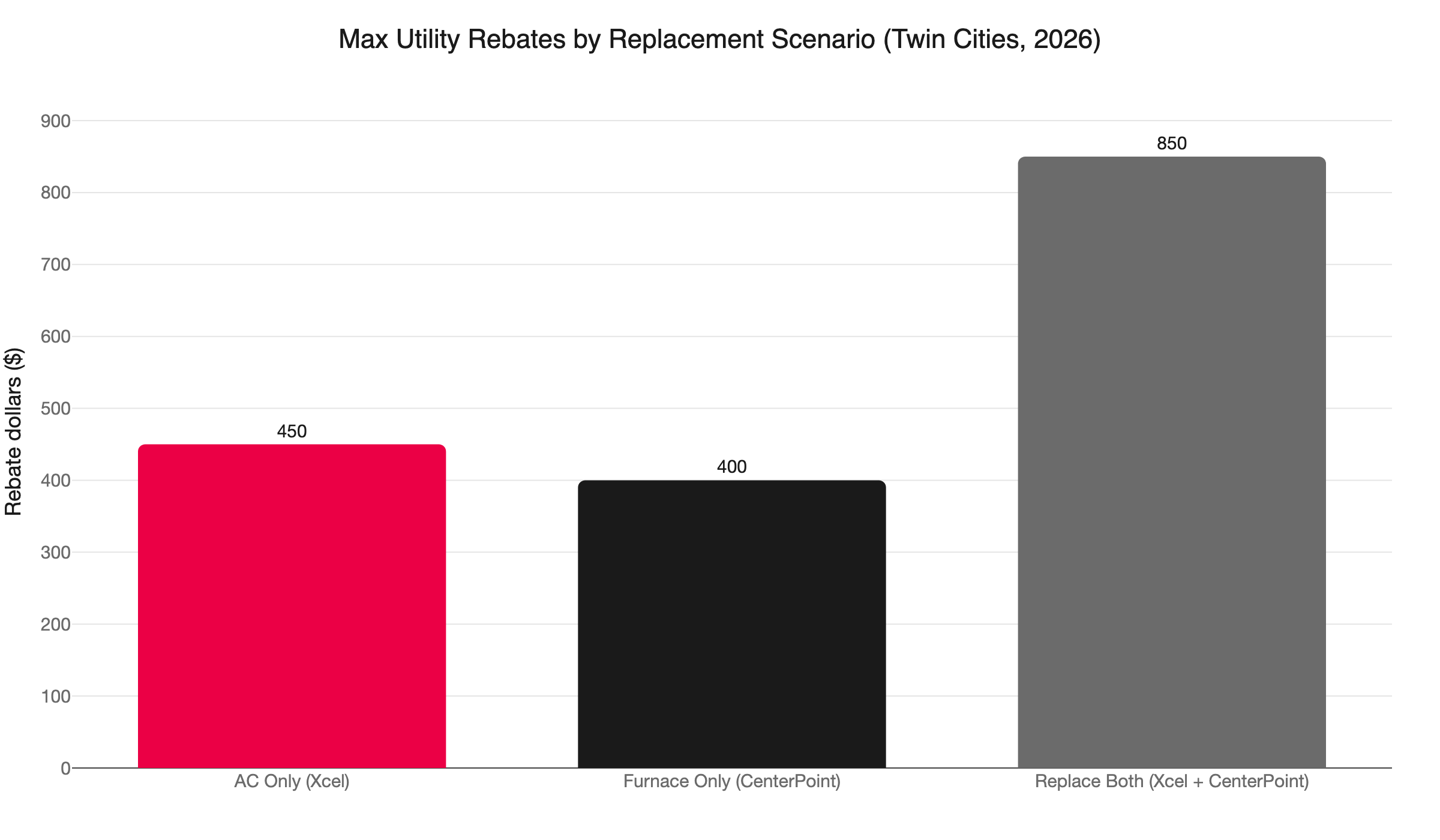
Short answer: Xcel Energy discontinued its gas furnace rebate as of January 1, 2026. A furnace-only replacement earns no Xcel incentive. Replace both the AC and furnace, and you can stack Xcel’s AC rebate with CenterPoint’s furnace rebate - up to $850 in utility incentives alone.
This is the most locally specific argument for replacing both systems, and it is not covered by any national source ranking for this topic.
Here is what is available for Twin Cities homeowners in 2026:
Xcel Energy AC rebates (Minnesota):
- $150 for systems at 13.4 SEER2 minimum
- Up to $450 at 15.2 SEER2 with a Quality Install
- Cold-climate heat pump: up to $2,000
Xcel Energy gas furnace rebate: Discontinued as of January 1, 2026. No Xcel rebate exists for a furnace-only replacement this year.
CenterPoint Energy gas furnace rebates:
- Up to $400 for a 95%+ AFUE furnace (standard)
- Up to $1,200 income-qualified
- $1,100 for a dual-fuel heat pump with a 92%+ AFUE backup furnace
The rebate math by scenario:
- Replace just the AC: Xcel rebate, up to $450. No CenterPoint rebate.
- Replace just the furnace: CenterPoint rebate, up to $400. No Xcel rebate.
- Replace both: Stack both - up to $850 in utility rebates. Income-qualified households can access significantly more.
The federal 25C Energy Efficient Home Improvement Tax Credit covered qualifying central ACs and furnaces through December 31, 2025: 30% of cost, up to $600 for AC or furnace, and up to $2,000 for heat pumps. Whether Congress extended 25C for 2026 was not confirmed at press time. Before counting on it, check the ENERGY STAR guidance on the 25C credit or consult your tax professional directly.
For a deeper look at how these incentives layer together, our guide on stacking HVAC rebates and tax credits in Minnesota covers all current programs in one place.
When Does Replacing Just the AC or Furnace Make Sense?
Short answer: When the remaining system is fewer than five years old, the indoor coil is already AHRI-matched to the replacement condenser, and the equipment is within its expected service life. That is a narrow window, but it exists.
A partial replacement makes the most sense when:
- The remaining system is genuinely new. A furnace installed two or three years ago with a compatible, AHRI-matched coil may pair cleanly with a new condenser. Confirm the AHRI certificate number before agreeing to the install.
- The systems’ ages are far apart. If your furnace is two years old and your AC just died at 15, replacing only the AC is the right call. If both units are 12-15 years old, replace both. You will be back doing the second job in two or three years anyway.
- Budget requires it this season. If a partial replacement is the only option right now, do it right: install a matched coil with the new condenser. The coil adds upfront cost, but it restores the warranty and the efficiency rating.
- You are adding a ductless system. Ductless mini-splits do not share an indoor coil with the furnace. Adding or replacing a mini-split does not raise the same matched-system concerns.
What does not hold: the assumption that a condenser swap is fine because the old coil “still works.” That reasoning produces a voided warranty and a 20-30% efficiency penalty on a system you paid $7,500 or more to install.
What Does It Cost to Replace Both Systems in the Twin Cities?
Short answer: Expect $4,950-$9,100 or more for an installed furnace, depending on efficiency tier. Central AC adds $7,500-$15,600. Replacing both in one visit reduces total cost compared to two separate service calls, and unlocks rebate stacking that neither system alone qualifies for.
Here is what a full matched-system replacement looks like at Northern One Hour, installed:
Furnace by efficiency tier:
- 80% AFUE: starting around $4,950 installed
- 95-96% AFUE: starting around $6,500 installed
- 97-98% AFUE: starting around $9,100 installed
Central AC, installed:
- Mid-tier split system: $7,500-$10,400
- High-efficiency (18-20+ SEER2): $11,000-$15,600
Replacing both systems in the same visit lowers the combined cost compared to two separate jobs. Permit fees, refrigerant handling, and mobilization overlap. You also avoid paying diagnostic charges twice.
Financing is available for homeowners who need to spread a larger replacement over time. Ask about current options when you call or book online.
Questions to Ask Before the Install
Whether you are replacing one system or both, these five questions protect your investment:
- Is this an AHRI-registered combination? Ask for the AHRI certificate number for the condenser-coil pair. If the contractor cannot produce it, that is a problem.
- Does this install include a new indoor coil? If the answer is no, ask why - and get the warranty terms in writing before you agree.
- What AFUE does my city require? Minneapolis, St. Paul, and Edina all exceed the statewide 80% floor. Know your local code before the estimate.
- Is the mechanical permit included? It should be. A contractor who does not mention the permit is a warning sign.
- What rebates do I qualify for? A contractor worth hiring will run the rebate math with you before the job, not after.
Knowing what to look for when comparing bids is as important as knowing the right questions. If you want a full list of warning signs to watch for, keep them in mind when you are vetting any HVAC company you have not worked with before.
Ready to Make the Right Call for Your Home?
The matched-system rules, Minnesota permit requirements, and 2026 rebate changes make this decision more nuanced than a quick internet search will show you. The right answer depends on your equipment’s age, your city’s code floor, your utility providers, and whether an AHRI-certified pairing exists for your specific combination.
We are locally owned and operated in Ramsey. Our team pulls the permit, confirms the AHRI match, and handles the rebate paperwork so you are not navigating it alone.
“Always On Time… Or You Don’t Pay a Dime!(R)”
Call us at (763) 260-6662 or schedule your estimate online to get an honest answer for your home.
Frequently Asked Questions
Can I replace just my AC without replacing the furnace? +
Does a mismatched coil void my new AC warranty? +
What rebates are available if I replace both my furnace and AC in Minnesota? +
What AFUE is required for a replacement furnace in Minneapolis or St. Paul? +
Need a technician now?