
Evaporator Coil Replacement Cost: Twin Cities Homeowners' Guide
Key Takeaways
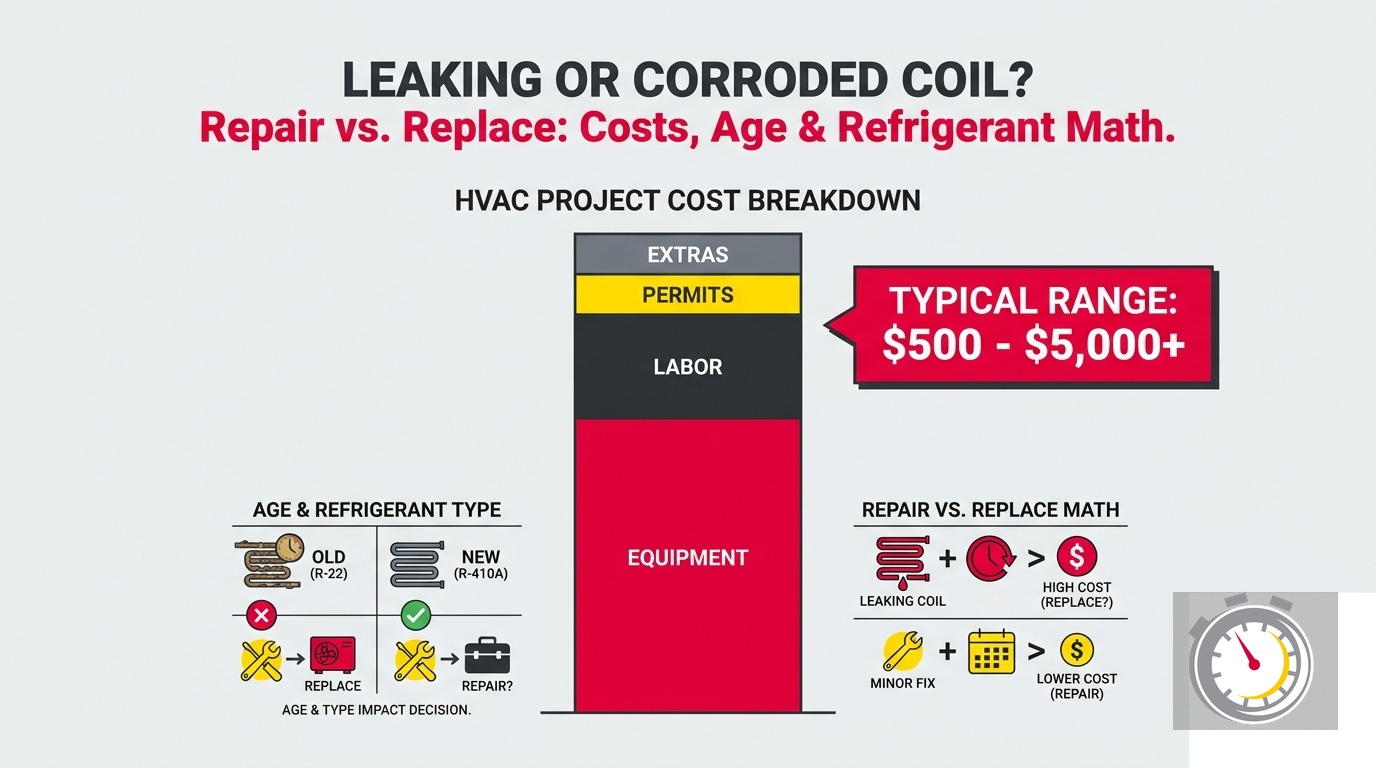
- Evaporator coil replacement in the Twin Cities typically runs $1,950-$4,500 installed, covering parts, labor, refrigerant recharge, and permit fees.
- Age and refrigerant type are the two biggest variables. A coil failure on an R-22 system, or any system 15 or more years old, almost always tips the math toward full replacement.
- New residential AC equipment using R-410A was restricted from manufacture after January 1, 2026. Repairing an aging R-410A system today means staying on a refrigerant already in transition to R-454B.
- Minnesota requires a mechanical permit for evaporator coil replacement. Always ask your contractor to pull it before work begins.
- The 25C federal tax credit does not apply to a standalone coil repair. It only applies when you replace a qualifying whole system - a fact that significantly shifts the repair-vs.-replace math.
- When replacement is the right call, stacking Xcel Energy, CenterPoint, and the federal 25C credit can total $3,000-$5,000 off a qualifying heat pump installation.
What Is an Evaporator Coil, and What Does It Do?
The evaporator coil is the indoor half of your cooling system. It is a set of refrigerant-filled copper or aluminum tubes housed inside your air handler or furnace cabinet. Warm indoor air passes over the coil, the refrigerant absorbs the heat, and the system pushes cooled air back into your home.
The outdoor condenser releases that heat outside, then cycles refrigerant back to the indoor coil. Without a functioning coil, your system moves air but cannot cool it.
Coils fail for several reasons. Formaldehyde off-gassing from building materials and cleaning products reacts with copper tubing to cause “formic acid corrosion,” creating pinhole leaks in newer equipment. Older coils develop leaks as joints and tubing degrade with age and pressure cycles. Refrigerant escapes through those leaks, cooling capacity drops, and eventually the system quits entirely.
Symptoms of a failing coil include ice forming on the indoor unit, weak airflow despite the system running, warm air blowing from vents when the thermostat calls for cooling, or refrigerant levels that keep dropping after recharges. A technician needs to pressure-test the system to confirm the coil is the source, not another component.
What Does Evaporator Coil Replacement Cost in the Twin Cities?
Most Twin Cities homeowners pay $1,950-$4,500 installed for an evaporator coil replacement. That range covers parts, labor, a refrigerant recharge, and permit fees. Nationally, sources like Angi put the all-in range at $1,000-$2,500. Local labor rates and Minnesota permit requirements push Twin Cities costs above that benchmark.
Here is how the components break down:
- Coil (parts only): $300-$1,100, depending on system size and brand
- Labor: $400-$1,000 for removal, installation, and leak testing
- Refrigerant recharge: $150-$400 for R-410A systems; significantly more for R-22 (covered below)
- Mechanical permit: typically $75-$200 depending on the city
A straightforward coil swap on a mid-size R-410A system in otherwise good condition lands in the $1,950-$2,800 range. Larger systems, specialty or hard-to-source coils, or systems that require a full refrigerant charge after extended downtime push costs closer to $4,500.
If the coil failure is caught early and the refrigerant loss was minimal, the recharge portion stays modest. If the system has been slowly leaking for months before the homeowner noticed, the technician may need to pull a vacuum, leak-test all connections, and perform a full charge - adding time and materials.
What Factors Drive Evaporator Coil Replacement Cost Up or Down?
Four variables move the needle more than anything else: system size, refrigerant type, matched vs. unmatched equipment, and labor complexity.
System size. A 2-ton coil is smaller and less expensive than a 4- or 5-ton unit. Labor time scales with the coil size. Most single-family Twin Cities homes land in the 3-4 ton range.
Refrigerant type. R-22 systems cost dramatically more to service, for reasons covered in the next section. R-410A systems are more straightforward and far more economical to recharge.
Matched vs. unmatched equipment. Manufacturers design coils as matched sets with specific condensing units. An unmatched coil can void the manufacturer’s warranty and reduce system efficiency. If the original coil model has been discontinued, sourcing a compatible replacement takes longer and sometimes costs more. This is increasingly common on systems more than 10-12 years old.
Labor complexity. A coil inside an accessible first-floor mechanical room is straightforward work. A coil jammed into a tight attic, or one that requires significant ductwork disconnection to reach, adds labor time and cost. Always get a written breakdown before authorizing work.
How Does Refrigerant Type Change the Repair-vs.-Replace Math?
If your system uses R-22, a coil repair is rarely worth the cost. R-22 is scarce, expensive, and your system is almost certainly past its reliable service life. R-410A systems require a closer look, but a new variable has entered the picture.
R-22 production and import were banned on January 1, 2020 under the Montreal Protocol, per the EPA. Only reclaimed R-22 remains available on the market, priced at $50-$150 per pound. A standard 3-ton system holds 6-12 pounds of refrigerant. That is $300-$1,800 in refrigerant alone, before parts or labor. Combine that with coil and labor costs and you can reach $4,000-$5,000 on a repair for a system that is already 15-plus years old.
For R-410A systems: a coil repair is more defensible on a system under 10 years old that is otherwise performing well. But there is a new regulatory factor that changes the long-range calculus.
The R-410A Phasedown: What It Means for Your Repair Decision
New residential AC equipment using R-410A was restricted from manufacture after January 1, 2026 under the AIM Act. New systems sold today ship with R-454B, a lower-GWP successor refrigerant. R-410A is not banned in existing equipment - service refrigerant remains available - but availability will tighten as the industry transitions.
Repairing a 2015 or 2016 R-410A system with a new evaporator coil today keeps you invested in aging equipment running a refrigerant whose supply chain is shrinking. You are not locked in permanently. But you are spending $2,000-$4,500 to extend a system that will still need full replacement within the decade, without capturing any of the incentives available at replacement.
Our post on what homeowners need to know about the R-454B refrigerant change covers the transition timeline in more detail. For R-410A systems already in the 10-12 year range, the math often favors replacement before the refrigerant question even factors in.
One other note: EPA Section 608 requires certified technicians to handle any refrigerant addition or removal. Venting refrigerant is illegal under the Clean Air Act, regardless of refrigerant type. Verify that any contractor you hire holds current Section 608 certification before authorizing coil work.
Does Minnesota Require a Permit for Evaporator Coil Replacement?
Yes. Evaporator coil replacement requires a mechanical permit in Minnesota. The “no permit required” exemption under Minnesota Rules 1346.0105 covers only replacement of minor parts that do not alter the approval of the equipment. An evaporator coil is not a minor part. The work involves refrigerant handling and modifies the core equipment installation.
The City of Minneapolis requires mechanical permits for all HVAC installation and replacement work. This requirement holds across the metro: St. Paul, Blaine, Maple Grove, Plymouth, and surrounding communities follow the same standard.
Why does the permit matter to you? It protects you in two ways. First, the inspection process catches installation errors before they become safety or efficiency problems. Second, permitted work creates a documented record. Unpermitted HVAC work can be flagged by a buyer’s inspector during a home sale, requiring disclosure or remediation.
At Northern One Hour, we pull permits on every job that requires one. Ask to see documentation before any coil work begins. If a contractor waves off the permit question, that is a red flag.
When Does a Coil Failure Mean You Should Replace the Whole System?
Replace the system when the repair cost exceeds 40-50% of a new system’s installed price, when the system is 15 or more years old, or when it runs on R-22. In Minnesota, you also need to factor in your furnace’s remaining life alongside the AC.
The standard industry threshold: repair cost exceeding 50% of new system cost generally favors replacement. For repairs where refrigerant cost is driving the bill, some contractors use a lower 30-40% threshold.
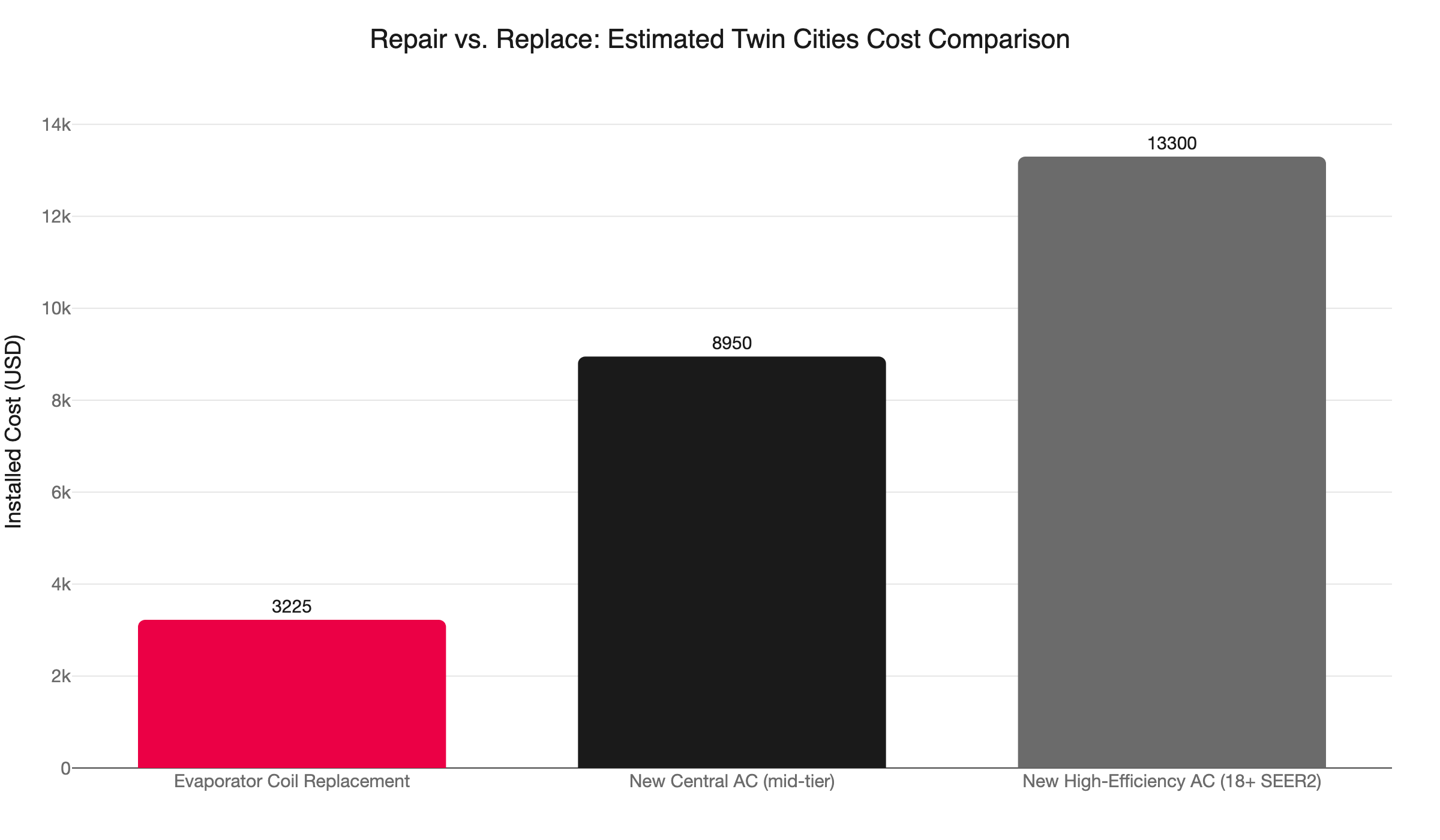
A mid-tier central AC installation in the Twin Cities runs $7,500-$10,400. At the 50% rule, a repair over $3,750-$5,200 tips toward replacement. A coil repair at $3,500 or more on a system approaching 15 years is getting close to that line before the furnace question comes up at all.
The Minnesota furnace factor. Our heating season runs nine months of the year. The furnace and evaporator coil often enter a home at the same time and age together. A coil failure on a 15-year-old system frequently means the furnace is also 15 years old. Replacing the AC now and the furnace in two years means two service disruptions, two permit pulls, two sets of installation labor, and a mismatched system in between.
Our post on replacing just the AC vs. replacing both systems together runs through the cost math in detail. For older matched systems, replacing both in a single project almost always pencils out better than staggering the replacements.
Quick decision framework:
- System under 10 years old, R-410A, otherwise good condition: coil repair is usually worth it.
- System 10-14 years old, R-410A: compare repair cost directly against full replacement, and factor in rebates before deciding.
- System 15 or more years old, any refrigerant: replace the system.
- System any age, R-22: replace the system.
What Rebates and Tax Credits Apply When You Replace the System?
A full system replacement unlocks incentives that a coil repair never does. The 25C federal tax credit, Xcel Energy rebates, and CenterPoint Energy rebates all require a qualifying whole-system installation. A standalone coil repair qualifies for none of them.
The 25C federal tax credit. Under the IRS Section 25C Energy Efficient Home Improvement Credit, qualifying heat pump installations earn 30% of cost, up to $2,000 per year. Qualifying central AC systems earn up to $600. The credit requires a qualifying whole system, not a component swap. Spend $3,500 on a coil repair and you receive zero in federal credits.
One important note: the “One Big Beautiful Bill” (Public Law 119-21, signed July 4, 2025) modified several energy credits, including 25C. The IRS has updated its FAQ accordingly. Verify current 2026 limits directly at the IRS website before relying on specific dollar figures - some amounts differ from pre-2025 guidance still circulating online.
Xcel Energy rebates (qualifying replacement systems only):
- Up to $400 for qualifying central AC at SEER2 16+
- Up to $2,000 for a cold-climate ducted heat pump
- $600 bonus when paired with qualifying insulation or air-sealing upgrades
CenterPoint Energy rebates (existing Minnesota homes):
- Up to $1,500 for a ducted air-source heat pump
- $1,100 for a dual-fuel configuration (heat pump plus gas furnace)
- Requires SEER2 16+ and a switchover temperature programmed at 40 degrees Fahrenheit or lower
Stacked together, Xcel plus CenterPoint plus the federal 25C credit can total $3,000-$5,000 off a qualifying heat pump installation. Our post on Minnesota heat pump rebates and tax credits covers how the stacking works and which systems qualify.
When you run the numbers with rebates, the net cost gap between a coil repair and a new qualifying system often narrows considerably. Add the warranty, modern refrigerant, and improved efficiency a new system brings, and the case for repair on an older system weakens further.
Financing is available for qualifying system replacements. Ask about current terms when you call.
What to Expect From Our Team
When a Northern One Hour technician arrives, the diagnostic visit covers more than just the coil.
We confirm where the leak is, not where we assume it is. We check the refrigerant type, system age, and overall condition before quoting anything. If the repair does not make financial sense given the system’s age and the cost of the work, we tell you. We are not going to sell you a $3,500 coil repair on a 16-year-old R-22 system.
We pull permits on every job that requires one. Our technicians carry current EPA Section 608 certification. Pricing is transparent before work starts, with no surprise line items after the fact.
We are locally owned and operated in Ramsey, MN, and our team works across the Twin Cities: Minneapolis, St. Paul, Blaine, Maple Grove, Plymouth, Brooklyn Park, Woodbury, Bloomington, and surrounding communities. When you call, you reach our local team, not a national call center.
“Always On Time… Or You Don’t Pay a Dime!(R)” That is not a marketing slogan. It is how we run our business.
Call (763) 260-6662 or schedule a diagnostic visit online. If the coil is the problem, we will walk you through repair vs. replace with honest numbers, explain the permit requirements, and give you a clear total before any work begins.
Frequently Asked Questions
How much does evaporator coil replacement cost in the Twin Cities? +
Does replacing an evaporator coil require a permit in Minnesota? +
Does the 25C federal tax credit apply to evaporator coil replacement? +
Should I replace my evaporator coil or the whole AC system? +
Need a technician now?