
Air Handler Replacement Cost in Twin Cities: What to Know
Key Takeaways
- A standalone air handler replacement in a heat pump system runs $2,500-$8,000 installed in the Twin Cities, depending on unit type and configuration.
- A coil-only swap on a gas furnace system is a smaller project: expect $1,500-$2,500 in the Twin Cities metro.
- New equipment manufactured from January 1, 2025 forward ships with R-454B refrigerant. It is not compatible with R-410A. Verify refrigerant compatibility before choosing any indoor unit.
- Xcel Energy customers may qualify for up to $2,000 in heat pump rebates. CenterPoint customers may qualify for up to $1,100 for a qualifying dual-fuel system.
- Federal 25C heat pump tax credits expired December 31, 2025 and are no longer available.
- Minnesota contractors must carry a $25,000 DLI bond. Verify this at dli.mn.gov before work begins.
- Expect a mechanical permit fee of $50-$175 in most Twin Cities jurisdictions. Your contractor should pull it.
You Probably Don’t Have an Air Handler (And That Changes the Numbers)
Most Twin Cities homeowners searching “air handler replacement cost” are actually looking at a different piece of equipment: a gas furnace with an evaporator coil mounted on top. That combination is not the same as a standalone air handler. The cost picture and the decision logic differ in important ways.
A true standalone air handler is an indoor unit paired with a heat pump. It circulates conditioned air through your home and typically includes electric heat strips for backup heat. In Minnesota, you find them in newer all-electric homes, homes built around heat pump systems, and homes that have converted from gas. Most Twin Cities homes built before the last decade or so have a gas furnace instead.
If you are not sure which you have, our guide to air handlers vs. furnaces explains the difference and what it means for replacement costs.
This post covers all three real scenarios Twin Cities homeowners face: a coil-only swap on a gas system, a full air handler replacement in a heat pump setup, and an indoor unit replacement as part of a whole-system upgrade. We also cover refrigerant compatibility, local rebates, permit requirements, and what separates a careful contractor from a risky one.
What Does Air Handler Replacement Cost in the Twin Cities?
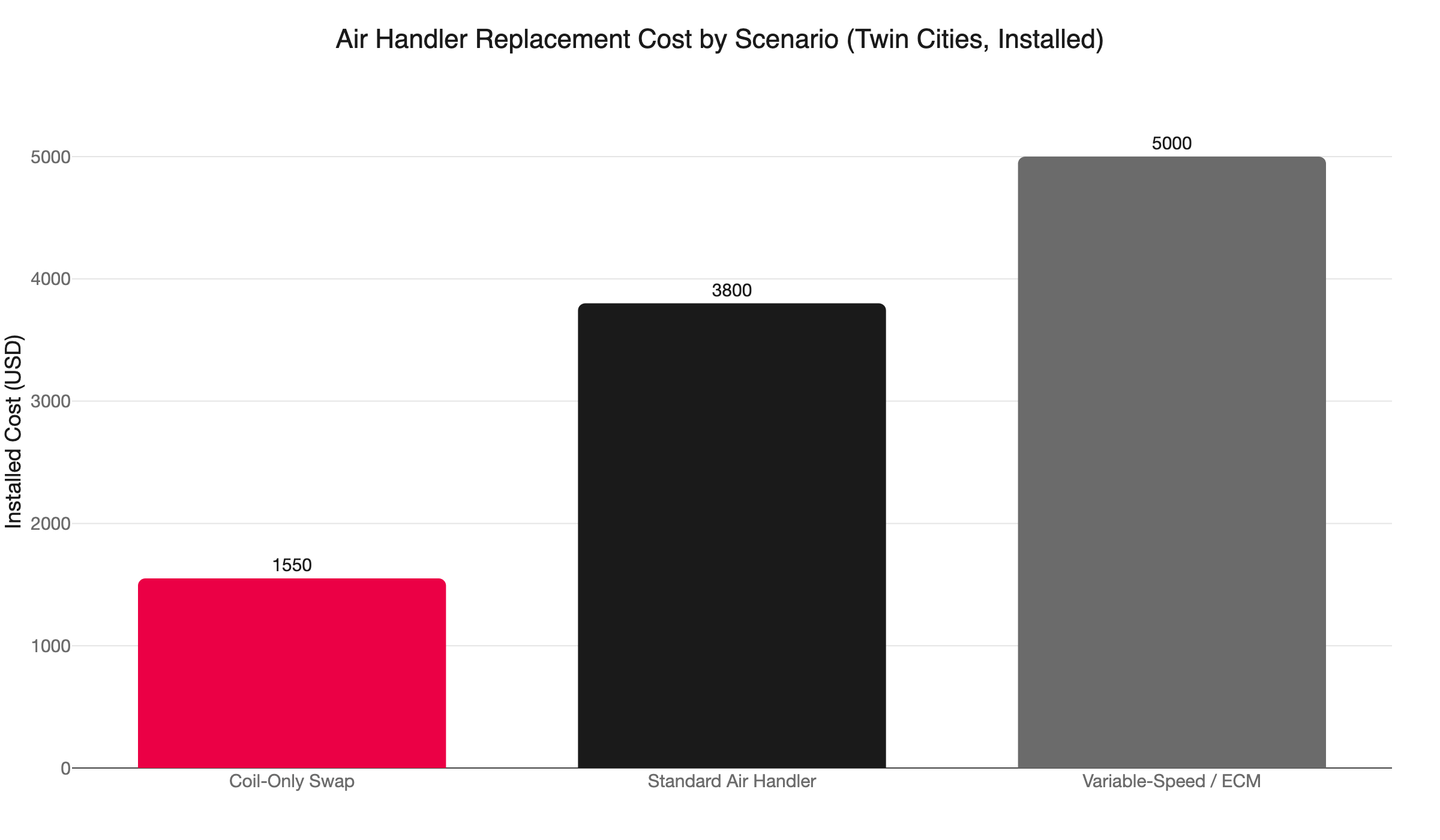
Short answer: A standard unit runs $2,500-$5,000 installed in the Twin Cities. Variable-speed and ECM models run $4,000-$8,000. A coil-only swap on a gas furnace system runs $1,500-$2,500. Scope, unit type, and refrigerant compatibility all affect where the final number lands.
The national baseline: a 3-ton Midwest air handler swap averages around $3,800, with labor running $75-$125 per hour and most installs taking three to eight hours. Twin Cities pricing sits at the higher end of that range. Local labor rates, permit fees, and the added coordination that comes with refrigerant-transition installs all push costs upward.
Several factors drive the spread:
- Unit type. A single-speed air handler costs less upfront than a variable-speed or ECM model. The efficiency gap between them is significant in a home that runs the fan year-round, as most Twin Cities homes do.
- System compatibility. Whether you can reuse the outdoor unit shapes the entire scope. An aging or R-410A outdoor unit often makes a full matched replacement more cost-effective than a single-component swap.
- Refrigerant. New indoor units ship with R-454B. If the outdoor unit runs R-410A, a compatible indoor unit simply is not available. This forces a broader decision.
- Lineset condition. Switching refrigerant types may require flushing or replacing the line set between the indoor and outdoor units.
- Ductwork modifications. Resizing the air handler may require duct changes to maintain proper airflow.
- Permits and inspection. Budget $50-$175 for a mechanical permit in most Twin Cities municipalities.
What Are the Three Replacement Scenarios?
Short answer: Coil-only swap on a gas system, full air handler replacement in a heat pump system, or indoor unit as part of a whole-system upgrade. Each has a different cost, scope, and decision logic.
Scenario 1: Coil-only swap on a gas furnace system
This applies when your gas furnace is running well but the evaporator coil is leaking, corroded, or at the end of its service life. Nationally, a coil-only replacement runs $600-$2,500. Twin Cities installs land toward the upper end of that range.
One caution: if the outdoor AC unit is old or from a different system generation, replacing only the coil may void the warranty on the new coil. Manufacturer warranties typically require matched equipment. For the full repair-vs-replace breakdown, see our evaporator coil replacement cost guide for Minnesota.
Scenario 2: Full air handler replacement in a heat pump system
This is the scenario most homeowners mean when they search for air handler replacement. You are replacing the entire indoor unit: blower motor, coil, and heat strips. Nationally, variable-speed and ECM air handlers run $2,000-$8,000 installed, with a midpoint around $5,000. Twin Cities installs land at the higher end of that range. Expect $3,500-$8,000 for a quality 3-ton install in the metro.
The key question before quoting: what refrigerant does the outdoor unit run? If it is R-410A and the new indoor unit ships with R-454B, you have a compatibility problem. A full system replacement is often the cleaner and more cost-effective path.
Scenario 3: Indoor unit as part of a system upgrade
Some homeowners use an air handler replacement as the entry point to a broader project: converting to a dual-fuel heat pump, upgrading an aging AC system to a high-efficiency split, or moving to a fully variable-speed matched pair. In this case, the air handler is one line item in a system-wide project. Central AC replacement in the Twin Cities runs $7,500-$10,400 for mid-tier equipment and $11,000-$15,600 for high-efficiency 18-20+ SEER2 systems. This is also where rebate stacking becomes worth exploring in detail.
Should You Replace Just the Air Handler or the Whole System?
Short answer: If the outdoor unit is over 10-12 years old or runs R-410A, a complete matched system replacement is usually the better call. Pairing a new indoor unit with an aging, incompatible outdoor unit hurts efficiency and extends the risk of future failures.
Air handlers have a typical service life. Minnesota’s thermal stress accelerates wear. The swing from -20°F winters to 90°F-plus summers causes coil micro-fractures and refrigerant leaks that shorten equipment life. At the 15-year mark, review the full repair history of both units before committing to a single-component swap.
Pairing a new indoor unit with an aging outdoor unit creates a mismatched system. Efficiency drops because the two units were not designed to operate together. The new indoor unit carries load stress from a declining partner. In many cases, the added cost of a full system replacement pays for itself through efficiency gains and avoided future repairs.
Questions to work through before deciding:
- How old is the outdoor unit? Anything over 12-15 years has used most of its useful life.
- What refrigerant does it run? R-410A outdoor units cannot pair with new R-454B indoor units.
- How many repairs has the system had in the last two to three years? A pattern of repairs signals declining reliability.
- Is the system meeting your comfort needs? If not, a system upgrade solves the problem rather than extending it.
What Is the Refrigerant Transition, and Does It Affect Me?
Short answer: Yes, if your current system uses R-410A. New equipment manufactured from January 1, 2025 forward uses R-454B. The two refrigerants cannot be mixed, and the equipment built for each has different pressure ratings, electrical requirements, and safety features.
Under the EPA’s AIM Act, new residential split systems must use low-GWP refrigerants. R-410A has a GWP of 2,088. It is no longer used in newly manufactured equipment. R-454B (GWP 466) is the dominant replacement for residential split systems in 2026.
R-410A and R-454B operate at different pressures. R-454B is classified as A2L (mildly flammable), which requires sealed electrical components and leak detection equipment that R-410A systems do not have. You cannot convert an R-410A system to R-454B. They are fundamentally different platforms.
The practical impact: if your outdoor unit runs R-410A, no new indoor unit will be compatible with it. A full system replacement is the path forward. If you are replacing both indoor and outdoor units at the same time, they will both use R-454B and will be matched from the start.
One clarification worth making: R-410A equipment manufactured before January 1, 2025 can still be legally installed under an EPA final rule effective July 27, 2026. You may find R-410A inventory available. But this is end-of-life stock. Buying it now means planning another replacement sooner than you would with R-454B equipment.
For a full breakdown of what the transition means for your home, see our R-454B refrigerant guide for Twin Cities homeowners.
Is a Variable-Speed ECM Blower Worth the Extra Cost?
Short answer: For most Twin Cities homes, yes. ECM motors cut fan energy use by more than 50% compared to PSC motors. The savings are especially clear in homes that run the fan year-round for humidity and air quality management.
DOE Building America research (PNNL) shows ECM motors cut fan energy use by more than 50% compared to PSC motors when ductwork is properly installed. A PSC motor draws 500-550 watts during heating and cooling. An ECM draws around 400 watts during cooling and as little as 80 watts in continuous fan mode.
The annual savings compound. The same DOE data shows blower savings of 38-42% for single-stage furnace setups and 63-67% for two-stage systems. One utility study estimated ECM payback under three years, with more than $700 in operating savings over 10 years.
The installed cost difference: a PSC blower motor runs around $1,100 installed. An ECM motor runs around $2,200 installed. For a full air handler with an ECM, budget an additional $800-$1,500 over a standard single-speed unit.
In Minnesota, the case for ECM is strong. Twin Cities homeowners typically run the fan year-round. Continuous fan mode at low speed helps with humidity management, air circulation, and filter performance across both the heating and cooling seasons. A PSC motor running continuously draws five to six times the power of an ECM in the same role. Over a 10-15 year equipment life, that premium pays back multiple times.
What Rebates Are Available for Twin Cities Homeowners?
Short answer: Xcel Energy offers up to $2,000 for a qualifying cold-climate heat pump. CenterPoint offers up to $1,100 for a dual-fuel system. Federal 25C credits expired December 31, 2025.
Xcel Energy
Xcel offers $2,000 for a cold-climate ducted heat pump for gas or combo customers. Electric-only customers get $1,500. The unit must meet all four thresholds:
- 15.2 SEER2 minimum
- 10 EER2 minimum
- 8.1 HSPF2 minimum
- COP of at least 1.75 at 5°F
It must also appear on the NEEP cold-climate heat pump directory. An additional $600 is available when the heat pump is paired with qualifying insulation and air sealing work.
CenterPoint Energy
CenterPoint’s 2026 rebate form shows $1,100 for a ducted ASHP paired with a 92%+ AFUE gas furnace in an existing home. This is a dual-fuel setup: the heat pump handles heating down to around 40°F, then the furnace takes over below that. The heat pump must meet HSPF2 of at least 7.8. New construction installations get $400.
CenterPoint also rebates gas furnaces on their own: $300 at 94-95.9% AFUE, $400 at 96%+.
CenterPoint does not rebate cooling-only AC or heat pumps that fully replace gas. Cooling rebates come from your electric utility.
Federal credits
The 25C federal heat pump tax credits expired December 31, 2025 and are no longer available to stack. Check with your contractor for any new programs that have come online since then.
Do You Need a Permit for Air Handler Replacement in Minnesota?
Short answer: Yes, in almost every Twin Cities jurisdiction. Permit fees run $50-$175. Your contractor must carry a $25,000 DLI bond to pull permits. Confirm this before work starts.
Air handler replacement triggers a local mechanical permit in most Minnesota jurisdictions. Minneapolis and St. Paul run $75-$175. Suburban Twin Cities (Hennepin, Ramsey, Dakota, and Washington counties) run $50-$150. Greater Minnesota runs $40-$120.
The contractor pulling that permit must carry a $25,000 bond posted with the Minnesota Department of Labor and Industry under Statute 326B. There is no statewide HVAC license requirement, but the bond is mandatory. Verify your contractor at dli.mn.gov before signing a contract.
A permit is not a formality. An inspector verifies equipment sizing, refrigerant handling, and code compliance for venting and combustion air. Skipping the permit creates complications with homeowner’s insurance, equipment warranties, and future home sale disclosures. It also leaves you with no third-party confirmation that the work was done correctly.
How Do You Find a Contractor You Can Trust for This Job?
Short answer: Start with the DLI bond check at dli.mn.gov. Then verify they will pull the permit, size equipment with a load calculation, and confirm refrigerant compatibility before writing a quote.
Specific things to ask before signing anything:
- DLI bond verification. Required under Minnesota Statute 326B. Check dli.mn.gov before scheduling.
- Permit commitment. A contractor who suggests skipping the permit is a red flag, not a cost savings.
- Manual J load calculation. Proper sizing is critical. An oversized air handler short-cycles and handles humidity poorly. An undersized one runs constantly. Neither is acceptable in a Minnesota climate.
- Refrigerant compatibility check. A reputable technician will verify that the new indoor unit matches the outdoor unit before quoting. If they do not ask, you ask.
- Written warranty terms. Equipment warranties typically require a licensed contractor and a registered install. Get this in writing before work starts.
We are locally owned and operated in Ramsey, MN, serving the full Twin Cities metro: Minneapolis, St. Paul, Maple Grove, Blaine, Woodbury, Brooklyn Park, Plymouth, and the surrounding area. Our technicians show up when they say they will. That is the commitment behind “Always On Time… Or You Don’t Pay a Dime!(R)“
Ready to Schedule Your Assessment?
Air handler replacement in the Twin Cities is not a simple national average. Refrigerant compatibility, permit requirements, equipment matching, and available rebates all shape the final cost.
The right answer starts with a proper look at what you actually have and what it needs. Call us at (763) 260-6662 or book online and we will tell you exactly what you have, what needs replacing, and what it will cost - no guesswork, no surprises.
Frequently Asked Questions
How much does air handler replacement cost in the Twin Cities? +
Can I replace just the indoor unit and keep my existing outdoor unit? +
Do I need a permit to replace an air handler in Minnesota? +
Need a technician now?