
Should I Replace My Air Conditioner With a Heat Pump?
Key Takeaways
- A failing AC next to a working gas furnace usually points to dual fuel, not an all-electric home.
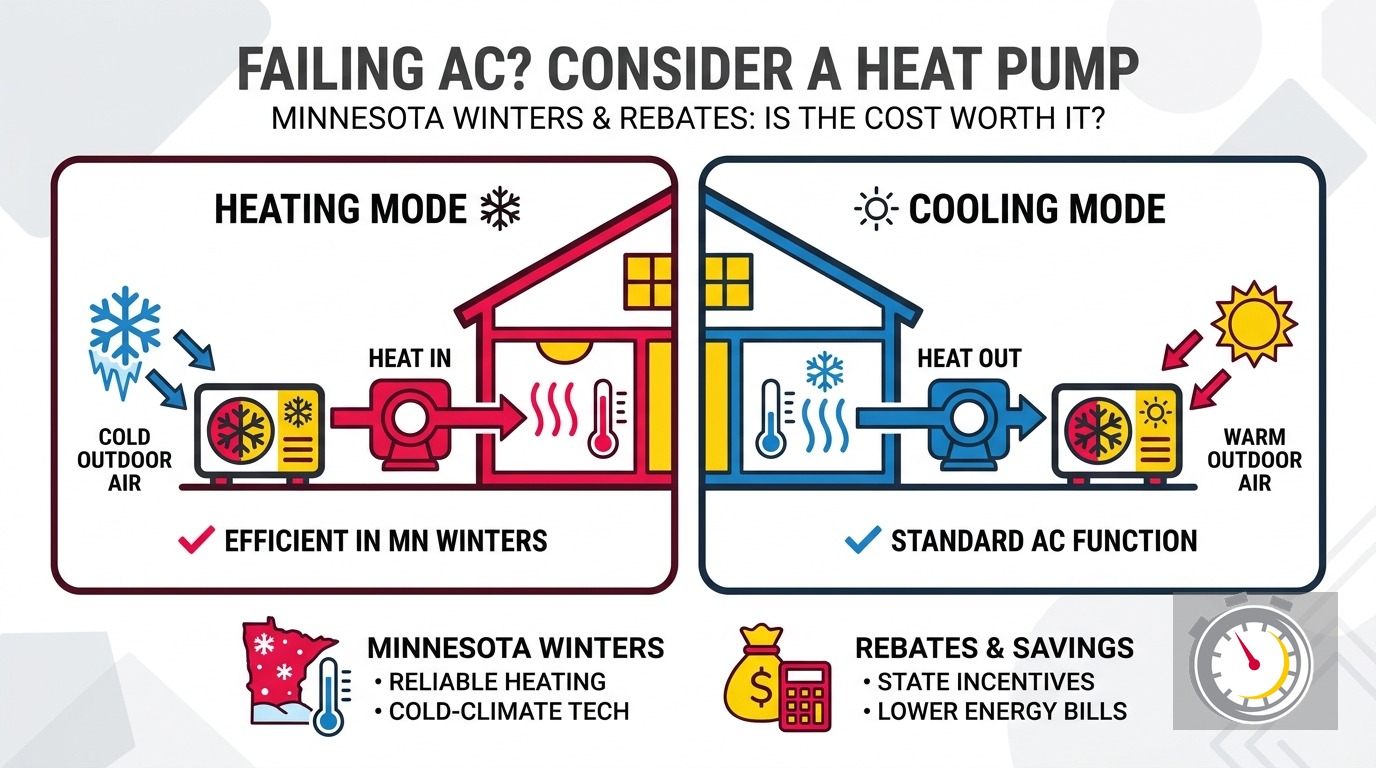
- In cooling mode, a heat pump works like an air conditioner. You do not give up cooling.
- Cold-climate heat pumps can heat well in Minnesota winters. Many homes still need backup heat on the coldest days.
- The federal 25C tax credit ended for installs after December 31, 2025.
- The state heat pump rebate has not launched. Do not wait for it.
- Xcel Energy and CenterPoint Energy offer utility rebates for ducted heat pumps. Confirm current amounts before you sign.
- Your furnace, coil, and ductwork must match the new outdoor unit. Check them before you accept any quote.
The Short Answer
Replace your failing AC with a heat pump if your gas furnace still works well. Keep the furnace as backup heat. That setup is called dual fuel. For most Twin Cities homes, it is the smartest version of this upgrade.
Skip the all-electric version unless you have a specific reason. Commerce-funded research found that all-electric heat pumps in Minnesota save energy. They also cost more upfront and more to run than gas furnace heating. Dual fuel avoids that trap.
We are Northern One Hour, a locally owned and operated HVAC company in Ramsey. We help Twin Cities homeowners make this call every cooling season.
What Is the Real Choice When Your AC Fails?
Short answer: Most Minnesota homes with a dead AC also have a working gas furnace. So you are rarely choosing between AC and an all-electric home. You are choosing between a new AC and a heat pump that cools in summer and shares heating duty with your furnace.
A heat pump is an AC that can also run backward. In summer, it moves heat out of your house. In cold weather, it pulls heat from outdoor air and moves it inside.
Paired with your furnace, the two systems split the winter work. The heat pump handles mild days. The furnace takes over when the temperature drops below a set point. Our guide to dual fuel heat pump and gas furnace hybrid systems covers the details.
That changes the question. You are not betting your winter comfort on new technology. You are adding a more flexible cooling unit to a furnace you already trust.
Does a Heat Pump Work Better Than an AC?
Short answer: In summer, a heat pump cools about the same as an air conditioner with a similar efficiency rating. The difference shows up in the other seasons. A heat pump can also heat your home, which an AC cannot do.
Both machines use refrigerant, a compressor, an outdoor coil, and an indoor coil. In cooling mode, the work is the same. Rated efficiency, called SEER2, tells you how well each model cools. Our post on SEER2 ratings explains how to read it.
The heat pump adds a reversing valve. It flips the flow of refrigerant so the system can heat. That extra part is one reason heat pumps cost more upfront.
A heat pump can beat a plain AC in these ways:
- It heats in spring and fall, so your furnace runs less.
- It dehumidifies as it cools, just like an AC.
- It runs year-round, so you get more use from the equipment you buy.
An AC can still win in these ways:
- It costs less to buy and install.
- It has fewer parts that can fail.
- It needs no decisions about switchover temperatures or backup heat.
A heat pump is better when you will use the heating side. Otherwise, the plain AC may serve you fine.
Do Heat Pumps Work in Minnesota Winters?
Short answer: Cold-climate heat pumps can heat effectively below zero, but many Minnesota homes still need backup heat on the coldest days. Standard heat pumps lose ground faster in the cold. That is why model choice and a good furnace pairing matter here.
Minnesota Commerce tells homeowners to ask for a cold climate air source heat pump. Its guidance says many can provide effective heating even as temperatures drop below zero. The same guidance notes that many parts of the state may still need a backup source.
Xcel Energy defines “cold climate” with numbers. Its rebate sheet lists a minimum coefficient of performance the unit must meet at low outdoor temperatures. Heating capacity at 5°F must be at least 70% of rated capacity at 47°F. Those are minimums, not guarantees for your house.
The switchover point matters too. Commerce-funded modeling found that a switchover near 10°F let a heat pump meet about 71% of the heating load in Duluth. Installers commonly set 25°F to 35°F for non-cold-climate units. That report dates to 2017, so treat it as a rough guide.
Newer research is underway. MnCEE is running a 2026 to 2029 field study of newly released cold-climate heat pumps below 0°F. It reports no results yet, so we won’t quote numbers that don’t exist.
Want to see how staging and backup heat behave in real homes? Read our explainer on how heat pump staging works.
Are Heat Pumps Worth It in Minnesota?
Short answer: They can be, in a dual fuel setup with rebates and a heat pump sized for your home. They are a weaker deal as an all-electric swap for a working gas furnace. Your payback depends on your gas and electric rates, which change.
Start with upfront cost. Our floor for a mid-tier central AC replacement is $7,500 to $10,400 installed. A high-efficiency AC runs $11,000 to $15,600. A ducted cold-climate heat pump prices closer to that high-efficiency range. Your quote depends on the home, the ductwork, and the equipment.
The extra cost over a basic AC is real. Here is what it buys:
- Heating help in the shoulder seasons, when the furnace would otherwise cycle on.
- A second heat source, which adds resilience.
- Utility rebates that an AC-only job does not qualify for.
- A system that runs more months of the year.
Electricity and natural gas prices move. We won’t hand you a payback number built on rates that may shift next year. During a visit, we compare your actual bills and your home’s needs.
A few situations tilt toward a heat pump:
- Your furnace is under about ten years old and runs well.
- You want to shave some winter heating cost.
- You qualify for a utility rebate.
- Your AC is near the end of its life anyway.
A few tilt away from one:
- Your ductwork is badly undersized or leaky.
- You rarely run the heat in spring or fall.
- Your furnace is failing too and you want one clean replacement plan.
For a deeper look at running costs, see our heat pump vs. gas furnace operating cost comparison.
Is the Federal Tax Credit Still Available?
Short answer: No. The 25C credit covered property placed in service before December 31, 2025. If your heat pump goes in during 2026 or later, plan as if no federal credit applies. Check with a tax professional about your own situation.
The IRS page for the Energy Efficient Home Improvement Credit says it applies to property placed in service on or after January 1, 2023, and before December 31, 2025. That window has closed.
While it was active, the cap was $2,000 per year for qualified heat pumps. That sat apart from the $1,200 cap for other improvements. You had to claim the credit for the tax year the property was installed, not merely purchased.
Old articles still promise the credit, and some sites show an outdated end date. Trust the IRS page over a marketing summary.
If you installed a qualifying unit in 2025, you may still have a filing to complete. Our guide to claiming Form 5695 covers it.
Is the State Heat Pump Rebate Available Yet?
Short answer: No. Minnesota Commerce updated its page on October 12, 2026, and says Save Energy Minnesota has not launched. It gives no estimated launch date. Do not delay a failing AC replacement while you wait for it.
The Commerce page for the Residential Heat Pump Rebate Program lays out how the program is planned. The rebate is the lesser of a set amount, $4,000, or the cost minus other rebates. Amounts vary by household income, checked against 80% or 150% of county Area Median Income.
These planned rules matter if you hope to use it later:
- The unit must be an ENERGY STAR certified, cold climate rated air-source heat pump.
- A contractor on an approved list must install it.
- Commerce says it will release that list before launch.
Your AC is failing now. Summer heat and humidity do not wait for a state website. Going without cooling while you hold out for a program with no date is a poor trade.
We suggest you buy now and use the utility rebates that exist today. If the state program opens later, it may help the next homeowner. We would not bank on it for your project.
What Xcel and CenterPoint Rebates Can You Get?
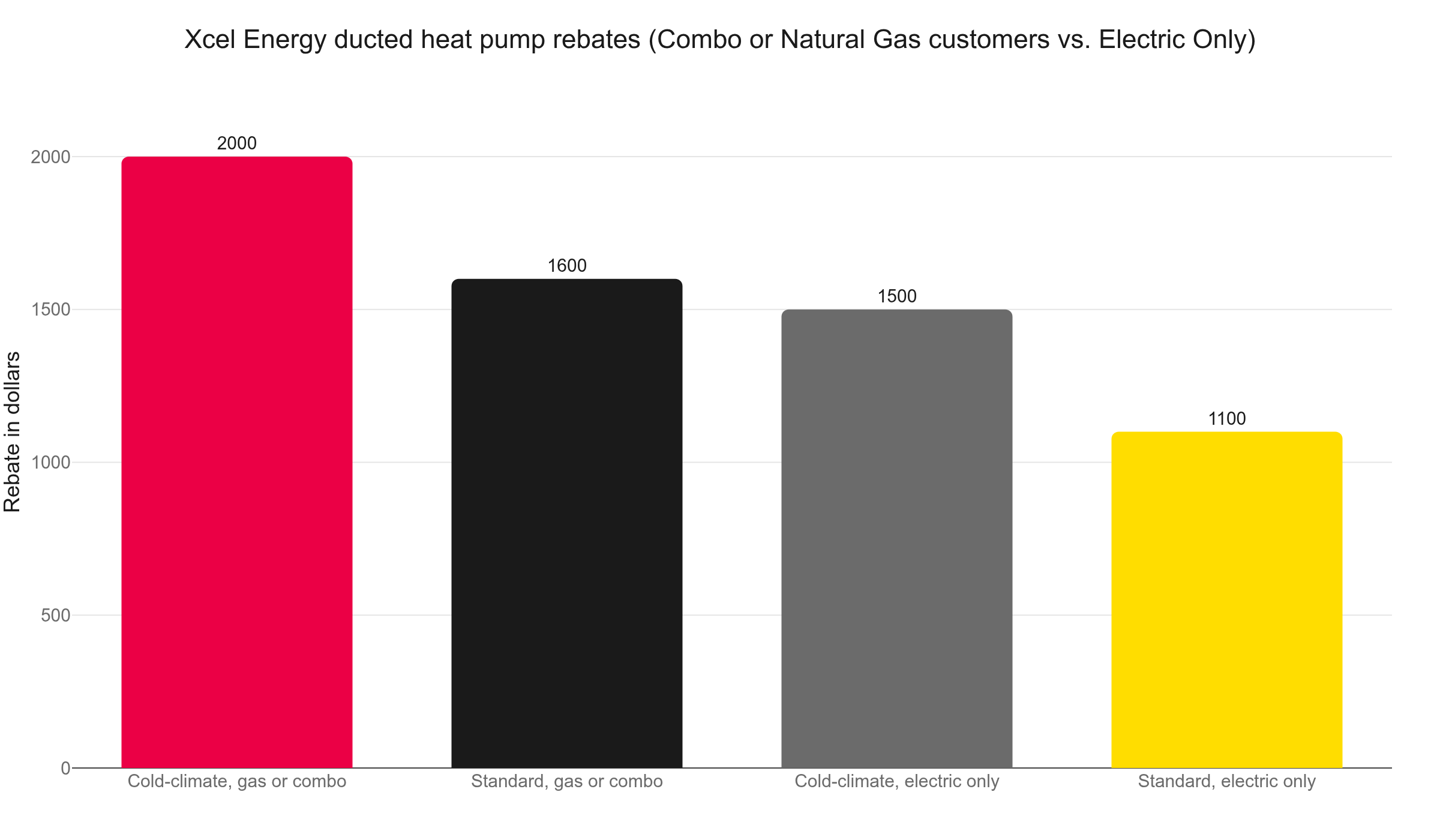
Short answer: Xcel Energy lists ducted heat pump rebates of up to $2,000 for gas or combo customers. CenterPoint Energy offers a hybrid heating rebate for gas customers with a high-efficiency furnace. Rules, dates, and amounts change, so confirm them before you sign.
Xcel’s Minnesota 2024-2026 rebate sheet lists these amounts for ducted air-source heat pumps:
- A ducted cold-climate heat pump earns $2,000 for Combo or Natural Gas Only customers, and $1,500 for Electric Only customers.
- A standard ducted heat pump earns $1,600 for Combo or Gas Only customers, and $1,100 for Electric Only customers.
- The cold-climate unit must meet 15.2 SEER2, 10.0 EER2, and 8.1 HSPF2, with quality installation.
- A $600 bonus applies if Xcel-qualifying insulation and air sealing is followed by a qualifying heat pump within two years.
You can read the Xcel Energy rebate summary sheet yourself. Sheets get updated, so check the live version first.
CenterPoint Energy serves many gas customers in the metro. Its ducted air-source heat pump rebate is built for hybrid heating with a high-efficiency gas furnace. The unit must be installed between January 1 and December 31, 2026. It must also be set to switch over at 40°F or lower. The heating dealer files the application.
That 2026 install window is close. If you want the rebate, talk to us soon. We will confirm the current amount and file the paperwork with you.
CenterPoint also runs a separate hybrid heating pilot. It says rebates of up to 40% of material and equipment costs will be offered for a new dual-fuel rooftop unit or other hybrid system. It is a pilot, not a standard residential rebate. Ask before you assume you qualify.
Mini-splits follow different rules. CenterPoint does not rebate them. Xcel treats its ducted rebates separately from its mini-split rebates. Our guide to Xcel and CenterPoint HVAC rebates in Minnesota tracks the details.
Here is a simple example of how a rebate shifts the math. Say a ducted cold-climate unit quotes at $11,000 installed. A $2,000 Xcel rebate would bring your net cost to $9,000. That is an illustration, not a quote. Your numbers depend on the job.
Can a Heat Pump Use Your Existing Ductwork?
Short answer: Often yes, because ducted heat pumps use the same duct system as your AC and furnace. But the ducts must handle the airflow, and the new outdoor unit needs a matching indoor coil. We check both before quoting.
If you already have central air, you likely have ducts that can carry cooled air. A ducted heat pump moves the same air, plus warm air in winter. Our guide on heat pump and existing ductwork compatibility walks through the checks.
On a visit, we look at four things:
- Duct size and leaks. Undersized or leaky ducts hurt both cooling and heating.
- The indoor coil. A new outdoor heat pump needs a matching coil. An old coil can limit performance or void a warranty.
- The furnace. We confirm it works with the heat pump in a dual fuel setup.
- Thermostat and wiring. A heat pump needs controls that manage backup heat and switchover.
Some Twin Cities homes have no ducts, or have ducts that cannot be fixed economically. Those homes may suit a ductless setup instead. Weigh that against the rebate rules above, since ducted and ductless units qualify differently.
Ready to talk through a replacement plan? Our heat pump services page shows what we install and repair.
When Keeping a Plain AC Makes Sense
A heat pump is not right for every house. Be honest about your situation before you spend more.
Choose a standard AC if:
- You want the lowest upfront cost and need cooling fast.
- Your furnace is new, efficient, and you use it for nearly all winter heat.
- Your ducts need major work and your budget is tight.
- You do not want to manage a switchover setting or backup heat.
Choose a heat pump if:
- You like the idea of spreading heating across two systems.
- You want to use utility rebates while they last.
- Your home runs the heat long into spring and starts early in fall.
- You plan to stay in the home long enough to benefit.
Neither choice is wrong. A good contractor lays out both and lets you decide. If one company pushes only one option, ask why. Our post on spotting HVAC contractor red flags can help.
Financing can ease the upfront gap. If your quote includes a larger job, ask us about financing options.
What to Do Next
Here is a simple path from “my AC died” to a decision:
- Get the system checked. Confirm the AC is beyond a sensible repair.
- Ask about both options. Request a quote for a new AC and a ducted heat pump.
- Check the furnace and ducts. Make sure they can support a dual fuel setup.
- Confirm rebates. Check Xcel and CenterPoint amounts on their live pages.
- Compare net costs. Subtract rebates from each quote, then weigh comfort and running cost.
- Decide on your timeline. If you want CenterPoint’s 2026 rebate, plan to install before December 31.
The state rebate may arrive one day. Leave it out of this plan.
Why Homeowners Choose Northern One Hour
We are locally owned and operated, and our team lives and works in the Twin Cities. We know what January does to a heat pump. We also know what August humidity does to an AC.
We back our work with our “Always On Time… Or You Don’t Pay a Dime!(R)” promise. We arrive within the time window you select. If your technician does not show up on time, you do not pay for the service. We also stand behind our work with a 100% satisfaction guarantee and honest, transparent pricing.
Call us at (763) 260-6662 or book online. We will look at your AC, your furnace, and your ducts. Then we will tell you plainly whether a heat pump fits your home.
Frequently Asked Questions
Can a heat pump cool a house in 100 degree weather? +
Should I wait for the state heat pump rebate before replacing my AC? +
Do I need a new furnace when I add a heat pump? +
Need a technician now?