
How to Claim the Heat Pump Tax Credit on Form 5695
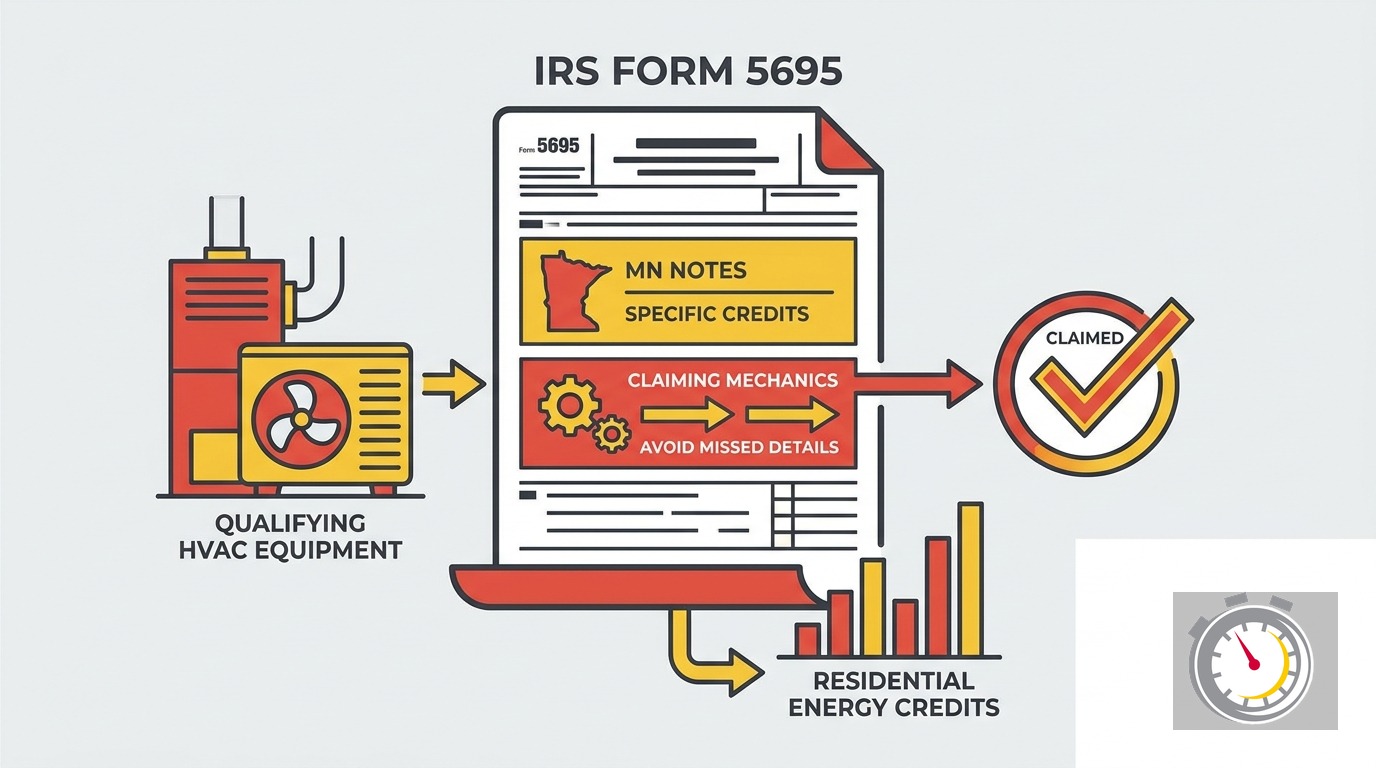
Key Takeaways
- Air source heat pumps use Part II of Form 5695 (IRC Section 25C, Energy Efficient Home Improvement Credit). Geothermal uses Part I (Section 25D), no dollar cap, carryforward allowed.
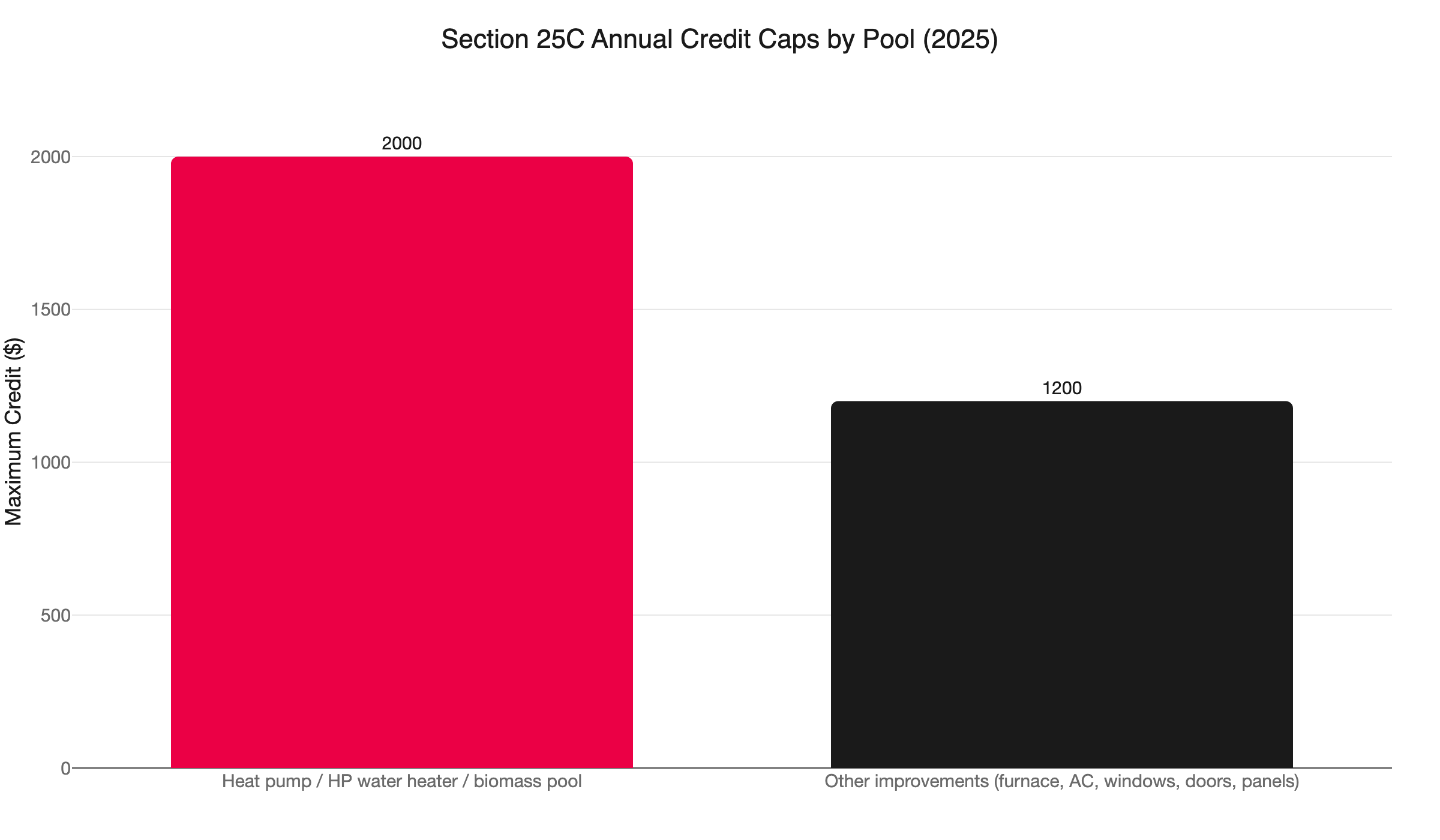
- The credit rate is 30% of eligible installed cost, capped at $2,000 for the heat pump pool (heat pumps, heat pump water heaters, and biomass stoves or boilers).
- A separate $1,200 annual pool covers furnaces, central AC, windows, doors, and electrical panel upgrades. You could receive up to $3,200 in total from both pools in one tax year.
- New for 2025: you must report a Qualified Manufacturer Identification Number (QMID) on Form 5695. No QMID, no credit.
- The Part II credit is nonrefundable with no carryforward. Unused credit is permanently lost.
- Any utility rebate excluded from your gross income reduces your cost basis before the 30% calculation applies.
- Tax year 2025 is the last year to claim. Equipment must be installed by December 31, 2025.
How to Claim the Heat Pump Tax Credit: What Most Guides Leave Out
Most articles about how to claim the heat pump tax credit land on the same three facts: 30% credit, $2,000 cap, file Form 5695. All three are accurate. None of them tell you what goes wrong after you buy qualifying equipment.
The homeowners who lose money aren’t confused about the basics. They’re missing a four-character code the contractor forgot to put on the invoice. They applied the 30% calculation to the wrong cost basis because Xcel sent a rebate that should have reduced it first. They hit a nonrefundable ceiling mid-calculation and lost hundreds of dollars they thought they had already earned.
This guide walks Form 5695 Part II line by line. It is written for Twin Cities homeowners navigating Xcel Energy and CenterPoint rebates alongside the federal credit.
Which Form Do You File, and Where Does the Heat Pump Go?
File Form 5695. Air source heat pumps belong on Part II (Section 25C). Geothermal heat pumps go on Part I (Section 25D). One form, two separate credit structures with different caps, different qualifying standards, and different rules for unused credit. Do not put an air source unit on Part I or vice versa.
Most articles treat the two as interchangeable. They aren’t. The structural differences matter:
- Part II (air source heat pumps): 30% of eligible cost, capped at $2,000. Nonrefundable, no carryforward. Equipment must meet the CEE highest-efficiency tier.
- Part I (geothermal heat pumps): 30% of eligible cost, no dollar cap. Unused credit carries forward to future years. Qualifying standard is Energy Star certification, a lower bar than Part II.
If you have both types of equipment, complete both sections on the same Form 5695. If you have only an air source heat pump, fill out Part II only.
Part II shares its credit year with other home improvements. A separate $1,200 annual pool covers central AC, furnaces, windows, exterior doors, insulation, and electrical panel upgrades. The heat pump’s $2,000 pool is independent of that $1,200. A homeowner who replaces a heat pump and upgrades their electrical panel in the same tax year could receive up to $2,600 in total credits from both pools, and up to $3,200 if they also replace a furnace or add windows.
Does Your Heat Pump Actually Qualify?
To qualify under Part II, your heat pump must achieve the highest efficiency tier established by the Consortium for Energy Efficiency (CEE) as of January 1 of the installation year. This standard is stricter than Energy Star. Energy Star certification alone is not enough. Ask your contractor to confirm CEE highest-efficiency tier compliance before you sign the contract.
This distinction trips up more Minnesota homeowners than any other qualification detail. In the Twin Cities (HVAC Climate Zone 6) and across northern Minnesota (Climate Zone 7), the only practical air source option is a cold-climate certified unit that holds rated capacity well below 0°F. Models on the NEEP Air Source Heat Pump Specification rated to operate at -13°F or colder tend to overlap with CEE’s highest-efficiency tier. Your contractor should be able to confirm this in writing before installation day.
The basic eligibility checkboxes are Lines 21a through 21c on Form 5695. All three must be “yes” before you proceed:
- Line 21a: Your main home is in the United States.
- Line 21b: You are the original user of the equipment. Buying a home that already has a heat pump installed does not qualify, even if the unit is relatively new.
- Line 21c: The installation is in an existing home, not new construction. Part II credits are not available for newly built homes.
If any answer is “no,” you cannot claim the credit for that equipment.
Your contractor should provide the manufacturer’s written certification confirming the unit qualifies. Store it with your tax records. Do not attach it to your return; the IRS can request it separately if needed.
What Is a QMID, and How Do You Get One?
A QMID (Qualified Manufacturer Identification Number) is a four-character alphanumeric code the manufacturer assigns to qualifying equipment. Starting January 1, 2025, you must enter the QMID on Form 5695 when claiming any Part II heat pump credit. Missing QMID means denied credit, full stop.
This requirement is new for tax year 2025. The Form 5695 instructions added it for “specified property,” which includes heat pumps and heat pump water heaters.
The QMID flows from the manufacturer to the contractor to you. Before the installation crew leaves your home, ask directly: “Can you give me the QMID for this unit?” It should appear on your invoice or on the manufacturer’s product certification document. If your contractor isn’t familiar with QMIDs, ask them to contact the manufacturer’s technical or warranty support line before tax season.
A missing QMID is easy to catch on installation day and nearly impossible to reconstruct during filing. Build it into your checklist for the day the job is completed.
Walking Through Form 5695 Part II, Line by Line
Here are the key lines for a standard air source heat pump installation.
Lines 21a-21c: Eligibility checkboxes. All must be “yes.” See the section above.
Line 29a: Enter the QMID and your installed cost for the single most expensive qualifying heat pump placed in service this year.
Line 29b: Any additional qualifying heat pumps beyond the most expensive one. Attach a statement listing the QMID and cost for each additional unit.
Lines 29c and 29d: Heat pump water heaters, same structure as 29a and 29b.
Lines 29e and 29f: Biomass stoves and boilers.
Line 29h: Sum the qualifying amounts from lines 29a through 29g, then apply the $2,000 cap. Calculate 30% of your total eligible cost. If that figure is below $2,000, that is your amount. If it exceeds $2,000, enter $2,000.
To make the math concrete: a heat pump installation totaling $10,000 fully installed generates a 30% credit of $3,000, capped to $2,000. An installation totaling $6,000 generates a 30% credit of $1,800, which is below the cap and enters as $1,800. The cap only cuts you off above $6,667 in eligible costs.
Line 31 worksheet: This is where the nonrefundable mechanic plays out. The worksheet starts with your tax liability from Form 1040, line 18. It then subtracts foreign tax credits, education credits, retirement savings credits, and several other credits. The resulting number is your ceiling for the Part II credit. If it is below your line 29h amount, you can only claim the lower figure. The remainder is gone permanently.
Line 32: The final credit amount. It flows to Schedule 3 (Form 1040), line 5.
The full Form 5695 instructions detail each worksheet step on pages 6-7 if you want to follow along exactly.
What Happens If You Got a Utility Rebate?
If your utility company provided a rebate for your heat pump installation that was excluded from your gross income, you must subtract that rebate from your installed cost before calculating the 30% credit. This rule applies even if the contractor received the rebate on your behalf rather than you receiving it directly.
IRS Fact Sheet 2025-01 is explicit: “This rule also applies if a third party (such as a contractor) receives the subsidy on your behalf.” The IRS FAQ for energy home improvement credits covers the same mechanics in more detail.
Here is the math with an Xcel rebate. Your heat pump installation totals $14,000 fully installed. Xcel provides a $1,500 rebate excluded from your income. Your eligible cost drops to $12,500. Your credit is 30% of $12,500, which is $3,750, capped at $2,000. In this case, the rebate didn’t change your final credit because you were already well above the cap.
Now run the same math on a smaller job. Installation cost: $8,000. Xcel rebate excluded from income: $2,000. Eligible cost: $6,000. Your credit drops from $2,000 (30% of $8,000) to $1,800 (30% of $6,000). That $200 difference is real money and it comes entirely from a reporting omission.
One more rule that applies separately: amounts paid through any federal, state, or local program whose principal purpose is subsidized energy financing cannot be used to calculate the Part II credit at all. This is distinct from the rebate basis-reduction rule above.
For current Xcel Energy rebate amounts, verify directly at their programs and rebates page. CenterPoint rebate amounts also change. Check with them directly before filing. Do not rely on a third-party listing for rebate amounts; programs update more often than blogs do.
What If Your Tax Bill Isn’t High Enough?
The Section 25C credit is nonrefundable. It can reduce your federal tax liability to zero, but not below zero. There is no carryforward. If the credit exceeds your actual tax bill, the difference is permanently lost.
This is the mechanic that costs retired homeowners and part-year workers the most. A homeowner with a $700 federal tax liability who calculates a $2,000 credit walks away with $700 in tax savings. The remaining $1,300 is gone.
The line 31 worksheet is where this calculation happens. Run it before you assume the full $2,000 is available to you. If you can estimate your 2025 tax liability before you commit to the installation, do it. A conversation with a tax preparer before you sign an installation contract is worth more than the same conversation during filing season, when the timing can no longer be adjusted.
If your income is variable, look at whether other deductions or income recognition decisions in 2025 could raise your liability enough to use the full credit.
Compare this to Part I (geothermal): unused credit there does carry forward to subsequent years. That structural difference is meaningful when a geothermal system can cost $25,000 or more. For higher-cost installations against variable income, the carryforward provision in Part I is a significant advantage worth pricing into the comparison.
For two unmarried co-owners who split the cost of a shared installation, the $2,000 cap applies separately to each filer. Each person files their own Form 5695 and claims their proportionate share of the eligible cost. Two co-owners could collectively receive up to $4,000 in heat pump credits for a single installation.
Can You Also Claim the Electrical Panel Upgrade?
Yes, if the panel upgrade was required to enable the heat pump installation. Qualifying panel upgrades go on Lines 25a-25e of Form 5695 and can add up to $600 in credit. The panel and the heat pump must both be installed in 2025, or in consecutive years under the safe harbor.
Per the Form 5695 instructions, enabling property covers electrical panel upgrades made specifically to allow qualifying energy property to be installed and used. The $600 panel credit sits within the separate $1,200 annual aggregate for other improvements, which also includes windows, exterior doors, insulation, furnaces, and central AC.
The consecutive-year safe harbor is useful for homeowners who planned ahead. If you upgraded your panel in 2024 specifically to prepare for a heat pump installation in 2025, both can be treated as placed in service in 2025. The connection must be documented: the panel upgrade must have been made to enable the heat pump installation.
Keep documentation that ties the two together. Your contractor’s proposal or invoice linking the panel work to the heat pump installation is the right paper trail.
One downstream note worth knowing: the allowed credit reduces your home’s cost basis by the credit amount. This affects the capital gains calculation when you eventually sell. It is not a reason to skip the credit, but it is worth noting before a sale in the near term.
Minnesota Notes: Xcel, CenterPoint, and the HOMES Program
The Twin Cities sits in HVAC Climate Zone 6. Northern Minnesota is Zone 7. A standard air source heat pump loses most of its rated heating capacity below 0°F. Cold-climate certified units rated to operate at -13°F or colder are the practical choice here, and they also align with the CEE highest-efficiency tier the credit requires. The equipment that works in a Minnesota winter is the equipment that qualifies.
Xcel Energy covers most Twin Cities suburbs and much of the metro. They offer residential air source heat pump rebates. Any Xcel rebate excluded from your gross income reduces your cost basis before the 30% calculation. Rebate amounts and program eligibility change: verify current figures at xcelenergy.com before filing, not from a third-party source.
CenterPoint Energy provides natural gas across much of the Twin Cities and offers rebates on qualifying dual-fuel and heat pump systems. Same basis-reduction rule applies. Verify current amounts directly with CenterPoint before filing.
Minnesota HOMES rebates: Minnesota received IRA funding for consumer HOMES rebates, with potential amounts up to $8,000 for heat pumps for income-qualifying households. As of this writing, Minnesota had not fully launched consumer-facing HOMES rebates through the IRA program. Check mn.gov/commerce for current status before assuming this program is available.
Minnesota does not have a parallel state income tax credit for heat pumps. The federal 25C credit is the primary tax incentive here. State programs run as rebates, not credits.
One local permit note: Minnesota requires building permits for new HVAC installations. Permit fees paid to the city or county are not installation costs and cannot be included in your credit calculation. Labor directly attributable to the heat pump installation is includable.
For a full breakdown of how rebate stacking works for Twin Cities homeowners, see our guide on stacking HVAC rebates and tax credits in Minnesota. For more on the current rebate landscape, see Minnesota heat pump rebates and tax credits.
When Is the Last Year to Claim This Credit?
December 31, 2025, is the final day to place qualifying equipment in service under Section 25C. Tax year 2025 returns, filed in spring 2026, are the last returns on which you can claim this credit. Equipment installed in 2026 does not qualify unless Congress passes an extension.
“Placed in service” means installed and operational at your home, not ordered or under contract. A signed agreement in November does not protect you if the equipment is not physically installed and running by December 31.
In the Twin Cities, HVAC contractors fill their Q4 schedules fast. Equipment supply chains tighten late in the year. If you are planning a heat pump installation to capture the 2025 credit, schedule it by September or October. Waiting until December is a real risk to the installation date.
Northern One Hour is locally owned and operated, serving Ramsey, Blaine, Maple Grove, Plymouth, Brooklyn Park, and the broader Twin Cities area. We install cold-climate certified heat pumps and provide the manufacturer certification and QMID documentation you need for your Form 5695 filing.
We show up when we say we will. “Always On Time… Or You Don’t Pay a Dime!(R)”
Call (763) 260-6662 or schedule your heat pump installation online. Financing is available for qualifying homeowners. Ask us about current options when you book.
Frequently Asked Questions
Does the heat pump tax credit carry forward if I don't use it all? +
What is a QMID and where do I find it? +
Do utility rebates affect how much heat pump credit I can claim? +
Need a technician now?